📍 Indiana, United States
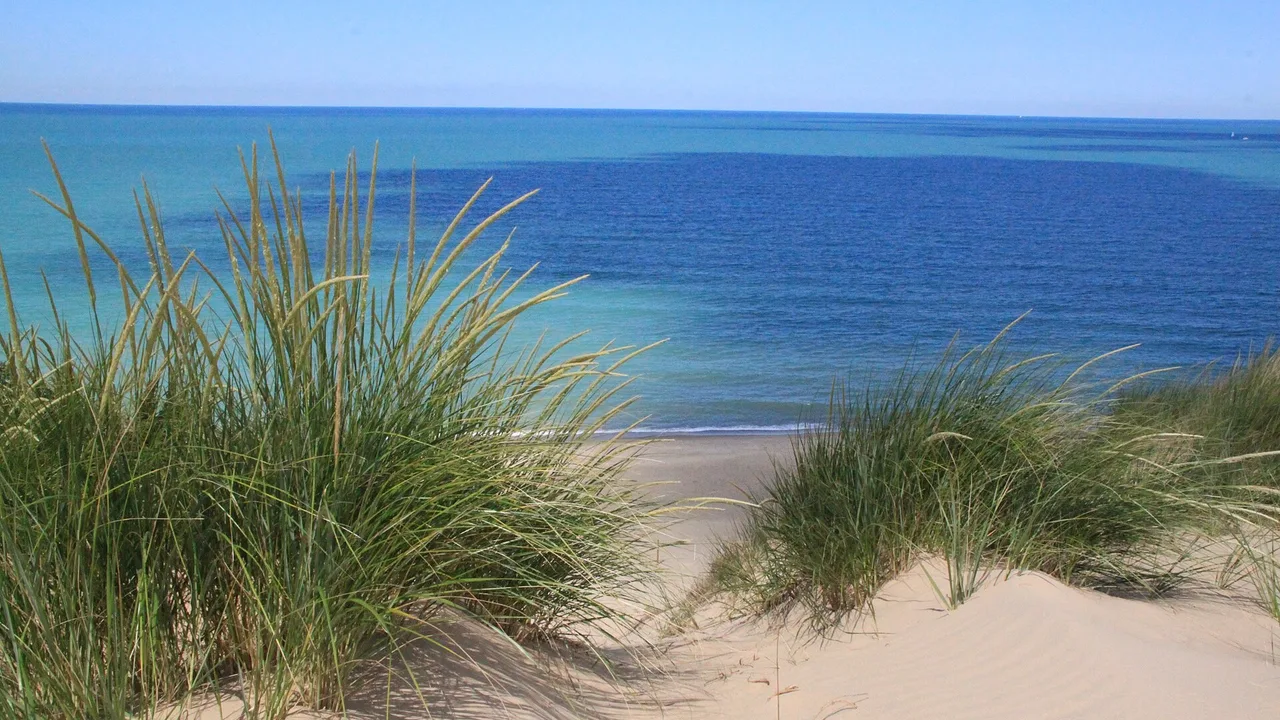
Photo: Indianadunes / Wikimedia Commons, CC BY-SA 4.0
Search demand for Indiana's surf spots registers at essentially zero, yet a small, active freshwater surf scene does exist — it just isn't showing up in search data.
Every spot-level term we measured for Indiana — "indiana dunes surfing," "mount baldy surfing," "portage indiana surfing," "indiana dunes national park surfing," "kiteboarding indiana," "kitesurfing indiana" — came back at exactly 0 searches a month. Only the bare state name shows any volume — "surfing indiana" and "indiana surfing," both around 110/mo (the same measurement counted twice by Google's own grouping, not two separate signals), against 10/mo for "windsurfing indiana." That is thinner than every other state in this Great Lakes series. We are not padding this page with the park's own huge general-tourism volume — "indiana dunes national park" and "indiana dunes state park" measure in the thousands and tens of thousands a month, but that's camping and hiking traffic, not surf demand, and citing it here would misrepresent what people are actually searching for.
That doesn't mean there's nothing here. Indiana Dunes National Park and the separate, Indiana DNR-run Indiana Dunes State Park both front the south shore of Lake Michigan, and a small, real, decades-old freshwater surf community rides it — mostly in the fall and winter, when storm-driven wind builds the biggest fetch across the lake. This page covers what's actually documented: the park's own beach rules, the dune that's closed and the beach beneath it that isn't, and what Indiana's PFD statute does and doesn't require.
The park has a lifeguarded swim beach where surfboards, paddleboards and kayaks are banned while lifeguards are on duty; six more unguarded designated swim beaches; and a mast ban at West Beach — all listed in the park's own current compendium and boating page.
National Park rules arrow_forward
Mount Baldy the dune is closed to the public over a real sand-collapse hazard. Mount Baldy Beach, at its foot, remains open. The separate, Indiana DNR-run State Park next door has its own, thinner rulebook.
Mount Baldy and the State Park arrow_forward
Indiana's statute exempts sailboards and windsurfing boards by name from its boat-equipment rule, but its "watercraft" definition is broad, unlike South Carolina's, so where a surfboard or kiteboard falls is genuinely unresolved.
The PFD law arrow_forwardHow waves form on a lake and which nearby instruments measure them.
Lake Michigan has no tide. Every wave here is wind-driven swell — built by storm fronts pushing across open water, with the size of the wave depending on how far and how hard the wind blows across the lake's "fetch," not on any lunar cycle. Southern Lake Michigan is downwind of the lake's greatest north-south fetch during cold-season frontal passages, which is why the local surf community (below) rides mostly from fall through the first half of winter, not in summer.
NOAA CoastWatch's own Lake Michigan-wide average surface-temperature chart (1995-2026, the Great Lakes Node's own long-running GLSEA record) shows the whole lake bottoming out near 1-2 °C / 34-36 °F from January through March, and peaking around 21-22 °C / 70-72 °F in late July and August. That is a whole-lake average, not a reading from the Indiana shore specifically — the shallower southern basin nearshore, where Indiana's beaches sit, typically warms faster and runs a little above that average at the height of summer, and cools close to it in winter. The nearest permanent instrument to this coast, NDBC Station 45170 ("Michigan City Buoy, IN," 41.755°N 86.968°W, about 2 miles off Michigan City, maintained by Illinois-Indiana Sea Grant and Purdue Civil Engineering), carries its own water-temperature sensor — we did not pull a verified multi-year dataset from it this session, so treat the figures above as the regional picture, not a station-specific reading.
In practice, winter water here sits near freezing, and surfers who ride it wear thick, hooded wetsuits with boots, gloves and often a separate head flap — the same order of neoprene our wetsuit thickness guide recommends for the coldest water it covers.
Reported as real, named, and thirty years old; the sources are journalism and a tourism blog rather than a government record, so its tier is lower.
Chicago public radio station WBEZ profiled an informal group its reporting calls the "Southend Surf Club" — named for the "Southend" of Lake Michigan's U-shaped southern tip, a roughly 50-mile stretch of shoreline running from Chicago's South Side, through the Indiana Dunes, to New Buffalo, Michigan. The club is described as nearly 30 years old, made up of construction workers, engineers, autoworkers and retirees from the Calumet industrial region rather than a typical coastal surf crowd. Named surfers include Dr. Chuck Hurst, a Chesterton-based orthodontist — Chesterton borders Indiana Dunes State Park directly — and his son Andy. Two active online communities, the Facebook groups "Lake Michigan Surfing" and the "Great Lakes Surfing Association," are named in the same reporting and in a companion piece on the Indiana Dunes Tourism board's own blog.
Geography check — stated plainly both sources call Whihala Beach, in Whiting, Indiana, the real center of gravity for this scene — its pier is described as producing "long, tapered waves favored by surfers." Whiting sits at the far western end of Indiana's Lake Michigan shoreline, in Lake County near the Illinois state line, roughly 30 miles west of the Indiana Dunes National Park entrance at Porter. It is not inside either park covered on the rest of this page. We're naming it because it's the documented heart of Indiana's freshwater surf community — not implying it sits within the dunes themselves.
The same reporting is blunt about risk. Surfing the Great Lakes in the conditions that produce the best waves here is "dangerous when you don't know what you're doing," and both pieces recommend the sport only to people already comfortable in cold, open water — not as a first-timer's introduction to surfing.
Read the park's Superintendent's Compendium (effective May 14, 2026) and its "Fishing & Boating" page directly on nps.gov.
Only West Beach is lifeguarded, seasonally, from the Friday before Memorial Day through Labor Day. Read verbatim from the park's own current compendium: the designated swim area there is marked by a line of buoys about 300 feet from shore, extending roughly 850 feet east and west of the bathhouse's main staircase, and "the following is prohibited when lifeguards are on duty: Use of a surfboard, paddleboard, kayak or similar rigid device." The compendium states its own reasoning plainly — these activities "are determined to threaten public health and safety and cause user conflicts" inside a lifeguarded swimming zone.
Six more beaches — Portage Lakefront, Porter Beach, Kemil Beach, Dunbar Beach, Lake View Beach, Central Beach and Mount Baldy Beach — are also designated swim beaches under the same compendium, each with its own 300-foot swim zone. However, none of them are lifeguarded, so the surfboard/paddleboard/kayak prohibition above only applies when lifeguards are on duty, and only West Beach has lifeguards. Across all of these zones, the compendium's general boating rule (36 CFR §3.17) still applies: "Operating a power driven or sailing vessel within 500 ft of marked designated swimming area is prohibited," and operating any vessel "in excess of flat wake speed within 100 feet of a person swimming, wading, fishing from shore or floating with the aid of a floating device is prohibited."
The park's separate "Fishing & Boating" page adds details the compendium does not: "the launching of motorized vessels of any type from lands within the Indiana Dunes National Park is prohibited" everywhere. Outside West Beach's lifeguarded zone, non-motorized vessels (canoes, kayaks, sailboats) may be launched from any park beach. West Beach itself allows a narrower exception: "non-motorized vessels without a mast (no sailboats or windsurfing) may be launched and recovered," provided they stay at least 100 yards from the swim area. Every vessel launched anywhere in the park must be non-motorized, single-hull, no longer than 18 feet, and carried (not dragged) over the dunes on designated paths.
Kiteboarding and kitesurfing are not named anywhere in either document. We searched the fetched compendium text directly for "kite" and found no match. That absence is real — it is neither a ban we are inventing nor a permission we are assuming; treat it the same way this guide treats Myrtle Beach's silence on kiteboards on the South Carolina page: simply unaddressed.
Both pages agree on one safety line worth repeating verbatim: "never paddle without a personal flotation device." Lake Michigan's conditions "can quickly change from calm to dangerous," per the same page — check the forecast before you go out, on a board or in a boat.
We consulted the same compendium and Indiana Dunes State Park's DNR pages — a separate park run by a separate agency, right next door.
The compendium makes clear that two distinct places share the name "Mount Baldy" and are managed differently. Mount Baldy the dune — the National Park's tallest, a "living," wandering dune that moves roughly four feet a year — is, read verbatim, "closed to the public but open to ranger-led hikes and programs. A life and safety hazard persists due to decaying (ghost) trees beneath the surface, and the undetectable but persistent risk of sand collapse." The compendium gives a second, separate reason for restriction: the area contains threatened and endangered plants that off-trail walking would harm. Mount Baldy Beach, at the foot of the dune on Lake Michigan itself, is one of the seven designated swim beaches listed above — open, unguarded, and subject to the same 300-foot-swim-zone and 500-foot-vessel rules as the others.
Indiana Dunes State Park is a separate, Indiana DNR-run park, adjacent to but administratively distinct from the National Park — a dual-jurisdiction geography this site has already documented at Cape Cod and the Outer Banks (state vs. federal land right next to each other), and it holds here too. The State Park's own rules and regulations page and its park-specific page, both fetched directly, name the usual visitor-conduct rules — no dogs on the beach, no alcohol anywhere on the property, a seasonal lifeguarded swim beach with hours that vary by staffing and weather — but state no surfboard, paddleboard, kayak or kiteboard-specific rule of their own that we could find. That's a genuine absence in the DNR's own material, not a gap we're filling in with the National Park's rule next door.
A vessel-within-500-feet-of-a-designated-swimming-beach rule is described in a search summary as applying to "the national park's West Beach and Indiana Dunes State Park Beach" alike — plausible, since it would mirror the federal-style buffer the National Park lists in its compendium, but we did not find a State Park primary page asserting that figure during this session. Flagged COMMERCIAL-tier for a follow-up direct read.
Indiana Code § 14-15-2-6 and § 14-8-2-305, quoted from the current codification.
Indiana's core equipment statute, IC 14-15-2-6, states: "This section does not apply to the following: (1) A sailboard or windsurfing board." (A second exemption covers specific competitive-racing shells and kayaks and is not relevant here.) When the section does apply, it imposes a carry requirement rather than a universal wear mandate. The statute says: "A person may not operate a boat unless the boat contains: (1) for each person on board, one (1) personal flotation device that meets the requirements for designation by the United States Coast Guard as a wearable personal flotation device". It also requires a throwable PFD for any boat 16 feet or longer other than a canoe or kayak.
Indiana's statute differs materially from South Carolina's, and we won't smooth over that difference. South Carolina's chapter (see our South Carolina guide) explicitly writes surfboards and windsurfers OUT of its very definition of "watercraft." Indiana does the opposite: its definition, IC 14-8-2-305, is broad — "watercraft" means "any instrumentality or device in or by means of which a person may be transported upon the public water of Indiana" — and IC 14-8-2-25 says "boat," for the purposes of this chapter, simply means "watercraft." Neither definition excludes a surfboard, SUP or kiteboard the way South Carolina's does. Combined with the fact that neither term appears anywhere in § 14-15-2-6's own exemption list, whether a surfboard, SUP or kiteboard counts as a "boat" requiring a carried PFD under Indiana law is genuinely unresolved by the statute's text — not excluded, and not clearly included either. We're stating that ambiguity rather than picking a side of it.
Two independent boating-safety-course sources (neither the primary administrative text and thus flagged as secondary) report a wear mandate — not a carry requirement — for children under 13 on Indiana's "waters of concurrent jurisdiction," a category both sources say includes the Indiana portion of Lake Michigan. Under those descriptions, a PFD must actually be worn, not just carried, except when the child is below deck in an enclosed cabin or the boat is docked or at anchor. We could not reach the underlying administrative code (312 IAC 5-13) directly this session — both mirrors we tried returned a bot-detection challenge page. Emergencies on this coast: 911, or the Coast Guard on VHF 16.
There is a small, decades-old freshwater surf community riding the south shore of Lake Michigan, mostly in fall and winter when storm-driven wind builds the biggest waves. Measured search demand for it is close to zero, so this page states that plainly rather than overstating the scene.
Surfboards, paddleboards and kayaks are banned at West Beach only, and only "when lifeguards are on duty" (seasonally, Memorial Day weekend through Labor Day). The park's other six designated swim beaches, including the one at the foot of Mount Baldy, aren't lifeguarded, so that specific rule doesn't apply to them. The documented local surf scene centers further west, at Whihala Beach in Whiting, outside either park's boundary.
You cannot access the dune on your own. The dune is closed to unsupervised public access, per the park's own compendium, because decaying "ghost" trees hidden beneath the sand create a risk of sudden sand collapse and to protect threatened and endangered plants. Ranger-led hikes and programs are the only way up. The beach at its foot is a separate, open, unguarded swim beach.
Indiana's statute exempts sailboards and windsurfing boards by name from its PFD-carriage rule, but doesn't mention surfboards, SUPs or kiteboards at all, and its "watercraft" definition — unlike South Carolina's — doesn't exclude them either. Whether one legally counts as a "boat" here is genuinely unresolved by the text. A secondary source describes a separate wear (not carry) rule for children under 13 on Lake Michigan specifically, which we flagged for a direct-source follow-up.
Indiana is one of four Great Lakes states featured on this site.
See also Michigan's Grand Haven and South Haven on the "Third Coast," where a real city ordinance keeps board sports open during dangerous-wave beach closures. Also Wisconsin's Sheboygan surf scene, the "Malibu of the Midwest," pairs with a stand-up-paddleboard culture across the state's 15,074 documented lakes. And Illinois's Chicago lakefront features Montrose Beach, which runs a real, if uncodified, kiteboarding scene.