📍 Illinois, United States
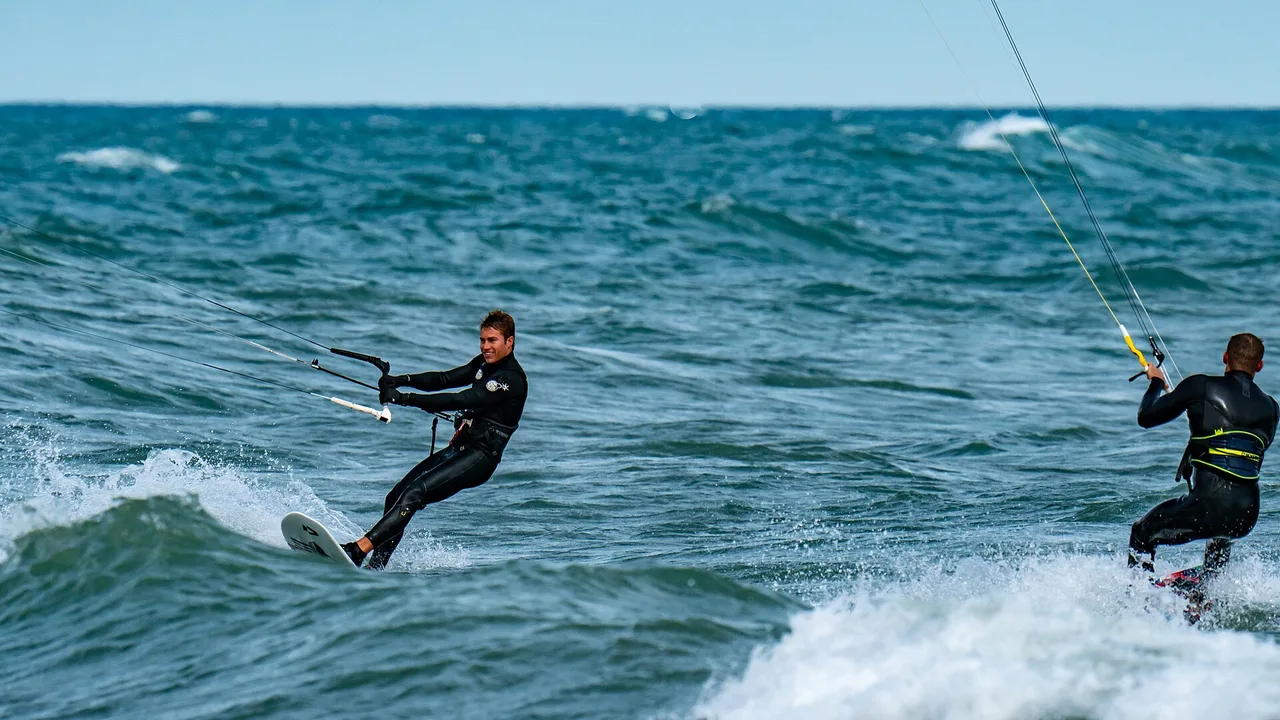
Photo: Joseph Gage / Wikimedia Commons, CC BY-SA 2.0. Taken at Waukegan, further up Illinois's Lake Michigan shore from Chicago — no suitably licensed photo of Montrose Beach itself was found on Commons during this search.
Search data show "surfing chicago" is about 2.8 to 1 more popular than "kiteboarding chicago" — a real gap, though not as pronounced as on our South Carolina, Georgia or Michigan guides. This page covers both.
Illinois has exactly one stretch of coast that matters for watersports: Chicago's Lake Michigan lakefront, a dense, urban shoreline of city-run swimming beaches rather than a dune-backed beach town. That changes what's actually documented here. There's no "Illinois surf coast" the way Michigan's west shore has one — search volume for state-level Illinois terms is close to zero — but Chicago itself has a real, if small, kiteboarding scene at one specific beach, a separately real board-sport allowance (surfing, in the Park District's own narrow definition) at several beaches, and one very specific piece of freshwater safety context that other Great Lakes pages on this site don't carry to the same degree: this is a working harbor city, not just a beach.
One assumption we started with turned out to be wrong. Ohio Street Beach is often grouped with Montrose Beach as a Chicago kite spot, but on every source we checked — the Chicago Park District's own page for the beach and a permanent federal safety zone protecting it — Ohio Street is a dedicated open-water swim training course, not a documented kiteboarding or windsurfing location at all.
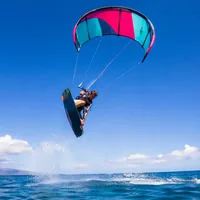
An organized kite scene — with an IKO-certified school, a detailed spot guide, and explicit rigging rules — exists at a place the Chicago Park District code does not specifically name.
Montrose Beach in detail arrow_forward
An open-water swim training course protected by its own permanent federal safety zone — and every source we checked confirms it is not a kite or wind spot.
Ohio Street Beach, corrected arrow_forward
Illinois explicitly lists kiteboards and paddleboards within its definition of "watercraft", the first state in this guide's tree to do so rather than leaving the term undefined.
The PFD law arrow_forwardData from NOAA NDBC Station 45198, "Chicago Buoy" — downloaded and parsed directly, 2021-2025.
Like every Great Lakes page in this guide, Lake Michigan at Chicago has no meaningful tide. Read directly from NOAA's own National Ocean Service: "the Great Lakes spring tide, the largest tides caused by the combined forces of the sun and moon, is less than five centimeters in height... Consequently, the Great Lakes are considered to be non-tidal." A wind-driven seiche can look tide-like over a few hours, but it's a weather event, not a lunar one.
| Month | Water temp | Wave height | Dominant period | Wind ≥15 kt |
|---|---|---|---|---|
| May | 12.1 °C / 53.8 °F | 0.47 m | 3.6 s | 16.9% |
| June | 17.4 °C / 63.4 °F | 0.38 m | 3.3 s | 8.7% |
| July | 22.0 °C / 71.7 °F | 0.37 m | 3.4 s | 3.4% |
| August | 22.7 °C / 72.8 °F | 0.47 m | 3.6 s | 8.2% |
| September | 20.4 °C / 68.8 °F | 0.53 m | 3.8 s | 13.0% |
| October | 15.4 °C / 59.7 °F | 0.63 m | 4.3 s | 23.7% |
| November* | 12.0 °C / 53.6 °F | 0.42 m | 4.0 s | 26.9% |
*No December-April row exists because none of the five years has any data for those months* — the buoy is pulled out of the water every winter and re-deployed in spring, confirmed by checking each year's own file directly rather than assumed. November's own figures come from a noticeably shorter deployment window each year (roughly a third the readings of the other months), so treat that row as the least certain in the table.
The wind pattern is the opposite of a thermal sea breeze. Wind over 15 knots is least common in the middle of summer — just 3.4% of hours in July — and most common in spring and fall, peaking at 26.9% in November. That's consistent with a fetch/synoptic wind mechanism (wind built by passing storm systems over open water) rather than a daily thermal cycle, the same mechanism NOAA's Great Lakes wave research describes for the lake generally. Dominant wave period sits at a short 3.3-4.3 seconds every month — local wind-chop, not groundswell; a lake has no long-distance swell to receive. The buoy itself sits close inshore, in just 9 meters of water — not the kind of 40-nautical-mile deepwater reading some of this site's Atlantic-coast pages caveat around.
Chicago's lakefront is also a working harbor, not just a beach. The Chicago Park District's own surfing safety document states this directly, and it's worth reading as written: "Once you go beyond the buoys you are beyond the waters of the Chicago Park District. Doing this is extremely dangerous because if you travel past the buoys you are in navigable waters! This means that you could be in the path of a boat. Remember that boats do not have brakes and cannot stop immediately like cars." That's not a generic safety reminder we added — it's the Park District's own words, about its own beaches. Consistent with it, Chicago's near-shore lake and harbor waters carry real federal vessel-traffic management, including the standing Ohio Street Beach swim-course safety zone covered below and periodic Coast Guard safety/security zones near Navy Pier and the Chicago River mouth.
No shark hazard exists here — fresh water, and every official Great Lakes invasive-species watchlist we're aware of names real freshwater threats (sea lamprey, Asian carp, round goby) and none names a shark. Our wetsuit thickness guide can help size a suit for water that's genuinely cold outside a short summer window.
See the Chicago Park District's "Surfing Information and Safety Awareness" PDF, plus an IKO school and a spot guide — read them directly.
The Chicago Park District's safety document lists Montrose Beach as a beach where board-sport access is allowed, but its definition of "surfing" is narrow: "any self-propelled wave riding board sport, including Longboard and Shortboard Surfing, Body/'Boogie'boarding, Stand Up Paddling and skimboarding." Wind-powered sports aren't included, so the document doesn't authorize kiteboarding or windsurfing by name. It does state Montrose is an allowed board-sport beach seasonally (Memorial Day-Labor Day, with surfers barred from active swim areas) and, when there are no lifeguards, out-of-season as well.
Kiteboarding at Montrose happens in practice even if it's not written into the Park District's code. WindyCity Kite Sports, an IKO-certified school, teaches here and states that riders need "IKO level 4/PASA Advanced Level" certification to ride the spot. A separate, independent spot guide, Kite Insider, sets a different standard for the same beach — "PASA Level II or IKO Level 3L or equivalent" — and provides specific detail: rideable wind from "NW greater then 320 degrees, N, NE, E and SE up to 135 degrees" (west is dead offshore and not ridden), a hazard list including swimmers, chop, cold water outside midsummer, and "the Montrose hook and the shoreline east of it: breakwalls, boulders," a required kite streamer, a 100-foot safety buffer from people and structures, and a rigging spot at the beach's west end, by the dog beach near Wilson Avenue. We're reporting both certification claims rather than picking one — they don't match, and neither is an official Park District rule.
A local kiteboarder resource, Chicago Kiteboarder, calls Montrose "the unofficial kite beach for the Chicago area" — and that word, unofficial, fits what we found in the Park District's own code too. No Chicago Park District ordinance or facility page names kiteboarding at Montrose, or anywhere else, by name. It's real, it's organized by the riders and schools who use it, and it's tolerated — not codified.
Kite Insider recommends May, June, September and October for onshore wind — which matches the buoy's seasonal pattern above, where wind over 15 knots is far more common in spring and fall than at the height of summer.
Both the Chicago Park District's facility page and 33 CFR 165.932, a standing federal safety zone, state this explicitly.
It's easy to assume Ohio Street Beach is a second Chicago kite spot alongside Montrose — the two beaches are often grouped together. In every source we checked for this session that assumption proved incorrect. The Chicago Park District's own facility page for Ohio Street Beach describes it as "an ideal training site for open water swimming," naming swimming and nothing else.
The federal government treats this as a swim course, not open water generally. 33 CFR 165.932, "Ohio Street Beach Swim Course Safety Zone" — read directly from the Code of Federal Regulations — is a standing regulation that authorizes the Coast Guard to close a defined stretch of water there to "all vessel traffic" for swim events, with entry, transiting or anchoring inside the zone prohibited "unless authorized by the Captain of the Port, Lake Michigan." In this session's research we found no rule, school, club or independent spot guide that names Ohio Street Beach as a kiteboarding or windsurfing location.
This doesn't mean Ohio Street Beach is closed to everyone or that a kiteboard could never be there. The beach is documented as an open-water swim course with a federal protection zone behind it, not as a kite or wind destination. Treat Montrose, above, as this coast's only documented kite spot.
Chapter 7 (beaches) and Chapter 8 (harbors) — read directly, they don't govern the same waters.
Chapter 7 of the Park District's Code lists both Montrose Avenue and Ohio Street as authorized bathing beaches and establishes that entering the water is permitted "only during the bathing season established by the General Superintendent." We searched this chapter for the terms "kite," "windsurf," "board," "vessel" and "device" — none appear, and it contains no board-sport or wind-sport rule. Any beach-level rules for board sports are found in the separate surfing document noted above, not in this chapter.
A different chapter bans windsurfing outright — but only in the Harbor System. Chapter 8, Rule 35, reads verbatim: "No person shall swim, dive, water ski, fly board, windsurf or use any other unapproved device within the Harbor System." The Harbor System refers to Chicago's network of boat harbors and mooring fields, which is separate from the open-lake swimming beaches Chapter 7 covers. This rule does not apply to Montrose or Ohio Street Beach and should not be read as a citywide windsurfing ban.
In an emergency anywhere on this coast: 911, or the US Coast Guard on VHF 16 or (414) 747-7182 for Sector Lake Michigan's command center.
See 625 ILCS 45/1-2 and 45/4-1 on codes.findlaw.com; Illinois DNR's guide is available directly from the agency.
Illinois's core definitions section, 625 ILCS 45/1-2, defines "Nonpowered Watercraft" as "any canoe, kayak, kiteboard, paddleboard, ribbed inflatable, or any other watercraft propelled by oars, paddles, or poles." Kiteboard and paddleboard are named outright, in the statute's own current text — the first state page in this guide's tree where that's true, rather than the term simply being undefined the way it is on our Michigan and Georgia guides. An ordinary surfboard is not named anywhere in this list.
Because "Nonpowered Watercraft" falls under the Act's broad "Vessel/Watercraft" definition — "every watercraft used or capable of being used as a means of transportation on water" — the general equipment rule, 625 ILCS 45/4-1, applies to it on its face: "No person may operate a watercraft unless at least one wearable U.S. Coast Guard approved personal flotation device for each person is on board." That's a carriage rule, not a wear mandate — read literally, it says a kiteboard or paddleboard needs a PFD aboard, without saying how that applies to a board with no deck to store one on, and we're not resolving that gap ourselves.
Windsurfers get a real exemption — but from an official guide whose own wording doesn't match the current statute we read. Illinois DNR's own PDF, "Illinois Boat Registration & Safety Act Information" (dated to law in effect as of January 1, 2015), states plainly: "Sailboat means any watercraft propelled by sail or canvas, including sailboards," and "The PFD requirement does not apply to sailboards." But the current codified definitions we read directly define "Sailboat/sailing vessel" narrowly, as "any vessel under sail so long as the propelling machinery, if fitted, is not being used" — and the word "sailboard" doesn't appear in that list at all. We're reporting both: a real, official state exemption for windsurfers exists in DNR's own guide, but its exact wording is over a decade old and doesn't line up with the statute text as currently written.
Wear, rather than mere carriage, is required only in two situations: for everyone aboard a personal watercraft or specialty prop-craft (jet skis and similar, any age), and for anyone under 13 while in tow or on the deck of an open watercraft that is underway (with exceptions for enclosed cabins, anchored swim platforms and certain charter vessels). Watercraft 16 feet or longer, except a canoe or kayak, must also carry a throwable PFD aboard.
The federal PFD baseline that the site uses to fill gaps (33 CFR 175.15) is covered on our United States guide rather than being restated here.
Montrose Beach is the coast's only documented kite spot — an IKO-certified school teaches there, and an independent spot guide provides detailed wind, hazard, and rigging information. No Chicago Park District rule actually names kiteboarding at the site; a local kiteboarder resource calls it "the unofficial kite beach for the Chicago area," which fits our findings: active and organized, but not codified.
It isn't documented as a kite or wind spot on any source we found. The Chicago Park District's own page calls it an open-water swim training site, and a standing federal regulation (33 CFR 165.932) protects it as a swim course, letting the Coast Guard close it to vessel traffic for swim events. Treat Montrose Beach as this coast's kite spot instead.
Both activities exist, and the measured gap here is much smaller than on this site's other Great Lakes pages — "surfing chicago" beats "kiteboarding chicago" by roughly 2.8 to 1, not the 25-88x margins found elsewhere. The Park District's own rules recognize several beaches for self-propelled board sports (surfing, SUP, skimboarding); kiteboarding is concentrated at Montrose alone.
Illinois's statute names kiteboards and paddleboards directly as "Nonpowered Watercraft," a category of "watercraft" subject to the state's general rule requiring one wearable PFD aboard per person. Windsurfers ("sailboards") are exempted from that requirement under Illinois DNR's own official guide, though that guide's exact wording is dated and doesn't match the current statute text word-for-word. Ordinary surfboards aren't named either way.
Illinois is one of four Great Lakes states featured on this site.
Also check Michigan's Grand Haven and South Haven on the "Third Coast," where a real city ordinance keeps surfing and kiteboarding open during dangerous-wave beach closures; Wisconsin's Sheboygan surf scene, the "Malibu of the Midwest," and its stand-up-paddleboard culture across the state's 15,074 documented lakes; and Indiana's quieter Indiana Dunes National Park coast, home to a small, real freshwater surf community and Mount Baldy's dune closure.