

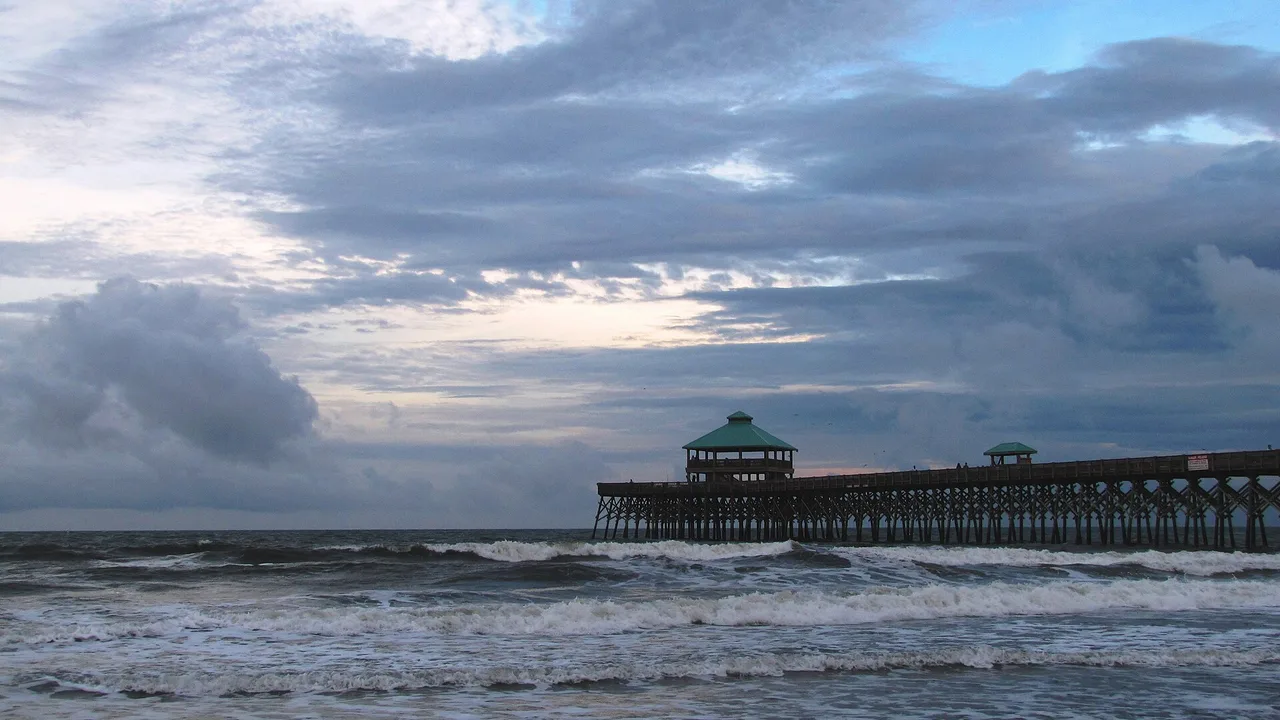
📍 South Carolina, United States
Photo: Brian Stansberry / Wikimedia Commons, CC BY 3.0
Folly Beach and the Grand Strand's own city ordinances, not a generic East Coast rule borrowed from somewhere else.
South Carolina's coast is genuinely surf-led, not wind-led — the numbers say so plainly. Search demand for "surfing South Carolina" and Folly Beach's own surf terms runs at roughly 88 times the volume of "kiteboarding" or "kitesurfing South Carolina," a far wider gap than most states in this guide. Folly Beach, just south of Charleston, is the state's best-known break and the one with the most specific rules; Myrtle Beach and the wider Grand Strand add real length of coast and their own, differently-worded ordinance; Isle of Palms is real but smaller, and its own rules are thinner than its neighbours'.
None of these towns run the same rule. Folly Beach names kiteboards and windsurfboards explicitly inside its "surfboard" definition; Myrtle Beach's ordinance doesn't mention either. Know which beach you're on before you rig up.

A seasonal swimming-zone rule that names kiteboards and windsurfboards by definition, a 200-foot pier buffer, and a year-round leash requirement.
Folly Beach rules arrow_forward
Five named surf zones, a 75-yard pier buffer, and a differently-worded leash rule — read directly from the city's own pages, not a tourism guide.
Myrtle Beach rules arrow_forward
South Carolina's own statute explicitly excludes surfboards and windsurfers from its definition of "watercraft" — read the definition, not a boating-course summary.
The PFD law arrow_forwardNDBC 41004 ("Edisto"), 41 nautical miles southeast of Charleston — the only US Atlantic page in this guide with wind, wave and water temperature all from one station.
NDBC 41004 sits at 32.50°N, 79.10°W, about 41 nautical miles southeast of Charleston in 35 meters of water. Unlike the New England pages in this guide, which had to split wind and wave/water-temperature readings across two separate stations, 41004 carries an anemometer as well as wave and water-temperature sensors, so every column below comes from the same buoy. The trade-off is distance: this is a genuine deepwater reading, not a Folly Beach-specific one. Open water read this far offshore typically shows more wind than a beach sheltered by dunes and buildings, and offshore wave height is not the same figure as what actually breaks at the shoreline once it crosses the shallow continental shelf. Treat this as a regional proxy for season and swell period, not a beach-side measurement.
| Month | Water temp | Wave height | Dominant period | Wind ≥15 kt |
|---|---|---|---|---|
| January | 20.6 °C / 69 °F | 1.38 m | 7.0 s | 47.3% |
| February | 19.8 °C / 68 °F | 1.41 m | 7.7 s | 41.9% |
| March | 20.0 °C / 68 °F | 1.41 m | 7.2 s | 39.6% |
| April | 21.2 °C / 70 °F | 1.23 m | 7.4 s | 25.0% |
| May | 24.0 °C / 75 °F | 1.12 m | 6.8 s | 25.2% |
| June | 26.9 °C / 80 °F | 1.05 m | 6.7 s | 23.2% |
| July | 28.8 °C / 84 °F | 1.00 m | 7.0 s | 20.0% |
| August | 28.8 °C / 84 °F | 1.12 m | 7.5 s | 18.5% |
| September | 27.8 °C / 82 °F | 1.35 m | 8.4 s | 28.6% |
| October | 26.2 °C / 79 °F | 1.48 m | 8.1 s | 39.0% |
| November | 24.6 °C / 76 °F | 1.47 m | 7.0 s | 47.2% |
| December | 22.5 °C / 73 °F | 1.51 m | 7.6 s | 45.5% |
This is a real Atlantic groundswell coast, warm for most of the year, and windiest in winter. Dominant period holds at 6.7-8.4 seconds every month — genuine groundswell, not local windsea — peaking in September, consistent with NOAA's Atlantic hurricane season (1 June-30 November, peaking around 10 September) sending long-period swell up the coast. Water temperature never drops below 19.8 °C / 68 °F even at its coldest, in February, and peaks at 28.8 °C / 84 °F in July and August — warm enough that a wetsuit is optional for much of the year, a sharp contrast with the New England pages in this guide. Wind over the open water is a winter pattern: 40-47% of hours over 15 knots from November to January, dropping to 18-25% from May to August. Our wetsuit thickness guide converts water temperature into a suit recommendation.
Folly Beach City Code §§ 151.04, 151.05 and 151.07, read directly from the city's own beach-rules pages and South Carolina DES's Folly Beach Local Comprehensive Beach Management Plan.
Folly Beach doesn't create a surfer-only zone; it creates a swimming zone that surfboards, kiteboards and windsurfboards are kept out of during the season. Verbatim, from the city's own current beach-rules page: "SURFING without a leash is prohibited. From May 15th to Sept. 15th surfing is prohibited between 10 am to 6 pm from 2nd Street East to 3rd Street West, known as the swimming zone. From September 16th to May 14th, surfing is allowed in any area except is always prohibited 200′ from the fishing pier." That leash requirement and the 200-foot pier buffer apply every day of the year, not just in season.
The full ordinance text (§ 151.05, read from the state's own beachfront management plan, which quotes the code verbatim) is explicit about which equipment counts: "No person shall use or assist anyone in using any device commonly known as a 'surfboard', 'skimboard', 'paddle board', 'kayak', 'kiteboard', 'windsurfboard', or any other apparatus or device of a hard or solid nature similar to and used for the purposes for which the aforementioned are generally used... within the swimming zone from May 15 through September 15 between the hours of 10:00 a.m. and 6:00 p.m." Kiteboards and windsurfboards are named outright — unlike most US beach rules in this guide, which simply don't mention them.
A separate section, § 151.07, sets a buffer for the pier and the beach's rock groins: "Surfing or swimming is hereby prohibited within 50 feet of any groin and within 200 feet of the pier." An older clause in § 151.04(M) states a slightly different pair of numbers for the pier specifically — 200 feet for a "surfboard," 300 feet for "a boat or other vessel" — so a powered or larger craft is held to a wider buffer than a surfboard at the same pier.
The swimming-zone boundary is given two slightly different ways in two official sources. The city's current public beach-rules page names "2nd Street East to 3rd Street West"; the ordinance text in § 151.04(B), as quoted in the state's 2021 beachfront management plan, defines the general swimming zone as "3rd Street East to 3rd Street West." We are reporting both rather than picking one — the city's own current page is the more likely to reflect any intervening amendment, but we have not tracked down the amendment itself.
Personal watercraft (jet skis) have their own, more detailed rules under the same section: two 50-foot-wide launch lanes, one just east of the swimming zone off 2nd Street East and one just west of it off 3rd Street West, idle-speed operation, and a rule that personal watercraft must always yield to swimmers, surfers, non-motorized boats, kiteboards and boogie boards.
The City of Myrtle Beach's own "Beach Conditions & Laws" page and its police department's marine-unit page, both read directly.
Myrtle Beach runs its own ordinance, worded differently from Folly Beach's — don't assume one town's rule at the other. Verbatim, from the city's own beach-conditions page: "kayaks and surfboards are allowed between 10:00 a.m. and 5:00 p.m." from May 1 through Labor Day, and only within five named stretches of shoreline: from 710 feet of the centre line of 29th Avenue South to the southern city limit; 34th to 47th Avenue North; 78th to 81st Avenue North; 87th Avenue North to the northern city limit; and 62nd to 68th Avenue North. Outside those hours, or outside that season, the rest of the beach opens up.
The pier buffer is wider here than at Folly Beach: "Aquatic activity (swimming, surfing, etc.) is not allowed within 75 yards of a pier" — confirmed on both the city's beach-conditions page and its police department's marine-unit page, which separately gives the leash rule: "All surfers shall be required to wear a surfing leash with a maximum length of 7' at all times." Where Folly Beach's leash rule sets no length limit, Myrtle Beach's caps it at 7 feet.
Neither Myrtle Beach page names kiteboards, kitesurfing or windsurfing at all — the same absence pattern as New Hampshire's Hampton Beach rules elsewhere in this guide. That is not a ban and not a permission; the ordinance simply doesn't address that equipment, so treat it as ungoverned by this particular rule rather than either allowed or forbidden by it.
Isle of Palms measures real search demand (140/mo) but noticeably less than Folly Beach or Myrtle Beach, and its documented rules are correspondingly thinner. The city's general beach-rules page covers the usual visitor conduct (no glass, no fireworks, and so on) without setting out a surf-zone map the way Folly Beach's or Myrtle Beach's do. A separate ordinance, described in a search summary as Ordinance 2021-13 amending City Code § 7-3-20, appears to govern commercial surf-instruction permitting rather than a general swim/surf zone — we did not read that ordinance directly, so treat this one as COMMERCIAL-tier pending a direct read, not as confirmed fact. Charleston County Parks, which manages the Isle of Palms County Park, has its own rules page but it likewise did not, on our search, set out surf-zone geometry.
South Carolina Code of Laws § 50-21-870 and § 50-21-10(30), Title 50, Chapter 21 — read directly at scstatehouse.gov.
South Carolina's core PFD statute, § 50-21-870, sets two different wear rules depending on the craft. Everyone aboard a personal watercraft or specialty propcraft (jet skis and similar) must wear a US Coast Guard-approved PFD, regardless of age. On a Class "A" motorboat (a motorized boat under 16 feet), only persons under the age of twelve must wear one. Neither clause names canoes, kayaks or paddleboards.
The more unusual finding sits in the definitions, not the wear rule. § 50-21-10(30) defines "watercraft" as "anything used or capable of being used as a means of transportation on the water but does not include: a seaplane regulated by the federal government, water skis, aquaplanes, surfboards, windsurfers, tubes, rafts, and similar devices or anything that does not meet construction or operational requirements of the state or federal government for watercraft." Surfboards and windsurfers are not merely unaddressed by this chapter — they are written out of its definition of "watercraft" (and, by the same logic, "vessel," which is defined as "every description of watercraft"). We found no general, chapter-wide requirement that every paddlecraft carry a PFD; kayaks, canoes and paddleboards aren't named as exclusions, but no such carriage mandate for them was located in this chapter either.
Kiteboards aren't named in either the wear rule or the exclusion list, so where a kiteboard falls is genuinely unaddressed by this statute — don't read the surfboard/windsurfer exclusion as covering it by analogy. For the federal PFD baseline that fills gaps like this across every state, see our United States guide. In a sea emergency anywhere on this coast: 911, or the Coast Guard on VHF 16.
Not in the swimming zone (2nd Street East to 3rd Street West, per the city's current page) between 10am and 6pm from May 15 to September 15 — Folly Beach's ordinance names kiteboards and windsurfboards explicitly inside its "surfboard" definition. Outside that window, and everywhere else on the island except within 200 feet of the pier, the same rule that governs surfing applies to kiteboards and windsurfboards too.
Within five specific stretches of shoreline named in the city's own beach-conditions page, between 10am and 5pm, from May 1 through Labor Day — everywhere else on the beach is closed to surfboards and kayaks during those hours and dates. Outside that season, the beach opens up except within 75 yards of any pier.
Surfboards and windsurfers are explicitly excluded from South Carolina's statutory definition of "watercraft" (§ 50-21-10(30)), so the state's PFD wear rules — which apply to personal watercraft and, for under-12s, Class A motorboats — don't reach surfing or windsurfing at all. Kiteboards aren't named either way in this statute.
Surf, clearly, on the numbers: measured search demand for surfing terms in South Carolina runs at roughly 88 times the volume of kiteboarding or kitesurfing terms — the widest gap measured on any state in this guide. Folly Beach is the state's best-known break; Myrtle Beach and the Grand Strand add real length of coast under a different ordinance.