
📍 Michigan, United States
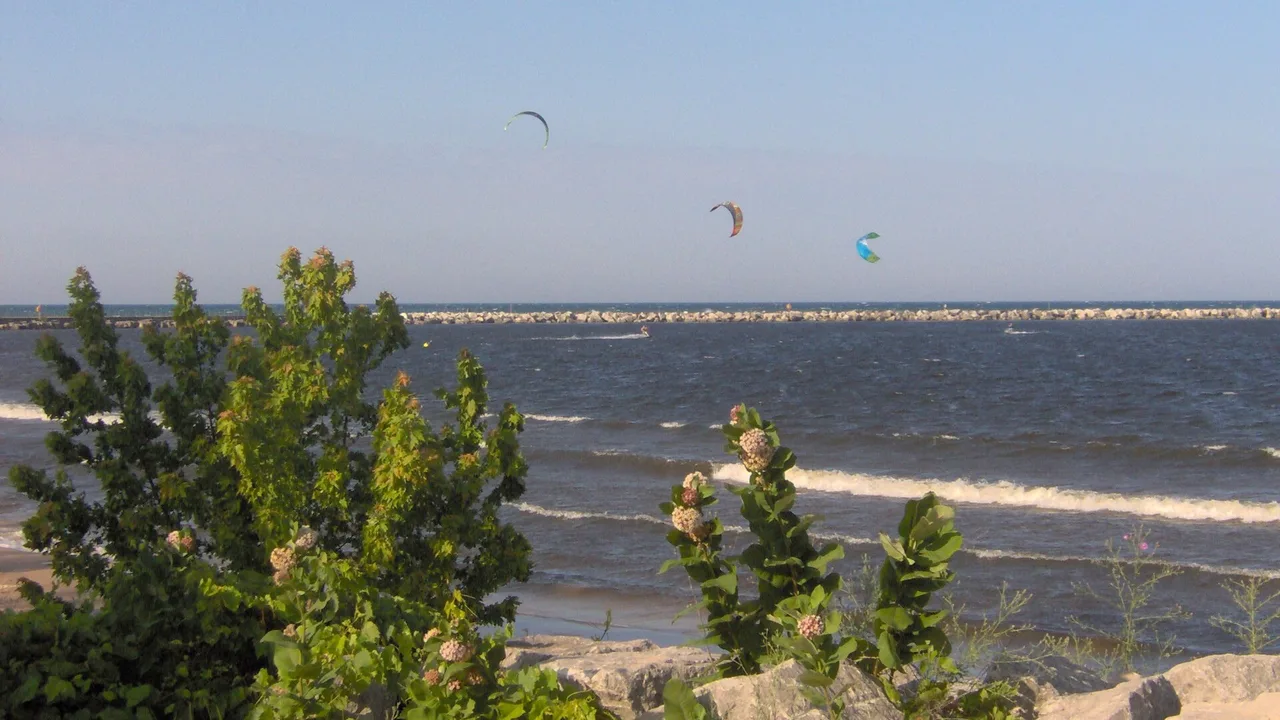
Photo: NOAA Great Lakes Environmental Research Laboratory / Wikimedia Commons, public domain. Commons captions this photo "windsurfing," but it shows kiteboarding kites, not a windsurf sail — our alt text describes what the photo actually shows.
Search data shows "surfing" outpaces kiteboarding and windsurfing terms by roughly 25 to 1 — mirroring the pattern on our South Carolina and Georgia guides.
Lake Michigan's west shore — Grand Haven, South Haven, Muskegon, and a scatter of towns further north — has a decades-old surf culture surfers call the "Third Coast," a name popularized by Third Coast Surf Shop further south in New Buffalo and St. Joseph and reflected in regional magazine features and the 2005 documentary Unsalted: A Great Lakes Experience. A 1973 Detroit Free Press article once dubbed Grand Haven "Surf City, Michigan," and today's search demand for Great Lakes surf terms is real and measurable.
Kiteboarding has a real, documented presence too — schools operate at Grand Haven, Muskegon and Holland State Park — but it is a smaller, secondary story on this coast by the numbers. That is the opposite framing from most of this site's ocean-facing US pages, and it is why this page leads with surfing throughout.
This is the highest-volume named spot on this coast, served by two real board shops — but no municipal ordinance naming surfing, kiteboarding or windsurfing was found.
Grand Haven in detail arrow_forward
A real city code section — read directly — keeps surfing and kiteboarding open even when the beach is closed to swimmers for dangerous waves.
South Haven's rule arrow_forward
No meaningful tide, cold water even in summer, and a real, named local hazard — structural currents at the piers — are details the ocean pages on this site don't have.
The freshwater differences arrow_forwardFour genuine, sourced differences from the ocean-facing pages on this site.
NOAA's National Ocean Service states "Studies indicate that the Great Lakes spring tide, the largest tides caused by the combined forces of the sun and moon, is less than five centimeters in height. These minor variations are masked by the greater fluctuations in lake levels produced by wind and barometric pressure changes. Consequently, the Great Lakes are considered to be non-tidal." A wind-driven seiche — an oscillating standing wave that can run several feet high, with a high-to-low cycle of roughly four to seven hours — can look and feel tide-like, but it's a weather event, not a lunar one, and it isn't predictable months in advance the way an ocean tide table is.
The National Weather Service's own "Great Lakes Safety" page names this explicitly: "The pier (steel, concrete, rock) structures focus strong currents. The water has nowhere else to go but out along the pier. (Grand Haven pier is 1/4 mile long!) ... We call these currents structural currents in the Great Lakes." Michigan Sea Grant uses the same term for the same mechanism at piers and breakwaters statewide. NWS's own advice: don't swim within 100 yards of a pier, and never jump or dive from one — you could be jumping straight into the current it creates. This isn't a generic ocean rip current warning repeated for a lake; it's the specific hazard this coast's piers create, named as its own category in Great Lakes safety material.
NOAA's Great Lakes Environmental Research Laboratory publishes a 30-year average surface-temperature curve for the whole lake. It sits close to freezing (2-4°C / 36-39°F) through winter, climbs through spring, and peaks around 20-22°C (68-72°F) in late July and August before falling again — noticeably colder, at its warmest, than most ocean pages on this site. That's a lake-wide average, not a Grand Haven-specific nearshore reading, and it can run colder still: a sustained offshore wind can trigger an upwelling, pulling cold deep water toward the beach even at the height of summer. On this coast a wetsuit is a genuine, not optional, consideration for most of the season — our wetsuit thickness guide can help size one.
Lake Michigan is fresh water. Every official Great Lakes invasive-species and fish watchlist we checked (USGS, EPA, US Fish & Wildlife Service) names freshwater threats — sea lamprey, Asian carp, round goby — and none names any shark; there's no realistic shark hazard here. The waves themselves come from a different mechanism than most ocean pages on this site describe. NOAA's own Great Lakes wave-prediction research explains lake wave height as a function of wind speed and fetch — the distance wind travels uninterrupted over open water — driven by passing storm systems and cold fronts, not a daily thermal sea breeze. Because Lake Michigan runs roughly 300 miles north to south, a sustained north wind builds surf on the southern end (Grand Haven, South Haven) while a sustained south wind builds it on the northern end (Ludington, Frankfort) — the opposite ends of the lake rarely have good waves on the same day.
Two board shops and a "Surf City" nickname dating to 1973 — but no municipal ordinance naming any of these sports was found.
MACkite runs two storefronts in Grand Haven — a "Toy and Surf Shop" downtown and a separate boardsports center — per the business's own site (a single-operator source, not independently verified, the same tier as the Action Sports Maui listing on our United States guide). Surf-forecast sites recognize Grand Haven as an established break. Locally, the town has carried the nickname "Surf City, Michigan" since a 1973 Detroit Free Press feature, when shops with names like Beach Point Surf Shop reportedly operated here and in nearby Muskegon — a piece of local surf history, not a claim that those specific shops still exist today.
See on Google Maps open_in_newWhat we did not find, in the accessible sections of Grand Haven's own municipal code, is any ordinance naming surfing, kiteboarding or windsurfing specifically. That's a genuine absence, not a gap we're filling in — it means the town's own beach rules simply don't address board sports either way, unlike South Haven's, below. Grand Haven State Park, on the beach itself, does fall under the statewide Michigan DNR rule covered further down this page.
City of South Haven Code of Ordinances § 58-90, adopted 2021-12-20 — available in the city's newsletter and code PDFs.
South Haven's code gives beach-safety officials — the city manager, police chief, harbormaster, or the director of the South Haven Area Emergency Services Authority — authority to close public beach water for a health or safety risk, including "identified wave height in excess of 8 feet." The ordinance then specifies a named carve-out. Quoted verbatim: "In situations where the closure is due to severe weather or wave height, this prohibition does not apply to board sport recreational individuals accessing the water for the purpose of surfing, utilizing a self-propelled wave riding board, including longboards and shortboards; kiteboarding; body/'boogie' boarding with swim fins; and, skimboarding, so long as the following conditions are satisfied: (1) Entry into the water to conduct any of the above identified activities shall be at the user's own risk. (2) Users will follow commonly accepted safety rules and procedures which includes the following: controlling boards at all times, using a safety leash, and wearing appropriate cold weather gear as conditions dictate."
Windsurfing is not on that exemption list. Surfing, kiteboarding, boogie-boarding with fins and skimboarding are named; windsurfing isn't — an absence in the ordinance's own wording, not a stated ban on it.
A separate section, § 58-101 ("Lake Michigan Piers"), prohibits diving or jumping from a Lake Michigan pier and swimming within 50 feet of one, reflecting the structural-current hazard noted above. The same code also bars surfboards from the Black River, an inland waterway distinct from the lake itself.
Pere Marquette Park is a City of Muskegon park — an important distinction, because a county ordinance on watercraft could be mistakenly applied to it.
MACkite's kiteboarding lesson center, the "MACshack," is described on the school's own site as sitting on "a section of beach in Muskegon reserved exclusively for our students" at Pere Marquette Park. The school says it has been teaching since 2001 — that claim comes from a single operator and isn't independently verified, but it does identify a specific, named beach.
A real Muskegon County ordinance exists — and it does not govern this beach. The Muskegon County Parks Ordinance, Section 16 ("Watercraft"), bans launching a "boat, canoe, jet ski, sailboard, raft or other similar device" outside designated times and places on county park property, and separately bans entering a posted swim area with a "boat, canoe, jet ski, sailboard, paddleboard, surfboard, or other similar device." Pere Marquette Park, however, is owned and operated by the City of Muskegon, not the county — it does not appear on the county's list of county parks. The county rule applies to county-run parks elsewhere in Muskegon County, but it is not the regulation that governs the beach where the documented kite lessons take place. No City of Muskegon ordinance naming surfing, kiteboarding or windsurfing was found in the accessible sections of the city's own code.
Surf-forecast sites separately track Muskegon as a recognized break, reflecting its location on this coast between Grand Haven and Holland.
Clear recognition, smaller paper trails.
Holland has a MACkite retail address and a kite-spot directory listing for Holland State Park (both single-source, COMMERCIAL-tier). No municipal ordinance naming board sports was found. Ludington's own city code sets a general rule restricting swimming/bathing/wading to areas the recreation director designates and posts (§ 38-70) — not surf-specific — while surf-forecast sites separately recognize both the city beach and Ludington State Park as breaks.
Traverse City and Grand Traverse Bay — further north — offer the thinnest evidence among the three. The region's own tourism site lists "surfing (wave, wind, and kite)" among its watersports, and a kite-spot directory names Petobego on the bay, but the nearest specifically-named surf shop in our sourcing, Sleeping Bear Surf & Kayak, is in Empire, not Traverse City itself. No ordinance for any of these three towns was found.
Michigan DNR Land Use Order 5.1(7), read directly, is worded almost identically to South Haven's rule.
Read directly from the Michigan DNR's own Land Use Orders (Chapter V, "State Parks and Recreation Areas"), Order 5.1(7): when a state-managed beach is closed to water entry for a health/safety risk — including "identified wave height in excess of 8 feet" — the closure still "does not apply to board sport recreational individuals accessing the water for the purpose of surfing utilizing a self-propelled wave riding board, including longboard and shortboard; kiteboarding; body/'boogie' boarding with swim fins; and, skimboarding," subject to the same own-risk, leash and cold-weather-gear conditions as South Haven's ordinance above. This is a genuinely statewide rule: it applies at Grand Haven, Holland, Ludington and Muskegon State Parks alike, wherever a beach closure is in effect for that reason.
Windsurfing is absent from this list too, the same absence as South Haven's municipal ordinance. Whether that's a shared oversight or a deliberate choice, both rules draw the line in the same place.
MCL 324.80104, 324.80142 and 324.80205, available at legislature.mi.gov.
Michigan's core marine-safety definitions section, MCL 324.80104(t), defines "vessel" broadly: "every description of watercraft used or capable of being used as a means of transportation on water." Unlike South Carolina's statute, which explicitly excludes surfboards and windsurfers from its own definition, Michigan's text names no exclusion at all — and no explicit inclusion either. Whether a surfboard, windsurfer or kiteboard counts as a "vessel" under Michigan law is genuinely unaddressed by the statute's own wording, not settled in either direction.
Section MCL 324.80104(u) defines "waters of this state" to include "those waters of the Great Lakes that are under the jurisdiction of this state." That means Michigan's PFD statute treats Great Lakes water as ordinary state water. We found no separate Great Lakes carve-out in state law, and no federal Coast Guard district rule specific to Great Lakes navigation beyond the general baseline (33 CFR 175.15) already covered on our United States guide.
MCL 324.80142 requires anyone under 6 to wear a Type I or II PFD on the open deck of an underway vessel — quoted directly, and again turning on the same undefined "vessel" question above. MCL 324.80205 applies to personal-watercraft (jet ski) operation. Every rider must wear a PFD regardless of age, inflatable PFDs are banned, a child under 7 must have a parent, guardian or their designee aboard or towed alongside, operation is prohibited from sunset to 8 a.m., and operation in water under 2 feet deep is prohibited except at slow-no-wake speed or while docking or launching.
A widely-repeated citation for Michigan's general PFD carriage rule appears to be wrong. A frequently-cited secondary source points to MCL 324.80165 as the law requiring one wearable PFD per person aboard any vessel. We read § 80165 and found it concerns regatta and race permits, not that requirement. Michigan DNR's own official rules page does state the general carriage requirement in plain language, but without citing a section number — so we report it on the DNR's authority rather than attaching a specific, unverified MCL citation to it.
In an emergency anywhere on this coast call 911 or the US Coast Guard on VHF 16.
This is a well-documented, decades-old surf culture sometimes called the "Third Coast." Waves are generated by sustained wind blowing over a long, open stretch of the lake (a mechanism called fetch) during storms and cold fronts rather than by ocean swell — Lake Michigan's roughly 300-mile length means the south end (Grand Haven, South Haven) and north end (Ludington) rarely break well on the same day.
Lake Michigan runs colder than most ocean locations on this site, even in summer. NOAA's own 30-year average for the whole lake peaks around 20-22°C (68-72°F) in late July and August, and a wind-driven upwelling can pull colder water toward the beach even then. A wetsuit is a real consideration for most of the season here.
No meaningful tides. NOAA states the Great Lakes' largest tide is under 5 centimeters and is masked by wind- and pressure-driven water-level changes, so the Great Lakes are considered non-tidal. A wind-driven seiche can look tide-like but is a weather event, not a lunar one.
Structural currents — a Great Lakes-specific term the National Weather Service and Michigan Sea Grant both use for the strong current a pier or breakwater focuses. NWS's own advice: stay at least 100 yards from any pier, and never jump or dive from one.
This site covers four Great Lakes states, including Michigan.
Explore Wisconsin's Sheboygan surf scene, the "Malibu of the Midwest," paired with a real inland-lake stand-up-paddleboard culture across the state's 15,074 documented lakes; Indiana's much quieter Indiana Dunes National Park coast, where a small, real freshwater surf community rides alongside Mount Baldy's dune closure; and Illinois's Chicago lakefront, where Montrose Beach runs a genuinely organized, if uncodified, kiteboarding scene.