

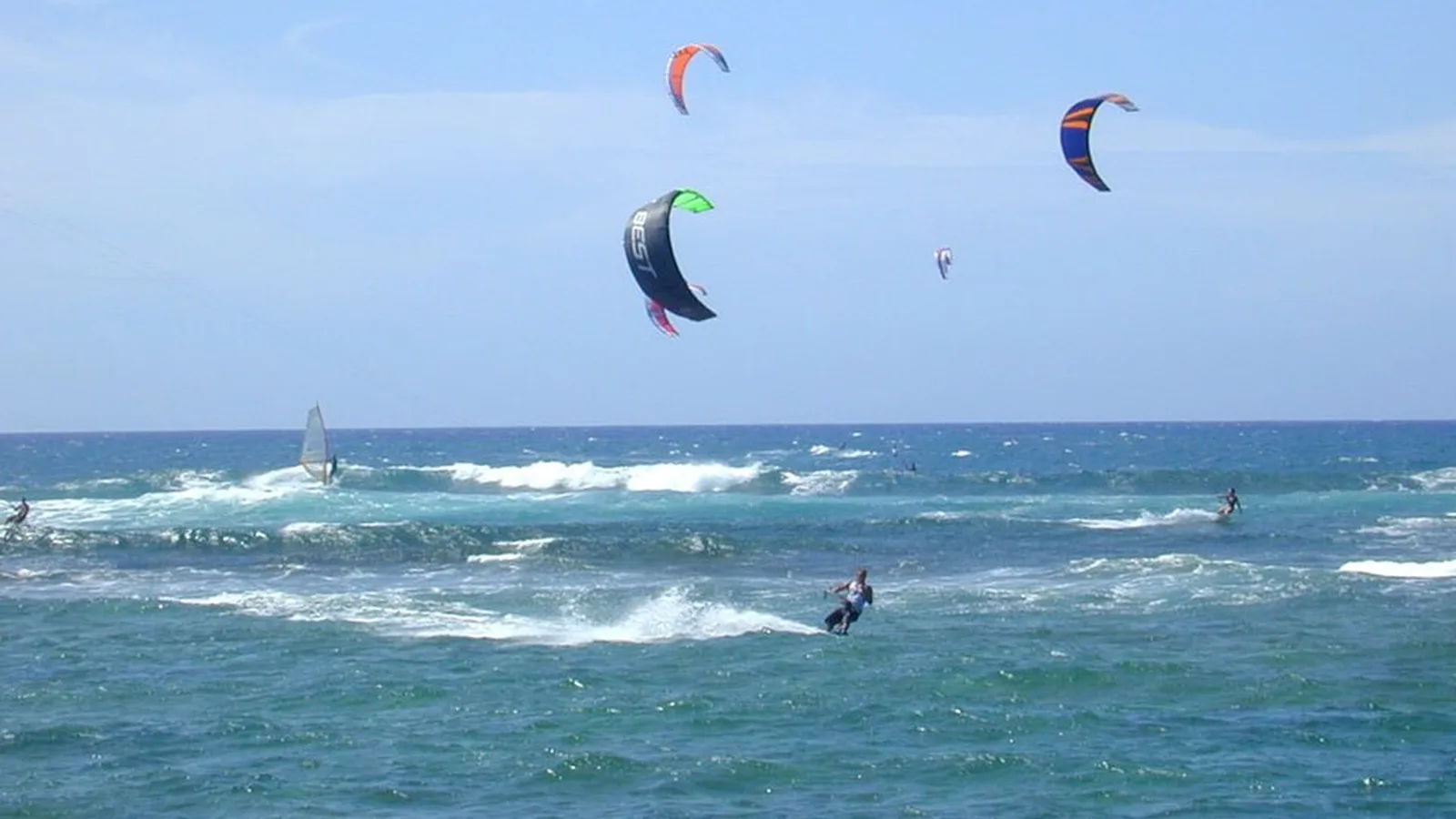
Photo: Eric Guinther / Wikimedia Commons, CC BY-SA 3.0
Maui's Kanaha is the world benchmark. Oahu's two spots are just as real — but one of them has a genuinely unresolved legal problem worth knowing before you book a lesson.
The most reliable trade wind in the US, on up to 95% of summer days.
Kanaha in detail arrow_forward
A genuine beginner bay — with a commercial-lesson ban that's actively enforced, and operators who advertise anyway.
Kailua in detail arrow_forward
A reef wave spot with no kite school at all — not a beginner venue by any account.
Mokuleia in detail arrow_forwardTwo islands, three real spots, one genuinely unresolved regulatory question.
The world's benchmark kite spot — covered in full depth in our United States guide.
Kanaha Beach ("Kite Beach"), in Kahului, owes its reputation to the north-east trade wind funnelled between the Haleakalā massif and the West Maui Mountains, boosted by the afternoon thermal — 15-25 knots, rideable on up to 95% of summer days, May to October. It's a busy, mixed-level spot: the outer reef area leans intermediate to advanced (exposed coral, buried rocks, strong currents at low tide), while beginners are taught by schools on more sheltered sections. Action Sports Maui, which describes itself as the island's only IKO/PASA-accredited school for over 29 years, teaches here. The water stays warm year-round (24-28°C): a rash vest or boardshorts are enough most of the year.
See on Google Maps open_in_newKahului Airport (OGG) is about 8 miles away, a 2-minute taxi ride. See our full United States guide for the launch-zone etiquette, the 125 ft altitude guideline reported by one operator, and the sourcing caveats around it.
A genuine beginner bay, and Hawaii's clearest example of a regulation that's real, enforced, and openly ignored.
Kailua Bay, on Oahu's windward side, is a wide sandy bay worked by the year-round trade wind. Sources disagree on the exact speed range — one aggregator gives 15-35 knots, while the local spot guide and an operator both describe something gentler, roughly 10-25 knots, strongest June-August — so treat "consistently windy, strongest in summer" as the safe claim rather than any single number. Inside the bay, in the lee of Flat Island, the water is flat and used for freestyle; further out, near the Mokulua Islands, the outer reef breaks ("Moku's Breaks") are steeper and more exposed, especially when a powerful winter NW swell arrives — a genuinely more serious, advanced proposition than the tame inner bay. Reef hazards sit underwater; trees and concrete are the main hazards on the beach itself.
The bay is explicitly a beginner-to-intermediate venue — "the place to take lessons, learn, progress and develop," per the local spot guide — with advanced riders heading to the outer reef instead. The water runs 75-81°F (24-27°C) year-round; no wetsuit is generally needed, at most a thin top for early mornings. Honolulu International (HNL) is about 16 miles away, roughly 25-35 minutes by car outside rush hour, but 55 minutes to 1h15 during the 3-6:30pm window.
See on Google Maps open_in_newSchools and regulation are tangled together here, and worth reading before booking anything. After years of resident complaints about commercial operators crowding the beach park, the Honolulu City Council passed Bill 11 in 2012, banning nearly all commercial activity — including kiteboarding lessons — at Kailua and Kalama Beach Parks; the mayor's veto was overridden 7-2. It is not a dead letter: in January 2017, state DOCARE officers proposed an $11,000 fine against an operator caught giving paid kitesurfing lessons there without a permit. And yet, today, operators including Hawaiian WaterSports continue to market Kailua kite lessons, describing themselves as Oahu's only official IKO centre; a long-standing rival, Windward WaterSports, shows as closed on its own listing as of an April 2026 update. We could not resolve this contradiction — whether current lessons operate under some permit arrangement we couldn't find, or simply continue on the same basis press coverage described in 2017 — so we're reporting it plainly rather than asserting either that lessons there are legal or that no one teaches there. Recreational, non-commercial kiting is unambiguously legal and governed instead by a designated launch zone, a swim-zone exclusion, a 200 ft no-jump buffer from shore, and voluntary no-fly days on major holidays, per Hawaii Administrative Rules and the community-run Kailua Windsports Association.
A reef wave spot with real hazards and no resident kite school at all.
Kite Insider's "Oahu North Shore" entry corresponds, in every other source checked, to Mokuleia, at the North Shore's western end — not the famous surf breaks further east (Pipeline, Waimea, Sunset), which no source describes as kiteable. The wind here is trade-driven with a thermal assist: most days average 14-16 knots, building to 16-22 knots on strong trade days, filling in around 11am and peaking 2-5pm on sunny days. Wave season runs September-May, with October-November and March-May the best windows for kiting specifically; November-March brings the biggest swell alongside inconsistent trades, a combination kiters tend to avoid.
The break is a running right-hander over reef, handling waves up to 6-8 ft before conditions get "out of control," and the reef is shallow enough — especially at low tide — to be genuinely hard on equipment. This is explicitly not a beginner spot: multiple sources put it bluntly ("do yourself a favor and learn in Kailua"), and unlike every other spot on this page, no kite school of any kind was found based at Mokuleia or anywhere else on the North Shore — a real gap, not an oversight in this research.
No DLNR or City & County ordinance specifically restricting kiteboarding at Mokuleia was found — the North Shore's well-documented big-wave surf season (heaviest December-February, home to Pipeline and the on-call Eddie Aikau Invitational) is a real safety fact about the coast generally, not a kiteboarding-specific rule, and no source mentions kiteboarding in that context at all. HNL is about 28 miles away, roughly 41 minutes by one estimate — allow more given Oahu's traffic generally, since no rush-hour-specific figure was found for this route.
Hawaii doesn't have a single kiteboarding statute — but Kailua's own rule is real, enforced, and worth understanding before you go.
No single Hawaii state law governs kiteboarding across the islands. Kanaha's operating guidelines and Kailua's launch-zone rules both come from Hawaii Administrative Rules and local practice rather than a dedicated kiteboarding statute. The one genuinely significant, actively enforced rule on this page is Kailua's 2012 commercial-activity ban (Honolulu City Council Bill 11) — real law, with a real 2017 enforcement case, that current advertised lessons there don't appear to fully square with. We report that contradiction rather than resolve it.
No regulation specific to kiteboarding was found for Mokuleia/the North Shore. A rule found at one Hawaii spot never automatically applies to another, even on the same island.
In a sea emergency, contact the US Coast Guard (VHF channel 16) or 911.
What riders ask most before heading to Hawaii.
Kanaha Beach on Maui and the inner bay at Kailua on Oahu are both genuine beginner venues. Kailua's commercial-lesson legal status is unresolved (see the regulations section) — worth knowing before booking a lesson there specifically.
It's genuinely unclear. Commercial kiteboarding instruction has been banned there by city ordinance since 2012, with a real enforcement case (an $11,000 proposed fine) in 2017 — yet operators currently advertise Kailua lessons. We can't resolve that contradiction, so we're reporting it rather than picking a side.
No. The reef break at Mokuleia is explicitly described as unsuitable for beginners, and no kite school of any kind is based there — a genuine gap, not an oversight.
Kanaha (Maui) runs best May-October. Kailua (Oahu) is windiest roughly June-August, though sources disagree on the exact speed range. Mokuleia (Oahu) kites best October-November and March-May; November-March brings big swell and inconsistent trades, a combination worth avoiding there.