

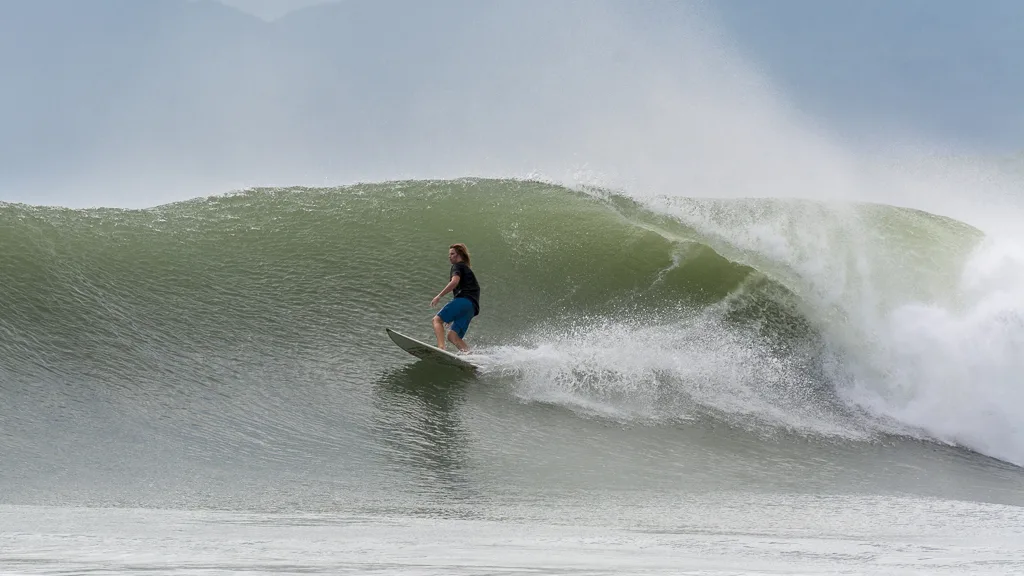
📍 Oaxaca, Mexico
Photo: Heidi Donat (StellarD) / Wikimedia Commons, CC BY-SA 4.0
Zicatela is famous for a reason. La Punta, a short walk south, is the reason most visitors actually get in the water.

Heavy and hollow, this sand-bottom beach break has a genuine expert-only reputation — powerful shorebreak, strong rips, and no safe channel out.
Zicatela in detail arrow_forward
At the south end of Zicatela, the headland turns that same swell into long, mellow walls — a genuine intermediate option a short walk away.
La Punta in detail arrow_forward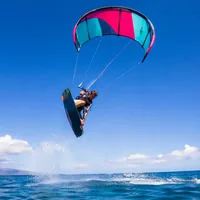
Puerto Escondido is a surf town. There is no permanent kite school here, and search demand reflects that — see below before packing a kite.
Read this before you go arrow_forwardGenuinely two different waves, ten minutes apart, and a Mexican jurisdiction — not a US one.
Playa Zicatela is a beach break with a sand bottom rather than a reef or a point, and that is what makes it dangerous. A steep beach drops into a shallow, shifting sandbar close to shore, so long-period south swell stands up fast and pitches over with very little water underneath it. Multiple independent surf-travel guides describe the result similarly, calling them short, square, extremely powerful barrels that can throw a surfer directly onto hard-packed sand.
The season is genuinely a spring-through-autumn one, not a winter one — the opposite pattern from most of this site's northern-hemisphere surf spots. Independent guides converge on roughly April/May through October/November for south and south-west groundswell out of the Southern Hemisphere, with the biggest, most consistent days clustering in June through September (some sources frame it as May-September with a July-August peak). Puerto Escondido's own big-wave surf contest and a WSL-affiliated event are both run inside that window, which several guides point to as informal confirmation of when the swell is most reliably large. That's commercial-tier sourcing — surf-travel and surf-data guides, not a government meteorological agency — and it's presented that way rather than as a guaranteed forecast.
See Zicatela on Google Maps open_in_newThe main peak is advanced/expert-only, and every independent source we checked points to the same reasons — heavy shorebreak landing in almost no water, persistent and strong rip currents, no true paddle-out channel (every session out is described as a fight through the whitewash rather than a clean path around it), and hold-downs of 30 seconds or more on a bad wipeout. This isn't one blog's opinion; that perspective appears across surf-travel guides, spot databases and hazard-focused write-ups alike. Zicatela is not the place to learn to surf.
Zicazteca Surf School (based at Hotel Rockaway on Calle del Morro, right on Playa Zicatela) and Chingon Surf Lessons (in the adjacent Brisas de Zicatela neighborhood) both run lessons in the area, confirmed against their own sites. Given Zicatela's reputation, most lesson bookings here are steered toward calmer water or toward La Punta rather than the main peak — worth asking about directly when you book.
La Punta is located on the far south headland of Playa Zicatela — Surfline's spot guide places it there and describes it as a left-hand point break, and independent spot databases corroborate that it is Puerto Escondido's main left point. It is a genuine, separately named spot rather than a marketing gloss on Zicatela.
The same headland that makes Zicatela's beach break so heavy also works in La Punta's favor: it absorbs and refracts the raw swell energy arriving from the open Pacific, and a sand-and-rock bottom (rather than pure open sand) organizes it into longer, more predictable walls. Independent guides describe La Punta as offering "long, mellow walls perfect for intermediates" — genuinely more approachable than Zicatela's main peak, though the inside section can still speed up and get hollow, so "mellow" is relative rather than absolute.
One guide places La Punta roughly 2 km south of the main Zicatela area. We haven't found an exact published walking time, so treat this as an estimate rather than a sourced fact: at that distance, a beachside walk would likely run 20-30 minutes depending on pace and starting point. Beyond the surf, La Punta is documented in travel guides as a trendier, more social strip of restaurants, cafés and nightlife than the Zicatela stretch further north.
See La Punta on Google Maps open_in_newB SURFER, founded in 2011 and located directly on the beach at La Punta de Zicatela, is confirmed by its own site to be a long-running local school. Puerto Escondido International Airport (PXM) serves the town directly and is the gateway for this whole stretch of coast.
Puerto Escondido appears in broad Oaxaca-coast searches. To be clear, this is a surf town, not a kiteboarding destination, and this page doesn't pretend otherwise. Measured US search demand for "kiteboarding Puerto Escondido," "kitesurfing Puerto Escondido" and "kiteboarding Oaxaca" all registered essentially zero, matching research that found no permanent kite school operating in town.
Only one named location appears: Laguna de Manialtepec, a lagoon about 14 km west of town. A regional tourism source describes some beginner/intermediate kitesurfing there but explicitly notes there is no permanent school — only seasonal freelance instructors. A separate mobile school, Oaxakite, markets kiteboarding lessons along the wider Oaxaca coast between Puerto Escondido and Salina Cruz, using beaches near Mazunte and Huatulco, but it isn't based in Puerto Escondido and names no fixed local spot here. If you're set on kiteboarding in Mexico, this site's Baja California Sur or Quintana Roo guides are the real kite trips.
Parque Nacional Lagunas de Chacahua is the nearest CONANP-protected natural area to Puerto Escondido — a federally protected national park created by decree in 1937 and covering nearly 15,000 hectares of lagoons, mangrove and coastline. The park's own management plan puts it roughly 89 km down the coast from Puerto Escondido; other sources we checked give distances anywhere from about 54 to 100 km, depending on the route and reference point used, so treat any single figure as approximate. It's commonly sold as a full or half-day boat excursion from Puerto Escondido (roughly an hour to 90 minutes by road to the Zapotalito or El Zapotal embarkation point, then by boat), most often marketed for wildlife, mangrove tunnels and bioluminescence rather than surfing.
We relied on the park's management plan itself for this page instead of repeating a secondary summary. Cabo Pulmo's plan (which names zero kite or wind activity) and Yum Balam's plan on this site's Quintana Roo page (which explicitly permits kite surf, wind surf and paddle board by name) represent opposite approaches; Chacahua's plan falls between them. It does not itemize surfing by name among permitted activities, but its descriptive text for the Bahía de Chacahua area states plainly that visitors there come mainly "interested in the marine swell to practice surfing." Treat that as what it is — a real, if narrow, primary-source finding about one part of the park, not a blanket "surfing is an official park activity."
Oaxaca is in Mexico; it's an international destination for a US-based surfer and is not governed by US Coast Guard rules. It's not Spain or France — none of this site's European coastal rules (a 300-metre limit, a specific mandatory-kit list) apply here, and we're not going to transplant one onto this page.
Mexico's maritime authority is SEMAR (Secretaría de Marina); it is administered locally by the Capitanía de Puerto and operates under the federal Ley de Navegación y Comercio Marítimos.
We found no federal or state law requiring a life jacket to be worn by a surfer who isn't aboard a registered vessel — a gap this site has documented in other parts of Mexico. That's reported as "not found," not as "confirmed exempt."
We also found no published municipal ordinance or official lifeguard flag system specific to Zicatela or La Punta from the municipality of San Pedro Mixtepec. What's visible online about beach safety here comes from surf schools and tour operators describing conditions, not from a cited local statute — treat any flag or signage you see on the beach as local practice, not confirmed law.
In an emergency, dial 911 — unified nationally across Mexico since 2017. Note also that Pacific Mexico's official hurricane season (per the US National Hurricane Center) runs mid-May through November — overlapping the entire south-swell surf season above, which is worth building into any trip planning.
Questions surfers most often ask before heading to Puerto Escondido.
No. Every independent source we checked describes Zicatela's main peak as advanced/expert-only, due to heavy shorebreak, strong rip currents and no safe paddle-out channel. Beginners are far better served at La Punta, a short walk south, or in a proper lesson with a local school.
Zicatela is the open beach break directly in front of town — the famous, heavy "Mexican Pipeline." At Zicatela's south headland, La Punta is the point break where the same swell is bent into longer, mellower walls that suit intermediates. They're a short walk apart but genuinely different waves.
Roughly April/May through October/November for south swell, with the biggest and most consistent surf converging on June through September per multiple independent surf-travel sources. That's the opposite season from most northern-hemisphere winter surf spots.
Not really. There's no permanent kite school in town and measured US search demand for it is essentially zero. Laguna de Manialtepec, about 14 km west, sees some beginner kitesurfing with seasonal freelance instructors only. For an actual Mexico kite trip, see this site's Baja California Sur or Quintana Roo guides.
It isn't a Zicatela-style wave, and it's roughly 89-100 km from Puerto Escondido depending on the source — people usually visit as a separate day trip for wildlife, mangrove tunnels and bioluminescence rather than as a surf destination. Its management plan notes that visitors to one of its bays come partly to surf, which is more than some Mexican parks acknowledge, but it isn't built around surfing the way Zicatela is.
The town is served directly by Puerto Escondido International Airport (PXM).