

Photo: Roberto Bolaños / Wikimedia Commons, CC BY 2.0
Quintana Roo is the Mexican state that holds Cancún, Playa del Carmen, Tulum, Isla Holbox and Laguna Bacalar. They are not equally real for kiteboarding, and this page is weighted the way the research actually came out, not the way the map suggests.
Isla Holbox is the strongest, most-documented kite spot on this coast, with real IKO-affiliated schools and a management plan that explicitly names kiteboarding as a permitted activity. Cancún's actual kite scene is not in the hotel zone at all — it's based in Isla Blanca, a lagoon spot north of town — and Playa del Carmen has its own long-running school. Tulum has a genuine kite beach on the Boca Paila road, bordering the Sian Ka'an Biosphere Reserve. Laguna Bacalar, the "Lagoon of Seven Colors," is real for flat-water SUP and sailing, but only thinly for kite. And the Cancún hotel zone itself, contrary to its diving-and-nightlife reputation, turns out to have a genuine, if modest, beginner surf scene.
Every school named on this page was checked for a working website plus independent corroboration before being named. Where the evidence was thin, we say so instead of rounding it up.
Real, IKO-affiliated kite schools on a Caribbean-side barrier island — and a CONANP management plan that names kitesurfing as a permitted activity.
Isla Holbox in detail arrow_forward
The real kite scene isn't in the hotel zone — it's Isla Blanca, Coco Beach, and Tulum's Kite Beach on the Sian Ka'an boundary.
Cancún & Playa del Carmen arrow_forward
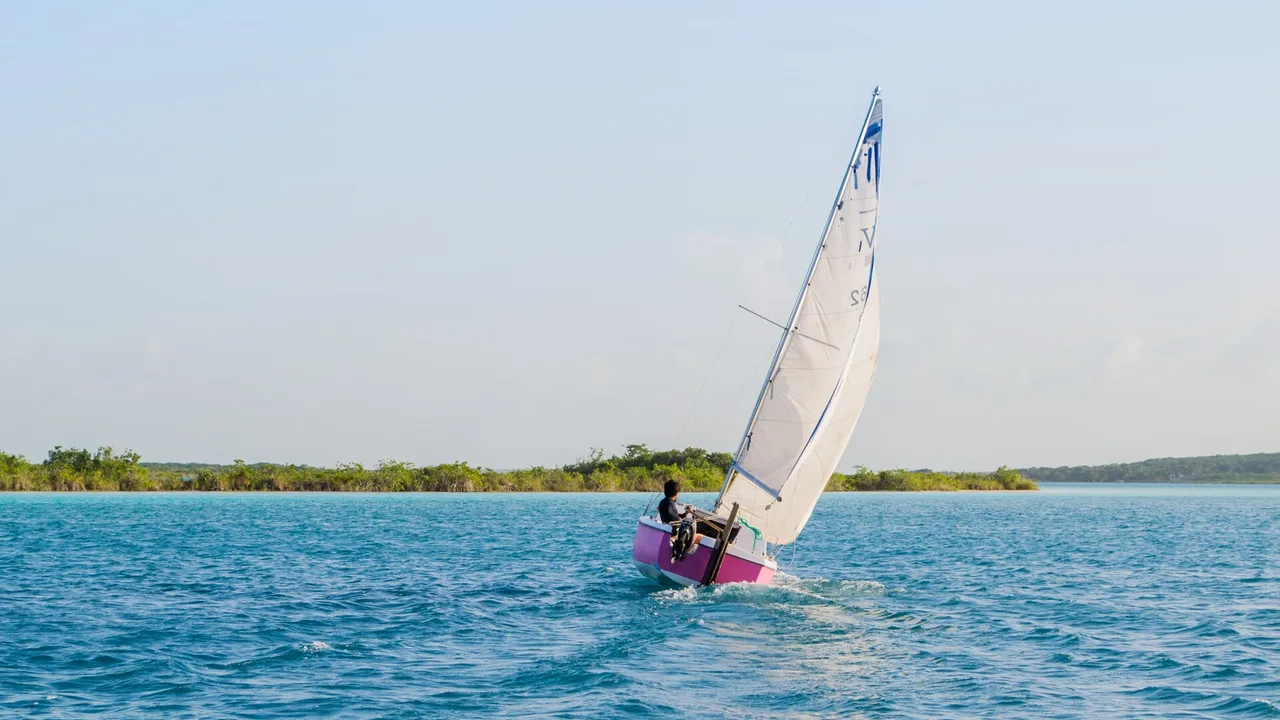
The Lagoon of Seven Colors: real SUP and sailing operators on flat, freshwater-clear water. Kite here is thin, and we say so.
Laguna Bacalar in detail arrow_forwardThe essentials before picking which part of this coast to fly into.
A barrier island north of the Yucatán Peninsula, inside a federally protected area whose own management plan names kiteboarding as permitted.
Most kite-spot guides and a local school's own trip-planning blog broadly agree on a core season of November through May, with the most consistent stretch December through April. Typical rideable wind runs 12-25 knots. Winter brings periodic "norte" cold-front passages — strong northerly wind events that can gust 20-30 knots for a day or two before easing back into steadier easterly trades around 14-18 knots in the afternoon. This is the pattern reported consistently across independent kite-spot guides and school marketing; we have not found a peer-reviewed meteorological study describing the mechanism in that level of detail, so it's presented as the trade explanation, not an academically verified one.
Holbox Kiteboarding School and KukulKite are both listed in the official IKO school directory under Holbox, each with a specific street address and hundreds of independent reviews across multiple booking platforms — the strongest evidence tier on this page. Holbox Kiteboarding School (founded 2009, per a local tourism portal) teaches kite, kitefoil and wing, with rentals and multi-day camps; KukulKite similarly teaches kite, wingfoil and offers rental, in several languages, with an FAQ addressing insurance and legal registration. Neither advertises standalone windsurf lessons — kite and foil are the focus.
Lifestyle Kiteboarding, described by a local Holbox information portal as the island's newest kite school with IKO-certified instructors and a specific address, has moderate-to-high confidence — real, but with less independent corroboration than the two schools above. Casa Las Tortugas, a boutique hotel, runs its own "Sport Club" offering kiteboarding and wingfoil lessons and rentals directly from the hotel — a real, hotel-operated watersports program, though its instructor certification status isn't stated on its own page. We found no dedicated, independently-verified windsurf school on Holbox; any windsurf activity appears to run informally through the kite schools' rental gear rather than as its own standing offer.
Isla Holbox sits inside the Área de Protección de Flora y Fauna Yum Balam, a federal protected area (decreed 1994; management plan published in the Diario Oficial de la Federación, 5 October 2018). We read the management plan's own PDF directly rather than relying on a summary, and found something worth stating precisely: its own definitions section explicitly lists "kite surf," "wind surf" and "paddle board" — by name, alongside kayaking, diving and wildlife viewing — as recognised examples of "turismo de bajo impacto ambiental" (low-impact tourism). That category is an explicitly permitted activity in the beach-and-dune subzone covering Isla Grande's own shoreline, and in the marine sustainable-use subzone offshore. This is a stronger finding than "not banned": CONANP's own management plan for Yum Balam names kiteboarding as a recognised, permitted activity here.
The same document sets a real, separate rule worth knowing if a school's boat is involved: a 3-knot maximum speed for vessels inside channels, waterbird nesting areas and diving sites (Regla 49). It also generally restricts single-use plastics, drone use outside authorized research, and new large-scale development — the plan's broader conservation framework, not kite-specific.
The hotel-zone beaches aren't it. Isla Blanca and Coco Beach are.
Cancún's kite schools market themselves as "Cancún," but they actually teach at Isla Blanca, a shallow lagoon spot north of downtown, and occasionally at Puerto Juarez and Puerto Cancún — chosen for better wind angle and safer shallow water, well away from the main tourist beach. Several independently-verified operators teach there: Kitesurf Mexico and AquaCore Adventures (both describing themselves as IKO-certified, with active, detailed sites showing current seasonal dates), Shaka Vibes (an owner-operated kite, wingfoil and windsurf school, with a separate windsurf-specific page giving exact directions to their beach camp), and Ikarus / Kiteboard Mexico (a longer-standing operation with its own lodging built around the Chacmuchuch lagoon). All show active, current websites with consistent seasonal and pricing detail.
PDC Kiteboarding & Water Sports School, based at Coco Beach in the heart of Playa del Carmen, is the genuine article here — a long-running, IKO-certified school teaching kite, wingfoil, wakeboarding and SUP, with consistent hours, pricing and location across its own site and multiple independent booking platforms. We found no comparably established standalone windsurf school in Playa del Carmen; any windsurf gear there runs through multi-sport rental operations rather than a dedicated school.
Tulum has a real, substantive kite scene along the Boca Paila coastal road, often called "Kite Beach," roughly between km 3 and km 9 heading toward Sian Ka'an. Siankite Watersport School is the strongest-evidenced operator — its own site plus multiple independent directory listings agree on its location and offer, teaching kite, SUP and touring. Tulum Kite School & Rentals and a kite-and-surf program run through the Maya Tulum hotel are both real, active operations with somewhat thinner independent corroboration. Chiringuito Tulum, a beach club, partners with a separate operator, COA Water Sports, for its kite program. Standalone windsurf branding is rare here; most Tulum operators teach kite, wingfoil and SUP, not traditional windsurf.
We read the actual Sian Ka'an Biosphere Reserve management plan (DOF, 23 January 2015) rather than a summary. Unlike Yum Balam's plan, it does not name kitesurfing, windsurfing or surfing anywhere in its text — a real difference between the two documents, not a gap in our search. It does confirm that the Boca Paila road area is partly inside the Reserve's boundary, in a named, mapped public-use subzone ("Caapechen-Boca Paila," SUP2), where "tourism and low-impact tourism" is a generically permitted activity — without naming kite specifically the way Yum Balam does. Whether any individual school's exact beach frontage sits inside that subzone or on private/ejido land just outside the Reserve boundary is not something this research could pin down to the meter; treat this as a zone-level finding, not a per-school compliance claim.
Quintana Roo's Caribbean coast is broadly reef-protected, and the Cancún hotel zone is genuinely not a kite or wind destination. But it turns out to be a real, if modest, beginner surf spot — and the search data backs that up: "surf lessons cancun" and "is there surfing in cancun" are both measurably searched terms, more than any kite phrase on this page. The waves are small wind-driven beachbreak at Playa Delfines and Chac Mool, occasionally boosted by winter cold-front (norte) swell — not a serious wave, but real enough to teach on. Verified operators include 360 Surf School Cancún (next to the Surfin Burrito Bar on Blvd. Kukulcan, daily hours, board rentals), Good Vibes Surf School Cancún, and Academia Mexicana de Surf at Playa Delfines — all soft-top, beginner-focused group and private lessons rather than a performance surf culture. Puerto Morelos, by contrast, did not turn up a dedicated surf, kite or wind school in this research; it reads as a diving and snorkeling town, not a board-sports one.
The "Lagoon of Seven Colors" — a freshwater lagoon with genuine watersports operators, and a real, if informal, boat-traffic problem.
Bacalar's lagoon is genuinely used for stand-up paddleboarding and sailing/windsurfing, with real, currently operating rental and tour businesses. Laguna Adventures Bacalar and Bacalar Sunrise both run current SUP tours from their own active sites, with a Bacalar address; Bacalar Fun Rentals and Paradise Living Bacalar both list windsurf equipment rental directly on their current booking pages. Kiteboarding is thinner: one operator, Camp Toucan, mentions using the wind for both windsurfing and kiteboarding instruction, but we could not independently corroborate a dedicated, established kite school on the lagoon the way we could for SUP and windsurf — treat kite at Bacalar as possible, not established. The best conditions for wind-dependent sports are generally the windier stretch of the dry season into spring; for SUP, sunrise through mid-morning is the favored window, before thermal wind and boat traffic build — several operators explicitly market sunrise tours on that basis.
The lagoon is a Parque Ecológico Estatal (state ecological park), decreed 1 April 2011 in the Quintana Roo state gazette — a state-level protection, not a federal CONANP designation, and not a Ramsar wetland site (the "Laguna de Bacalar" Ramsar listings that exist are in Honduras, unrelated to this one). Motorboat and jet-ski traffic on the lagoon has been a real, publicized problem, and the port authority (APIQROO) has responded with operating rules restricting jet skis to designated zones and, more recently, a five-zone navigation scheme separating low-speed, towing-sport, jet-ski and restricted zones. A weekly Wednesday closure to navigation is reported as a locally agreed measure between the Bacalar town government and boating associations, not a codified state or federal law. The town of Bacalar itself became its own municipality by decree of the Quintana Roo state congress (Decree 421, dated 2 February 2011, published 17 February 2011), splitting off from Othón P. Blanco municipality (the Chetumal area).
One major international airport, one newer one, and a ferry.
CUN is the main international gateway for this entire coast — Cancún itself, Isla Blanca, Playa del Carmen, and Isla Holbox all connect from here. Holbox has no airport of its own: the standard route is a drive or bus (roughly 2.5-3.5 hours) to the small port town of Chiquilá, followed by a passenger ferry of about 30 minutes across the lagoon to the island.
A newer airport opened in December 2023 specifically to serve Tulum and the southern part of this coast, cutting the drive from CUN. Its route network is still smaller than Cancún's, so many travelers heading to Tulum or onward to Bacalar still fly into CUN and drive south.
Bacalar sits inland from the coast, close to the Belize border. It has no airport of its own; the practical routes are a rental car or bus from either Chetumal (the closer regional city) or from Tulum/CUN further north, on Highway 307.
What's genuinely documented, and what simply hasn't been found.
Across Mexico, maritime safety runs through the Secretaria de Marina (SEMAR) and the local Capitania de Puerto, under the Ley de Navegacion y Comercio Maritimos. That framework regulates hulled vessels and the people aboard them; no federal or Quintana Roo state law was found requiring a kiteboarder, windsurfer or SUP rider — not aboard a registered vessel — to wear a life jacket. That's a documented gap, not an oversight we've skipped over; see our wetsuit thickness guide for water-temperature planning instead of a prescribed number, since Caribbean water here runs warm nearly year-round.
Two federal protected areas touch this coast directly: Yum Balam at Isla Holbox, whose management plan explicitly names kiteboarding, windsurfing and paddleboarding as permitted low-impact tourism (see above), and the Sian Ka'an Biosphere Reserve at Tulum's southern edge, whose plan permits general tourism in its public-use subzones without naming specific sports. Laguna Bacalar is a state-level protected area with its own port-authority navigation rules, not a federal one. Beyond these, we did not find a Quintana Roo state or municipal ordinance (Benito Juárez/Cancún, Solidaridad/Playa del Carmen, or Tulum) that names kiteboarding, windsurfing or watercraft specifically — school and beach-club practice, not codified law, sets the day-to-day rules at most spots on this page.
911 is Mexico's single, unified national emergency number, free from any phone. VHF channel 16 is the international maritime distress convention; we did not find a SEMAR-published, region-specific distress channel for this coast beyond that international standard. Travel insurance covering medical evacuation is strongly worth carrying, particularly for Holbox and Bacalar, both a real distance from a major hospital.
Isla Holbox has the strongest, best-verified school scene: Holbox Kiteboarding School and KukulKite both carry official IKO directory listings and hundreds of independent reviews. Cancún's real kite schools are at Isla Blanca, north of the hotel zone, not on the tourist beach itself. Playa del Carmen has one long-running, IKO-certified option, PDC Kiteboarding at Coco Beach. Tulum's Kite Beach, on the Boca Paila road, has a genuine cluster of schools led by Siankite Watersport School.
Not really, and not where you'd expect: the hotel-zone beaches are not a kite destination. Cancún's actual kite schools operate from Isla Blanca, a lagoon spot north of downtown, chosen for better wind angle and shallower, safer water. The hotel zone itself turns out to be better suited to beginner surf lessons at Playa Delfines and Chac Mool.
Yes — more than "allowed." We read Yum Balam's own CONANP management plan directly, and its definitions section explicitly names "kite surf," "wind surf" and "paddle board" as recognised examples of permitted low-impact tourism, both on Isla Holbox's beach subzone and in the marine zone offshore. A separate rule sets a 3-knot speed limit for boats in channels, bird-nesting areas and dive sites.
Possibly, but it's not well established. Bacalar has real, verified operators for stand-up paddleboarding and windsurfing/sailing. One operator, Camp Toucan, mentions kiteboarding instruction, but we could not independently confirm a dedicated kite school on the lagoon the way we could for SUP and windsurf. Treat kite at Bacalar as a maybe, not a plan.
Yes, in a specific, modest sense: small, wind-driven beachbreak at Playa Delfines and Chac Mool, sometimes boosted by winter cold fronts, taught on soft-top boards by real, verified beginner surf schools. It's not a wave destination in the way Pacific-coast Mexico is — this is reef-protected Caribbean water — but it's a real, teachable beach, not a myth.