

📍 Connecticut, United States
Photo: Rhododendrites / Wikimedia Commons, CC BY-SA 4.0
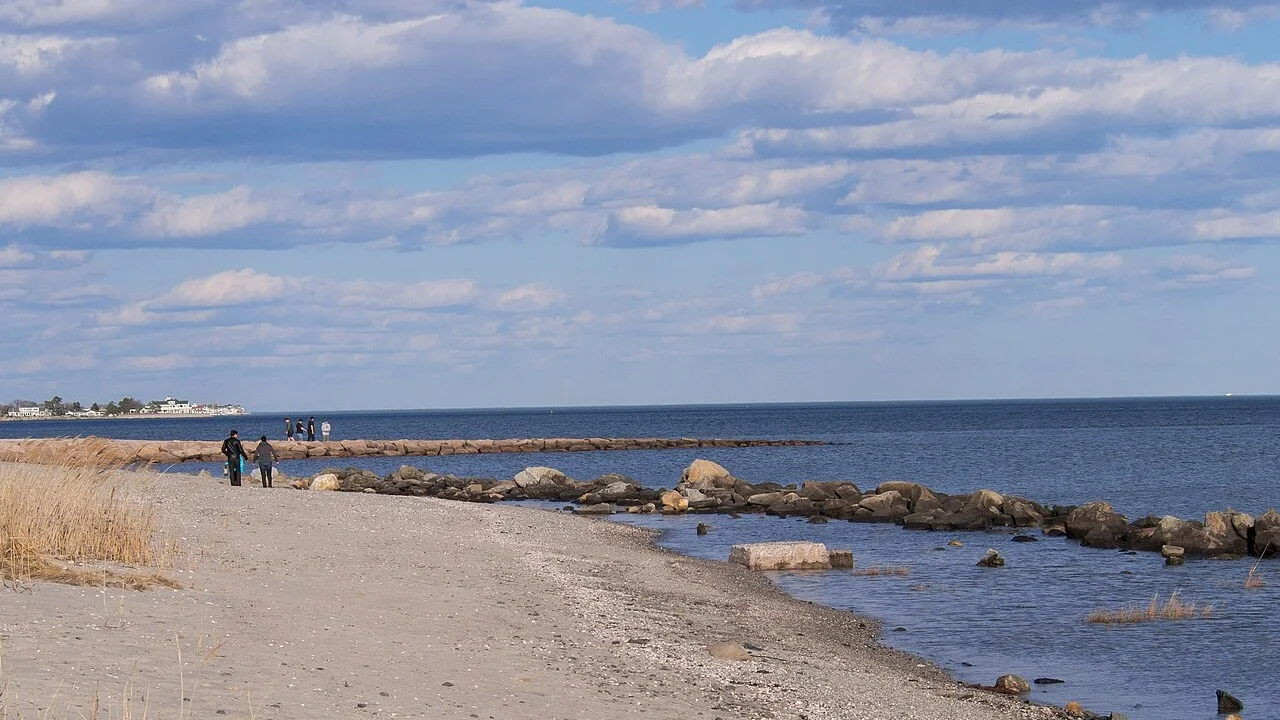
Every other state in this New England batch — Massachusetts, Rhode Island, Maine — faces the open Atlantic and gets a real groundswell signal. Connecticut mostly does not. Long Island sits offshore like a breakwater, and the water on the other side of it, Long Island Sound, behaves like a large, sheltered bay rather than an ocean coast. We are not going to force a surfing narrative onto that geography. This page is about what the Sound is actually good for: accessible, sheltered SUP and kayak paddling, at real state parks with real rules.
That said, "not a surf coast" is not the same as "never any waves." A big nor'easter, hurricane swell, or the right Atlantic system can push enough energy into the Sound to produce rideable waves, occasionally, at spots including Old Saybrook and Stonington. Treat that as a rare-event footnote, not a standing recommendation.
NDBC 44039, Long Island Sound near New Haven — with real, stated gaps in the record.
A genuine caveat before the numbers: buoy 44039 has been offline since mid-April 2024 and has not reported since (checked 2026-09-16), and 2021-2022 are partial years. Each monthly figure below is averaged from whatever years are actually available for that month — 2 to 4 years depending on the month — not a clean five-year run like the other pages in this batch. We are stating that rather than smoothing over it.
| Month | Water temp | Wave height | Dominant period | Wind ≥15kt |
|---|---|---|---|---|
| January | 5.6 °C / 42 °F | 0.55 m | 3.6 s | 36.5% |
| February | 4.4 °C / 40 °F | 0.40 m | 3.2 s | 21.8% |
| March | 4.5 °C / 40 °F | 0.49 m | 3.5 s | 29.5% |
| April | 7.6 °C / 46 °F | 0.41 m | 3.5 s | 21.5% |
| May | 12.5 °C / 54 °F | 0.34 m | 3.1 s | 11.4% |
| June | 18.4 °C / 65 °F | 0.28 m | 3.0 s | 8.2% |
| July | 23.5 °C / 74 °F | 0.25 m | 2.8 s | 6.9% |
| August | 23.8 °C / 75 °F | 0.32 m | 2.9 s | 9.8% |
| September | 22.6 °C / 73 °F | 0.47 m | 3.3 s | 32.1% |
| October | 18.8 °C / 66 °F | 0.49 m | 3.4 s | 30.0% |
| November | 14.1 °C / 57 °F | 0.58 m | 3.5 s | 39.3% |
| December | 8.9 °C / 48 °F | 0.59 m | 3.7 s | 39.1% |
Dominant wave period never exceeds 3.7 seconds, in any month. That is pure local windsea — the same signature Nantucket Sound shows on our Massachusetts guide — never anywhere close to the 6.9-8.7 second groundswell the open-Atlantic buoys read on that page or on our Rhode Island and Maine guides. This is the measured confirmation, not just the geographic inference, that Long Island Sound is a flatwater venue.
It is also the warmest water in this whole New England batch: 23.8 °C / 75 °F in August, warmer than any figure on the Massachusetts, Rhode Island or Maine pages, because a shallow, semi-enclosed Sound heats up faster than the open Atlantic. Wind follows the same winter-favours-heavy pattern as its neighbours — 36-39% of hours over 15 knots from November to January, dropping to 7-10% in summer.
Hammonasset Beach State Park and Silver Sands State Park, both in Madison/Milford, are the state's best-known paddling beaches: sheltered water, official boat launches, and long stretches of sand to paddle alongside rather than through surf. Compo Beach in Westport is a similar, smaller-scale option with its own marina and launch facilities.
CT DEEP's own boaters' guide states the general rule and its exception clearly: "Manually propelled vessels, including kayaks, canoes, and rowboats, are prohibited inside authorized swim areas per RCSA Sec 15-121-B12(a). Standup paddleboards are exempt from this prohibition and may be used in swim areas." That is a real, specific carve-out — kayaks and canoes are kept out of designated swim zones, but a SUP is not. Worth knowing before you choose which craft to bring to a guarded beach.
CT DEEP's rule for the Hammonasset launch, verbatim: "All shores – 6 MPH limit and no water-skiing within 100 yards of shore." That speed limit applies to powered craft near shore; it is not a paddlecraft-specific rule, but it tells you what kind of water you're launching into — calm, close-managed, and shared with motorised traffic at low speed.
CT DEEP's own paddling page states it directly: "Between October 1 and May 31, all adults must wear a properly fitting life jacket while onboard a manually propelled vessel." Children under 13 must wear one year-round. DEEP also confirms the federal baseline for boards specifically: "Stand-up paddleboards are considered vessels (boats) by the U.S. Coast Guard unless they are being used in a surf zone or designated swim area" — which is the same "beyond the narrow limits of a swimming, surfing or bathing area" test used nationally (see our United States guide).
How this compares to the rest of New England: Rhode Island requires wear year-round and names kiteboards and sailboards specifically. Massachusetts requires it only on a canoe or kayak, for two shorter seasonal windows. Maine and New Hampshire have no general adult mandate at all. Connecticut's 1 October-31 May window sits in the middle of that range.
Emergencies anywhere on this coast: 911, or the Coast Guard on VHF 16.
Not as a real, standing destination — Long Island shields most of the coast, and five years of measured buoy data show a dominant wave period under 3.7 seconds every month, pure local windsea rather than groundswell. Occasional rideable waves are reported at Old Saybrook and Stonington during major storms (a nor'easter, hurricane swell, or a strong Atlantic system), but that's a rare-event footnote, not something to plan a trip around.
Yes, specifically. CT DEEP's boaters' guide exempts standup paddleboards from the general ban on manually propelled vessels (kayaks, canoes, rowboats) inside authorized swim areas — SUPs may be used there; other paddlecraft may not.
Adults must wear one from 1 October to 31 May while on a manually propelled vessel, per CT DEEP. Children under 13 must wear one year-round. Outside that October-May window, adults are not required to wear one, though carrying one remains the federal baseline requirement.
Hammonasset Beach State Park and Silver Sands State Park (both near Madison/Milford) are the state's best-known paddling beaches, with official boat launches and long, sheltered stretches of sand. Compo Beach in Westport is a smaller, marina-adjacent alternative.