

📍 Maine, United States
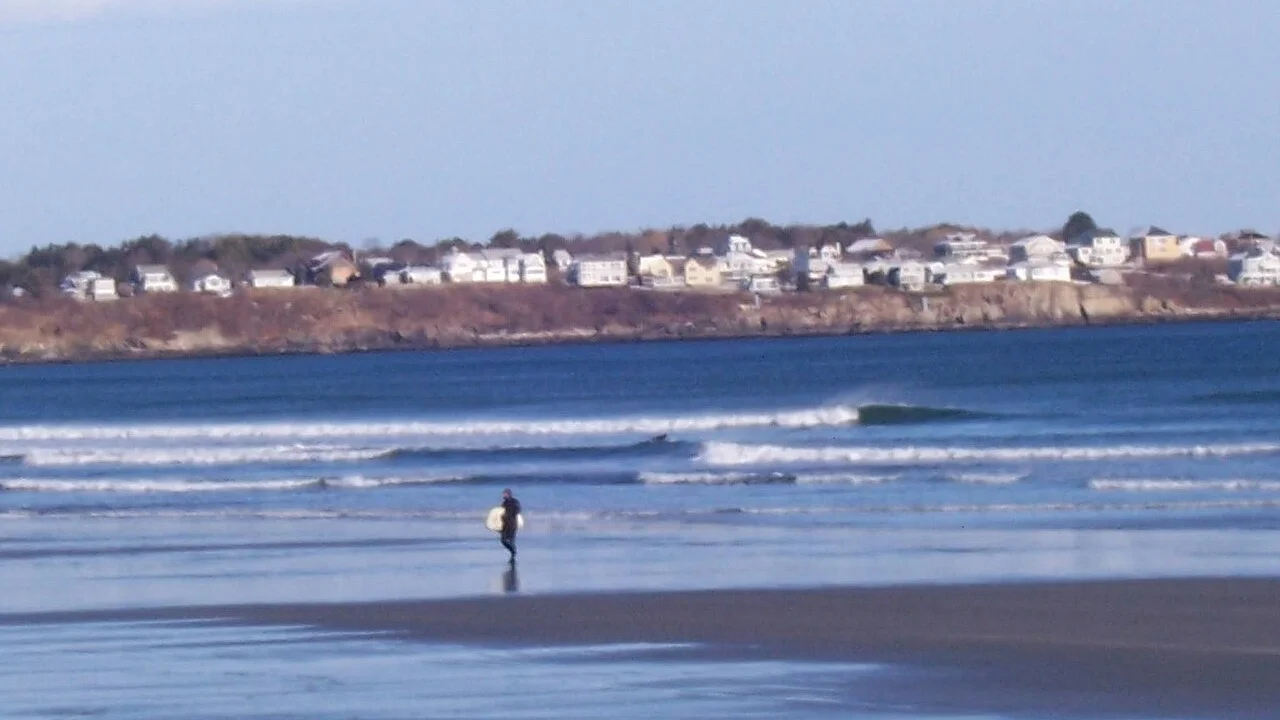
Photo: EgorovaSvetlana / Wikimedia Commons, CC BY-SA 4.0 — Long Sands Beach, York, looking toward Cape Neddick.
Southern Maine packs three different beach authorities into about ten miles of coastline, and no two of them agree on when you can surf.
Maine's surf coast is short and concentrated: York, Ogunquit, Wells and Scarborough, most of it beach break exposed to the open Gulf of Maine. What makes it genuinely tricky is jurisdiction, not the surf itself. York alone runs two separate ordinances that do not say the same thing about the same town. Scarborough has a state park beach and, a short drive away, a privately-associated beach with its own rulebook. None of it is arbitrary, but all of it needs checking beach by beach.
The water is also seriously cold. Every month of the year sits below the National Weather Service's cold-shock threshold, and that matters more here than any single beach ordinance.

Two beaches, two ordinances, two different seasonal windows — one bans surfing by the hour, the other bans it for five and a half months straight.
The York rules arrow_forward
Scarborough Beach State Park charges a fee the state pass doesn't cover. Higgins Beach, a few miles away, has its own piping-plover rules entirely.
Scarborough & Higgins arrow_forward
Strong currents at Popham, and a Maine PFD law that is narrower than most commercial sites claim — read the statute, not the summary.
Safety & the law arrow_forwardFive years of NOAA hourly data (2021-2025) from two stations that measure two different things.
NDBC 44098 sits on Jeffreys Ledge, off the southern Maine coast, and carries no anemometer — wave height, dominant period and water temperature only. For wind, the nearest instrumented station is NDBC 44007 in Casco Bay off Portland. The same caveat applies here as on our Rhode Island guide: Casco Bay is more sheltered than the fully open surf beaches (York, Ogunquit, Higgins), so treat the wind numbers as a proxy rather than a beach-side reading.
| Month | Water temp (Jeffreys Ledge) | Wave height | Dominant period |
|---|---|---|---|
| January | 7.2 °C / 45 °F | 1.61 m | 7.4 s |
| February | 5.9 °C / 43 °F | 1.52 m | 7.3 s |
| March | 5.5 °C / 42 °F | 1.48 m | 7.3 s |
| April | 6.4 °C / 44 °F | 1.19 m | 7.6 s |
| May | 10.2 °C / 50 °F | 1.04 m | 7.6 s |
| June | 15.3 °C / 60 °F | 0.81 m | 7.3 s |
| July | 19.0 °C / 66 °F | 0.76 m | 7.4 s |
| August | 19.5 °C / 67 °F | 0.79 m | 7.7 s |
| September | 18.1 °C / 65 °F | 1.03 m | 8.7 s |
| October | 14.2 °C / 58 °F | 1.30 m | 8.3 s |
| November | 11.3 °C / 52 °F | 1.29 m | 6.9 s |
| December | 8.9 °C / 48 °F | 1.53 m | 7.2 s |
Maine is a real, year-round groundswell coast — dominant period never drops below 6.9 seconds in any month, and peaks at 8.7 s in September, the same long-period autumn signature the buoys show all the way down the coast in Massachusetts and Rhode Island. Wave height peaks in winter (1.5-1.6 m, December-January) but at a shorter period than the September-October swell, which is the better-quality window.
Water temperature is the lowest anywhere on the US East Coast we cover. It peaks at just 19.5 °C / 67 °F in August and bottoms out at 5.5 °C / 42 °F in March — never reaching 70 °F even at the height of summer, and below 50 °F for eight months of the year (October through May). Our wetsuit thickness guide converts that into a suit; expect to need the thickest recommendation it gives for most of the year here.
Share of hours at 15 knots or more at NDBC 44007 (Portland), and the dominant direction when it is windy.
| Month | ≥15 kt share | Top directions |
|---|---|---|
| January | 41.7% | N, NNW, NW |
| February | 37.1% | N, WNW, NNW |
| March | 29.3% | NW, WNW, W |
| April | 22.9% | NNW, S, NW |
| May | 11.3% | S, ENE, NE |
| June | 7.4% | S, SSW, NNE |
| July | 5.2% | S, SSW, NE |
| August | 5.1% | S, ENE, SSE |
| September | 8.8% | N, NNW, S |
| October | 21.0% | NNE, NNW, N |
| November | 38.1% | W, WNW, WSW |
| December | 42.4% | W, NNW, WSW |
This is the windiest winter of any US East Coast state we cover — 38-42% of hours at 15 knots or more from November through February, out of the north and northwest. Summer drops sharply to 5-11%, with a weak southerly signal. There is no meaningful kiteboarding or windsurfing season implied by this data; Maine's coast is a surf destination first, and this page treats it as one.
Long Sands and Short Sands sit under different rule-makers, a few hundred metres apart.
The Town of York Beach Ordinance, Section 5 "Surfing" (amended 4 November 2025, still the current version as of this writing), sets the baseline: "Surfing at Short Sands Beach is controlled by the Ellis Short Sands Park Ordinances. At other public beaches, surfing is prohibited from June 14 to and including Labor Day between the hours of 9:00 a.m. and 5:00 p.m. EDT, except as provided in subsection C." Subsection C carves out Long Sands: within the "Mixed Use Zone," surfing is permitted during those same dates and hours provided "a Surf Leash shall be properly engaged at all times when the surfboard is in the water" and surfers "maintain a minimum distance of twenty feet (20') from any swimmer." Outside the restricted hours and dates, the whole beach is open. On bad-weather days the entire beach can be reclassified Mixed Use at the discretion of the Parks and Recreation Director.
Short Sands is not covered by the ordinance above — it falls under the Ellis Short Sands Park Ordinances (revised 14 May 2018), a distinct governing body operating under an 1887 Deed of Trust. Its rule is far stricter: "Surfing and the use of surfboards are prohibited from May 1 to October 15." That is five and a half months, all day, every day — not the 9am-5pm summer-only window that applies elsewhere in town. Where the two documents conflict, the York Beach Ordinance itself states "the more restrictive provision shall apply."
Practical reading: Short Sands is closed to surfing from May through mid-October regardless of time of day. Long Sands is open outside 9am-5pm in summer, and open inside those hours only in the Mixed Use Zone with a leash and a 20-foot buffer from swimmers.
Two different rulebooks. An earlier version of our own research briefly conflated them — corrected here.
Run under a public/private partnership: Maine's own park-fees page confirms it is "operated in a public/private partnership by Black Point Resource Management LLC," and explicitly notes the Maine State Park Pass does not apply here. The park's own site states that surfing and boating require a fee, but that exact rate is not published consistently — two sources gave us conflicting figures — so we are stating the requirement rather than a number you might pay twice for. Confirm the current rate at the gate or on the park's own booking page before you go. Dogs are reported banned on the beach in season; check current dates directly.
The specific kites/dogs/wheeled-device ban for shorebird protection belongs to a different beach: Higgins Beach, run by the Higgins Beach Association, a few miles from the state park. Its own rules page is explicit: "No kites, drones, ultralights, parasail, kneeboards or other devices flown manually or remotely powered by wind power, battery, gas or electric motors, wheeled vehicles such as bicycles, skateboards sand surfers or other wheeled recreational devices... within 650 feet of the protected area." Dogs are banned from that protected area 1 April through Labor Day, with separate seasonal leash rules for the rest of the beach year-round. Do not apply this rule to Scarborough Beach State Park, and do not apply Scarborough's fee rule to Higgins.
Maine's Bureau of Parks and Lands is direct about the risk here: "Due to consistently strong currents, attempts to swim to the islands are strongly discouraged," and "Two hours after low tide the sandbars will likely be covered with cold, fast-moving water." Floating devices, face masks and snorkels are prohibited at the surf beaches. Lifeguards are on duty mid-June to mid-August only. Rip-current advice is standard: swim parallel to shore until clear, then in.
12 M.R.S. § 13068-A has no general adult wear mandate. We read the statute directly rather than trust the commercial sites that claim otherwise. What it actually requires: federal equipment compliance for all vessels; from 1 January 2026, a child under 13 must wear a PFD while underway for recreation; wear is required specifically "while canoeing or kayaking on the Saco River between Hiram Dam and the Atlantic Ocean between January 1st and June 1st," and on named stretches of the Penobscot and Kennebec. The civil penalty for non-compliance is $100-$500. The Saco provision is real but narrow — do not read it as a Maine-coast-wide rule; it applies to that one river, in that season.
Compare the neighbours: Rhode Island requires PFD wear on every paddlecraft, year-round, and names kiteboards and sailboards by definition. Connecticut requires it 1 October-31 May. Massachusetts requires it only on a canoe or kayak, seasonally. Maine, by contrast, has no general adult mandate at all — the loosest of the four. See our Rhode Island guide for the strictest end of that range.
Ogunquit's town code does regulate beach access generally (a night closure, roughly 11pm-5am from May to October), but does not spell out separate zones, hours or boundaries for surfboarding, windsurfing and small craft the way some summaries imply — we checked directly and found no such detail. Treat Ogunquit as "ask locally," not as a documented rule. Emergencies anywhere on this coast: 911, or the Coast Guard on VHF 16. The federal flotation baseline for the whole country is on our United States guide.
Not from 1 May to 15 October — the Ellis Short Sands Park Ordinance bans surfing and surfboards outright for that entire window, all day. That is a separate, stricter rule from the rest of York's beaches, which only restrict surfing to certain hours in summer.
Yes, with conditions. Outside 14 June-Labor Day, 9am-5pm, the whole beach is open. Inside that window, surfing is permitted only in the designated Mixed Use Zone, with a surf leash engaged at all times and at least 20 feet from any swimmer.
No — that specific rule belongs to Higgins Beach, a different beach nearby, run by the Higgins Beach Association. Its rules ban kites, drones and wheeled devices within 650 feet of the protected area, and dogs from that area 1 April through Labor Day. Scarborough Beach State Park's own rule is that surfing/boating there requires a fee not covered by the Maine State Park Pass.
Not generally. 12 M.R.S. § 13068-A has no general adult wear mandate — only federal equipment-carriage rules, a child-under-13 wear requirement from 2026, and specific wear requirements on named stretches of the Saco, Penobscot and Kennebec rivers. Several commercial sites overstate this rule; the statute itself is narrower.
September and October, on the measured data — dominant wave period peaks at 8.7 seconds in September, the same long-period autumn signal seen down the coast in Massachusetts and Rhode Island, while water is still around 65 °F. Winter brings bigger waves but at a shorter period, and water down near 42 °F.