
📍 Rhode Island, United States
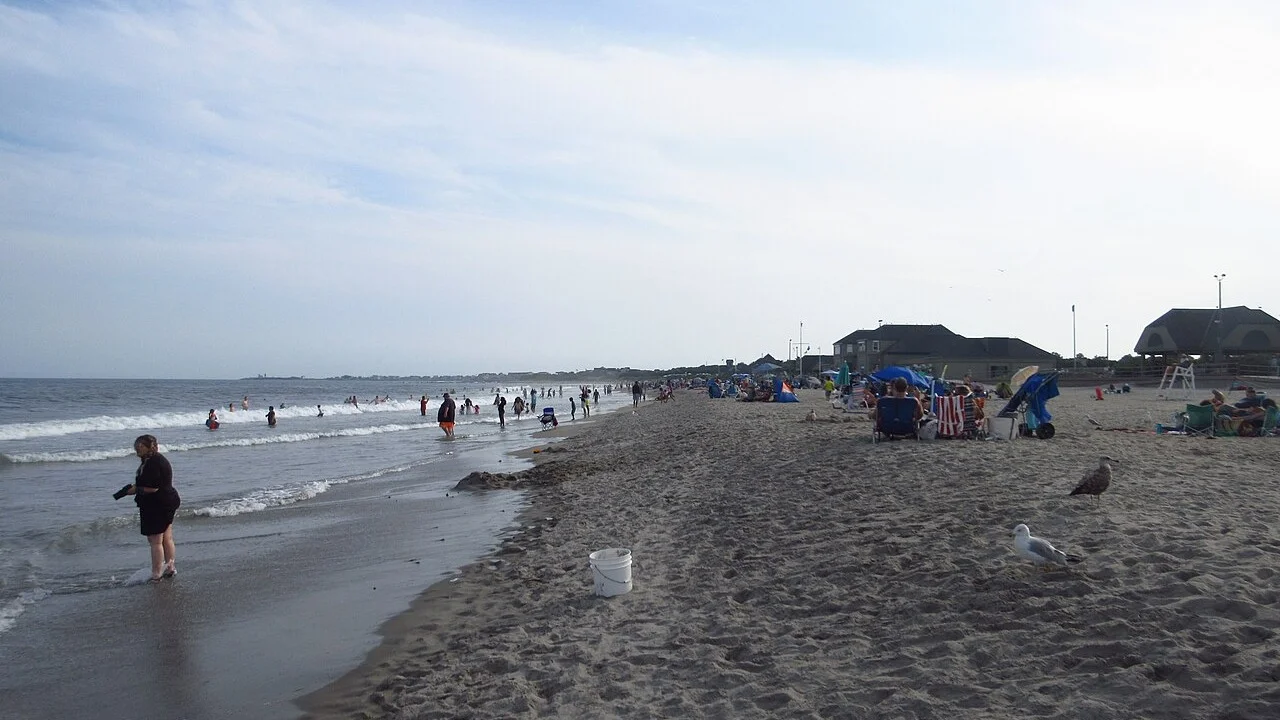
Photo: VitaleBaby / Wikimedia Commons, public domain — Scarborough State Beach, one of Rhode Island's eight state beaches on the south shore.
Rhode Island's south shore is a genuine, open Atlantic surf coast — and the only state in New England where the life-jacket law names kiteboards and sailboards by definition.
The south shore, from Watch Hill to Narragansett, faces open Rhode Island Sound and the Atlantic beyond it, with no Long Island in the way the way there is off Connecticut. That is real swell exposure, not the flatwater some of the rest of New England has to make do with. It is also the most tightly regulated stretch of water in the region: a state-level personal flotation device rule stricter than any neighbour, a town beach that bans kiteboarding and windsurfing outright, and a Middletown ordinance that draws a hard line between two beaches a few hundred metres apart.
None of that is a reason to avoid the state. It is a reason to know which beach you are on before you rig up.

Narragansett Town Beach, Scarborough and the other state beaches — real Atlantic surf, and a fee schedule that changed for 2026.
South shore rules arrow_forward
Sachuest (Second) Beach allows kitesurfing and windsurfing outside the swim area. Third Beach, a short drive away, bans kite boards within 1,000 feet of the shore.
The Middletown rule arrow_forward
Every paddlecraft, every day of the year — the only state in New England that regulates it this way, and the only one that names kiteboards and sailboards in its definitions.
Read the rule arrow_forwardFive years of NOAA hourly data (2021-2025) from two stations that measure two different things.
NDBC 44097 sits in Block Island Sound, offshore of the south shore, and carries no anemometer — it contributes wave height, dominant period and water temperature only. For wind, the nearest instrumented station is NWPR1, a fixed C-MAN station at the mouth of Narragansett Bay in Newport. Read that wind data with one clear caveat: Newport harbour is more sheltered than the fully open, south-facing beaches this page is about (Misquamicut, Narragansett Town Beach, Sachuest/Second Beach), so it likely understates how windy those beaches actually get. It is the best instrumented proxy available, not a reading taken at the beach.
| Month | Water temp (Block Island Sd) | Wave height | Dominant period |
|---|---|---|---|
| January | 8.4 °C / 47 °F | 1.76 m | 7.5 s |
| February | 5.4 °C / 42 °F | 1.63 m | 7.7 s |
| March | 5.7 °C / 42 °F | 1.63 m | 7.6 s |
| April | 7.3 °C / 45 °F | 1.34 m | 7.5 s |
| May | 11.5 °C / 53 °F | 1.16 m | 7.3 s |
| June | 16.8 °C / 62 °F | 1.01 m | 6.9 s |
| July | 21.9 °C / 71 °F | 1.05 m | 7.2 s |
| August | 21.9 °C / 71 °F | 1.07 m | 7.8 s |
| September | 20.4 °C / 69 °F | 1.25 m | 8.6 s |
| October | 17.0 °C / 63 °F | 1.45 m | 8.4 s |
| November | 14.5 °C / 58 °F | 1.52 m | 7.2 s |
| December | 11.2 °C / 52 °F | 1.71 m | 7.7 s |
This is a real swell coast, not a sheltered one. Dominant period sits at 6.9-8.6 seconds in every month of the year — nothing like Nantucket Sound's flat 3.3-3.9 s next door in Massachusetts. September's 8.6 s is the longest-period month, coinciding with the Atlantic hurricane season NOAA puts at 1 June-30 November with a 10 September peak. Winter brings the biggest waves (1.5-1.8 m, November-January) but at a shorter period than the early-autumn groundswell.
Water temperature peaks at 21.9 °C / 71 °F in July and August and bottoms out at 5.4 °C / 42 °F in February — warmer in winter and cooler in summer than Nantucket Sound's shallow extremes, because Block Island Sound is deeper, open water rather than a shallow bay. Our wetsuit thickness guide converts that into a suit recommendation.
Share of hours at 15 knots or more at NWPR1 (Newport), and the dominant direction when it is windy.
| Month | ≥15 kt share | Top directions |
|---|---|---|
| January | 14.1% | N, SW, WSW |
| February | 10.2% | NW, SW, S |
| March | 13.3% | WNW, NW, SSW |
| April | 9.0% | SSW, SW, WNW |
| May | 5.1% | SSW, NNE, SW |
| June | 2.1% | SSW, SW, S |
| July | 2.5% | SSW, SW, S |
| August | 2.4% | SSW, S, SW |
| September | 2.7% | SW, N, SSW |
| October | 6.2% | SW, NNE, N |
| November | 10.6% | SW, W, SSW |
| December | 12.4% | SW, SSW, WSW |
At the Bay mouth, winter is the windy season — 10-14% of hours at 15 knots or more from November to March, from a mixed N/NW/SW pattern that reads as passing synoptic systems rather than a thermal breeze. Summer drops to 2-3%, with a consistent SSW/SW/S signal that is the thermal sea-breeze direction, just a weak one at this particular station.
Repeat the caveat above: this is measured at the mouth of Narragansett Bay, not on the open coast. Misquamicut and Narragansett Town Beach face the open Atlantic directly and are reported by local kiteboarders to see meaningfully more summer sea-breeze wind than this — we are not going to put a number on that without a station actually there, but do not read Newport's 2-3% as the ceiling for the open beaches.
Not a state beach — a town beach with its own policy, and the jurisdiction trap on this coast. The Town of Narragansett's 2026 Updated Beach Activity Policy is explicit: "Kayaks, jet skis, windsurfing, kite surfing, kite flying, fishing and scuba diving are not allowed." Surfing and swimming are each restricted to their own designated zones — "Swimming is not allowed in designated surfing areas" and vice versa — and surfers are confined to "the seawall to the banner designated for surfing." Body boards are permitted everywhere but controlled by lifeguards between chairs 2 and 6; skim boards are restricted to the surfing area. Inflatables of any kind are banned, including inflatable life vests, and dogs are banned 15 May-15 September.
2026 fees, verified against the town's own beach page (an earlier commercial estimate of $10/$20 daily circulating online is out of date): daily admission is a flat $12 per person for residents and non-residents alike, with children 11 and under free. A season pass is resident/taxpayer-only — $25 for adults 18-61, $10 for youth 12-17, free for seniors 62+ — and there is no non-resident season pass in 2026; non-residents pay the $12 daily rate each visit.
Rhode Island runs eight state beaches: Charlestown Breachway, East Beach (Charlestown), East Matunuck, Misquamicut, Roger Wheeler, Salty Brine, Scarborough North and Scarborough South. The standard fee schedule, from regulation 250-RICR-100-00-3:
| Weekday | Weekend/holiday | Season | |
|---|---|---|---|
| Resident | $6.00 | $7.00 | $30.00 |
| Resident senior | $3.00 | $3.50 | $15.00 |
| Non-resident | $12.00 | $14.00 | $60.00 |
| Non-resident senior | $6.00 | $7.00 | $30.00 |
Misquamicut carries its own, higher rate — confirmed directly against riparks.ri.gov rather than left as a conflict: $10 weekday / $15 weekend-holiday for residents, $20 weekday / $30 weekend-holiday for non-residents, above the standard schedule in the table.
Two beaches a few hundred metres apart, opposite rules. Confirmed against the town's own kitesurfing page and municipal code.
The Town of Middletown's own "Kitesurfing & Windsurfing" page sets out the rule for the designated swim area at Sachuest Bay: "Kitesurfing, windsurfing and other sailboarding sports are prohibited in the designated swim area marked by buoys placed in Sachuest Bay off Sachuest Beach from May 15 – Oct. 1." Outside that area, riding is "allowed... between May 15 - Oct. 1 after 6 p.m. only and anytime of day the rest of the year." Riders must stay at least 100 feet from swimmers, waders, boats and other watercraft, launch at least 50 feet from the swim area during the restricted season, and store equipment at least 25 feet from the water's edge — never in the dunes. The town also reserves the right to close the area if piping plovers are nesting.
Fees from 1 July 2026: $30 weekday / $40 weekend-holiday daily, season passes $100 resident / $200 non-resident, walk-ons free, in effect Memorial Day weekend through Labor Day weekend, 8am-5pm.
Third Beach is often assumed to be open to kiting because it sits so close to Second Beach — it is not. Middletown's municipal code, § 93.60 "Third Beach Regulations," is explicit: "No person shall set up, launch, land or ride kite boards within 1,000 feet of the shoreline" at Third Beach. That is a flat distance ban, not a swim-area exception like Second Beach's. If you are kiting in Middletown, Sachuest/Second Beach is the venue; Third Beach is not.
250-RICR-80-00-1, RI Department of Environmental Management, amendment effective 4 February 2023.
Verbatim, § 1.7.1(A)(1)(a)(3): "All operators & passengers of canoes, kayaks, sailboards, kiteboards, paddleboards, and any other paddlecraft shall wear at US Coast Guard approved PFD at all times while underway regardless of age." ("Wear at" is a typo in the regulation itself, not ours — quoted as written.) This is a year-round mandate with no seasonal window, unlike every neighbouring state.
The regulation's own definitions leave no ambiguity about what counts. § 1.5(A)(5): "'Kiteboard' means a vessel, similar in appearance to a surfboard, with or without foot-straps or bindings combined with a large controllable kite to propel the rider and board across the water." § 1.5(A)(17): "'Sailboard' means a vessel, similar in appearance to a surfboard, equipped with a swivel mounted mast and sail not secured to a hull by guys or stays." A paddleboard counts as a vessel under § 1.5(A)(9) specifically "when intended to be used as a water sport activity beyond the narrow limits of a swimming, surfing, or bathing area" — a carve-out written into the paddleboard definition only; the kiteboard and sailboard definitions carry no equivalent exemption for use close to shore. Surfboards themselves are not defined as vessels in this regulation, so surfing sits outside the rule.
Vessels under 39.4 feet, including kiteboards and sailboards, must also carry "some means of making an efficient sound signal capable of a 4 second blast and audible for ½ nautical mile" (§ 1.12(C)(2)). The penalty for non-compliance is a $100 ticket, effective 2 April 2023.
How Rhode Island compares to its neighbours: Connecticut requires PFD wear 1 October-31 May on manually propelled vessels. Massachusetts requires it only on a canoe or kayak, and only 1 January-15 May and 15 September-31 December — it does not name kiteboards or sailboards at all. Maine has no general adult wear mandate. Rhode Island is the only one of the four with a year-round rule that names your equipment by definition.
Kite flying is not permitted at the Ninigret National Wildlife Refuge's Salt Pond Unit, per the US Fish and Wildlife Service's own trail map. That rule applies to the refuge specifically, not to the pond or breachway generally.
We found no Charlestown town kiteboarding ordinance — not documented, and we are not going to guess one. Charlestown Breachway's state ramp is one of two public launch points with no launch fee.
Emergencies anywhere on this coast: 911, or the Coast Guard on VHF 16. The federal flotation baseline for the whole country is on our United States guide.
No. The town's own 2026 beach policy states plainly that windsurfing, kite surfing and kite flying are not allowed at Narragansett Town Beach. It is a town beach, not a state beach, with its own rules separate from Rhode Island's state-beach system.
Yes, at all times, year-round. 250-RICR-80-00-1 requires a US Coast Guard approved PFD on every kiteboard, sailboard, paddleboard and other paddlecraft while underway, regardless of age — the only year-round rule of its kind in New England, and the only one that names kiteboards and sailboards in its own definitions.
Sachuest (Second) Beach in Middletown, outside the buoyed swim area — prohibited inside that swim area from 15 May to 1 October, allowed outside it after 6pm during that window and anytime the rest of the year, with a 100-foot buffer from swimmers and boats. Third Beach nearby is a separate rule: the municipal code bans kite boards within 1,000 feet of the shoreline there.
The standard 2026 schedule is $6 weekday / $7 weekend for residents and $12/$14 for non-residents, with season passes at $30 and $60 respectively (250-RICR-100-00-3). Misquamicut is more expensive: $10/$15 for residents and $20/$30 for non-residents. Narragansett Town Beach, a separate town beach, charges a flat $12 per person per day for everyone in 2026.
Both, and the wave side is the stronger of the two on the numbers. Five years of NOAA data from Block Island Sound show a dominant wave period of 6.9-8.6 seconds every month of the year — real groundswell, not local windsea — peaking in September on long-period Atlantic hurricane-season swell. Wind, measured at the Newport harbour mouth, is a winter pattern (10-14% of hours over 15 knots) rather than a strong summer thermal, though the fully open south-shore beaches are reported to see more summer breeze than that sheltered station shows.