

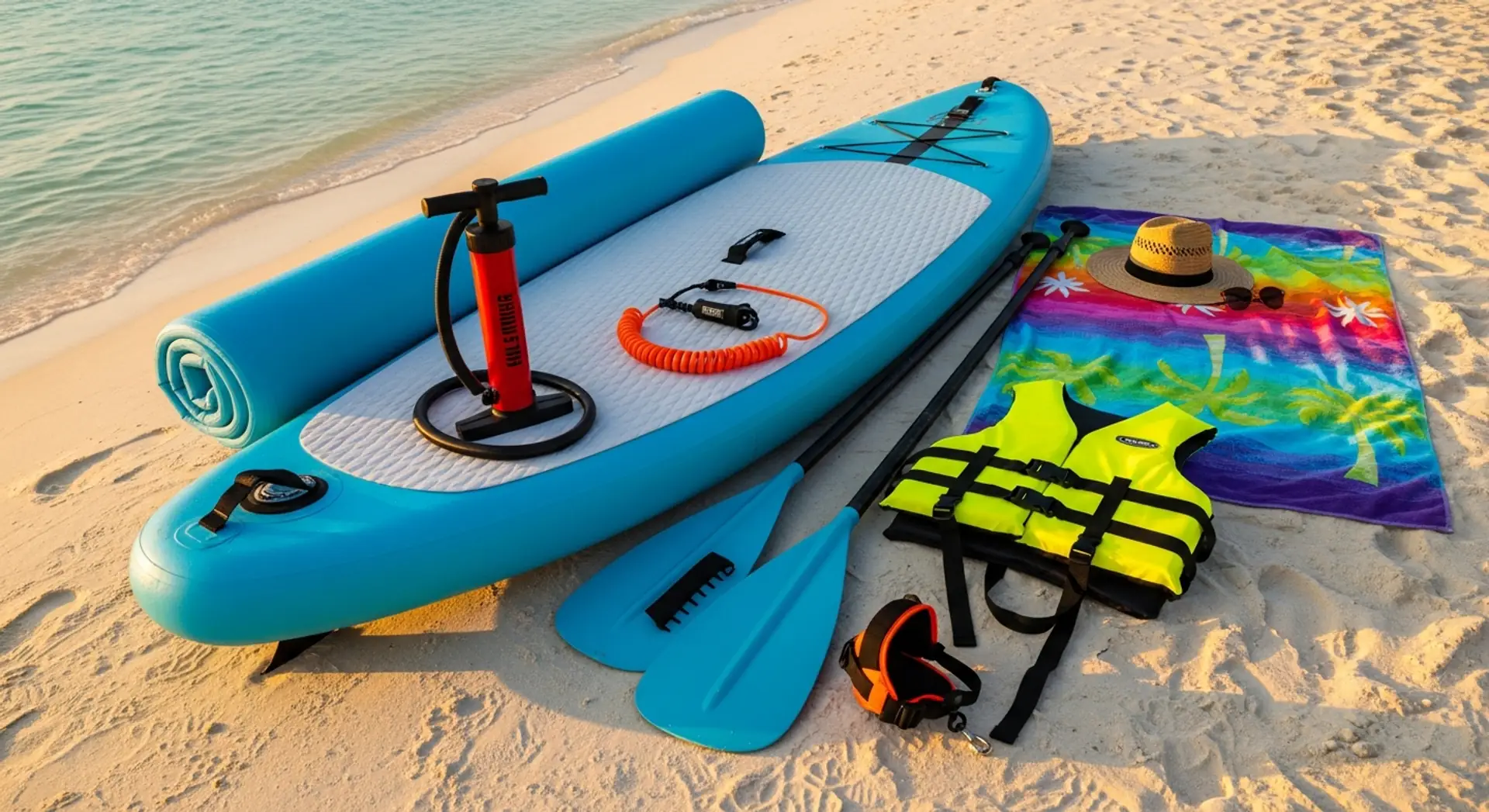
A first SUP is more than a board. Add the paddle, pump, leash, buoyancy aid, a bag and something to keep the sun off, and the list grows fast, which is where budgets overrun. This guide sorts the beginner kit into three levels: what you need before the first outing, what becomes useful later, and what you can skip without regret. The selection draws on manufacturer and retailer documentation, not on hands-on testing.
In short
The board pack (board, paddle, pump and leash) is most of the kit. Before you leave, add a buoyancy aid and some sun protection. A dry bag, a lighter paddle, an electric pump or decent sunglasses come next. The rest can wait.
What a pack already includes, and what it does not
An inflatable SUP pack generally comes with the paddle, pump, leash, fin, a backpack and a repair kit, as our guide to what an inflatable SUP costs sets out. The board budget, and what each price tier buys, lives there, so we do not repeat it here. Always check the product page for what is actually in the box, because contents differ from pack to pack.
What a pack almost never provides is whatever protects you: a buoyancy aid, sun protection, a way to keep your phone and keys dry. That is where the real budget of the kit is decided.
See inflatable SUPs on OutletSUP
The kit at a glance
The amounts below are editorial orders of magnitude, undated, and not prices seen at any retailer. They are there to compare items with one another, not to cost a specific purchase.
| Priority | Item | Why | Price |
|---|---|---|---|
| Must-have | Board, paddle, pump, leash (in a pack) | No outing without them | See the cost guide |
| Must-have | Buoyancy aid | It keeps you afloat, not the board alone | Compare current listings |
| Must-have | Sun protection | Skin and eyes, on water that gives no shade | Compare current listings |
| Worth adding later | Dry bag | Phone, keys, dry clothes | Compare current listings |
| Worth adding later | Lighter paddle | Less fatigue as outings add up | See the paddle guide |
| Worth adding later | Electric pump | Effortless inflating if you go out often | See the pump guide |
| Skip for now | Top-end carbon paddle, camera glasses, extra bags | Comfort or gadget, no effect on safety or progress | Budget nothing |
What to have before the first outing
Board, paddle, pump and leash: the pack
The simplest route for a beginner is to buy these four together. Buying them separately makes comparison harder, and a serious entry-level pack beats a bare board at a low price. For the paddle, length matters more than material at first: our page on what size paddle to choose gives the wrist method, which needs no tools. For the pump, the one in the pack is enough to start; the guide to choosing a pump explains what to look at if it lets you down.
The leash ties your ankle to the board. On flat water the coiled type is the usual choice for paddling, because it does not trail in the water. Rivers and moving water are another matter: an ankle leash can become dangerous there, and our page on the leash sets out the rule to know before you go.
A buoyancy aid
This is the item people put off most, and regret most when it is missing. For paddling on sheltered water, a 50 N buoyancy aid is the most common starting point, because it leaves your arms free. It has limits, which our guide to the buoyancy aid for paddleboarding explains: foam or inflatable belt, 50 N or 100 N, fit and care. Read it before you buy; the differences between models are not cosmetic.
Requirements for a lifejacket, a light or a distance from shore change with the country and sometimes with the beach. There is no single rule, so find out about the place where you will paddle, and start from our page on paddleboarding regulations at sea to see what to check.
Sun protection
On the water your skin is exposed for hours with no shelter. A sunscreen suited to the water, a covering top and a cap that stays on make the basic trio. Choosing the cream, its filters and the traps are covered in our article on sunscreen for surfing and paddling. For your eyes, the guide to sunglasses for the water explains lens categories and what actually stays on your head. Look above all for a frame that floats or is held by a strap: a pair that falls in is a pair lost.
Worth adding once the habit sets in
A dry bag
Once you head out for more than an hour, leaving phone and keys on the beach gets awkward. A dry bag fixed to the board solves it. It is not a first-outing purchase: a waterproof phone pouch may be enough to begin with.
Do not mistake it for the carry bag, which is already in the pack. If you travel with the board, our article on storing and transporting an inflatable SUP covers drying, folding and choosing a bag.
See SUP accessories on OutletSUP
A lighter paddle
The paddle that comes with an entry-level pack is often aluminium. It does the job, but you feel it after a few outings. Changing paddle is one of the most visible comfort gains for anyone who paddles regularly: the SUP paddle guide compares aluminium, fibreglass and carbon, and we do not repeat its figures here. If the urge comes, it presents fibreglass as a reasonable middle ground before you look at carbon.
An electric pump
Pumping by hand takes time and energy. If you go out every week, an electric inflator changes the experience. Our comparison of manual and electric pumps times the inflation and covers the power question. For occasional use, the pump in the pack is enough.
Skip for now
- The top-end carbon paddle. It makes sense for intensive use. Before you have found your rhythm, our paddle guide presents fibreglass as a reasonable middle ground.
- A second pump or a second bag. A decent pack already has what you need. A replacement bag only makes sense if the one in the pack is damaged or too small.
- Roof bars. An inflatable SUP travels deflated in its bag, which is the whole point of the format.
- Camera glasses. The BleeqUp Ranger, for example, are POV glasses designed for cycling, rated IP54 (splash resistant, not waterproof). They film from the beach but never go in the water, and they do not replace water-sports sunglasses with a strap. See the BleeqUp Ranger on BleeqUp.
A good test before buying any accessory: if you can do without it and the outing stays safe, it can wait. The buoyancy aid, the leash and sun protection fail that test; the rest pass it.
How much to budget in total
The budget for a complete kit has two parts: the pack, whose price depends on the tier you aim for (see the inflatable SUP cost guide), plus the extras that are not in the box. For those extras, here is the order of magnitude, again indicative and undated:
| Stage | What you add to the pack | Extras |
|---|---|---|
| First outing | Buoyancy aid, sun protection | The items above, added up |
| After a few outings | The same, plus a dry bag | The items above, added up |
| Regular paddling | The same, plus a lighter paddle and an electric pump | See the paddle and pump guides |
The order matters more than the amount: buy what protects you first, then what makes life easier, then what you simply fancy. A tight budget holds up better that way than with a dearer pack and a makeshift safety kit.
Mistakes that cost
- Spending on the board and forgetting the buoyancy aid. A stiffer board does not make up for having no flotation on you.
- Buying a leash at random, when the type depends on the water.
- Replacing the pack's paddle or pump too early, before you know what really bothers you.
- Assuming the rules are the same everywhere. They are not.
For the first strokes, our guide to getting started with SUP completes this kit.