

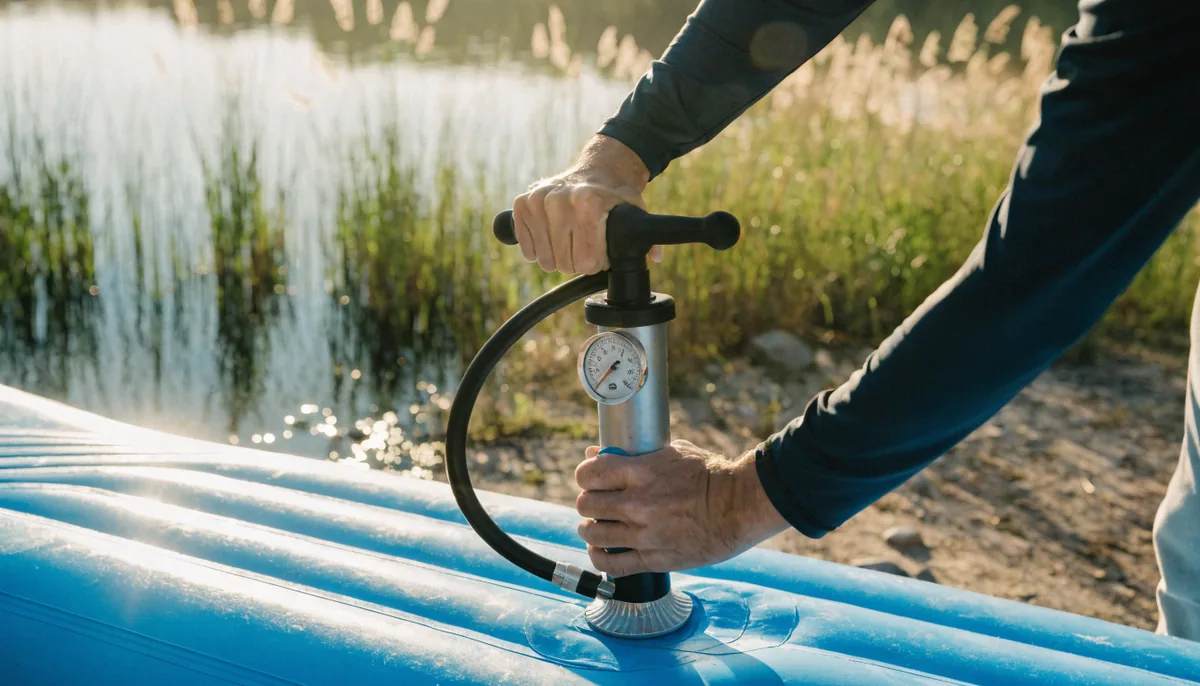
Manual or electric, the pump is the most underrated piece of inflatable SUP kit, and yet it decides whether your session starts with ten minutes of hard graft or a coffee while the board fills itself. This guide goes beyond the basics: we look at what pressure does to board rigidity, compare typical inflation times for both technologies, cover noise and power source, and go through the whole Star Pump range so you can choose without regretting it.
Why pressure matters more than pump type
Before choosing between manual and electric, it helps to be clear about what you're actually trying to achieve: a board inflated to the right pressure, not just a board that's inflated. An inflatable SUP is built from drop-stitch PVC, a structure of thousands of vertical threads that only becomes rigid under tension, generally between 12 and 18 PSI (roughly 0.8 to 1.2 bar) depending on the model; some stiffer boards are rated higher, so the figure printed next to the valve is the one to follow. Below that range, the board keeps visibly taking on air but stays soft: it flexes under the paddler's weight, absorbs the energy of each stroke instead of transferring it to the water, and becomes noticeably harder to control in chop. Two identical boards, one at the bottom of the recommended range and the other at the top, don't behave the same: the one with less pressure is softer and transfers the energy of each stroke less well. That's why the type of pump is really only a means to an end: the goal is always to reach target pressure without burning too much energy getting there, and never to stop 'roughly there' before the job is finished.
The key question: how long inflation takes
This is often the deciding factor in a purchase, so it's worth giving rough orders of magnitude. With a double or triple-action manual pump, inflating a standard-sized board (around 300 litres) to 15 PSI generally takes 10 to 20 minutes of hard physical work, arms and back going the whole time, with the difficulty ramping up sharply over the last few PSI as the resistance of compressed air increases. With an electric inflator, the same job typically takes 5 to 15 minutes depending on the model's power, but crucially with no effort at all: plug it in, set your target pressure, and it switches off automatically once it gets there. That hands-free stretch is the real difference: while the electric inflator does the work, you can get the rest of your kit ready, inflate a second board, or simply do nothing. It's this gap in effort, more than the raw minutes saved, that justifies buying an electric model if you paddle regularly.
Single, double or triple action: how a manual pump actually works
Not all manual pumps are equal, and the difference comes down to one simple mechanical detail. A single-action pump only pushes air when you press the piston down: the upstroke does nothing, which roughly doubles the number of strokes needed for the same volume of air. It's the most basic type, still found in some entry-level packages. A double-action pump pushes air on both the downstroke and the upstroke, cutting the overall effort considerably. Triple-action pumps take this further with a dual chamber: two pistons work in parallel and shift more air per cycle, usually with a switch that lets you drop back to single-chamber mode once pressure is already high, for when pushing both pistons together takes too much force. Generally, a double or triple-action pump remains the best compromise for a manual model: it still takes real effort, but noticeably less than a single-action pump for the same result. For the short version covering gauge, nozzle fit and handle comfort, our quick guide to choosing a SUP pump covers those points more briefly.
Electric inflators: noise and power source
The convenience of an electric inflator comes with two trade-offs that often get overlooked before buying: noise and reliance on a power source. An electric inflator runs on a small compressor that works continuously throughout the whole inflation cycle, typically several minutes: the noise level is usually described as similar to a vacuum cleaner, which is perfectly manageable outdoors but can raise eyebrows early in the morning on a pontoon or near a campsite. As for power, there are three common set-ups. Plugging into the vehicle's 12V socket is the most common option: convenient if you're inflating near the car, awkward otherwise, since you'd need to run a long cable or carry the board to the car park. Models with a rechargeable stand-alone battery remove that constraint entirely: you can inflate wherever you like, on the beach or by a lake, with no cable or vehicle nearby, at the cost of remembering to charge it beforehand and a limited number of boards per charge. Some models also plug into the mains, handy for getting the board ready at home before heading out. The right choice really comes down to where you usually inflate: near the car, a 12V socket does the job perfectly well; on a remote beach or while touring, a stand-alone battery changes the whole picture.
For occasional use plugged into a vehicle, the Star Pump 6 at OutletSUP is the simplest way to try electric inflation without a big outlay.
When a manual pump still makes sense
For all the convenience of going electric, a manual pump isn't just a budget fallback. It has real arguments in its favour, worth keeping in mind even if you already own an electric model.
Budget
A decent double or triple-action pump costs noticeably less than an electric inflator, often three to five times less. For occasional paddling, a handful of outings a year, the gap in comfort doesn't always justify the gap in price.
A reliable backup
A manual pump never runs out of battery and doesn't depend on any socket. It's the essential fallback while touring, wild camping, or simply on the day your electric inflator refuses to start. Plenty of regular paddlers still keep a compact manual pump in the bag even after buying an electric one.
Simplicity
No battery to charge the night before, no cable to pack, no electronics to fail. A well-maintained manual pump lasts years with barely any upkeep beyond the occasional seal check.
Bulk and weight
A manual pump packs down small in the carry bag, with no battery weight or extra cable to think about. For flights or van trips where every kilo counts, that's a real point in its favour.
Comparing the Star Pump range: 6, 7, 8 and 9
At OutletSUP, the Star Pump range covers several different needs, from an occasional backup model to the most capable inflator in the line-up. Here's what separates them.
| Model | Power source | Best suited to |
|---|---|---|
| Star Pump 6 | 12V vehicle socket | Entry-level model, the most accessible way into electric inflation. |
| Star Pump 7 | 12V vehicle socket | Mid-range version with a pressure readout, for regular inflation near the car. |
| Star Pump 8 | 12V vehicle socket | Dual-stage model, the most powerful of the vehicle-powered range, built for inflating several boards back to back quickly. |
| Star Pump 9 | Rechargeable stand-alone battery (plus mains) | The only model in the range fully independent of an external power source, with a battery capable of inflating several boards before it needs recharging. |
Maximum pressure, per the retailers' product pages: the Star Pump 6 and 9 inflate up to 16 PSI, the Star Pump 7 up to 16 PSI (Nootica listing) and the Star Pump 8 up to 20 PSI. That matters for boards rated above 16 PSI: compare the figure printed next to your board's valve with these maximums before choosing a model.
In short, choosing between these four models comes down to a trade-off between power and independence. The Star Pump 6 suits occasional use near the car. The Star Pump 7 adds a proper pressure readout for more regular use. The Star Pump 8 targets households inflating several boards in a row who want it done quickly. The Star Pump 9 is for paddlers inflating away from a vehicle, while touring or at remote spots, where a stand-alone battery makes all the difference.
For family use or several boards to inflate one after another, the Star Pump 8 dual-stage inflator at OutletSUP is the most powerful vehicle-powered model in the range.
Our take by paddler profile
Beginner, occasional outings
A double-action manual pump, or triple-action if your board is over 300 litres, is more than enough. There's little point investing in an electric model while inflating is still an annual chore rather than a weekly one.
Regular paddling, one board
A 12V electric inflator such as the Star Pump 6 or 7 changes how you feel about every outing, especially on a weekday evening after work when energy is already in short supply.
Family use or several boards
The more powerful Star Pump 8 avoids waiting between boards. Paired with a spare manual pump in the bag, it's the most comfortable set-up for a group outing.
Touring, remote spots
The Star Pump 9 and its stand-alone battery come into their own the moment inflation happens away from a vehicle, on a multi-day SUP tour or wild camping trip.
Before you head out, it's also worth revisiting our full method for inflating your SUP correctly and our pick of essential accessories so nothing gets left behind on the day.