

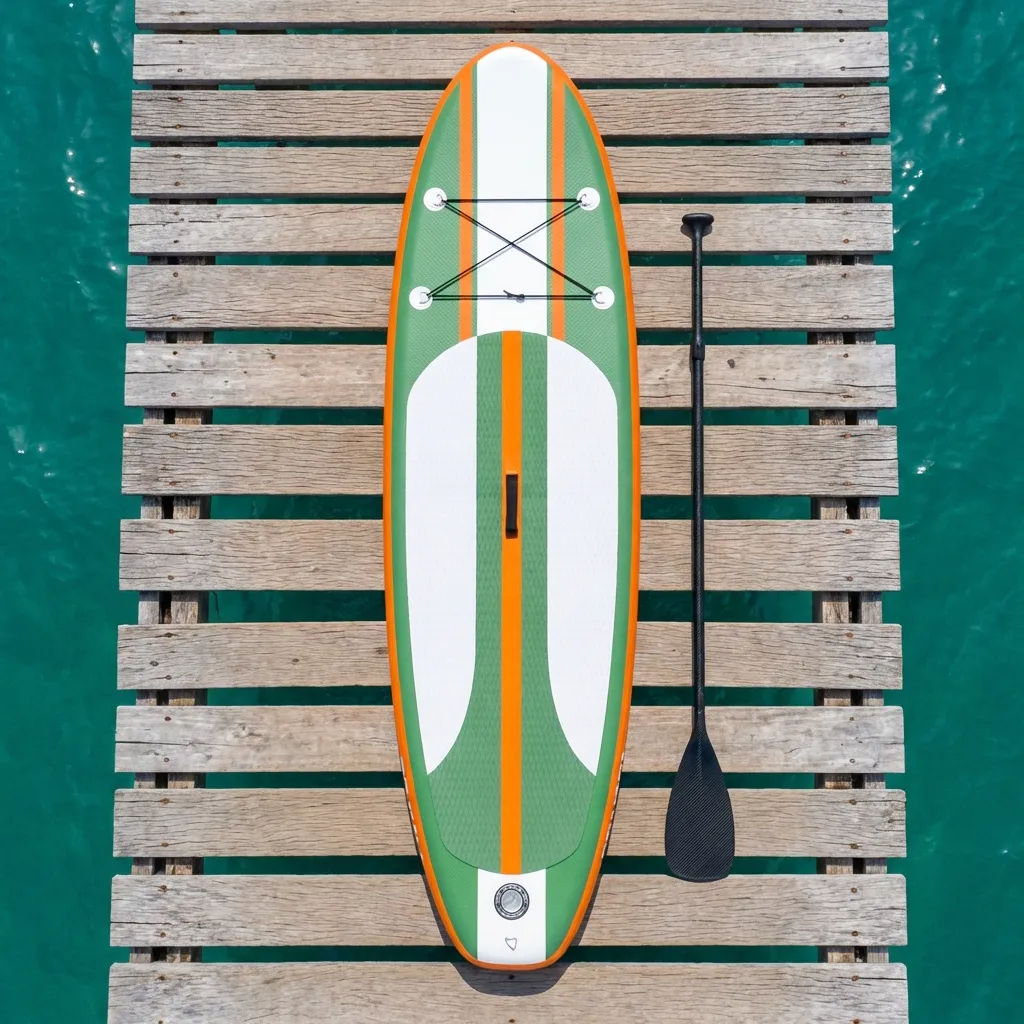
The inflatable SUP has firmly established itself as a serious alternative to a rigid stand-up paddleboard, particularly for anyone who values practicality over the last word in performance. Less bulky to store and generally more accessible to buy, it deserves proper consideration if you're weighing up your first board. See also our paddle gear hub for the rest of your kit.
Wear a suitable leash or buoyancy aid where appropriate, check tide times and wind with the Met Office before you head out, and never paddle further offshore than your ability and the conditions allow. If you get into difficulty, call 999 and ask for the Coastguard.
Why choose an inflatable SUP?
Practicality vs rigid: transport, storage, accessibility
The standout advantage of an inflatable SUP is how compact it becomes. Deflated, it packs into a bag around 70 to 90cm long, easy to fit in a car boot or a cupboard. That makes it a natural choice for anyone with limited storage space, or who wants to travel light.
Inflatable boards also tend to sit at a lower entry price than a comparable rigid board, and complete kits (board, pump, paddle and bag) mean you can get started without buying anything else straight away. For a full breakdown by budget, see our guide to how much an inflatable SUP costs.
Who it suits: beginners, families, travellers
Beginners tend to appreciate the stability of wider (75-85cm, or roughly 30-33 inches) and thicker (6-inch) inflatable boards, which are more forgiving of an unsteady first few sessions. Families benefit from the durability – less fragile than an epoxy board, an inflatable shrugs off knocks against rocks far better. Travellers gravitate towards the compact (3.80 to 4.20m) and light (8 to 12kg) models that fit into a rucksack-style bag.
Where inflatables fall short
On flat water and over longer distances, the lack of true rigidity becomes noticeable. Flex in the structure costs you glide and paddling efficiency compared with a rigid, heat-moulded board. In the sea or on fast-moving water, that same softness makes a board harder to control in waves or current. Racers and more advanced paddlers generally lean towards rigid boards for this reason.
For calm conditions – a lake, a gentle river, a sheltered stretch of coast – an inflatable is easily the more practical choice. In the sea or for competitive paddling, a rigid board makes more sense.
Choosing your inflatable SUP
Length and volume: beginner vs experienced
- Beginners: 3.00-3.35m (10' to 11') / 150-200 litres, for maximum stability
- Experienced / all-round: 4.00-4.50m (13' to 14'9") / 180-220 litres, a compromise between speed and stability
- Children under 10: 2.50-3.20m (8'2" to 10'6") / 60-100 litres
Volume should also track your own body weight, not just how you paddle. See our guide to inflatable SUP maximum weight for how to choose the right volume for your build.
Thickness (4" vs 6") and rigidity
- 4 inches: light and easy to manoeuvre, but noticeably less rigid. Suits an occasional paddler on calm water.
- 6 inches: better stability and structural rigidity thanks to the deeper drop-stitch construction. Worth choosing if you're over roughly 80kg, or want to use the board for more than one activity, such as SUP yoga.
Construction: drop-stitch, single or double layer
- Single layer: less costly, but noticeably more prone to damage from impact.
- Double layer: built from two bonded sheets, giving a firmer, less flexible surface.
- Drop-stitch: the core technology behind every inflatable board, with thousands of internal threads holding the top and bottom sheets in shape under pressure.
Accessories: paddle, pump, leash, bag
A complete kit typically includes an aluminium or carbon paddle (which breaks down for transport), a manual high-pressure pump (or an electric one on premium kits), a leash, and a waterproof bag. A carbon paddle is worth prioritising to reduce fatigue over a session, and a double-action pump makes inflating considerably quicker.
What budget should you plan for?
In the world of inflatable SUP, "budget" doesn't mean "poor quality": there are reliable boards at the entry level. The real danger comes from ultra-cheap boards that skimp on the PVC, the rigidity or the accessories included in order to advertise a headline price. The goal isn't to spend as little as possible, but to spend just enough for how you'll actually use it.
Where the cheap end stops being worth it
At the rock-bottom end there's very little room left for decent PVC quality and rigidity. Those boards can do for the odd outing, but they age badly and disappoint by the second season. The sweet spot sits a little further up: double-layer PVC, an all-round shape around 10'6" to 11'0", a width near 32 inches and a complete package. Higher up the range, what you mainly gain is rigidity and finish — useful if you plan to paddle regularly or carry more than one person, and hard to justify for a fortnight a year.
The pitfalls of low-cost boards
The most common trap is single-layer PVC, which stretches over time and loses rigidity, leaving the board soft and unpleasant to steer. Next comes the basic pump, slow and tiring to use, or a heavy, clumsy aluminium paddle. Finally, be wary of boards with volumes quoted too low to look compact: they sacrifice stability for marketing. Always check what's actually included before comparing two boards — a board-only listing is never comparable to a complete package.
What to budget for, by profile
- Beginner: a stable all-round shape in double-layer PVC, sold as a complete package, covers everything a first board needs.
- Family: to share a board across different sizes, favour length and volume — more buoyancy and more room on the deck.
- Occasional holiday use: a compact shape that packs and stores easily matters more than outright performance.
Inflating and looking after your SUP
Recommended pressure
- 4-inch boards: 10-15 psi (keep to the lower end on smaller boards)
- 6-inch boards: typically 15-18 psi, never above the maximum printed on the board
Overinflating can strain the seams over time. Use a pump with a built-in pressure gauge to keep an eye on it. For the full picture on PSI values and common mistakes, see our guide to what pressure an inflatable SUP should be, and for choosing the right pump, our guide to how to choose a SUP pump.
Setting up in the right order
- Fit the fin before inflating – it's much easier to clip in while the board is still deflated
- Inflate to around 70% of your target pressure
- Attach the leash at the tail and secure the paddle across the deck pad
- Finish inflating to your target pressure
Care and long-term storage
- After use: rinse with fresh water, let it dry fully, then partially deflate before rolling it up
- Store somewhere dry and free of temperature extremes (avoid anywhere that regularly tops 40°C)
- For long off-season storage, keeping the board at around half its usual pressure reduces wear on the material
To round out your kit, see our guide to choosing a SUP paddle, or visit our paddle gear hub for more advice.