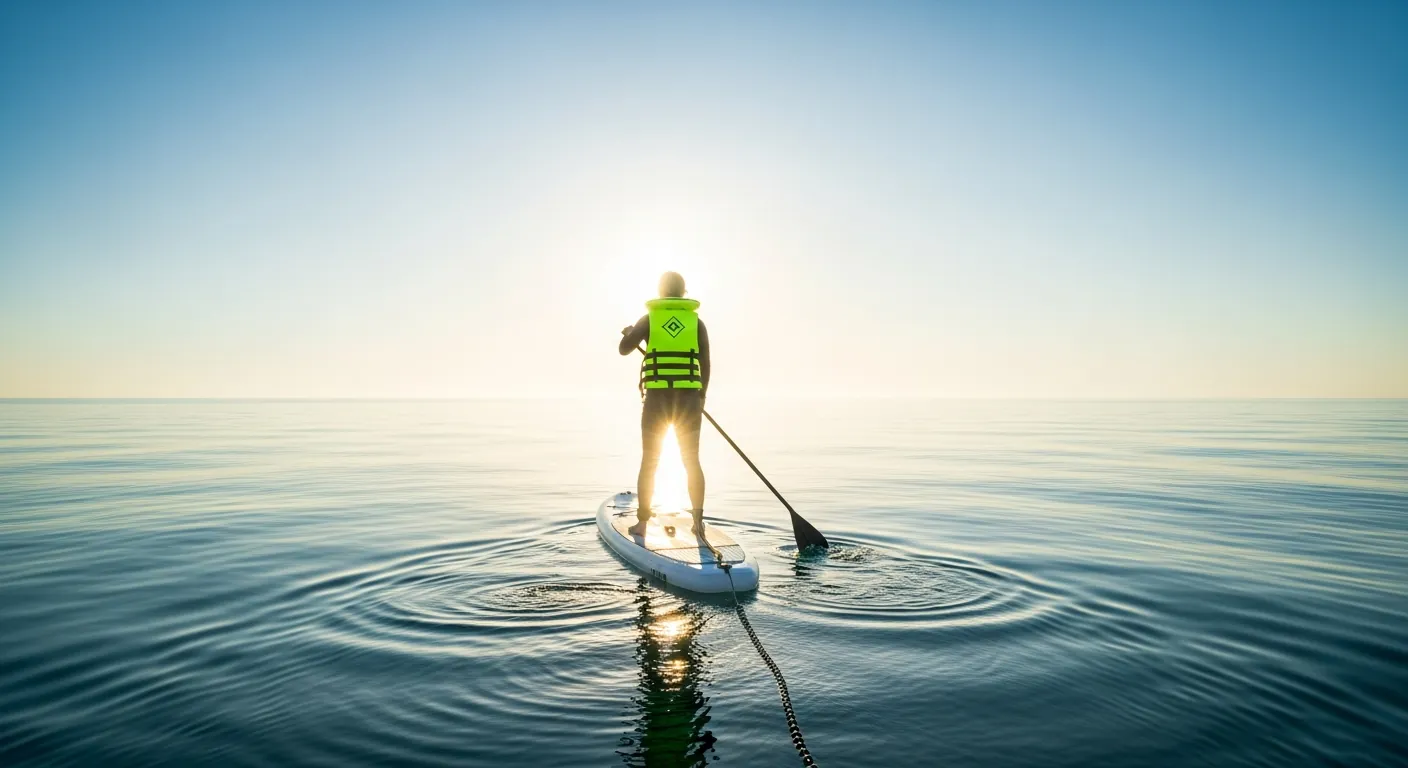
A buoyancy aid for SUP is the piece of kit paddlers buy last and need first. The labels — 50N, 100N, lifejacket, PFD — look interchangeable on the shop rail, but they promise very different things, and the difference only shows on the day everything goes wrong. Here is how to read the standard, pick the right type for paddleboarding, get the fit right and keep an inflatable actually working.
In short
For SUP on sheltered water, a 50N buoyancy aid (ISO 12402-5) is the default: immediate flotation and full paddling freedom. Know its limit: a 50N aid will not turn an unconscious person face-up — only 150N and 275N lifejackets are designed to do that. A waist-belt inflatable gives you nothing at all until you pull the handle.
50N, 100N, 150N: what the ISO 12402 classes mean
The ISO 12402 standard groups flotation devices by performance level, measured in newtons of buoyancy. Below 100N the device is not a lifejacket at all but a buoyancy aid — and that is not marketing language. The distinction is technical, and it decides what the device will do for you if you are knocked out in the water.
| Class | Buoyancy | Turns an unconscious wearer face-up? | Who and where |
|---|---|---|---|
| 50N — buoyancy aid (ISO 12402-5) | ≥ 50N | No | Conscious swimmers, sheltered water, help close by — the SUP scenario |
| 100N — inshore lifejacket (ISO 12402-4) | ≥ 100N | Not always guaranteed | Sheltered and coastal waters, quick rescue expected |
| 150N — offshore lifejacket (ISO 12402-3) | ≥ 150N | Yes, by design | All waters including open sea; realistic risk of injury or unconsciousness |
| 275N — extreme-conditions lifejacket | ≥ 275N | Yes, even in heavy clothing | Severe conditions, heavy foul-weather gear, offshore or commercial use |
On a paddleboard your board is the primary flotation and you are normally on sheltered water — exactly the scenario the 50N class was written for. A 100N lifejacket buys extra buoyancy at the cost of bulk that gets in the way of paddling and of climbing back on the board. The 150N and 275N levels are built for open sea and heavy clothing, and are overkill for a normal SUP session.
Foam vest or waist-belt inflatable: which type for paddleboarding
Foam vest
- Floats the moment you hit the water, no action needed
- No gas system: next to no maintenance
- The right call in waves, on moving water and for weak swimmers
- Robust, shrugs off repeated dunkings
Waist-belt inflatable
- Barely there: complete freedom to paddle
- Cooler in warm weather
- No flotation whatsoever until you fire it
- You must pull the handle, then fit the bladder over your head in the water
A manual waist-belt inflatable holds a folded bladder and a CO2 cylinder: you pull the handle, then work the inflated bladder over your head while treading water. That takes practice — and a paddler who is unconscious, injured or panicking will never deploy it at all. It belongs on confident swimmers in calm, sheltered water, with the board as primary flotation and the belt as back-up. It is not for children, weak swimmers, surf or moving water: there, wear foam. Hybrid designs — a foam core plus an inflatable bladder — exist but are rare in paddlesports.
A 50N buoyancy aid will not turn an unconscious person face-up. It helps a conscious swimmer stay afloat and buy time — nothing more. Even a 100N lifejacket does not guarantee that turn in rough water or heavy clothing: only the 150N and 275N levels are designed for it. Wearing flotation reduces the risk of drowning; it does not make falling in safe.
What the rules say in the UK
There is no blanket statutory requirement for paddleboarders to wear a buoyancy aid in the UK. What there is instead is unusually unanimous advice. The RNLI tells paddleboarders to wear a suitable PFD — a buoyancy aid or lifejacket that still lets you move and paddle freely — along with the correct leash for the water. British Canoeing recommends a buoyancy aid for SUP and draws a useful line: on moving or challenging water, a foam buoyancy aid should be your primary flotation; on placid, sheltered water an inflatable may serve as secondary flotation, with the board as primary. HM Coastguard puts it in one sentence: always wear a personal flotation device.
Harbours, clubs, schools and event organisers commonly make flotation compulsory through their own rules and insurance conditions, so check locally. If you get into difficulty at the coast, call 999 and ask for the Coastguard.
Rules are national. In France, Division 240 requires a 50N flotation device — or a conforming wetsuit worn permanently — beyond 300 m from shelter on boards of 3.50 m and over; in Spain a lifejacket is required outside marked bathing zones. Check before paddling abroad.
Fit and sizing: the ride-up test
An adult buoyancy aid is sized by chest measurement, cross-checked against the maker's weight range, then adjusted: side, shoulder and waist straps snug until nothing shifts. The check that matters takes two seconds: lift the aid firmly upwards by the shoulders. If it rides up over your chin or ears, it is too big or badly adjusted — and in the water it will do exactly the same, leaving your face below the foam instead of above it.
Children's flotation is sized by weight, not chest: go by the weight range on the label. Always fasten the crotch strap where one is fitted — it is what stops the aid riding up over a wet child's head — and run the same shoulder-lift test. Inflatables are generally not recommended for children: foam, no debate. Our guide to paddleboarding with kids covers the rest.
Care: CO2 cylinders and re-arming
A foam vest asks almost nothing of you: check the straps and stitching, let it dry. A waist-belt inflatable is a maintained device. Before each session, check the CO2 cylinder is fitted, screwed home and not pierced, with no corrosion or dents — some makers recommend weighing it against the stamped weight — and that the arming indicator shows green. On automatic models, check the firing capsule's expiry date; brands often limit it to around three years.
After any inflation the cylinder is spent and must be replaced: deflate the bladder through the oral tube, dry everything thoroughly, then fit a complete re-arm kit — new cylinder, new capsule. A red indicator, a corroded or underweight cylinder or an expired capsule means the device is not fit for service. Preventive replacement intervals vary by manufacturer, so follow your model's manual rather than a rule of thumb.
To go further, read our SUP safety guide, our page on the surfboard and SUP leash — the other piece of kit connecting you to your flotation — and our advice on paddleboarding with kids.