

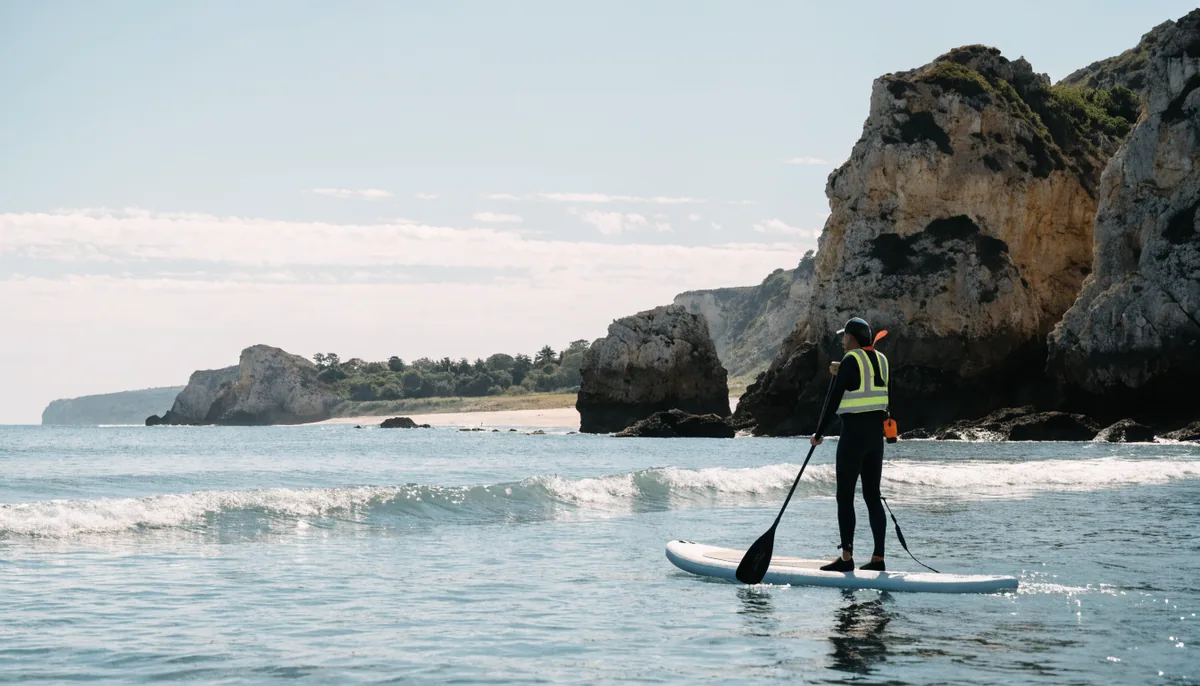
At sea, a paddleboard is not just a beach toy: once you head past the shallows, you're sharing the water with other vessels and, in the eyes of maritime authorities, you're skippering a small craft of your own. Here's what the law requires, what counts as strong safety guidance and what kit really matters, without the jargon.
Official guidance first, our summary second
UK paddlesport regulation is a mix of general maritime law, safety guidance and local byelaws that vary by harbour, beach and local authority. This page draws first on the Maritime and Coastguard Agency (MCA), the RYA and British Canoeing / the British Stand Up Paddle Association (BSUPA).
Primary sources
MCA safety guidance and the RYA's recreational boating advice take precedence over any simplification here. We'd rather flag a grey area than state a rule too broadly.
Local checks
Bathing zones, temporary restrictions, harbour directions and local byelaws can all change what's allowed on a given stretch of water. Harbour masters and local watersports centres are worth a call before you launch somewhere new.
Editorial caution
Guidance is updated periodically and a local harbour authority can be stricter than general practice. Use the official resources below to check the detail for your own trip.
Why sea paddleboarding rules are often misunderstood
Many paddlers assume they can head out wherever they like, the way they might on a sheltered lake. In practice, once you leave the immediate shallows, a paddleboard is treated as a small vessel that must keep a proper lookout and follow the general navigation rules that apply to all craft, alongside safety guidance aimed specifically at paddlers.
Unlike some other countries, the UK has no single, distance-based rule (such as a fixed number of metres from shore) that legally limits recreational SUP use at sea. There's also no licence requirement to paddle a SUP on the sea itself. What exists instead is a combination of general maritime navigation rules that apply to any vessel, MCA and RNLI safety guidance built around real incident data, and local rules set by harbour authorities, councils or beach management for specific stretches of coast. Treat any source that quotes a precise legal "safe distance" for UK waters with caution — the honest answer is that it depends on your ability, the conditions and local rules, not a single number.
Is there a distance limit for paddling at sea?
What the law actually says
There's no UK statute that fixes a maximum distance a paddleboarder may travel from shore. Instead, general principles apply. As the person in charge of your board, you're expected to keep a proper lookout, avoid creating a hazard to other water users, and act within your own competence and the conditions. MCA and RNLI guidance is built around exactly this: staying within a distance you could comfortably get back from if the wind or your energy turned against you.
What that means in practice
Safety bodies consistently recommend staying close to shore — as a rough guide, within about 200 metres — unless you're experienced, well equipped and confident in the forecast, the tide and your own fitness. Longer coastal paddles and crossings are for competent paddlers only, carrying appropriate safety and communication equipment. Some harbours, marinas and beaches also set their own local limits (for example, no-paddle zones near shipping channels or ferry routes) through harbour directions or council byelaws, so it's always worth checking locally before you launch.
Recommended kit, by how far you're going
Leash
A leash connects you to your board, your biggest and most visible float. At sea it's effectively your first line of defence: a board can be blown away by the wind far faster than you can swim. The right type of leash depends on the water you're on; we cover this in our SUP kit guide.
Buoyancy aid or lifejacket
There's no blanket legal requirement to wear a buoyancy aid on a recreational paddleboard at sea in the UK, but MCA and RNLI guidance is unambiguous: wear one, every time, particularly once you're beyond the shallows. Choose a buoyancy aid rated at least 50N and designed for paddlesport. Watch out for a common trap: the thin "impact vest" style buoyancy aids bundled with some inflatable SUP packages are built for comfort and abrasion resistance, not flotation, and shouldn't be relied on as your main safety kit once you're paddling any distance from shore.
Communication and visibility
Once you're any real distance out, you need a way to signal your position: a waterproof torch or light in poor visibility and a whistle attached to your buoyancy aid are simple, effective basics. A phone in a waterproof pouch, clipped to you rather than the board, lets you call for help; for longer or more exposed paddles, a handheld VHF radio (monitoring Channel 16) or a personal locator beacon adds a real safety margin. In a coastal or sea emergency, dial 999 (or 112) and ask for the Coastguard; Channel 16 is the VHF distress and calling channel.
Sharing the water with other vessels
Navigation rules
As a paddleboard is legally a vessel once you're afloat, the same broad "rules of the road" that apply to other small craft apply to you: keep a proper lookout, stay well clear of larger vessels, ferries and anything with restricted ability to manoeuvre, and never assume a boat has seen you. Powered vessels generally have right of way over paddlers in narrow channels and harbour approaches, and you should always give way rather than test the point. Stay out of designated shipping lanes and marked navigation channels wherever an alternative route exists.
Offshore wind
This is the single biggest hazard. A wind blowing from the land out to sea (offshore) can carry a paddleboarder out with almost no warning, often while the sea itself still looks calm from the beach. It costs nothing to drift out and everything to paddle back against it. In an offshore wind, stay close to shore or don't go out at all.
Bathing zones and sharing the beach
Never paddle into a marked, lifeguarded bathing area. On patrolled beaches, the black-and-white chequered flags mark the zone for craft such as SUPs and surfboards; the red-and-yellow flags mark the swimmer zone, which you must keep well clear of. Local council or harbour byelaws can add further restrictions in specific spots — check with the lifeguard station or harbour master if you're unsure.
Sea versus inland waters
The guidance above concerns the sea. On canals, rivers, lakes and reservoirs, different rules apply: many stretches require an access licence or permit from the relevant navigation authority (such as the Canal & River Trust or the Environment Agency in England and Wales, or the local authority managing the water), and some stretches are private or restricted. The safety principles — leash, buoyancy aid, checking conditions — stay the same everywhere, but the access rules can differ significantly from one stretch of water to the next.
The most common beginner mistakes
The classics are heading out without checking the marine forecast, underestimating a seemingly gentle offshore wind, paddling well beyond your ability on a basic inflatable with no safety kit, and mistaking a thin "splash vest" for genuine buoyancy protection. Close behind come forgetting a leash, and heading out solo without telling anyone. None of these mistakes is serious in isolation; it's the combination, on a day when conditions turn, that turns a paddle into a rescue callout. To build good habits from day one, see our getting started guide and our general SUP safety guide.
FAQ
Can you paddleboard anywhere at sea in the UK?
There's no single distance-based legal limit, but that doesn't mean anything goes. You're expected to stay within a distance and set of conditions matched to your ability, keep clear of shipping lanes and bathing zones, and follow any local harbour or council restrictions. MCA and RNLI guidance recommends staying close to shore unless you're experienced and properly equipped.
Is there an official "safe distance" from shore for paddleboarding?
Not a legal one. Safety bodies suggest around 200 metres as a sensible zone for beginners and casual outings, extending further only with experience, the right kit and confidence in the forecast and tide. Be wary of any source that presents a precise distance as UK law — it isn't.
Do you legally need a buoyancy aid to paddleboard at sea?
Not by law for recreational use, but it's strongly recommended by the MCA, RNLI and RYA at all times, and increasingly required by clubs, schools and organised events. Choose one rated at least 50N and designed for paddlesport, not a thin splash vest.
Is a leash always required?
Not by law, but it's one of the most effective safety habits in paddleboarding and is required by most clubs and schools. At sea, staying attached to your board — your main float — is one of the simplest things you can do to stay safe.
Are the rules the same on a lake or river?
No. Sea paddling is governed by general maritime navigation rules and safety guidance. On canals, rivers, lakes and reservoirs, access is often managed by a specific navigation authority and may require a permit or licence. The safety principles stay the same, but the access rules vary by location.