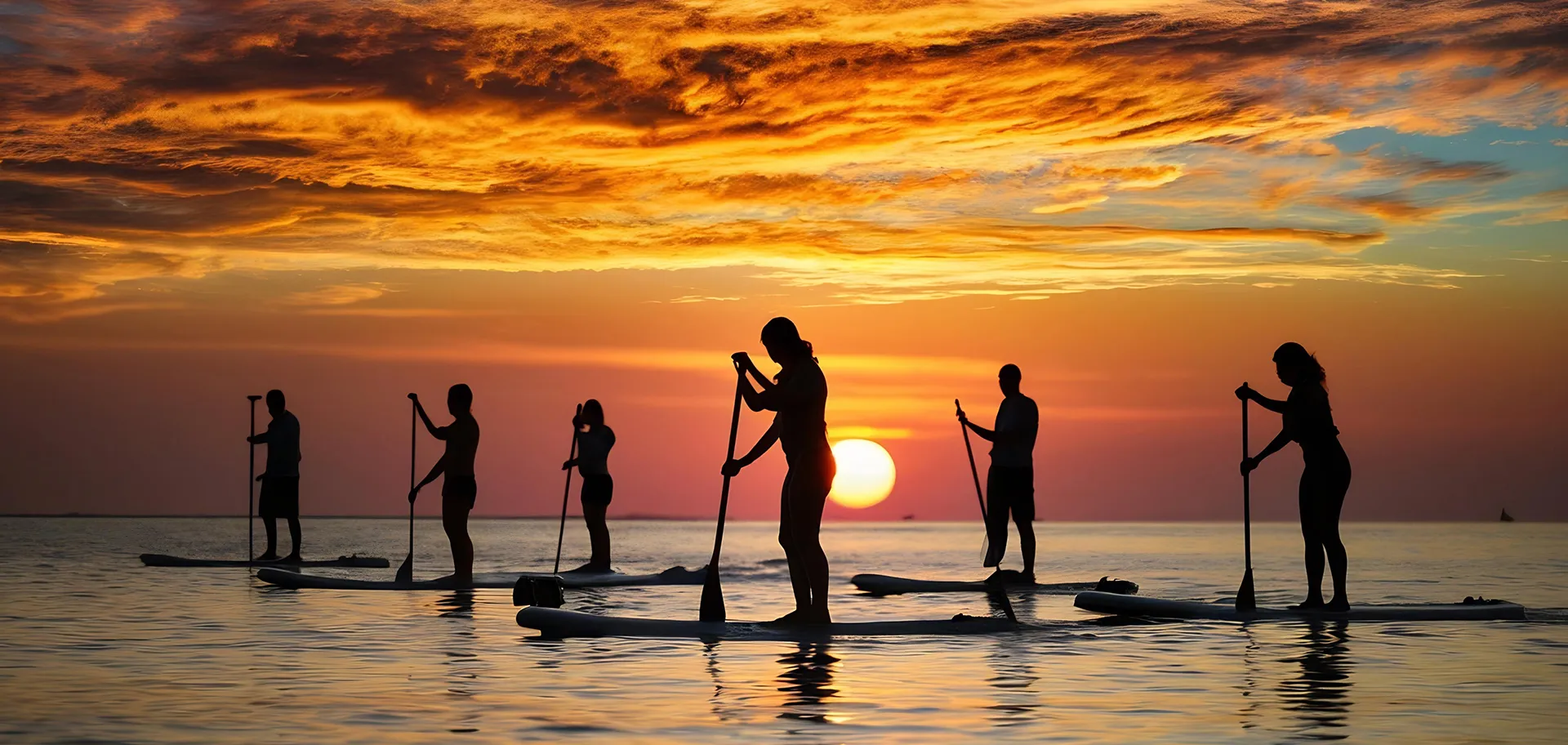

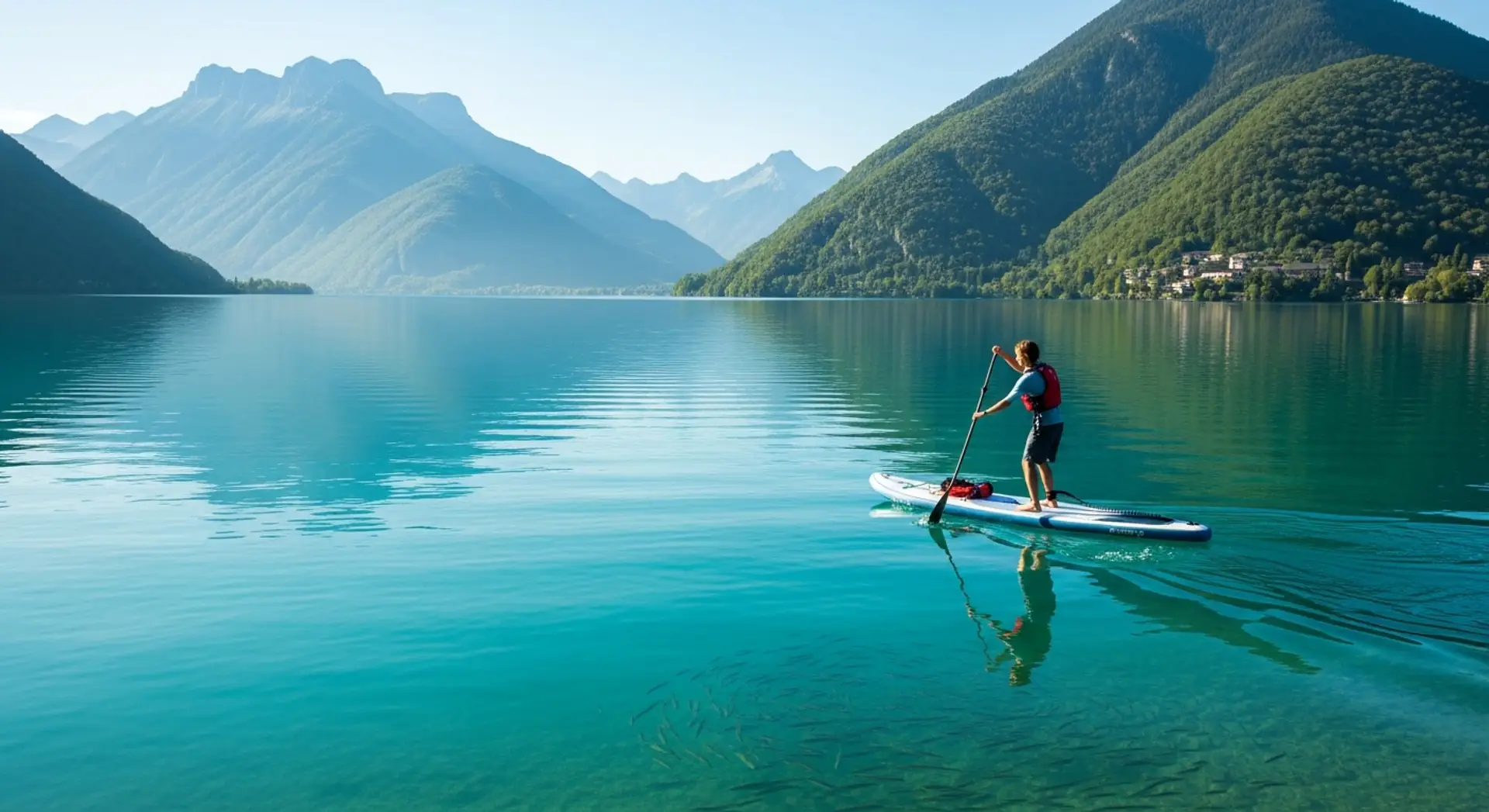
Stand-up paddleboarding is about the most accessible watersport there is. Within 10 minutes on flat water, most beginners are up on their feet for the first time. No wave to wait for, no wind to master: just you, your board and your paddle. From your first strokes on your knees through to your first sessions out on your own, here's how to progress one step at a time.
Step 1: Choosing your first paddleboard
Your choice of board is the single biggest factor in how well you get on with stand-up paddleboarding. Here's what matters.
Inflatable versus hard board
The inflatable SUP is what 80% of beginners choose. It inflates in 5 to 10 minutes with a double-action pump, rolls up into a rucksack and fits in a car boot. On the water, a good inflatable (15–18 PSI) is as stiff as a hard board for beginner and intermediate paddling. The hard board offers better performance (a slicker glide, and it's lighter) but it is bulky to carry and store.
The ideal dimensions for starting out
- Length: 10'6" to 11'6". Long enough to hold a straight line and glide well.
- Width: 31 to 34 inches. The wider it is, the more stable it is. Aim for 32 inches or more if you feel wobbly.
- Volume: 250 to 350 litres. Multiply your weight in kg by 3 for the minimum volume. An 80kg rider needs at least 240 litres.
- Thickness: 5 to 6 inches (inflatable). Six inches gives you more float and stiffness.
As a rule, the wider and more voluminous the board, the more stable it is. Don't pick a board that's too small in the hope of 'progressing faster' – a generous board will actually get you progressing faster, because you'll spend less time in the water and more time up on your feet paddling.
Board shopping for these dimensions? The WattSup Bream 10.6 (281L) and the Zray X1 (259L) both land squarely in this range — see them at OutletSUP →.
Step 2: Getting to your feet for the first time
The first time on a SUP, start on your knees. It lets you find your balance and build a bit of confidence before you stand up.
🔹 Phase 1: On your knees (5–10 minutes)
Climb onto the board from the water (feet first, then knees). Kneel in the middle of the board, paddle laid across it in front of you. Paddle on your knees to get a feel for the glide and the balance. Look at the horizon, not down at your knees.
🔹 Phase 2: The transition to standing (the key moment)
Once you're comfortable on your knees, lay the paddle across the board, put your feet where your knees were (in the middle of the board) and stand up one foot at a time, like a surfer. Keep your knees soft and your feet hip-width apart. Paddle in hand, eyes on the horizon.
🔹 Phase 3: Your first strokes standing up
Once you're up, plant the paddle blade in the water near the nose of the board and pull it back. Top arm straight, torso turned towards the blade. Swap sides every three to five strokes to hold a straight line.
Step 3: Mastering the paddle stroke
The paddle stroke is the fundamental move in SUP. A good stroke means more power, less fatigue and better steering.
The forward stroke technique
- Position: standing, knees softly bent, feet parallel and hip-width apart.
- The catch: plant the blade in front of your feet (not alongside). The blade should be fully submerged.
- The pull: draw the paddle back while keeping your top arm straight. It's your torso that rotates, not your arms.
- The exit: when the blade reaches your feet, lift it out of the water and bring it forward for the next stroke.
- Swapping sides: change sides every three to five strokes to hold a straight line.
Setting your paddle to the right length
Set the paddle to your height plus 15 to 25cm (roughly 6 to 10 inches). Standing on the board, arm stretched above your head, the paddle handle should sit in your palm. Adjustable paddles are recommended for beginners because they adapt as you progress and suit different users.
Almost every beginner makes the same mistake: paddling with your arms. An efficient stroke comes from your core and back, not your biceps. Think of pulling the board past the blade rather than dragging the blade through the water. The gain in power and stamina is immediate.
Step 4: Turning and manoeuvring
Once you're moving in a straight line, learn to turn:
The sweep turn
To turn right, plant the paddle well forward towards the nose on the right of the board and sweep it in a wide arc back to the tail. Reverse it to turn left. It's the simplest and most-used turn in SUP.
The back paddle (reverse)
To slow down or go backwards, plant the paddle behind you and push it forwards. Handy for backing away from an obstacle or repositioning.
Step 5: Falling in (and getting back on) without any stress
Falling in is part of SUP. Here's how to do it safely:
- Fall away from the board: avoid landing on the board (it hurts). Fall out to the side, into the water.
- The leash saves you: the ankle leash keeps you attached to the board, so it stays right beside you after a fall.
- Getting back on: swim to the middle of the board, grab the centre carry handle, pull your knees up onto the board and get back onto your knees. From there, stand up as you did at the start.
- Don't panic: your board is an excellent float. Stay calm, grab your paddle (which floats too) and climb back on.
Step 6: Progressing and mixing it up
Once you're comfortable on flat water, SUP opens up a world of possibilities:
- SUP touring: long distances on lakes and rivers, and exploring the coast.
- SUP surfing: catching waves on a SUP. Great fun, and within reach as soon as you can paddle a straight line.
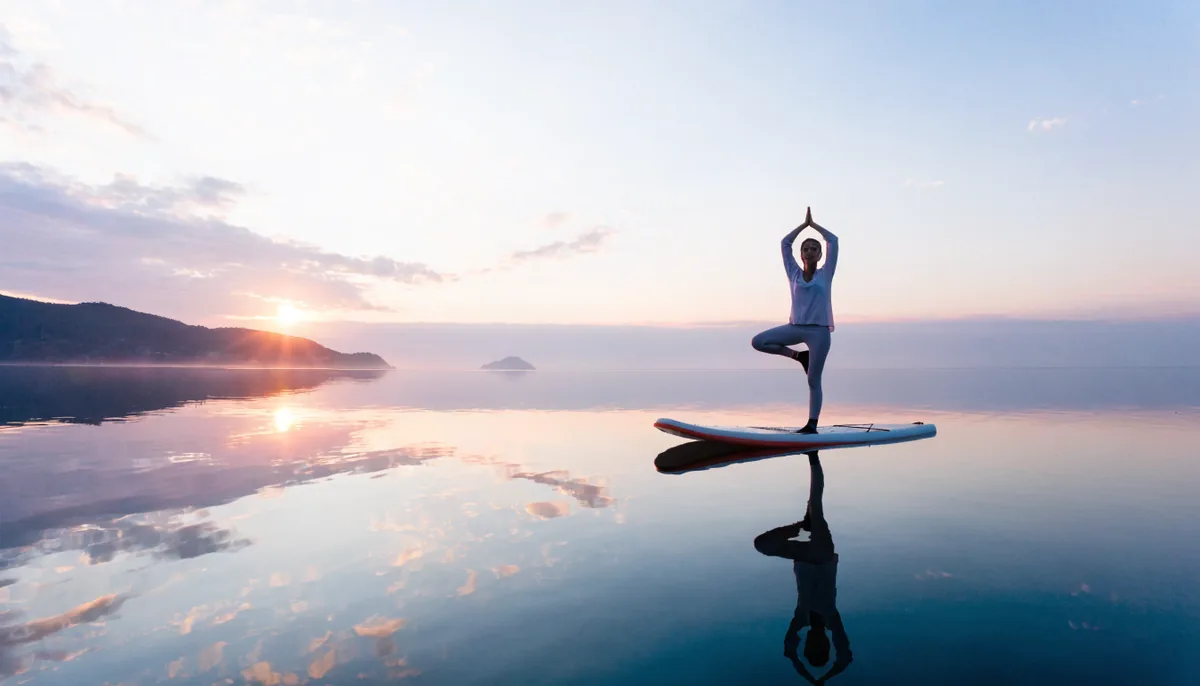
- SUP yoga: yoga and fitness standing on the board. Brilliant for your core and your balance.
- SUP fishing: fishing from a SUP. Increasingly popular, and it needs a stable, wide board (32 inches or more).
Looking for the right kit to start out? Read our SUP kit guide to find the board and accessories to match your paddling and your budget.
The best places to learn to paddleboard in the UK
- Windermere (Lake District): England's largest lake, with sheltered bays, clear water and miles of open water. The number-one first-paddle spot in the country.
- Loch Lomond (Scotland): vast, scenic and calm in the sheltered bays. Stunning and beginner-friendly on a still morning.
- Studland Bay (Dorset): shallow, warm and protected, with gently shelving sand. Ideal for your first sea sessions on a calm day.
- The Norfolk Broads: flat, slow-moving water and no waves. Perfect for building confidence over a long, easy paddle.
- The River Wye (Herefordshire): a gentle, meandering river through beautiful countryside – a classic UK SUP touring run.
❓ Frequently asked questions about learning to paddleboard
Is stand-up paddleboarding easy to learn?
Yes, it's one of the most accessible watersports there is. Most beginners are up on their feet within 10 to 20 minutes on flat water. Start on your knees, then rise to standing gradually.
Which SUP should I choose to start out?
An all-round inflatable SUP of 10'6" to 11'6" with a volume of 250 to 350 litres is ideal. Wide enough (32 inches or more) for stability and long enough to glide. An inflatable is practical for transport and storage.
Do I need to be able to swim to paddleboard?
Being able to swim is strongly recommended. Paddleboarding happens in open water and a fall is always possible. Always wear an ankle leash and a buoyancy aid, and check the tide and forecast before you go.