

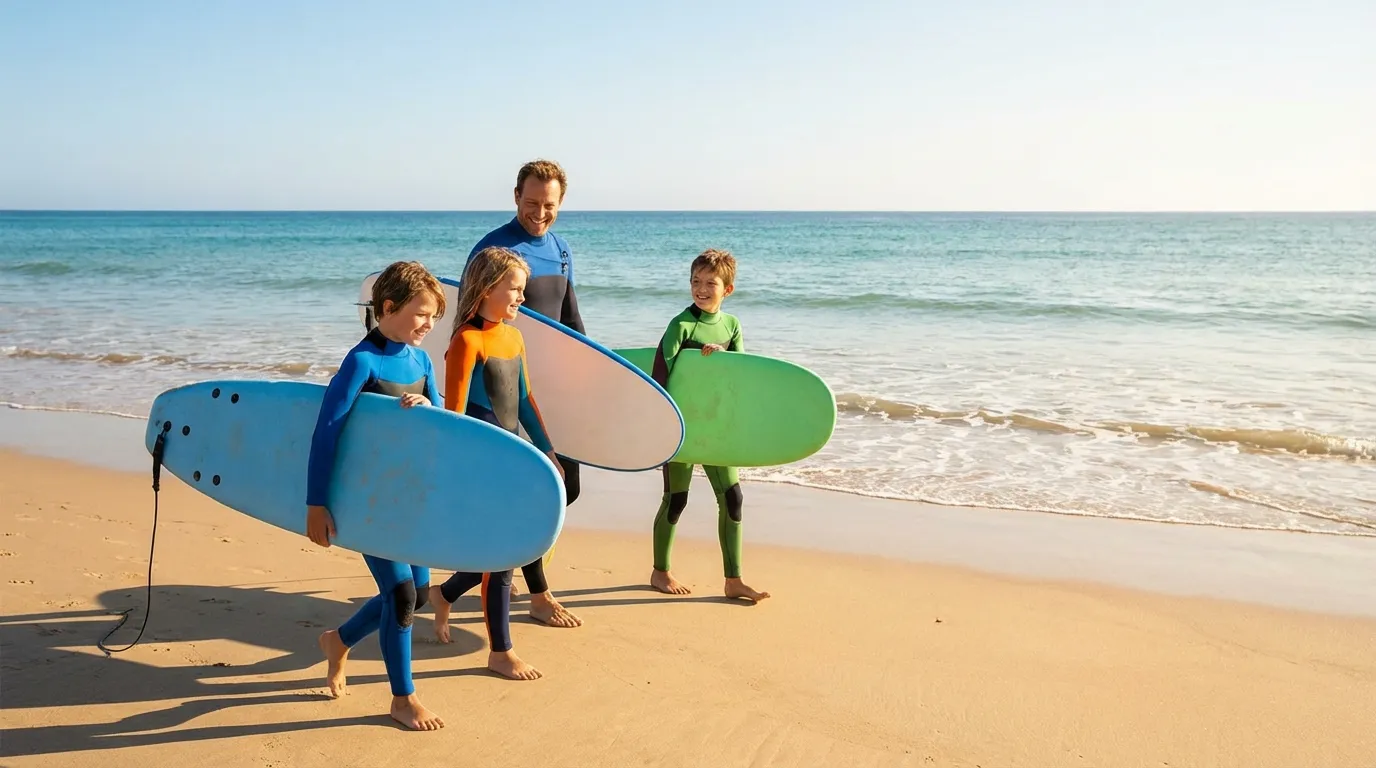
Surfing is an outdoor sport that keeps you in the sun for hours, often in the middle of the day when UV is at its strongest. The water reflects the sun's rays and adds to your exposure, so an unprotected surfer takes noticeably more UV than someone sitting on dry sand – and it happens even on a grey UK day. Sunscreen isn't an optional extra: it's a piece of health kit, every bit as important as your wetsuit or your leash.
Why sunscreen matters for surfers
The UV exposure that's specific to surfing
Out surfing, you're exposed to UV from three directions at once:
- Direct sun: the main source of UV, of course. Even on a cloudy day, a large share of UV still passes through the cloud.
- Reflection off the water: the sea reflects a fair amount of UV, and it reaches your face, neck and arms even between waves.
- Reflection off the sand: dry sand reflects about 15% of UV. On bright, sandy beaches the total exposure adds up quickly.
What poor protection leads to
Repeated sunburn is the number-one driver of premature skin ageing and skin cancer. Regular surfers are a higher-risk group: they clock up hundreds of hours of exposure a year. Beyond the health risk, sunburn on the face or the back of the neck makes your next sessions miserable – the wetsuit rubs on burnt skin and it stings.
As a rule, apply your sunscreen 15 to 20 minutes before you get in the water. That gives the filters time to bind to the skin so they're working from your first duck-dive. Applying just before you paddle out means delayed protection and near-guaranteed burning.
The best sunscreens for surfing
| Product | SPF | Strengths | Verdict |
|---|---|---|---|
| Stream2Sea EcoStick SPF 35 | 35+ | Reef-safe, third-party tested (per the brand), handy stick, zinc oxide and titanium dioxide | 🏆 Best overall |
| Green People Scent Free SPF 30 | 30 | UK-made, reef-friendly, kind on sensitive skin | 🌿 Reef-friendly pick |
| Sun Bum Original SPF 50 | 50 | Free of oxybenzone and octinoxate, water-resistant 80 min, pleasant scent | 🥇 Everyday value |
| Riemann P20 SPF 50 | 50 | Very water-resistant, but chemical filters (including octocrylene, homosalate and avobenzone), so not reef-safe | 💧 Ultra water-resistant |
| Avène Mineral Cream 50+ | 50+ | Sensitive skin, mineral filter, widely available | 🛡️ Sensitive skin |
| Raw Elements SPF 50+ Stick | 50+ | Natural formula, reef-safe, eco packaging | ♻️ Natural formula |
A closer look at the standouts
Stream2Sea EcoStick SPF 35: best overall
Stream2Sea built its name on reef-safe sun protection, with creams that the brand says are third-party tested for their impact on corals and fish. The active filters are non-nano zinc oxide and titanium dioxide (mineral, not chemical), giving broad-spectrum UVA/UVB protection. The stick format is perfect for the face: it doesn't run into your eyes when you sweat or take a wave on the head. A great everyday choice for surfers who care about what ends up in the water.
Sun Bum Original SPF 50: everyday value
Sun Bum is a firm favourite in the surf community. It's free of oxybenzone and octinoxate, though not of every filter on our not-reef-safe list: the UK formula contains octocrylene and avobenzone. It's water-resistant for 80 minutes, with a light, non-greasy texture that holds up through a two-hour session. Easy to find and easy to live with.
Green People Scent Free SPF 30: a UK reef-friendly pick
For surfers who want a home-grown, gentle option, Green People is a UK brand making mineral-led, scent-free sunscreens that suit reactive skin. SPF 30 is a sensible minimum for the body on cooler UK days; step up to SPF 50 on the brightest ones and always reapply between sessions.
Reef-safe: why it matters
The problem with chemical filters
Common chemical UV filters (oxybenzone, octinoxate, octocrylene) can act as endocrine disruptors for marine life. They contribute to coral bleaching, affect fish reproduction and work their way into the food chain. Studies estimate that thousands of tonnes of sunscreen wash into the world's reefs and coastal waters each year.
The rules coming in
More and more destinations are restricting sunscreens that contain certain chemical filters: Hawaii (law passed in 2018, in force from 2021, banning the sale of sunscreens with oxybenzone and octinoxate), Palau, the US Virgin Islands, Bonaire, Aruba, Thailand (in its marine national parks) and Mexico's protected reef parks such as Cozumel. Most of these rules name specific filters, usually oxybenzone and octinoxate (the US Virgin Islands also bans octocrylene, and Palau's list is longer), so the checklist below is a cautious buyer's guide rather than the wording of any one law. The direction of travel is clear: reef-safe creams are becoming the norm rather than the exception.
How to spot a reef-safe cream
A reef-safe cream uses mineral filters (zinc oxide, titanium dioxide) instead of chemical ones. Check the ingredients list:
- ✅ Reef-safe: zinc oxide, titanium dioxide (mineral filters)
- ❌ Not reef-safe: oxybenzone, octinoxate, octocrylene, homosalate, avobenzone (chemical filters)
Out surfing, you're in the sea for hours and every gram you put on ends up in the water. Choosing a reef-safe cream protects the playground you love. UK groups like Surfers Against Sewage campaign hard for clean water and healthy coasts – reef-safe sunscreen is one small choice that pulls in the same direction.
How to apply sunscreen for surfing
The pre-session routine
- 15–20 minutes before you get in: apply generously to the face, neck, ears, arms and any exposed skin. Don't forget the back of the neck – the spot surfers burn most.
- Use a stick on the face: it won't run into your eyes and holds up in the water better than a lotion. Apply a thick layer to the forehead, cheeks, nose and chin.
- Don't forget your lips: an SPF 30+ lip balm is a must. Lips burn quickly and it's painful in a wetsuit.
- Cover up between sessions: a cap or wide-brimmed hat on the beach cuts your exposure on long, sunny days.
Top-ups through the day
Even the best water-resistant creams start to fade after about 80 minutes in the sea. Top up on the beach between sessions: a stick for the face, and a spray or lotion for the body, which goes on faster over a large area.
Protecting your hair and eyes
It's not just skin – the sun affects surfers' hair and eyes too:
- Hair: salt and sun bleach and dry it out. An after-sun hair treatment, or a little coconut oil after a session, restores moisture. A neoprene hood or an old cap helps on long summer sessions.
- Eyes: polarised sunglasses on the beach protect your eyes from UV bouncing off the water — our floating sunglasses guide covers lens categories and frames that float. Some surfers wear strapped surf sunglasses for sessions in bright sun.