
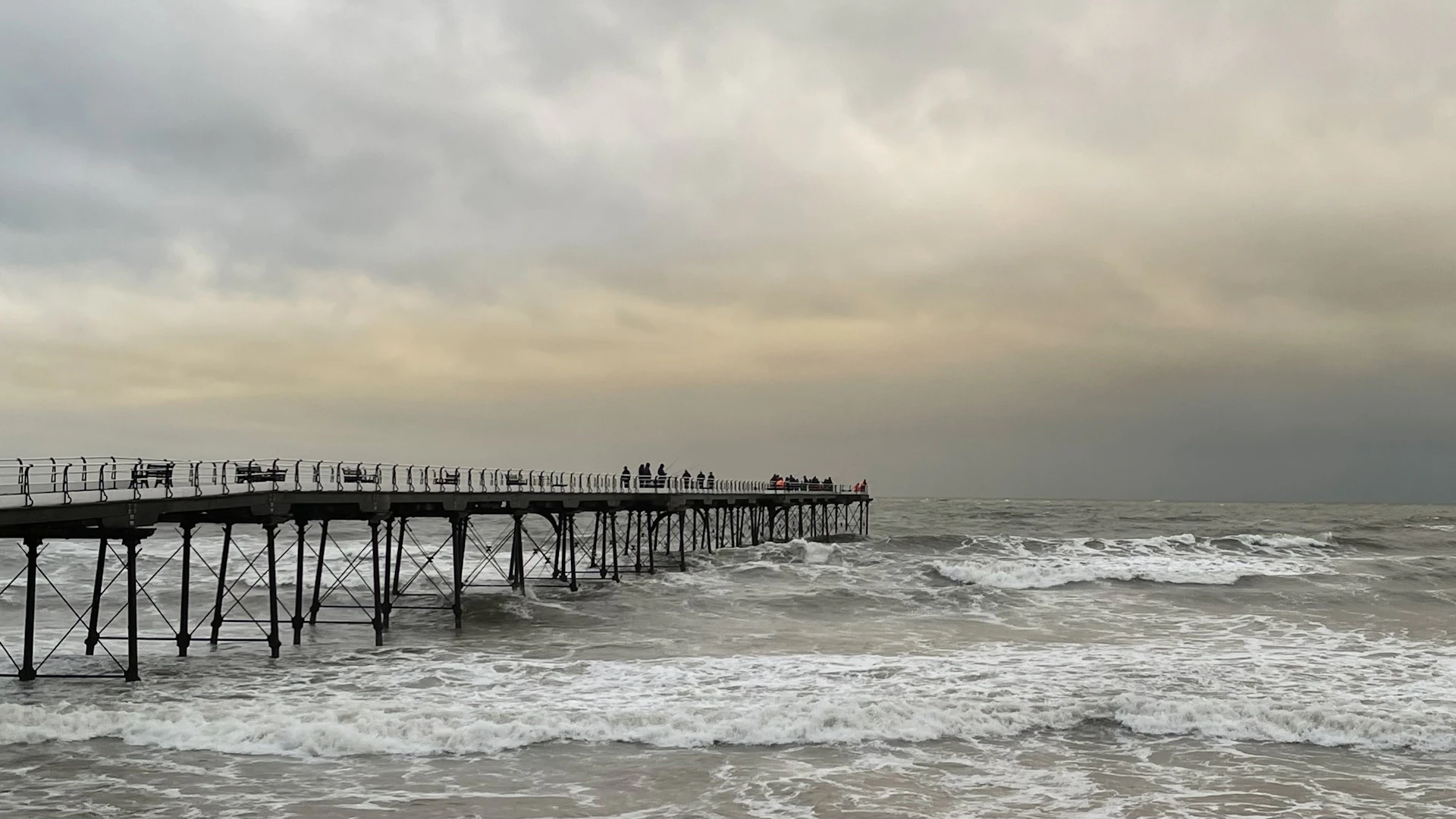
The North East of England's most reliable surf spot, with versatile sandbar peaks around a Victorian pier.

Sandbars formed by the pier pylons throw up rippable left and right-hand waves across the tides. Consistent, forgiving and, on the right day, fun for every level.
Surf guides arrow_forward
Saltburn Surf School, running since 1983, teaches all ages and abilities and is accredited by Surfing England and the ISA. One of the best places in the North East to start.
Learn to surf arrow_forward
RNLI lifeguards patrol Saltburn Beach in season. Surf between the black-and-white flags, watch the rip to the right of the pier and, in an emergency, dial 999 for the Coastguard.
Surf safety arrow_forwardVersatile sandbar peaks by the pier, plus a couple of reefs for when the swell lines up.
The heart of Saltburn's surf is around the Victorian pier, where the pylons help sandbars form and produce rippable left and right-hand waves throughout the tidal cycle. It's the most popular and adaptable part of the beach, working best on a short-period swell under 8 seconds of 2 to 4 feet (0.6 to 1.2 metres) from the north, with a light southerly wind and a high incoming tide. Beginners tend to progress quickly here, and there's enough on offer to keep improvers busy too. Watch for the rip current to the right of the pier when the surf picks up.
View on Google Maps open_in_newJust south of the pier, Penny Hole is a sand and cobblestone A-frame that serves up appealing lefts and rights. Further south, beneath the cliff, Saltburn Point is a quality slabstone reef that can throw up fast, reeling right-handers when the swell lines up – though it's a fickle, almost shy wave that softens swell rather than boosting it. Beyond the Point, the coast turns to flat slabstone reefs, where local surfers tend to keep their favoured, less-publicised spots to themselves.
View on Google Maps open_in_newA long-established, accredited school makes it easy to book a lesson or hire kit.
Established in 1983, Saltburn Surf School offers professional coaching for all ages and abilities, from first lessons to improver courses, plus equipment hire and a retail shop. It's fully accredited by Surfing England and the International Surfing Association (ISA), so you're in good hands. Forty-odd years of teaching this beach shows in how quickly the first session gets you standing. See our learn to surf guide for what to expect.
The surf school also hires out boards and wetsuits, handy if you're travelling light or want to ride something different for a session. A beachside car park sits right next to the shop. Our surf gear guide goes into what works in cold North Sea water.
The North Sea is cold. In winter the water can drop to around 4°C, when you'll want a 6/5/4mm or a well-fitting 5/4mm wetsuit with gloves, 5mm boots and a hood. In early to mid-August, when the sea peaks at 14 to 17°C, a 4/3mm or 3/2mm suit with 3mm boots is usually enough. Get the rubber right and Saltburn is surfable all year.
A characterful North Yorkshire town with a real surf community and plenty to do off the water.
Saltburn was one of the first places surfing took hold on England's east coast, and it's grown into the region's wave-riding hub. The Victorian pier, cliff lift and seafront give the town its character, and a stubborn local crew keeps the lineup busy through every season. Everything a travelling surfer needs sits within a few minutes of the beach.
When the surf goes flat, the Cleveland Way runs along the clifftops with wide views over the beach and coast, and the edge of the North York Moors is close by. Between the pier, the town and the walks, a flat spell passes easily enough.
By train or car, the North East's home break is straightforward to reach.
Saltburn station sits on the Esk Valley Line, a scenic route running around 35 miles (56 km) between Middlesbrough and Whitby. The station is a short walk from the seafront, so the train works well if you're travelling light or hiring kit at this end.
Saltburn is roughly 12 miles (19 km) south-east of Hartlepool and 5 miles (8 km) south-east of Redcar, with London about 263 miles (423 km) away. Two pay-and-display car parks, some free on-street parking and a beachside car park next to the surf shop cover most needs, though new restrictions are coming in for motorhomes and campervans, so read the signs.
Surf all year on this coast – the question is how much rubber it costs you.
Autumn and winter bring the most consistent and powerful North Sea swells, and when a cold Arctic swell arrives Saltburn can serve up its best, most challenging waves for experienced surfers. It's also the coldest stretch, with the sea dropping to around 4°C by late February, so a 6/5/4mm or 5/4mm wetsuit with hood, gloves and boots is essential.
Summer brings the warmest water, peaking at 14 to 17°C in early to mid-August, RNLI lifeguards on the beach and generally smaller, friendlier waves – the obvious window for a first lesson or a family session. A 4/3mm or 3/2mm suit is usually enough, and the pier peaks are forgiving on a clean, small day.
Spring keeps a wintery edge, with cold water lingering into April and May, but the lineups are quieter and there's still plenty of swell about. Stick with a 5/4mm suit and accessories until the sea warms up. Our gear guide covers choosing a cold-water wetsuit.
The questions surfers most often ask before a trip to the North Yorkshire coast.
Saltburn is often at its best on a high incoming tide, though some surfers prefer mid to high tide. Beginners should avoid waves over 4 feet (1.2 metres) and stick to smaller, cleaner days around the pier.
Yes. Saltburn is one of the UK's most versatile surf spots. Beginners can progress quickly on the sandbar peaks around the pier, while experienced surfers get more challenging waves when bigger, colder North Sea swells arrive.
In winter, when the sea can drop to around 4°C, wear a 6/5/4mm or a well-fitting 5/4mm wetsuit with gloves, 5mm boots and a hood. In early to mid-August, when water peaks at 14 to 17°C, a 4/3mm or 3/2mm suit with 3mm boots is usually enough.
Saltburn Surf School, established in 1983, offers professional coaching for all ages and abilities, along with equipment hire and a shop. It's fully accredited by Surfing England and the International Surfing Association (ISA). There's more in our learn to surf guide.
Water quality has improved but untreated sewage can still be legally discharged after heavy rain. Surfers Against Sewage (SAS) campaigns for cleaner water and provides real-time discharge alerts. Saltburn has lost its Blue Flag status over sewage concerns, so check conditions before you paddle out. There's more of the coast on our UK destinations hub.
A long way from the North Sea, and worth the drive: three more British breaks.

A dependable South Devon beach break, worked into shape by the River Avon's sandbanks.
See the spot arrow_forward
The most powerful beach in Wales, exposed to everything Pembrokeshire gets. Experienced surfers only.
See the spot arrow_forwardTwo Gower classics that could hardly be less alike – a wild 3-mile beach and a sheltered reef bay.
See the spot arrow_forward