
On an inflatable SUP, the pump matters almost as much as the board itself. It's what turns launching into a ten-minute job, or a chore that ruins the start of your session. Learning to spot an effective pump means you won't end up buying two, and you'll get your board up to the right pressure without wearing your arms out.
Why the pump makes more difference than you'd think
An inflatable SUP only becomes rigid at high pressure, generally between 15 and 18 PSI (roughly 1 to 1.2 bar). Under-inflated, it bows under the paddler's weight and becomes impossible to control. So the real challenge is reaching that pressure without turning every outing into a workout. The type of pump, a reliable built-in gauge and a comfortable handle are what separate a five-minute inflation from a gruelling fifteen minutes.
The different types of pump
Single-action manual pump
A single-action pump only pushes air on the downstroke, never on the upstroke. It's the most basic type, often the one bundled with entry-level packages. It works, but inflation takes longer and is more tiring, especially over the last few PSI where resistance rises sharply. For a larger-volume board, most people upgrade fairly quickly.
Double or triple-action pump
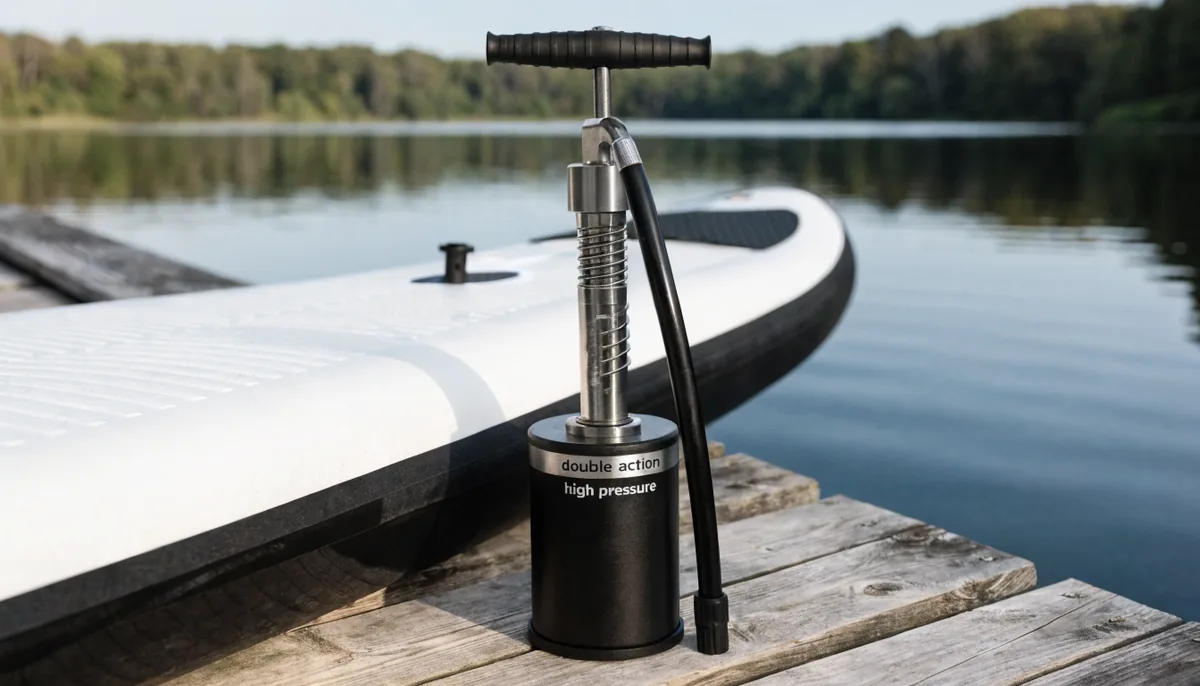
A double-action pump pushes air on both the downstroke and the upstroke, roughly doubling the airflow for the same number of strokes. Triple-action pumps go further still with a dual chamber and two pistons that shift more air per cycle. Most of these pumps include a switch to drop back to single-chamber mode above a certain pressure, for when pushing two pistons at once gets too hard. It's the best compromise for a manual pump.
Electric inflator
An electric inflator plugs into a vehicle's 12V socket, or connects directly to a battery via crocodile clips on stand-alone models. It inflates with no physical effort and switches off automatically once it reaches the pressure you've set, all in a compact unit of around 1.5 to 2.5kg depending on the model. It's the ultimate in convenience, at the cost of some noise and needing a power source nearby.
Two electric inflators worth a look, the Star Pump 6 and the higher-capacity Star Pump 8 — see them at OutletSUP →.
Useful buying criteria
Maximum pressure
A good pump should exceed your board's target pressure to leave some margin. Look for a model that reaches at least 15 PSI without struggling, ideally rated up to 20 or 25 PSI. A pump that only just scrapes to the recommended pressure will always leave you with a slightly soft board.
Comfort while inflating
A dual chamber, a wide well-shaped handle and a hose that's long and flexible enough are what make inflating bearable. A stable base you can brace between your feet also stops the pump sliding around on the hardest final strokes.
Gauge reliability
The gauge isn't a gimmick: without one, there's no way to know if the board has actually reached the right pressure, and you'll almost always end up under-inflating. Bear in mind that most gauge needles only start moving above 5 to 7 PSI. A clearly marked gauge, positioned in plain view on the pump body, is the easiest to read towards the end of inflation.
Which type of pump for your kind of paddling
Occasional beginner
For a handful of outings a year, the double-action pump that comes with the board does the job, provided it has a gauge. There's no need to spend more while you're still finding your feet with the sport.
Regular paddling
If you're getting out every week, a triple-action pump or an electric inflator earns its keep. The time and energy saved at every launch changes how you feel about heading out, especially after a full day's work.
Family use or multiple boards
Once you're inflating two or three boards back to back, an electric inflator quickly becomes worth it for comfort alone. Plug in, get the rest of the kit ready, and the boards are up to pressure without anyone being worn out before you've even started paddling.
Mistakes to avoid when buying
The first mistake is choosing purely on price: an overly basic pump tends to get replaced within the year. The second is overlooking the gauge, or trusting a model with no pressure reference at all. Also check the nozzle is compatible with your board's valve, generally a Halkey-Roberts-type valve on inflatable SUPs. And never head out on the water with an under-inflated board: it's the number-one cause of poor glide and instability. Before a first outing, it's worth checking our beginner's guide and our safety advice to avoid any nasty surprises.
FAQ
Is the pump that comes with a package good enough?
Often, yes, to begin with. Recent packages generally include a double-action pump with a gauge, which is plenty for occasional use. If yours only has single action or no gauge, plan to replace it fairly soon.
Is a triple-action pump worth it?
Yes, for regular paddling. The dual chamber shifts more air per stroke and saves real time on inflation, with the option to switch back to single chamber as pressure rises. For a handful of outings a year, a double-action pump is still plenty.
Should you buy an electric inflator?
It becomes worthwhile if you paddle often or have several boards to inflate. It inflates with no effort, stops automatically at your chosen pressure and weighs around 1.5 to 2.5kg. For occasional use, a good manual pump costs less and is perfectly sufficient.
What maximum pressure should a good pump reach?
Most boards are inflated between 15 and 18 PSI. Choose a pump that reaches these values without struggling, ideally rated up to 20-25 PSI to keep some margin and a properly rigid board.
How can you tell if a gauge is reliable?
A good gauge is clearly marked and easy to see on the pump body. Bear in mind the needle often doesn't start moving until 5 to 7 PSI, which is normal. If in doubt, cross-check the reading against a second gauge or an electric inflator's display.