

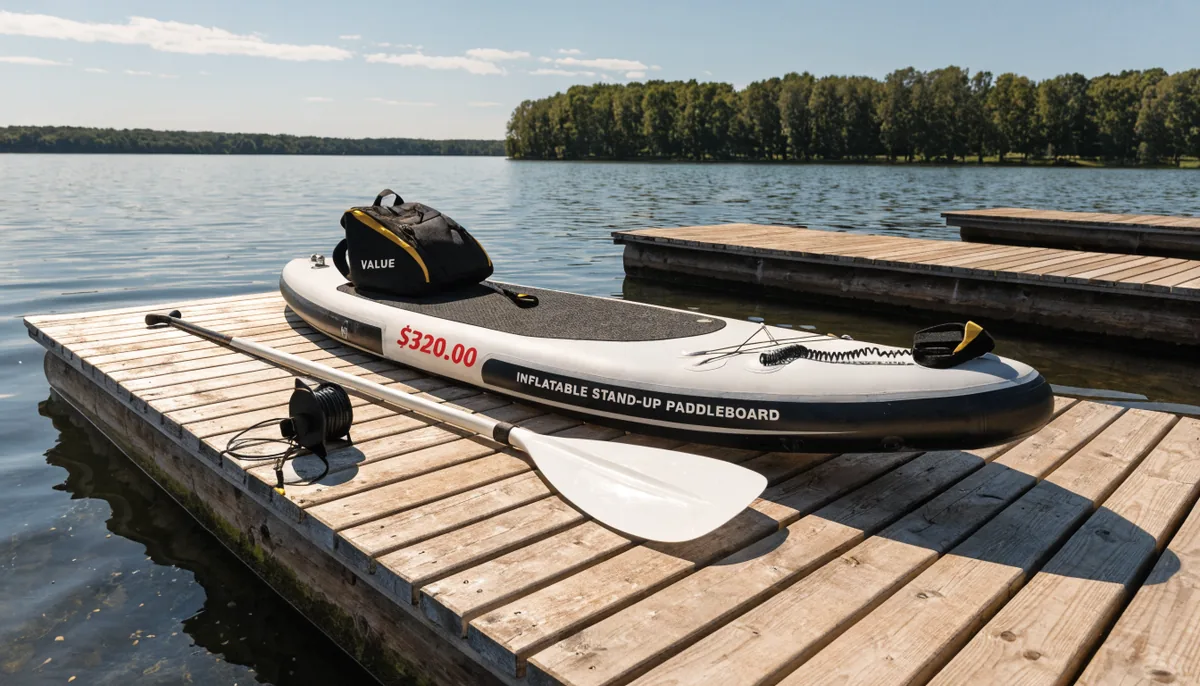
The price of an inflatable SUP ranges from budget entry-level packages right up to premium set-ups several times the cost, and the gap isn't just down to the logo on the deck. Between a board that folds under your feet the moment you stand on it and one that holds rigidity close to a hard board, the difference comes down to construction, the accessories in the box and how long it actually lasts. Here's how to work out the right budget for your kind of paddling.
What budget should you set for an inflatable SUP today?
Entry-level
A decent first inflatable SUP sits at the lower end of the market, usually sold as a package with a paddle, pump, leash and carry bag. At this price point, budget-friendly brands offer versatile 10 to 11-foot all-round boards that suit relaxed paddling on a lake or a calm river perfectly well. The construction stays simple (single-layer or fused single-layer), but it's more than enough for a handful of outings a year.
Mid-range
The mid-range band offers the best value for anyone paddling regularly. Boards at this level typically move to a double-layer or welded construction, stiffer and more durable, paired with a better-quality paddle and pump. This is the budget that avoids the classic beginner trap of having to buy a second board within a year because the first one disappointed.
Premium
Move into premium territory and you're paying for double-layer welded construction, internal reinforcement (stringers, cross-laid fibres), rigidity close to a hard board, and finishes built to last. That budget makes sense for frequent paddling, loaded touring trips, sea SUP, or simply wanting a board that's still going strong in ten years' time. The accessories follow suit, often with a carbon paddle and a high-volume double-action pump.
What actually drives the price
Construction and rigidity
This is the single biggest factor. A single-layer board costs less but stays softer and heavier; a double-layer welded (or fused) construction holds pressure better and ages more gracefully. Internal reinforcement such as stringers adds further rigidity, and the price climbs with it.
Accessories included in the package
A complete package bundles a paddle, pump, leash, fin, rucksack and repair kit. The quality of these pieces matters more to the overall price than you'd think: a carbon paddle or a double-action pump would each cost a meaningful sum bought separately. A suspiciously cheap price sometimes hides a heavy aluminium paddle or a sluggish pump.
Brand positioning
At equivalent construction quality, an established brand charges a premium for reputation and after-sales support. That's not always empty marketing: parts availability, warranty cover and a dealer network all matter. But plenty of value-focused brands now offer solid quality without the brand mark-up.
What to budget by paddler profile
Casual beginner
To try the sport without overspending, an entry-level package does the job. Look for a versatile all-round board of 10'6" to 11', stable and forgiving. There's little point stretching to premium kit before you know whether the sport is for you.
Family use
If several people will be sharing the board, it's worth moving up to mid-range for a sturdier construction and more carrying volume. A wide, thick (6-inch) board copes with the weight of an adult and a child up front without sinking too far.
Regular paddling
Once you're getting out every week, a higher budget pays for itself quickly: better rigidity, less fatigue when paddling and a lifespan that's often doubled. It's also the point at which a carbon paddle starts to make a real difference over a longer session.
An all-round inflatable that sits comfortably in the mid-range bracket: the ZRAY X1 — see it at OutletSUP →.
The mistakes to avoid with ultra-cheap boards
Below the lowest sensible price band, be careful. Boards sold at rock-bottom prices through supermarkets or online marketplaces often suffer from thin PVC that flexes underfoot, a fragile valve and disposable accessories. The result is a soft, unpleasant board to paddle, which puts newcomers off more than it introduces them to the sport. A properly built entry-level package, or a good second-hand board, beats an ultra-cheap model that ends up gathering dust in the shed. To compare reliable options, see our inflatable SUP buying guide, and if you're still unsure on sizing, our beginner's guide covers choosing the right board before you buy.
Inflatable paddle board cost: FAQ
Can you find a good SUP at a budget price?
Yes, without much difficulty. At the lower end of the market, several value brands offer complete packages that are perfectly reliable for casual paddling. Right at the very bottom of the market, though, quality becomes hit-and-miss and disappointment is common.
Is a complete package worth it?
Almost always. Bought separately, a paddle, pump, leash and bag would usually cost more than the difference charged for a package. Just check the quality of the paddle and pump, which vary a lot between packages.
Why do some inflatable SUPs cost twice as much as others?
The difference mostly comes down to construction: double-layer welded, internal reinforcement, more durable materials. On top of that come the quality of the accessories (carbon paddle, high-flow pump) and brand positioning, including warranty and after-sales support.
Should you buy new or second-hand?
Second-hand can be a good deal on a recent, lightly used board from a known brand. Check the seams, the valve, and inflate the board to confirm it holds pressure. On very cheap entry-level kit, buying new is usually the safer bet.
What budget should a beginner set to avoid mistakes?
Aim for a mid-entry-level package: enough for solid construction, genuinely usable accessories and some headroom to progress without needing to replace the board straight away.