

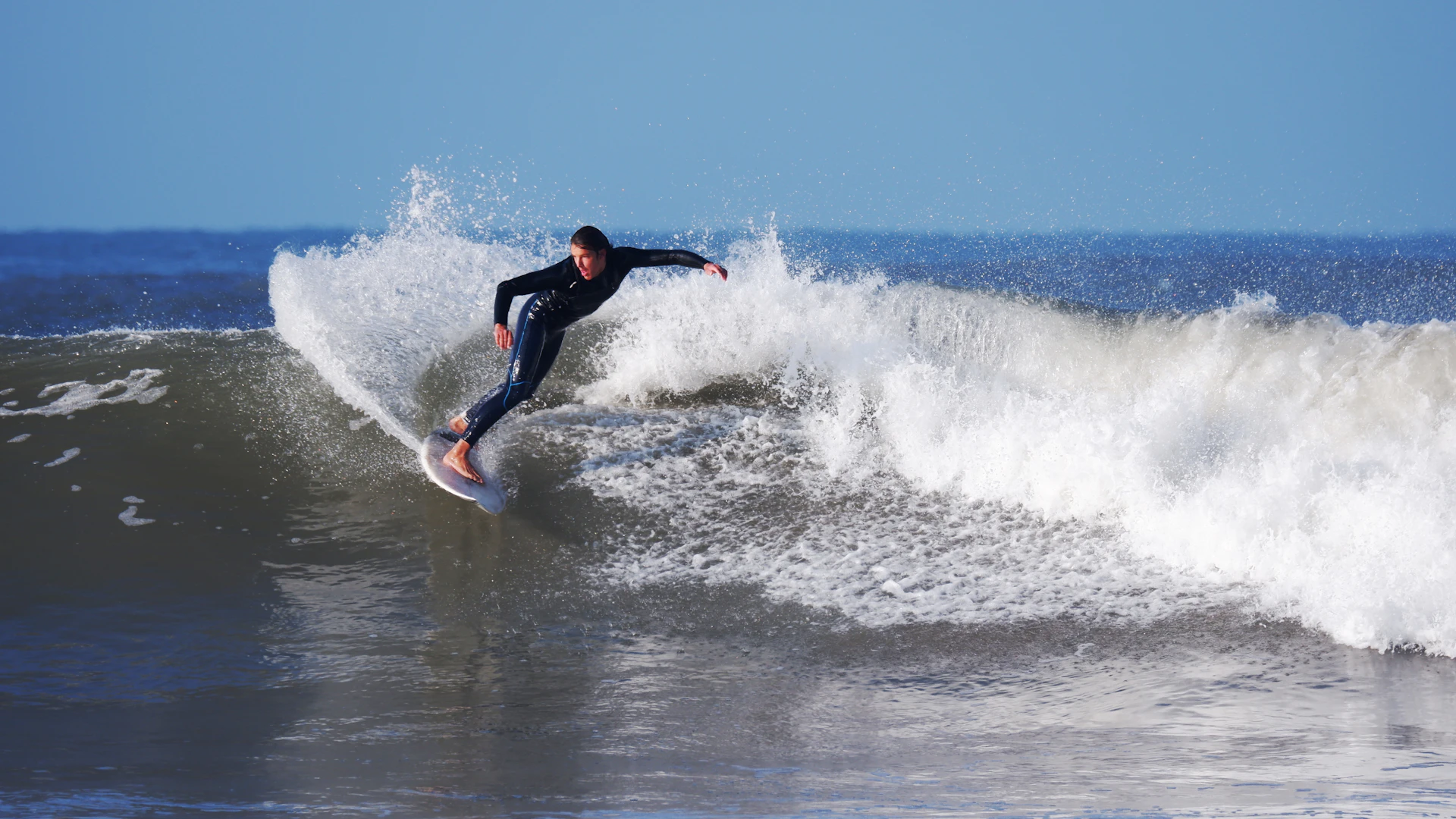
One of the UK's best beach breaks: powerful, hollow and best saved for when you can handle it.

Croyde is a hollow, high-quality beach break that packs real punch, at its best around mid-to-low tide. It asks more of you than the beaches either side of it, and it rewards surfers who are already improving.
Surf guides arrow_forward
Best suited to intermediate and above. If you're learning, start next door at Woolacombe or Saunton, where the waves are softer and there's far more room to make mistakes.
Learn to surf arrow_forward
Croyde Bay is RNLI lifeguarded in peak season. Surf inside the black-and-white chequered flags, keep clear of the bathing zone and watch for rip currents when it's pumping.
Surf safety arrow_forwardA short, punchy beach break that goes from world-class to closed-out depending on tide, swell and wind.
Tucked between two headlands, Croyde Bay concentrates Atlantic swell into a short, powerful, hollow beach break, and most people would put it among the best in the country. When it's on, it throws up fast, punchy walls and the occasional barrel, which is exactly why it draws such a crowd. It's heavier than neighbouring Woolacombe, so it suits confident intermediate and above surfers who can take off late and read a fast wave. On its day, Croyde is as good as beach-break surf gets in the UK.
View on Google Maps open_in_newCroyde is very tide-sensitive. It's at its best around mid-to-low tide, when the wave is hollowest and most powerful; around high tide it tends to back off, get fat and lose its shape. A clean groundswell with a light offshore wind is the classic setup. Because the bay is compact, it gets busy fast when the forecast lines up, so an early session or a weekday will always give you more room in the lineup. Check Surfline (which absorbed Magicseaweed in 2023), Surf-Forecast or Windguru for the Croyde surf forecast before you head down, and confirm the tide time against the day's swell rather than relying on the forecast alone.
If Croyde is too big, too crowded or simply out of your comfort zone, two of the best beginner-friendly beaches in the country are right on the doorstep. Woolacombe, just up the coast, offers mellower, more forgiving waves and space to spread out, while Saunton Sands rolls in long, gentle waves that are perfect for longboarding and learning. Few places in the UK put three beaches of that quality within a few miles of each other.
View on Google Maps open_in_newLessons, hire and advice across the North Devon coast, from Croyde to Woolacombe and Saunton.
Croyde itself is a step up for most learners, but the North Devon coast is one of the best places in the UK to start, thanks to Woolacombe and Saunton next door. Surf schools across the area run lessons on the gentler beaches, starting on the sand with safety, the pop-up and reading the waves before you head out on a soft-top. Once you're catching green waves confidently, Croyde becomes the natural next challenge. Our learn to surf guide walks through the early stages.
Surf shops in Croyde village and the surrounding towns hire out boards and wetsuits by the day or the week, so you can travel light or try a different board before committing. For punchy Croyde surf, a shortboard or performance board comes into its own, while a mini-mal is more forgiving on the beaches either side. If you're building your own quiver, our surf gear guide covers boards, wetsuits and leashes for UK waves.
Water temperatures follow the rest of the North Devon coast. In late summer the sea sits around 15 to 16°C, warm enough for a 3/2mm wetsuit, while in winter it drops to roughly 8 to 9°C, when a 5/4mm suit plus boots, gloves and a hood is essential. Get the rubber right and Croyde is a year-round wave.
A classic surf village with three of the country's best-known beaches within a few miles.
Croyde is a small, thatched-cottage village that swells with surfers whenever the swell arrives. It has a handful of pubs, cafés and surf shops within walking distance of the beach, and a laid-back feel that makes it a favourite for weekends away. Camping and holiday parks around the bay make it an easy, affordable base for a surf trip.
When the surf is flat or the wind turns onshore, the South West Coast Path runs over the headlands around Croyde, Baggy Point and Saunton, with sweeping views over the bays and the long sweep of Saunton Sands and Braunton Burrows behind. It's a fine way to stretch the legs and check the surf between spots before the next session.
Tucked into North Devon, Croyde is most easily reached by car.
Most surfers drive to Croyde. It sits around 10 miles from Barnstaple, with the A361 the main road into the area from junction 27 of the M5. A car also lets you check Woolacombe and Saunton before you commit to a session. In peak season, arrive early if you want to park near the bay.
The nearest railway station is Barnstaple, on the Tarka Line from Exeter. From there, local buses run out towards Braunton, Croyde and Woolacombe, though services are less frequent out of season. Travelling by train works best if you're hiring a board on arrival rather than carrying your own.
Croyde village is compact enough that once you have parked, the pubs, cafés and surf shops are all within walking distance of the sand. Braunton, the nearest large village, has shops, surf shops and places to stay, and makes a handy hub for the area.
Croyde has surf all year, but the season shapes the size, the crowd and the water temperature.
Autumn is prime time for Croyde. Regular Atlantic groundswell, lighter winds and water still relatively mild after summer give you the cleanest, most powerful waves of the year. The summer crowds have eased too. A 3/2mm or 4/3mm wetsuit will see you through, and an early start on a mid-tide push is still worth the alarm.
Summer brings the warmest water, at around 15 to 16°C, lifeguards on the beach and generally smaller surf. The waves are more manageable, but Croyde Bay gets very busy, so patience and good lineup etiquette go a long way. If it's small and crowded, you'll get a more relaxed session up the coast.
Winter delivers the biggest, most powerful surf, for experienced surfers who can handle it. The water drops to around 8 to 9°C, so a 5/4mm wetsuit with boots, gloves and a hood is essential. The lineups thin out, but the waves get heavier and the tides matter more than ever, so check the forecast and know your limits before you paddle out. Our gear guide covers winter wetsuits.
The questions surfers most often ask before a trip to North Devon.
Not really. Croyde is a powerful, hollow beach break, heavier than neighbouring Woolacombe, so it suits confident intermediate and above surfers. Beginners are far better off at Woolacombe or Saunton, both a short drive away. See our learn to surf guide.
Croyde works best around mid-to-low tide, when the wave is at its hollowest and most powerful. Around high tide it tends to back off and get fat, so time your session with the tide chart.
The same as the rest of the North Devon coast. A 3/2mm wetsuit sees you through late summer, when the water is around 15 to 16°C, while winter needs a 5/4mm suit plus boots, gloves and a hood as the sea drops to roughly 8 to 9°C.
Croyde sits near Braunton and Barnstaple in North Devon, around 10 miles from Barnstaple. Most surfers drive, with the A361 the main road into the area. It's a short hop from Woolacombe and Saunton if you want to move between spots. Explore more on our UK destinations hub.
Yes, several surf schools run lessons and improvers' coaching directly from Croyde. Total beginners are still better off starting at neighbouring Woolacombe or Saunton, where the waves are more forgiving, before graduating to a Croyde lesson once they can catch green waves confidently.
See how Croyde compares to the rest of the region in our Cornwall & Devon surf guide.