📍 Mississippi, United States
Mississippi's Gulf Coast:
kiteboarding, not surfing
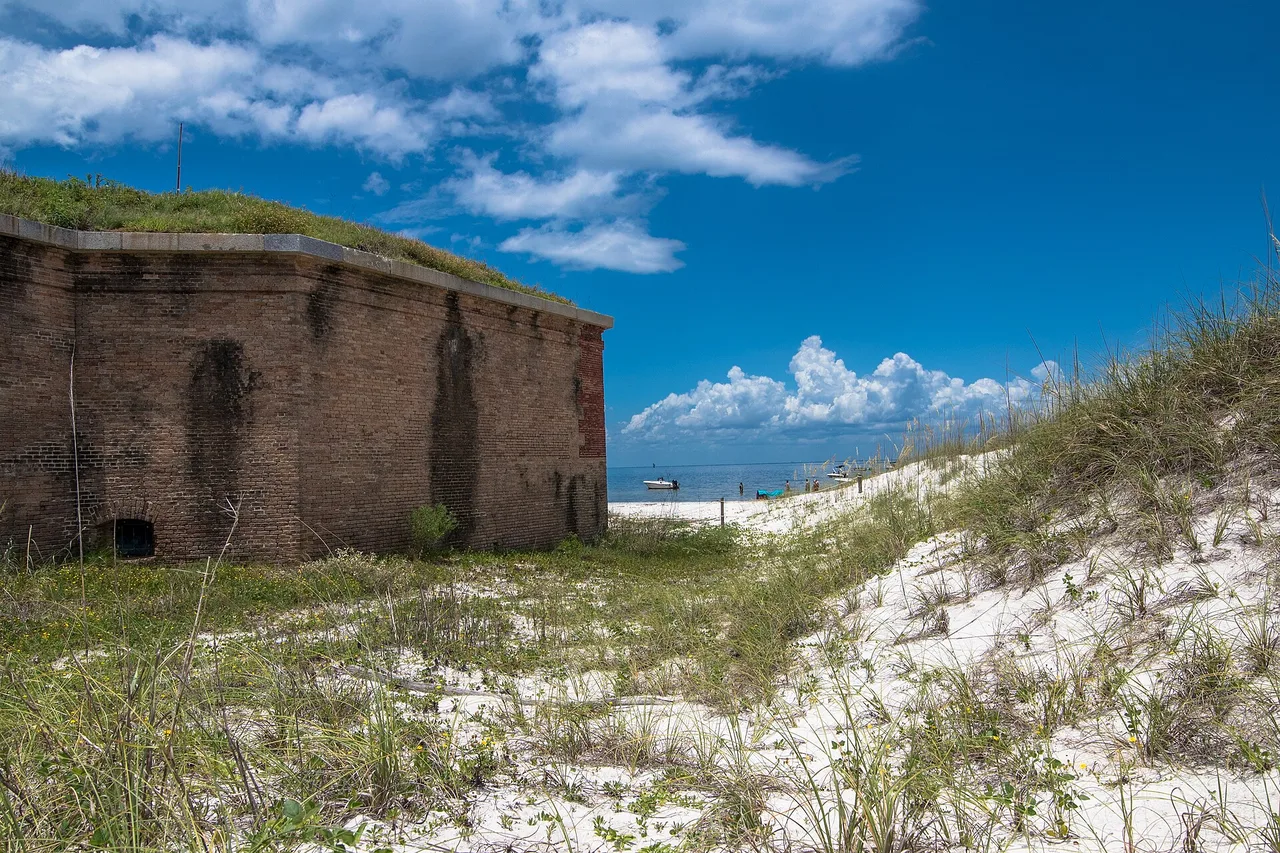
Photo: capt_tain Tom / Wikimedia Commons, CC BY 2.0. This is a scenic shot of Ship Island's fort and dunes rather than an action image — we couldn't find any on-topic action photo of someone surfing, kiteboarding, or paddling this coast available under a usable licence.
Measured search demand for any board sport on this coast is close to nothing. "Surfing Mississippi" and "Mississippi surfing" together measure 90 searches a month nationally — and Google groups them as one signal, not two, since both return the identical month-by-month trend. "Kiteboarding Mississippi" measures 10/mo. Kitesurfing, windsurfing, paddleboarding and every town-plus-sport combination we checked (Biloxi surfing, Gulfport kiteboarding, Ship Island kiteboarding, Horn Island kiteboarding, Ocean Springs kayaking, and more) came back at zero. Against all of that, "Ship Island ferry" alone measures 1,900 searches a month — real, substantial demand, just for the boat trip to a National Seashore island, not for a wind or wave sport.
We could not find a documented surf break anywhere on this coast — no surf shop, no National Park Service surf rule, no source describing real wave height. The mainland beach along US-90 and the Mississippi Sound behind the barrier islands are consistently described, across independent sources, as flat and sheltered. What IS real and documented is a small kiteboarding, wing-foiling and windsurfing scene, taught by two operators across five Gulf Coast towns, and a current federal rule that specifically addresses kite surfing on the barrier islands. This page leads with that, plainly, rather than padding a surf angle the research doesn't support.
The nearest NOAA buoy is Station 42007, labelled "BILOXI — 22 NM SSE of Biloxi, MS," at 30.09°N, 88.77°W — read directly from NDBC's own station page. Unlike the South Carolina and New England pages in this guide, we did not pull a verified multi-year climate dataset from it this session because the search-volume numbers above don't support that level of depth for this page. Commercial tourism sources (Coastal Mississippi's own site, general spot guides — not a NOAA climate-normals page we read ourselves) describe Gulf Coast water as cool in winter and warm by summer, roughly the same subtropical pattern as the Florida Panhandle just to the east; treat that as a general range, not a verified figure.
The one hazard worth naming plainly is Atlantic hurricane season, June through November, peaking August-October — the same window that governs every Gulf and Atlantic page in this guide, and the reason the National Seashore's own barrier-island rules below are dated the way they are.
Ship Island, Horn Island, Petit Bois Island, West Petit Bois Island and the NPS-owned portion of Cat Island make up the Mississippi District of Gulf Islands National Seashore. None of them are reachable by road. Ship Island, about 12 miles off the coast, is only accessible by boat, but it's the one with routine public access: a seasonal passenger ferry runs mid-March through October from Gulfport's Jones Park, landing near the island's Civil War-era fort, Fort Massachusetts. Operating a vessel faster than 5 mph, or creating a wake, is banned within 500 feet of the ferry dock, per the park's own compendium.
Horn Island and Petit Bois Island were designated federal Wilderness Areas in 1978 and are among the few undeveloped barrier islands left on the Gulf Coast. Both are private-boat access only: there are no facilities, no drinking water, no staff, and pets are not allowed. Camping is permitted but only for boat-in visitors, who must bring and remove their own firewood. This is not a beginner day-trip stretch of coast; it is genuinely remote.
The compendium's kite rule, quoted verbatim from Section 1.5(a)(2), "Kite Surfing, Kite Boarding, or Similar Device": "Kite surfing, kite boarding and similiar devices (board riding propelled by large wind-driven kite-like objects) is allowed in the National Seashore except in the following locations and in accordance with the following conditions... This activity is prohibited within 650 feet (216 yards) of all shorelines in the Mississippi District each year from April 1 through September 1." The park's own stated reason: kites of that size and movement disturb nesting shorebirds — it names black skimmer, least tern and snowy plover specifically — during nesting season, and the long lines and forces involved pose a hazard to other visitors during the high-visitation months. Outside that six-month window, or beyond 650 feet of the shoreline, the activity is allowed park-wide, Mississippi District included.
No source we found gives a documented kiteboarding operator or regular scene actually launching from any of these islands — the compendium rule tells you what's permitted, not that anyone routinely does it. Practically, the ferry schedule, the remoteness, and the six-month seasonal buffer make the barrier islands a place to know the rule for, more than a place to plan a kite session around.
The mainland shoreline along US-90 — Bay St. Louis, Pass Christian, Gulfport, Biloxi, Ocean Springs — is engineered and periodically replenished sand, sitting behind the barrier islands in the Mississippi Sound. Independent sources describe this water consistently: calm, generally under a foot of chop, good for swimming, paddleboarding and kayaking, and not a place with real surf. Nothing we found contradicts that.
That flat water supports a modest kiteboarding scene. Gulfport Board Sports, despite the name, is based in Biloxi and offers instruction in kiteboarding, wing foiling and windsurfing from beginner to advanced levels. Gulf Coast Kite teaches kiteboarding across Biloxi, Gulfport, Pass Christian and Bay St. Louis, MS (and in towns in three neighbouring states). Both are currently operating small businesses whose own sites we read directly — not spot-guide entries copied from somewhere else. A single spot-guide database (not independently verified) names East Beach in Ocean Springs as a kitesurf launch specifically; we're flagging that as unconfirmed rather than stating it as fact.
See on Google Maps
open_in_new
Harrison County's own current "Rules of the Beach" page — covering the county sand beach that runs through Gulfport and Biloxi — lists nine general rules (no glass, no fireworks without a permit, no animals, no motor vehicles except permitted ones, and so on) and says nothing at all about kites, kiteboarding, or a watersports zone. That's a genuine absence, the same pattern documented on Myrtle Beach's and Tybee Island's pages elsewhere in this guide — not a ban and not a permission, simply unaddressed by this particular rule. Biloxi's own Sand Beach ordinance (Code of Ordinances § 12-6-4) exists and almost certainly says more, but Municode's rendered page blocked automated access this session, the same blocker documented on our Georgia guide — so its actual content isn't represented here.
Under § 59-21-81, "every vessel" must carry a Coast Guard-approved personal flotation device for each person aboard, and anyone 12 or younger aboard a motorboat, sailboat or vessel under 26 feet must wear one while underway. Personal watercraft (jet skis) are subject to a stricter wear requirement: the statute requires everyone aboard, or being towed behind one, to wear a Type I, II or III PFD, regardless of age.
Mississippi does not carve surfboards, windsurfers or kiteboards out of its definitions the way South Carolina does. Mississippi's "vessel" is defined broadly: "every description of watercraft... used or capable of being used as a means of transportation on water." No exclusion for boards or similar devices was found. If anything, the statute points the other way: § 59-21-83, the reckless-operation rule, explicitly extends its own scope to "all watercraft... inclusive of, but not limited to... surfboards, aquaplanes, airboats, water skis or other watercraft." And § 59-21-87's towing rule requires an observer aboard any vessel towing a person on water skis, an aquaplane or a similar device — the statute itself doesn't name "surfboard," but the Mississippi Department of Marine Resources's own boating-rules guidance restates the same observer requirement using "water skis, a surfboard or a similar device." What we could not find, anywhere, is a clause that says whether an ordinary, un-towed surfboard, kiteboard or paddleboard counts as a "vessel" for purposes of the PFD-carriage rule in § 59-21-81 itself. That's a genuine gap in the statute, not something we're resolving for you either way.
For a sea emergency on this coast, call 911, the US Coast Guard on VHF channel 16, or the Mississippi Department of Marine Resources's own 24-hour dispatch line, (844) WE-R-MDMR / 228-523-4134. The federal PFD baseline that fills gaps like this across every state is on our United States guide.