

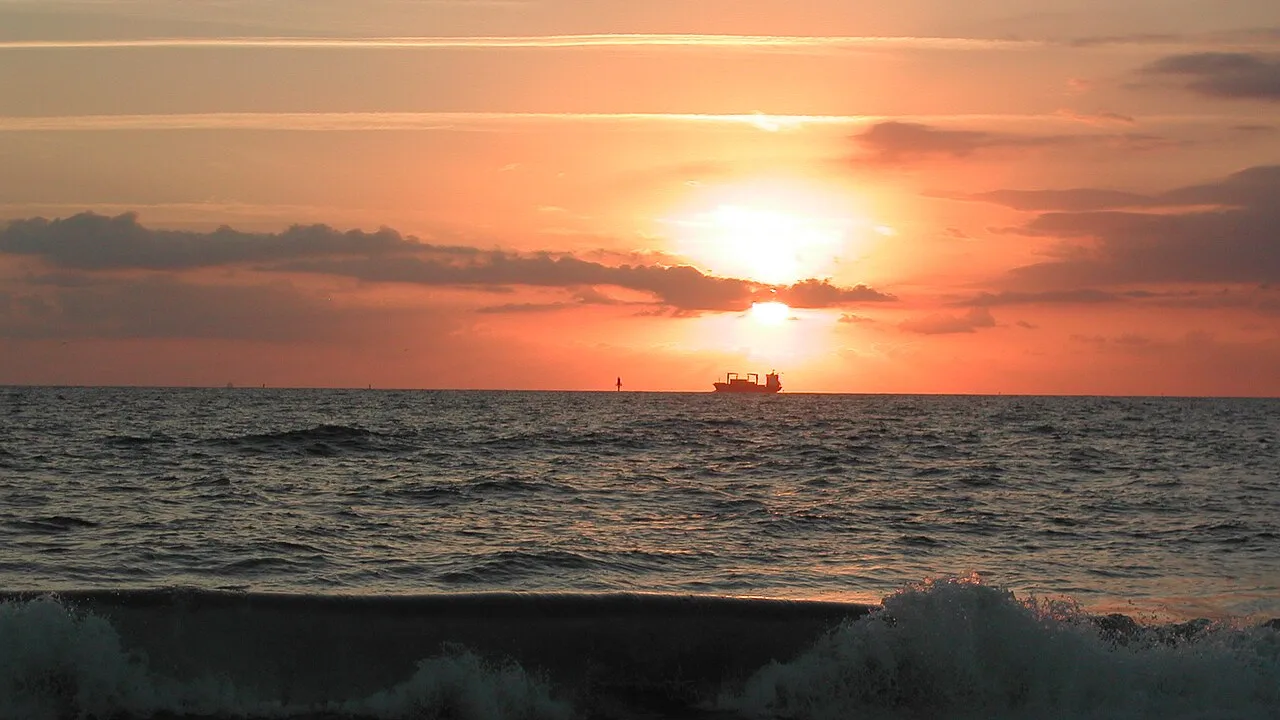
📍 Georgia, United States
Photo: Michael Sennello / Wikimedia Commons, public domain
Georgia's Atlantic coastline runs about 100 miles — short for a South Atlantic state, and unlike the Carolinas' open ocean beaches, most of it sits behind a chain of barrier islands (Tybee, Wassaw, Ossabaw, St. Catherines, Sapelo, St. Simons, Sea Island, Jekyll, Cumberland) fronting a wide belt of tidal marsh and sound. We could not find a single source stating outright that this geography wave-shadows the coast — that specific claim isn't ours to assert as fact — but it fits the pattern of what actually is documented: the state's one named surf rule (Tybee Island) and its one named kite launch (Jekyll Island's Kite Beach) both sit on an island's open ocean-facing edge, not in the marsh behind it.
A designated surf zone near Savannah, with a mandatory leash rule and a 1,000-ft buffer from motorized watercraft — Georgia's one documented surf spot.
Tybee Island rules arrow_forward
A real turtle-protection ordinance against land-based "wind-powered crafts" on the south end, and a separately-located kiteboard launch, Kite Beach, on the north end.
Jekyll Island in detail arrow_forward
A carry requirement for adults, a wear mandate for children under 13, jet-ski riders and towed sports — read the statute, not a summary, for what Georgia actually requires.
The PFD law arrow_forwardThe nearest NOAA buoy to this coast is Station 41008, "Grays Reef," roughly 40 nautical miles southeast of Savannah at 31.400°N, 80.866°W, inside the Gray's Reef National Marine Sanctuary — read directly from NDBC's own station page. It's a 3-metre discus buoy reporting significant wave height, dominant and average wave period, wind speed/direction/gust, air and water temperature, and barometric pressure.
What we did not do this session is pull a verified multi-year NOAA dataset from that buoy the way our New England pages do for the Northeast. So: Georgia's coast is genuinely subtropical, and commercial sea-temperature trackers (not a NOAA climate-normals page we read ourselves) put winter water in the low-to-mid 50s°F, climbing to the mid-70s to low-80s°F by July-August — warm most of the year, a real contrast with the New England coast further up this series. Treat those two figures as a general range, not a verified station reading. Atlantic hurricane season (June-November, peaking August-October) is the one seasonal hazard worth naming.
We looked for a Georgia-specific NOAA or Georgia DNR shark advisory precise enough to cite here and did not find one. The one real, sourced shark-related rule we found is narrower than a safety advisory: Tybee Island's own ordinance bans fishing for sharks from its public beaches, docks and piers — a fishing rule, not a swimmer-safety warning.
City of Tybee Island Code of Ordinances, Chapter 12, Sec. 12-1 — via secondary compilation, not read verbatim.
Two independent sources — Tybee's own visitor-facing rules page and an unrelated Savannah-tourism compilation — describe the same rule closely enough to trust its shape, even though Municode's rendered ordinance page and tybeeisland.com both blocked automated access when we tried to read the text ourselves this session. Surfing is permitted only in designated areas, with the rest of the beach reserved for swimming; boards must carry "an appropriate leash which is used at all times." Separately, motorized watercraft — jet skis, motorboats and similar craft — may not operate within 1,000 feet of the waterline anywhere between Tybee's north and south rock jetties. Violations reportedly carry a fine up to $1,000 and up to six months, at a judge's discretion — again, from a secondary source, not the ordinance text itself.
Neither source names kiteboarding, kitesurfing or windsurfing at all. Treat that equipment as simply not addressed by this rule, one way or the other — the same absence documented on Hampton Beach, New Hampshire's rules, on our New Hampshire guide.
Jekyll Island Authority Code, Chapter E, Article V, Section 2, item 7 ("Wind-powered crafts") — read directly.
Read directly from the Jekyll Island Authority's own code: "it is prohibited for any person to use or operate a kite buggy, beach-capable wind surfer, or any other wind-powered transport on the beaches of Jekyll Island" within a mapped zone covering the island's southern end — from the south dunes picnic-area boardwalk, around the southern tip, to a point roughly 2,000 feet south of the St. Andrews picnic area — plus a blanket ban on such craft in the dunes anywhere on the island, at any time. The ordinance states its reason plainly: protecting nesting sea turtles and shorebirds.
This is a rule about land-based, wind-driven vehicles — a kite buggy or a beach land-yacht — not about kiteboarding on the water. Its own text doesn't mention kiteboards, kitesurfing or windsurfing on the water anywhere.
Separately — and this is one kiteboarding operator's own description of their launch, Coastal Wind Sports, not a rule we verified against the Authority's text — Jekyll Island has a documented kiteboard spot, "Kite Beach," between Blackbeard's Restaurant and the Jekyll Island Club Pavilion on the island's north end — well outside the southern turtle-protection zone above. The operator describes a sandbar that's "an ideal spot for kiteboarders and kitesurfers," best launched at half-tide or lower, and stresses that professional instruction matters because the kites involved are "very powerful and dangerous" for a novice without it.
O.C.G.A. § 52-7-13, read directly.
Georgia Code § 52-7-13 creates a seasonal (May 1 - September 30) boating safety zone extending 1,000 feet from the high-water mark along the entire ocean-facing length of both St. Simons Island and Sea Island. Read directly, the restriction is narrow: "it shall be unlawful to launch, float, or operate any power boat" inside that zone, with named exceptions for lifesaving, emergency, law enforcement and dam-operation craft. That is a rule about engines, not about surfing, kiteboarding or paddling — nothing in the statute restricts a surfboard, kiteboard or paddleboard.
We found no separate St. Simons- or Sea Island-specific ordinance naming kiteboarding, kitesurfing or windsurfing directly. Glynn County's code does include a general clause against reckless operation of "any vessel or... water skis, aquaplane, surfboard or similar device" — a conduct rule about not endangering people, not a zoning ban on any of those activities. No sourced rule at all was found for Little Tybee, a smaller, largely undeveloped barrier island nearby; that's a genuine absence, not a gap we're filling in.
O.C.G.A. § 52-7-8, § 52-7-8.2 and § 52-7-7.1, read directly.
Georgia's paddlecraft rule is a general carriage requirement, not a universal wear mandate. § 52-7-8 requires every vessel to carry one wearable, USCG-approved PFD per person aboard, "readily accessible." The same section adds a real wear mandate, but only for children under 13, who must actually wear one "when the vessel is under way" unless inside a fully enclosed, roofed cabin — an exception that plainly doesn't apply to a kayak, SUP or surfboard.
Two activities carry their own wear mandate. Personal watercraft (jet skis): § 52-7-8.2 requires "each person aboard" to wear a USCG-approved Type I, II, III or V PFD, and bars anyone under 16 from operating one at all — 12-15 year-olds may, with an adult aboard or a completed boating-safety course. Towed sports (water-skiing, and by the same clause wake surfing): § 52-7-7.1 requires the person being towed to wear "a ski belt; ski jacket; or Type I, II, or III PFD," properly fitted and fastened.
Ordinary surfing, SUP paddling or kiteboarding — once past the swimming-area limit that turns a board into a federal "vessel" — falls under the general carriage rule above, not either wear mandate. Emergencies anywhere on this coast: 911, or the Coast Guard on VHF 16. The federal flotation baseline for the whole country is on our United States guide.
Tybee Island, near Savannah, is the state's one documented surf spot: a designated zone within its city beach rules, with a mandatory leash and a 1,000-ft buffer from motorized watercraft between the north and south jetties. We could not read the ordinance's own text directly this session, but two independent sources describe it the same way.
Jekyll Island's north end has a documented launch known as "Kite Beach," per a single kiteboarding operator's own description — sourced, but not independently verified. It sits well outside the Jekyll Island Authority's own turtle-protection zone at the island's south end, which bans land-based "wind-powered crafts" like kite buggies, not water-based kiteboarding.
Not as an adult. Georgia requires a PFD to be carried on board for every person, not worn, on ordinary paddlecraft. Wear is only mandatory for children under 13, for personal-watercraft (jet ski) riders of any age, and for anyone being towed on water skis or wake surfing.
Georgia's roughly 100-mile coastline sits almost entirely behind barrier islands and tidal marsh rather than open Atlantic beach. We found no single source stating outright that this wave-shadows the surf, but it matches what's actually documented here: one named surf rule and one named kite launch, both on an island's open ocean edge rather than in the marsh behind it.