
📍 Florida, United States
Photo: US National Archives / Wikimedia Commons, public domain
Florida's flat water is world-class. Its surf is real but small, short-period, and confined to one coast — worth saying plainly before you book a board trip.
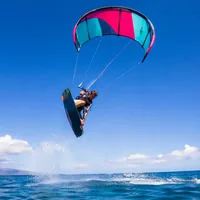
Turquoise shallows at Islamorada, Marathon and Key West; Fort De Soto and Navarre on the Gulf side.
The flat-water spots arrow_forward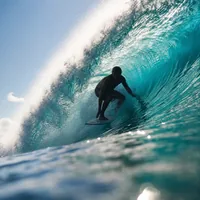
Jupiter, the Space Coast and New Smyrna — where Florida's surf actually is, and how big it actually gets.
The surf coast arrow_forward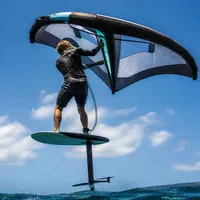
Miami Beach runs a certification-and-permit regime with real fines. Crandon Park is a separate thing entirely.
The Miami rules arrow_forwardFlorida is kite, wing and paddle country first, and a surf destination second. That is not a criticism — the flats in the Keys are among the best flat water anywhere in the world — but it does decide what you should pack and where you should go.
Real surf in Florida is confined to the Atlantic coast from roughly Palm Beach northwards: Jupiter, the Space Coast, New Smyrna. It is wind-swell dominated, short-period and small on a typical day — a normal Cocoa Beach day is shin-to-waist high with periods around six or seven seconds. The quality days come from winter nor'easters and hurricane swell, not from a regular groundswell window.
The Gulf coast and the Keys are not surf destinations at all. The Gulf has short fetch and no groundswell source; the Keys sit behind a reef. Both are outstanding for flat-water riding and useless for waves, and any guide that implies otherwise is selling you something.
The wind season is the cool season. Mid-latitude cold fronts cross the peninsula from roughly November to April: southerly and south-easterly ahead of each front, then north through north-west through north-east behind it as high pressure builds. Between fronts, easterly trades of around 18 to 22 knots can run for days. Summer gives a usable 10 to 20 knot sea breeze — in exactly the same hours as the afternoon thunderstorms.
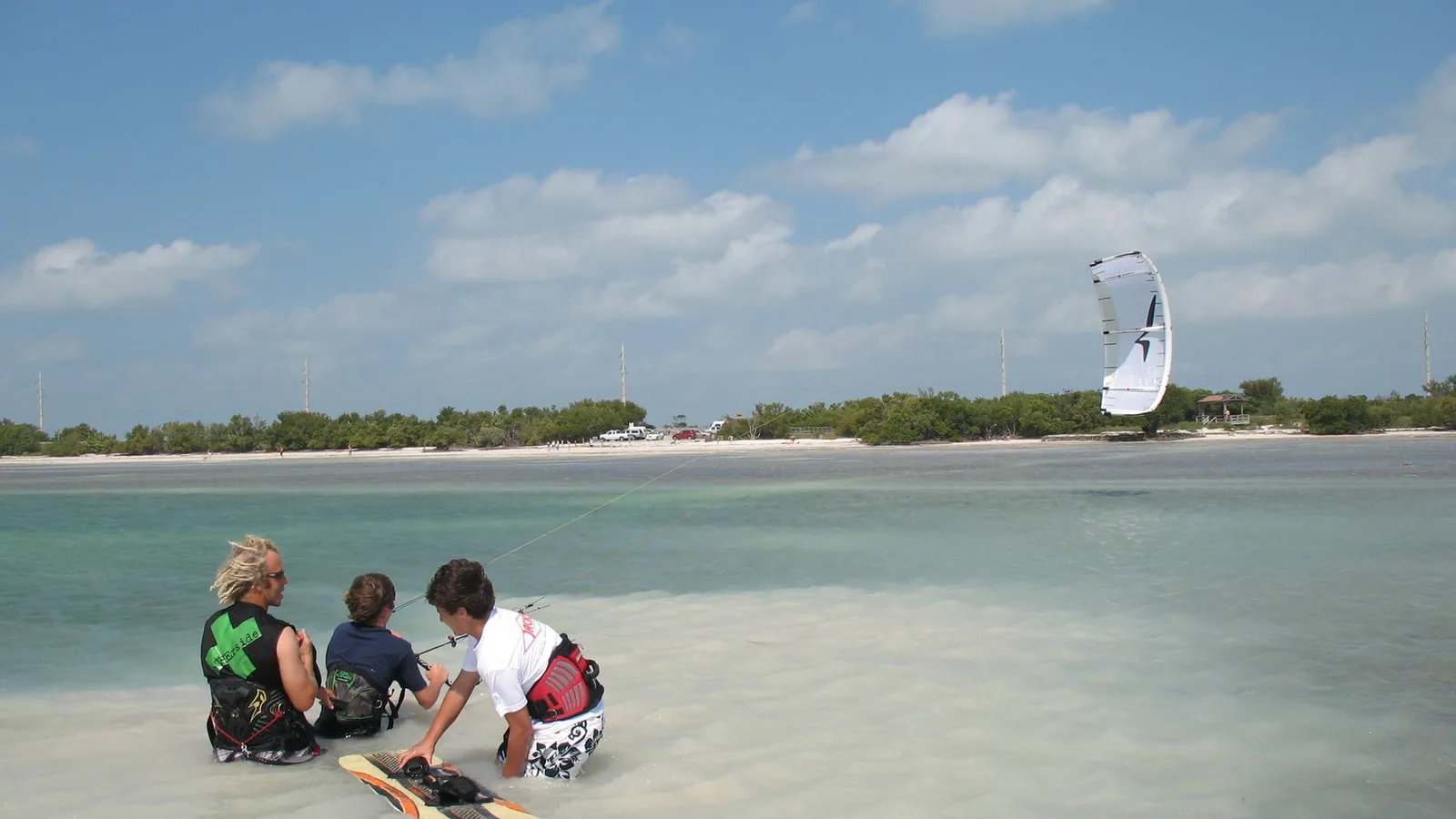
Reef-protected, turquoise and shin-to-waist deep for a long way out. Anne's Beach at mile marker 72 in Islamorada, Coco Plum and Sombrero in Marathon, Smathers and Higgs in Key West. The season is October to May at 15 to 25 knots; summer goes light enough to be big-kite territory. Water runs about 21 °C in winter to 29 °C in summer.
The hazards are the ones flat water always hides: shallow coral and seagrass, flats-boat and charter traffic, and current in the channels. At Smathers specifically, there are power lines and a road directly behind the launch — launch toward the water, every time.
We found no Key West or Monroe County kitesurf ordinance. The city's own Smathers Beach page lists opening hours and parking and nothing about watersports. That is a documented absence rather than documented permission — but note the statewide airport rule below does bite here, because Smathers sits alongside Key West International.
Shallow Gulf and bay flats, working on winter frontal northerlies and north-easterlies and a summer south-westerly sea breeze. Watch seagrass and oyster bars at low tide, and ship-channel traffic and current in the passes. The park is open 7 a.m. to sunset.
Local schools consistently describe the same site practice: riding is allowed across the island except North Beach inside the no-boating buoys, including the lagoon; stay out of swim zones; do not fly a kite over beach users; launch from the far north point; be out before sundown. We could not find any of that in Pinellas County code — treat it as ranger-enforced practice that is strictly enforced, rather than as an ordinance we can cite.
Santa Rosa Sound gives protected flat water with real fetch; the Gulf side gives wave-kiting and modest surf on frontal days. The season runs on afternoon sea breezes through the warm months and frontal wind autumn to spring.
The Panhandle is a different climate from South Florida and people get caught out. Winter water here runs in the mid-50s Fahrenheit — around 13 °C — which is a full wetsuit, not a shorty. Rip currents are the single biggest weather-related killer on this coast. Santa Rosa County's park rules ordinance mentions no watersports rule of any kind; another documented absence.
The best combination of wave-kiting and genuine surf in south-east Florida — Carlin Park, Juno Beach access 33. Open Atlantic exposure to north-easterly and easterly wind swell from winter fronts, with a summer south-easterly sea breeze of 10 to 20 knots. October to May, most consistent December to February.
Intermediate and above. Strong current, and deep water immediately off the beach at Juno — local advice is to walk out around twenty metres before riding. Any westerly component makes this dangerous: it is offshore, with no way back.
Florida's most recognised surf zone. First Peak sits next to the north jetty; Monster Hole is the outside bar. Cocoa Beach is the consistent, forgiving option and Sebastian is the quality one. It works on north-easterly or easterly swell with a south-westerly or westerly wind, and the days worth travelling for come from winter nor'easters and hurricane swell.
The hazards are inlet hazards: strong tidal current, jetty rips, heavy fishing pressure on the jetty and boat traffic in the channel. Sebastian Inlet is a Florida state park, so launching and closed areas are set park by park under the state's general rules rather than by a kitesurf-specific scheme.
The most consistent beach break in Florida, working off the sandbars around Ponce Inlet, and capable of double-overhead on hurricane swell. Beginner-friendly on small days and genuinely advanced when the inlet current runs.
Volusia County has real, published surf-zone rules, and they are simple: designated surf zones apply from 9:30 a.m. to 5:30 p.m., from the Saturday before Memorial Day through Labor Day. Outside those dates and hours, surfing is allowed along the whole beach. Surfing is never permitted within 300 feet of a pier, in any direction, or in an area designated for personal watercraft. Lifeguards may close an area to surfers when surfing would endanger bathers.
Those rules name surfing. They do not mention kitesurfing or windsurfing, and whether a kiteboard is treated as a surfboard for enforcement is not something we could establish.
This is where most Florida kite content goes wrong, so it is worth being precise. The City of Miami Beach kiteboarding ordinance and the Crandon Park access regime are completely different instruments — different authority, different beach, different rules. Neither one tells you anything about the other.
The city codifies kiteboarding at §82-468, and it is strict. Launching, entering and leaving the water are permitted only in designated areas: the stretch running 125 feet south of the northern boundary of 25th Street, and non-restricted swim areas north of 29th Street. 76th Street is reserved for lessons run by city-approved concessionaires.
Every operator other than a lesson student must hold a current Level 3 certification from IKO, IKA or PASA, and since October 2019 must produce a city-issued permit on demand and display city-issued identification on the board or kite at all times. The permit costs $46 and lasts five years. Watercraft other than surfboards and skimboards must stay 300 feet off the mean high water mark, and riders must keep 50 feet from bathers and swimmers.
The penalties are not nominal: civil fines of $500, $1,000, $2,000 and $5,000 for a first through fourth offence within six months, with the fourth also revoking the permit. Giving kiteboarding lessons outside a city concession agreement is a criminal matter — paid or unpaid — carrying a fine up to $500 and up to thirty days in county jail.
One honest caveat. The city's own Ocean Rescue page states riders must stay north of 29th Street except at 25th Street, keep 300 feet from shore, and stay 400 feet from any lifeguard stand. That 400-foot rule does not appear in the codified ordinance text we read, which instead sets a 50-foot separation from bathers. Both are official City of Miami Beach sources and they do not fully agree; we are reporting both rather than quietly merging them.
Crandon is a Miami-Dade County park, and kiteboarding there is managed through the park's watersports concession rather than by ordinance — the county's general park rules contain no kiteboarding provision at all.
Nearly every kite-travel site describes the same regime: sign in at the operator's truck, show Level 3 certification and insurance, collect a daily pennant on a first-come basis, a 25-rider cap on the water, a marked entry channel between two named lifeguard stands, and specific permitted dates that exclude summer weekends.
Those details belong to a concession that changed hands. In March 2026 Miami-Dade recommended a different operator for the Crandon watersports concession on a five-year contract. Neither the county nor the new concessionaire currently publishes access rules, rider caps, a certification requirement or a season. So we are not going to print the old numbers as though they were this year's. What remains verifiable from the county is narrower: no flotation devices on the beaches, and personal paddleboards and kayaks may not launch from the beach — they must go from the marina, unless you are out with the concession or an EcoAdventures tour.
Practical advice: contact the current Crandon watersports concession before you travel, and do not assume a rule you read on a spot guide still holds.
Florida Statutes §327.37(6) prohibits kiteboarding or kitesurfing within an area extending one mile along the centreline of an airport runway, half a mile wide, unless otherwise permitted under federal law. This is the only statewide kitesurf-specific law we found, and it matters more here than it would in most states — several Florida kite beaches sit next to airports, Smathers Beach and Key West International being the obvious pair.
Worth knowing before a ranger explains it to you. Under Coast Guard rules a paddleboard is classified as a vessel except when used within a swimming, surfing or bathing area. Once it is a vessel you need a USCG-approved wearable life jacket per person on board — mandatory to wear under age six — a whistle or horn audible for half a nautical mile, and a white light from sunset to sunrise or in restricted visibility. Non-motorised vessels under 16 feet do not need registration.
Biscayne National Park does, specifically. Its current compendium prohibits surfboards, kite boards and other wind-propelled rigid devices in all marked navigational channels. Several harbours and anchorages within the park are also closed to swimming and snorkelling. There is no permit scheme — it is a location-based prohibition.
Seagrass rules do not. Florida's statewide seagrass boating-restricted areas target internal-combustion vessels with external propellers, and expressly allow craft propelled by poling, paddling or floating through with no restriction. Site-level rules, like Crandon's own prohibition on riding over seagrass beds, are a separate matter and do apply.
Manatee zones are ambiguous for boards, and we are not going to resolve it for you. Manatee protection zones are established under the Manatee Sanctuary Act and implemented by rule. The wildlife commission's own material describes them in terms of restricting the speed and operation of vessels. A designated no-entry zone appears to exclude all vessels, powered or not, naming sailboards, surfboards and rafts — but not kiteboards. Speed zones are a motorboat instrument; a marked no-entry zone is not. Treat a posted no-entry zone as closed to you.
Call 911 anywhere in Florida. On the water, the US Coast Guard monitors VHF channel 16 continuously. Beach patrol is municipal or county rather than statewide — Miami Beach Ocean Rescue and Volusia County Beach Safety are separate services with their own numbers.
Miami Beach flies a flag system that is not the British RNLI scheme and must not be read as one: red with a crossed-out swimmer means the water is closed, red means high hazard, yellow medium, green low, and purple means dangerous marine life.
Florida leads the United States for lightning deaths, and it is not close. Over 1959 to 2007 the state recorded 449 deaths and 1,788 injuries — an average of nine killed and thirty-nine injured a year — and ranked first nationally by a margin of more than two to one over the next state. The interior sees 80 to 90 thunderstorm days a year. The worst months are May to September, peaking in the early-to-mid afternoon.
That timing matters for riders, because it is the same window as the summer sea breeze. The peninsula heats faster than the water on either side, both coasts push a sea breeze inland, and the two collide over the interior — which is what builds the daily afternoon storms. The wind you came for and the lightning arrive together.
On the northern Gulf coast, rip currents have caused more deaths since 2002 than flooding, tornadoes, lightning and tropical storms combined — the single biggest weather-related killer on that stretch of coast. Nationally, most surf-zone fatalities in a given year are attributed to rip currents, and Florida carries a meaningful share of them.
New Smyrna's reputation is real and statistically grounded, and also more modest than the headlines. The International Shark Attack File recorded 11 unprovoked bites in Florida in 2025 — more than any other state, but below Florida's own five-year average of 18. Volusia County accounted for six of them, roughly 54% of the state's total and well below its 2021 peak. There were no fatalities in Florida in 2025. Most incidents are minor bites in murky, baitfish-rich water near an inlet.
Atlantic hurricane season runs 1 June to 30 November, with a statistical peak on 10 September and roughly 85% of tropical cyclones forming across August, September and October. A recent average season produces about fourteen named storms, seven hurricanes and three major hurricanes.
For a rider, that season cuts both ways. It is the source of the best surf on the Atlantic coast — the long-period swell that arrives September to November is what New Smyrna and Sebastian are waiting for all year. It is simultaneously the worst kite window: light and fickle wind, daily lightning, and storm risk.
If you are coming to kite, come in the cool season: November to April, with October–November and March–May giving the best odds of both wind and comfortable water, and December to February the windiest but coldest.
Water temperature splits the state in half. Miami runs from about 22 °C in February to 30 °C in August; the Keys from roughly 21 °C to 29 °C. The Panhandle in winter is a different proposition entirely at around 13 °C. Rather than give you a thickness here, put your number into our wetsuit thickness guide — it keeps that figure in one place so it cannot drift.
What riders ask most before heading to Florida.
Yes. The city requires a current Level 3 certification from IKO, IKA or PASA, plus a city-issued permit produced on demand and city ID displayed on your board or kite. The permit is $46 and lasts five years. Fines run from $500 to $5,000 for repeat offences, and teaching without a city concession agreement is a criminal offence carrying possible jail time.
We can't tell you reliably, and neither can the guides quoting a 25-rider cap and a pennant system — those belong to a concession that Miami-Dade replaced in March 2026. The new operator publishes no access rules. Contact the current Crandon watersports concession before you travel rather than trusting a spot guide.
On the Atlantic coast from around Palm Beach north, yes, in a modest way — it is wind-swell dominated and typically small, with the real days coming from winter nor'easters and hurricane swell. The Gulf coast and the Keys are not surf destinations; they are excellent flat-water riding and have no groundswell source.
The cool season, roughly November to April, driven by cold fronts crossing the peninsula. Between fronts, easterly trades of 18 to 22 knots can run for days. Summer is the weakest wind and the highest lightning risk, in the same afternoon hours.
Less than the reputation suggests, though the reputation is grounded in real numbers. Florida recorded 11 unprovoked bites in 2025 — the most of any state, but below its own five-year average — of which six were in Volusia County, and none were fatal. They are overwhelmingly minor bites in murky water near the inlet. Lightning and rip currents are far more likely to hurt you.
No. Florida law prohibits kiteboarding within a corridor one mile along an airport runway centreline and half a mile wide, unless federal law permits it. This genuinely affects real spots — Smathers Beach in Key West sits next to Key West International.
Two of these are real local rules that we found reported but could not verify against a primary source, so we are listing them here rather than stating them as rules. Treat both as "a restriction probably exists — check locally".
Florida's rules are set city by city and county by county. Never carry one beach's rule to the next: Miami Beach, Crandon Park and Volusia County are three unrelated regimes within a couple of hours of each other.
In a sea emergency, contact the US Coast Guard (VHF channel 16) or call 911.