

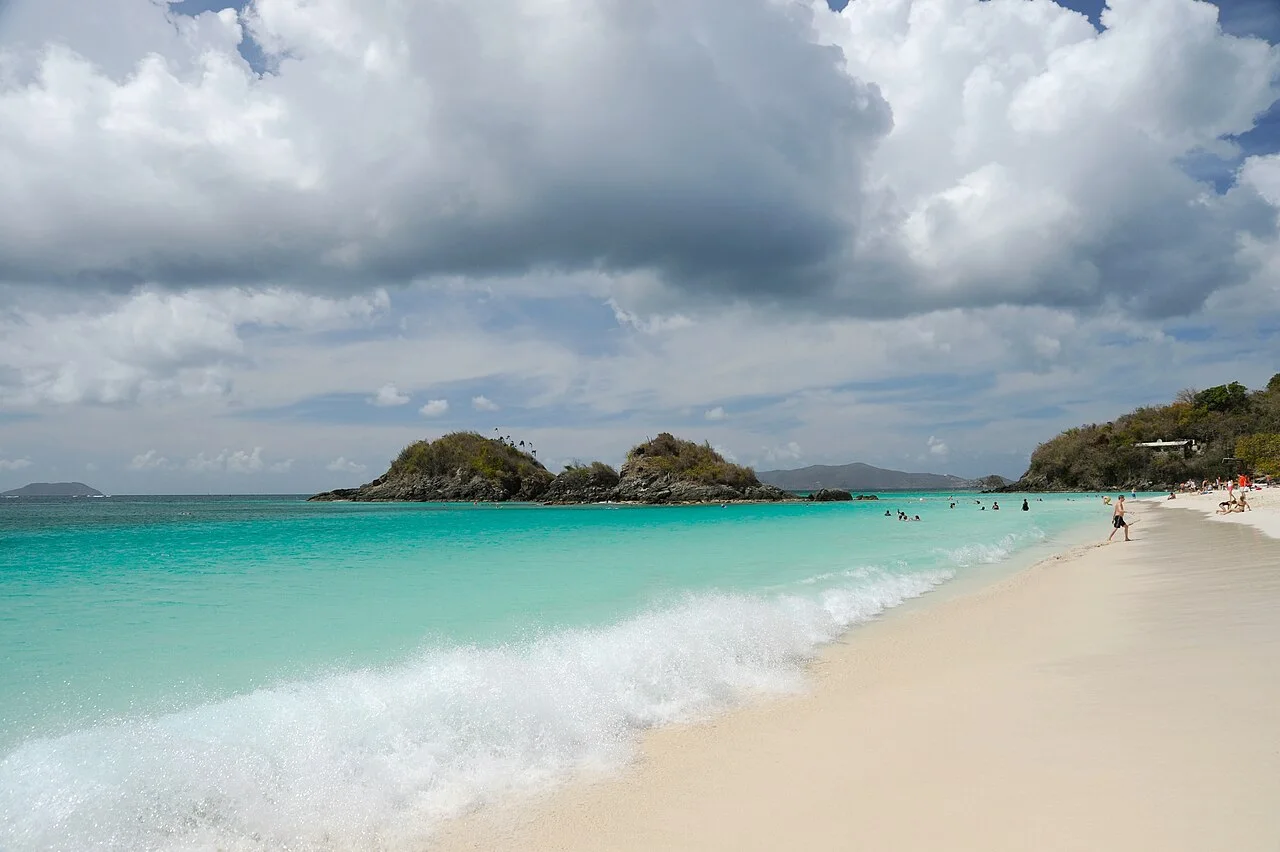
📍 US Virgin Islands, United States
Photo: Fred Hsu / Wikimedia Commons, CC BY-SA 3.0
St. Croix has the wind and the reef breaks. St. Thomas has a school and open water. And two federally protected areas — one of them a headline attraction — ban kiting and surfing outright.
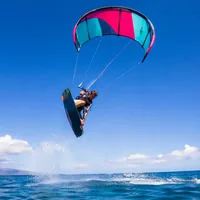
Trade winds down a 25-mile east-west island, a named kite operator, and four documented reef breaks.
St. Croix arrow_forward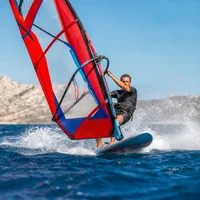
A real kite school based on St. Thomas, and a national park on St. John that restricts kiting, windsurfing and surfing in its own waters.
St. Thomas & St. John arrow_forward
Buck Island Reef National Monument bans surfing and kite surfing entirely. Read this before you pack a board for a Buck Island trip.
Read this first arrow_forwardThe USVI sits inside the Caribbean trade-wind belt, with a steady easterly flow from the ENE to the ESE most of the year. We did not find a NOAA buoy record for the islands to measure this the way our Puerto Rico page measures Rincón and San Juan, so the figures below come from the US Virgin Islands' own tourism sources rather than raw instrument data — treat them as commercial, not primary.
| Period | What local sources say |
|---|---|
| November–March | The best wind window, per St. Croix's own tourism board |
| December–January | The strongest wind, sometimes called the "Christmas winds" |
| June–August | Lighter but the most consistent wind, per the same source |
| June 1–November 30 | Atlantic hurricane season, clustering around August–September |
One commercial weather source gives a broader range of roughly 10–20 knots most of the year, rising to 15–25 knots in winter, with gusts reported "well over 30 knots." We could not independently verify the gust figure against a second source, so it is reported as a single-source claim rather than a fact.
St. Croix's tourism board describes the island's geography — about 25 miles long by 7 miles wide, running east to west — and says the ENE to ESE trade winds align with that axis, making it well suited to kiteboarding. Cruzan Kites is the operator named on the island's tourism page, offering kiteboarding, kitesurfing, windsurfing and SUP.
Search demand favors "surfing" roughly 5 to 1 over kite or wind terms on the phrases we measured, which fits a modest surf scene. Surfline lists four named St. Croix breaks: Fareham, Judith's Fancy, Vacuums and Grassy Point. The source did not state exact seasonal windows beyond the general Caribbean pattern of winter north/north-east swell, so we will not invent specific months.
Anecdotal local discussion also names Cane Bay, Rainbow Beach and Dorsch Beach for windsurfing and kiting, but these come from informal community sources rather than an official guide or the operator's own materials — treat them as starting points for local inquiry, not as a confirmed spot list.
Kite VI (kite.vi) is a currently operating kiteboarding and wing-foiling school based on St. Thomas, confirmed via its own website; it offers rentals, lessons, and private catamaran-based kite trips around the wider Caribbean rather than fixing on one beach. That finding is plain: we could not source a single named, dedicated kite or windsurf beach on St. Thomas the way St. Croix has its documented breaks. If a spot name exists locally, it did not appear in any source we could verify; we are reporting the gap rather than guessing at one.
Most of St. John's shoreline sits inside Virgin Islands National Park (VIIS) and the adjoining Virgin Islands Coral Reef National Monument (VICR). Their Superintendent's Compendium — the document that sets a national park's own local rules under federal authority — directly restricts the sports this page is about. See the rules section below for exactly what it says and where.
The USVI is a US territory, so the federal baseline described on our United States guide applies here too; a paddleboard or similar craft used beyond the limits of a swimming, surfing or bathing area counts as a vessel under 33 CFR 175.15, which requires a Coast Guard-approved wearable PFD per person, plus a sound-signalling device and a light after dark. We found no USVI-specific carve-out from that federal rule, and no Virgin Islands Code or Department of Planning and Natural Resources regulation written specifically for kiteboards, windsurfers or personal watercraft, distinct from the federal baseline.
Buck Island, off St. Croix, is one of the territory's best-known attractions and carries a clear prohibition. The National Park Service's own visitor page states it plainly: "Water skiing, jet skiing, fishing of any kind, surfing and kite surfing are prohibited." Anchoring in the lagoon is also prohibited; boats must pick up a mooring, and most visitors arrive with one of the authorized concessionaires departing from Christiansted Waterfront or Green Cay Marina rather than a private vessel. This is a full, park-wide ban on surfing and kite surfing — not a zone-specific restriction — so a board has no place at Buck Island regardless of conditions.
The Superintendent's Compendium effective 14 January 2026 sets out, in its own numbered items, exactly what is and isn't allowed in the park's Boat Exclusion Areas — nearshore zones marked on the water with white oblong buoys reading "NO BOATS" or an orange "boats keep out" diamond. Item 44 prohibits, inside those areas, motorized vessels, vessels under sail (which the compendium names as including windsurfers), surfing, skim boarding, and hook-and-line fishing.
Item 47 addresses kite surfing directly and in two parts: "Recreational kite surfing is prohibited in boat exclusion areas and mooring areas. Commercial Kite surfing activities are prohibited within VIIS and VICR waters." Read that second sentence carefully — it is not limited to the boat-exclusion zones. Any commercial kite surfing operation is banned across the whole of the park and monument's waters, not just inside the marked areas.
Trunk Bay and Hawksnest Bay, two of St. John's best-known beaches, are named in the park's own materials as carrying Boat Exclusion Area status. The compendium does not publish one single, complete list of every such area on one page — they are designated and marked on the water itself, bay by bay — so we will not guess at a complete list beyond the two named there.
Hurricane season runs 1 June to 30 November, the same Atlantic season that governs Puerto Rico and the US Gulf and Atlantic coasts, with local sources pointing to August and September as the most active stretch. Reef and coral hazards are common throughout the territory, as on any Caribbean reef coast — reef booties are a sensible precaution around St. Croix's rocky and reef breaks.
Emergencies: 911. At sea, US Coast Guard Sector San Juan is the sector covering USVI waters — we found no evidence of a separate, USVI-based Coast Guard sector — reachable on VHF channel 16. Inside Virgin Islands National Park specifically, the National Park Service also publishes a direct line, (340) 776-9110, for park land and waters.
What riders ask most before heading to the US Virgin Islands.
No. Buck Island Reef National Monument, off St. Croix, bans surfing and kite surfing outright, along with water skiing, jet skiing and fishing. It's a full, park-wide ban, not a zone-specific one — leave the board on the boat if you're going out to Buck Island.
In some places, but not everywhere. Virgin Islands National Park and the Virgin Islands Coral Reef National Monument prohibit recreational kite surfing, windsurfing and surfing inside marked Boat Exclusion Areas and mooring fields — Trunk Bay and Hawksnest Bay are two named examples. Commercial kite surfing operations are banned across the whole park and monument, not just those zones.
There's a real, currently operating school — Kite VI — but we could not source a single named, dedicated beach the way St. Croix has its documented breaks. That's a genuine gap in what's publicly documented, not a claim that nothing exists.
The same federal rule applies here as in the rest of the US: once your board is used beyond the limits of a swimming, surfing or bathing area, it counts as a vessel under 33 CFR 175.15, which requires a Coast Guard-approved wearable PFD per person aboard. We found no USVI-specific exception to that rule, and no separate territorial regulation written specifically for kiteboards or windsurfers.
St. Croix's own tourism board names November through March as the best window, with December and January the strongest — sometimes called the "Christmas winds" — and June through August the most consistent, if lighter. We did not find buoy data to verify this independently, so treat it as a commercial, not a measured, claim.
In an emergency call 911; at sea, the US Coast Guard monitors VHF channel 16.