
📍 Pennsylvania, United States
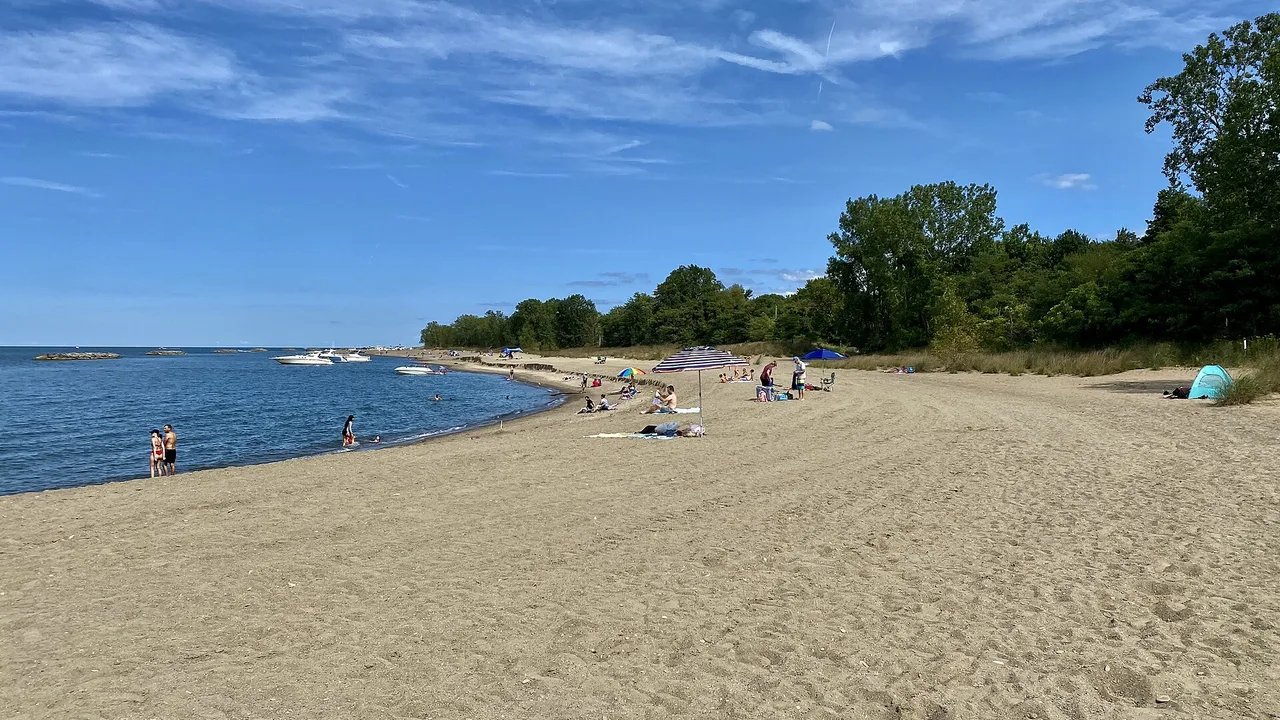
A scenic shot, not an action photo: no suitably licensed photograph of anyone surfing, kiteboarding or windsurfing at Presque Isle was found on Commons in this pass. Photo: Andre Carrotflower / Wikimedia Commons, CC BY-SA 4.0
Presque Isle State Park, on a sand spit enclosing Presque Isle Bay near Erie, is Pennsylvania's entire Lake Erie coast in practical terms.
Erie County contains Pennsylvania's entire Lake Erie frontage; it's the shortest stretch of any US state that touches a Great Lake. Almost all the water-sports interest concentrates within Presque Isle State Park, a recurved sand spit formed on a glacial moraine and continually reshaped by wave action and longshore drift, per Pennsylvania DCNR's own history page. The name is French for "almost an island," and DCNR's own account says the park "has been a real island several times" when storms have breached its narrow neck. That geography — a spit curling around a sheltered bay, rather than open shore — is what makes this page different from the rest of this guide's Great Lakes coverage.
Search demand for board sports in Pennsylvania is very low: every kiteboarding, kitesurfing and windsurfing term we measured came back at a flat 0/mo, and "surfing pennsylvania" itself sits at only 10/mo. That low search volume is not because nothing is documented — DCNR's own park rules permit surfing park-wide and name a real wind/kite spot — but because Pennsylvania's sliver of shoreline is simply too small to register much search volume either way. This page states what is actually documented, at the scale it actually exists.
DCNR's own rules permit surfing at every lakeside beach, year-round, outside guarded swim zones and Gull Point's seasonal closure — a permission, not a single named break.
Presque Isle's surfing rules arrow_forward
DCNR's own beaches page names this one spot — not Beach 11 or Beach 6 — as "popular with kite flyers and wind surfers." Zero measured search volume, but a real, primary-sourced spot.
Sunset Point in detail arrow_forward
Pennsylvania's own regulation names paddleboards and sailboards separately, and treats them very differently — read the statute, not a paraphrase.
The PFD law arrow_forwardAn NWS Cleveland text product pulled directly the day this page was built, plus NDBC/NOAA station 45167, off Erie, PA.
The Erie County shore of Pennsylvania is inside NWS Cleveland's Great Lakes rip-current warning area, even though the Cleveland office is in Ohio. Its rip-current page states its coverage runs along "the shoreline of Lake Erie from Maumee Bay to Ripley, NY," a span that covers the entire Pennsylvania shore between those points. The page's general mechanism applies here the same as it does on Ohio's own Lake Erie coast: "Rip currents can occur at any beach with breaking waves, including Great Lakes beaches."
A real, dated example, not a hypothetical: a Coastal Hazard Message issued by NWS Cleveland at 3:42 AM EDT on September 20, 2026 — the day this page was built — placed zone PAZ001, "Northern Erie," under a Beach Hazards Statement running from that Monday morning through Wednesday evening: "High risk of rip currents expected... Wind and wave action will cause currents on the lakeshore. Swimmers should not enter the water. Currents can carry swimmers away from shore through a sand bar and along structures extending out into the lake." Four Ohio counties (Lucas, Ottawa, Erie, Lorain, Cuyahoga) were under the identical statement the same morning. This is quoted as a concrete, live example that Presque Isle's shore is a real part of this warning area — not as a permanent climate statistic.
For water temperature, the nearest dedicated station is NDBC/NOAA 45167, the "Erie Nearshore Buoy," at 42.185°N, 80.135°W, owned and maintained by the Regional Science Consortium. Its live feed, pulled directly the day this page was built, reported a water temperature of 22.2°C (72°F) on September 20, 2026 — a real, dated reading, not a seasonal average. We did not pull a verified multi-year climate-normals table specific to Erie, PA this session (Ohio's equivalent NWS Cleveland table covers Toledo, Cleveland and an "Erie" column that our own direct check found refers to Erie, Ohio, not Erie, Pennsylvania — a distinction worth getting right rather than borrowing the wrong city's number).
Presque Isle is also the only Lake Erie-facing Pennsylvania state-park beach still staffed with lifeguards — a state legislative hearing record quotes DCNR's own reasoning for that as "because of potential hazards related to the lake's currents," surfaced via search rather than read by us directly this session. Our wetsuit thickness guide converts a water temperature into a suit recommendation.
DCNR's own "Surfing at Presque Isle State Park" page, read directly and quoted in full below.
Pennsylvania DCNR's own rules state plainly that surfing is allowed "at all beaches, on the lake side of the park year-round." That is a park-wide permission, not a single named break — Presque Isle doesn't have a documented "the surf spot" the way Ohio's Edgewater Park does. Three specific limits apply on top of that permission, quoted directly from DCNR's own page:
A search turned up a local nonprofit page describing specific designated surfing areas at Beach 1, Beach 10 and the North Pierhead — but that page returned only a bare parking-page redirect when we tried to load it directly this session, so those specific named breaks could not be verified and are not repeated here as fact. What's confirmed directly is DCNR's own park-wide rule above.
Gear locally: Presque Isle Boat Rental (814-838-3938), based inside the park itself, rents paddleboards, kayaks and canoes on Presque Isle Bay — confirmed directly from its own site. Lake Erie Outfitters, on Peninsula Drive at the park entrance, is described by its own site and by Erie's tourism board as a kayak/SUP rental "right on the doorstep" of the park — real and plausible, though not independently verified beyond those two sources. A local board shop, The Isle Surf & Skate, has genuinely conflicting signals on whether it's still open — a 2026 event listing describes it as active, an independent 2025 post claims it closed — so it isn't presented here either way.
DCNR's own Presque Isle beaches page, read directly — and a correction to this page's own starting assumption.
DCNR's current beaches page, read directly, names exactly one location for wind/kite activity: Sunset Point, next to Beach 10 (Budny Beach), described in DCNR's own words as an area "popular with kite flyers and wind surfers." Erie's own tourism board corroborates the same beach independently, describing Beach 10 as "popular for flying kites and windsurfing."
Two other named beaches are sometimes assumed to be Presque Isle's board-sports beaches, and DCNR's own page says otherwise. Beach 11 (Kohler Beach) is described as "the most sheltered beach" — shallow water, a large sandy beach, a smoke-free family beach with a bathhouse. Beach 6 (Lyons Beach) is a general-recreation beach with sand volleyball courts. Neither is described by DCNR as a surf or wind location; Sunset Point/Beach 10 is the one DCNR actually names.
No DCNR document names a designated kite-launch zone the way some other states in this guide do — Sunset Point is a described location, not a marked launch corridor. Search volume for every kiteboarding, kitesurfing and windsurfing term we measured for Pennsylvania came back at 0/mo: real activity that simply doesn't register at Pennsylvania's scale of search demand, the same way this page's surfing terms register thin but not zero.
58 Pa. Code §§ 109.2 and 97.1, read directly at pacodeandbulletin.gov.
Pennsylvania's regulation, 58 Pa. Code § 109.2 ("Paddleboards and sailboards"), defines and treats these two craft separately — and the two rules aren't the same. A paddleboard is defined as "a boat with no freeboard propelled by a paddle, oar, pole or other device." Read directly: "It is unlawful for a person to operate or attempt to operate a paddleboard on waters of this Commonwealth without having a United States Coast Guard approved wearable personal flotation device on board for each person... This prohibition does not apply to persons operating or attempting to operate a paddleboard in designated swimming, surfing or bathing areas."
A sailboard's rule is stricter: the PFD must be worn, not just carried. § 109.2 defines a sailboard as "a type of single or double hulled boat equipped with an articulating mast and designed to be operated by a person standing on the board and maneuvering through the trim of the hand-held sail and distribution of body weight on the board." Its rule, read directly: "It is unlawful for a person to operate or attempt to operate a sailboard on waters of this Commonwealth unless the person is wearing a United States Coast Guard approved wearable personal flotation device. Inflatable personal flotation devices may not be used to meet this requirement." A windsurfer in Pennsylvania must wear a PFD at all times, on the water, full stop — a paddleboarder only has to have one on board, and not even that inside a designated swimming, surfing or bathing area.
§ 97.1 ("Personal flotation devices") sets the general and seasonal rules underneath both craft. Read directly: one wearable PFD per person is required on board generally, plus a throwable device on boats 16 feet or longer (canoes and kayaks of that length are exempt from the throwable requirement). From November 1 through April 30, the rule tightens from carriage to actual wear: "a person shall wear a Coast Guard approved wearable PFD while underway or at anchor on boats less than 16 feet in length or any canoe, kayak or paddleboard" — paddleboards are named explicitly in that cold-weather wear rule. Separately, and year-round, children 12 and under must "wear an approved wearable PFD while underway on any boat 20 feet or less in length and all canoes, kayaks and paddleboards."
A plain surfboard — no paddle, oar, pole or comparable device — is not named anywhere in Chapter 109, and whether it falls inside the paddleboard definition above is genuinely unaddressed by the statute text; this page doesn't resolve that for you. A self-powered kiteboard isn't named either — Chapter 109's "boat-towed watersports" PFD rule covers a rider being towed BY a boat, not a kiteboarder riding under wind power alone. If you have an emergency on this shore, DCNR's own page says: call 911 and contact a park employee. For the federal PFD baseline that fills gaps like the plain-surfboard question above, see our United States guide.
Yes — DCNR's own rules permit surfing at every lakeside beach in the park, year-round, outside guarded swim zones during operating hours and outside the Gull Point Natural Area during its April 1-October 31 closure. There's no single named "the" surf break here the way some other Great Lakes pages in this guide describe; it's a park-wide permission.
DCNR's own beaches page names Sunset Point, next to Beach 10 (Budny Beach), as an area "popular with kite flyers and wind surfers" — corroborated independently by Erie's tourism board. Beach 11 and Beach 6, sometimes assumed to be the park's board-sports beaches, are described by DCNR as a sheltered family beach and a general-recreation beach respectively, not as surf or wind spots.
It depends on the craft. Pennsylvania's regulation requires a sailboard (windsurfer) rider to wear a Coast Guard-approved PFD at all times, with inflatables not accepted. A paddleboard only needs a PFD carried on board — and not even that inside a designated swimming, surfing or bathing area — except from November 1 to April 30, when the general cold-weather rule requires it to be worn. A plain surfboard isn't named in the statute at all.
Pennsylvania's Erie County shore sits inside NWS Cleveland's Great Lakes rip-current warning area, and Presque Isle is the only Lake Erie-facing Pennsylvania state-park beach still staffed with lifeguards specifically because of the lake's currents, per a state hearing record. A live NWS Coastal Hazard Message the day this page was built placed the Erie County zone under a high-risk rip-current warning, with the same sandbar-and-structure current mechanism documented on Ohio's Lake Erie shore.