

📍 Ohio, United States
A scenic shot, not an action photo: no suitably licensed photograph of anyone surfing or kiteboarding on Lake Erie was found on Commons in this pass. Photo: Erik Drost / Wikimedia Commons, CC BY 2.0
Edgewater Park, in Cleveland, is Ohio's documented surf spot. Headlands Beach, near Mentor, is its documented wind and kite spot. They aren't interchangeable.
Lake Erie is the shallowest, warmest and stormiest of the five Great Lakes — a combination that, per the National Weather Service's own Cleveland forecast office, makes it unusually prone to rapid, wind-driven water-level swings and to rip and structural currents at exactly the kind of piers, breakwalls and jetties that line Cleveland's lakefront. That's also what builds Lake Erie's waves: real, storm-driven surf, most reliable in fall and winter, not summer — the opposite seasonal pattern from most of the ocean coasts in this guide. Search demand backs up which sport leads here: "surfing" terms beat "kiteboarding" and "kitesurfing" terms by roughly 8 to 1 in Cleveland and up to 21 to 1 statewide, on Keywords Everywhere data measured for this page.
Edgewater Park, a Cleveland Metroparks lakefront reservation about five miles west of downtown, ranks as the state's most thoroughly documented surf location. It hosts a genuine local community that surfs Lake Erie's breakwall-and-jetty swell, corroborated by multiple independent surf-forecast sites and journalism pieces, not a single blog. Headlands Beach State Park, Ohio's longest natural beach near Mentor, is the state's documented wind and kite spot instead. Windsurfing measures a real, if modest, third signal of its own — well ahead of either kite term, but well behind surfing.
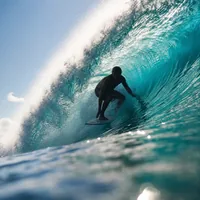
Cleveland Metroparks' own beach rules, a surf community that's well documented, and a seasonal wrinkle — summer lifeguards can close the swim zone to boards that are otherwise open to it the rest of the year.
Edgewater Park rules arrow_forward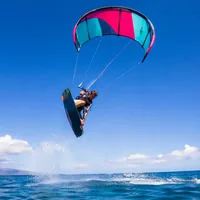
This state park is Ohio's longest natural beach and a recorded wind/kite spot — its status appears in Ohio's administrative code, and its launch-zone details come from the kite community itself.
Headlands Beach in detail arrow_forward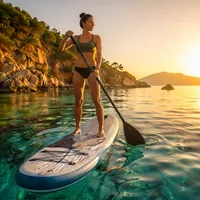
Ohio's shape is the mirror image of South Carolina's: it names sailboards and kiteboards as vessels outright — then exempts sailboards specifically, but not kiteboards, from the PFD rule that comes with being one.
The PFD law arrow_forwardNWS Cleveland's climate-normals page and NDBC Buoy 45164, located off the Cleveland shoreline.
The National Weather Service's Cleveland forecast office posts its monthly water-temperature normals for the water off Cleveland (1981-2010). Access the data directly instead of relying on a third-party estimate.
| Month | Average water temp (1981-2010) |
|---|---|
| January | 35 °F / 1.7 °C |
| February | 34 °F / 1.1 °C |
| March | 35 °F / 1.7 °C |
| April | 42 °F / 5.6 °C |
| May | 52 °F / 11.1 °C |
| June | 62 °F / 16.7 °C |
| July | 72 °F / 22.2 °C |
| August | 74 °F / 23.3 °C |
| September | 70 °F / 21.1 °C |
| October | 61 °F / 16.1 °C |
| November | 51 °F / 10.6 °C |
| December | 41 °F / 5 °C |
Most winters Lake Erie freezes near the shore, and by August the water warms into the low-to-mid 70s °F — a temperature curve unlike any ocean coast in this guide. Because of that, a full wetsuit, boots, gloves and a hood are standard gear for the fall/winter surf season the local community actually rides, per the journalism cited below. The nearest offshore station, NDBC Buoy 45164 ("Cleveland Buoy, OH"), sits at 41.748°N, 81.698°W in 22.6 m of water, owned and maintained by LimnoTech. It reports wind, wave height and period alongside water temperature, but we did not pull a verified multi-year wind/wave dataset from it this session — treat this as station identification, not a climate normal, for wind and wave.
NWS Cleveland's own rip-current guidance is explicit that this is not just an ocean hazard: "Rip currents can occur at any beach with breaking waves, including Great Lakes beaches." It names exactly the kind of structures that line Edgewater's shoreline: rip currents form "at low spots or breaks in sandbars, and also near structures such as groins, jetties and piers," and structural currents — a related, separate hazard found alongside those same structures — are "usually always present and are often dangerously strong." The advice is the same as any surf coast: "Only experienced surf swimmers should enter the water" when the risk is elevated, and rip currents "do not pull people under the water; they pull people away from shore." Our wetsuit thickness guide converts the water-temperature table above into a suit recommendation.
Cleveland Metroparks' beach rules page, presented verbatim — plus a search summary of the district's Code of Regulations describing those rules, flagged as such.
Edgewater Park is a Cleveland Metroparks lakefront reservation — a separate regional park district with its own governing board and its own Code of Regulations, not a City of Cleveland park. We searched for a City of Cleveland municipal ordinance about surfing, kiteboarding or windsurfing at this beach and found none; that absence isn't a gap but a jurisdictional matter, since the City doesn't control this stretch of shoreline.
Cleveland Metroparks' own current Edgewater Beach rules page, read directly, lists the following passages. "Obey Lifeguard instructions at all times," "No swimming when red beach flags are posted due to weather/safety conditions," "No flotation devices (only U.S. coast guard approved life jackets allowed)," and "No snorkels or scuba equipment." On paddling specifically, the same page states: "Paddling access follows along the rock jetty inside the buoys at the far side of the beach. Please stay clear of swim area." Surfing, kiteboarding and windsurfing aren't named on this particular page at all.
A search summary of the district's own Code of Regulations points to a more specific rule that we couldn't load and read ourselves — codelibrary.amlegal.com, which hosts it, returned a flat 403 on every attempt this session (the same bot-block Georgia's Tybee Island ordinance hit on a sibling code library). According to that summary, §743.02 prohibits "surfboards" and similar floating objects "in any locations specifically designed as swimming areas on Lake Erie," while §743.03 states "Sailboards are permitted, if the operator wears a type 1, 2 or 3 personal flotation device." If that summary is correct, the restrictions align with the seasonal pattern reported in the press below, with surfing permitted outside the posted swim zone and restricted inside it — but we're flagging this as COMMERCIAL-tier, sourced to a search summary, not our own read of the ordinance text.
What's genuinely well-corroborated is the surf community itself. Multiple independent surf-forecast sites (surf-forecast.com, surfing-waves.com, stormypetrel.surf) list Edgewater as a real, named beach break, describing a gradual sand-and-rock bottom best on north-to-northeast swell. Multiple independent journalism pieces — Cleveland.com, News5 Cleveland, Lake Erie Living, ideastream — separately describe a local surf community that gathers at Edgewater year-round, including in winter, when Lake Erie Living's own reporting states plainly: "the most popular place to surf in Cleveland is at Edgewater Park... fall and winter are actually peak seasons for the sport on Lake Erie." Cleveland.com's own March 2026 report adds the seasonal wrinkle directly: "summer lifeguards often prohibit surfing at the beach" — consistent with, though independent of, the swim-zone rule described above.
A direct reading of Ohio Admin. Code Rule 1501:46-1-03, along with the kite community's own documentation on launch zones.
Headlands Beach State Park, just outside Mentor in Lake County, contains Ohio's longest natural beach. That park's designation under Ohio's Division of Parks and Watercraft appears explicitly in Ohio Administrative Code Rule 1501:46-1-03 ("Areas administered as state parks"), where it is listed verbatim as "(26) Headlands beach, Lake." We searched for an ODNR-published hours/swimming-area page specific to Headlands and found one referenced by search, but our own attempts to load it returned a 404 — possibly a page our fetch tooling can't render rather than evidence it doesn't exist — so we're not quoting it here.
Headlands' status as a working kite/wind spot is documented by the kite community rather than by ODNR rule. Kiteforum's own spot page for "Lake Erie / Mentor Headlands" notes a launch area at the south end of the beach, against the park's southern boundary, best on west-to-southwest wind, and gives a plain safety instruction: "Keep your kite well out of the swimming areas," advising riders to stay upwind of the posted swim zone. The same page identifies the north end of the beach as a national wildlife preserve and a prohibited launch area — a geography-based no-go zone, not just a rider preference. Two independent spot directories (localkitespots.com, surfradar.info) list Headlands among Ohio's top wind/kite locations; surfradar.info's description reads: "Nice sandy beach. Used mostly for windsurfing and kiting." None of this is an ODNR rule naming a kite or wind zone by regulation — it's a real, working spot documented by the people who ride it, and treated as such.
Ohio Revised Code §1547.532, §1547.25 and §1547.24, and Ohio Admin. Code Rule 1501:47-1-22 were read directly and cross-checked against the state's Boat Operators Guide (Rev. 10/2024).
Ohio's shape is genuinely the mirror image of South Carolina's. Where South Carolina's statute defines surfboards and windsurfers out of its definition of "watercraft" entirely, Ohio's §1547.532 does the opposite — it names them as vessels, in so many words: "All of the following are exempt from registration under this chapter: Sailboards; Kiteboards; Paddleboards; Belly boats or float tubes." Being named in a registration-exemption list only makes sense if the craft is a vessel in the first place — Ohio's own official Boat Operators Guide (Rev. 10/2024) puts it in plain language: "Sailboards, kiteboards, paddleboards and belly boats or float tubes are exempt from registration and titling laws." Surfboards aren't on this list at all, and aren't defined as vessels anywhere we found — the same practical effect as South Carolina's exclusion, reached by omission rather than a stated carve-out.
Registration and the PFD-carriage rule, §1547.25, are separate; a registration exemption does not automatically remove the requirement to carry a PFD. Read directly: "no person shall operate or permit to be operated any vessel, other than a vessel exempted by rules" without carrying a PFD — one wearable device per person for anything under 16 feet, including paddlecraft, plus a throwable device for anything 16 feet or longer. Because §1547.532 defines a kiteboard and a paddleboard as vessels, those craft remain subject to this carriage rule unless they are specifically listed among §1547.25's exemptions.
Sailboards receive an additional, narrower exemption that kiteboards and paddleboards do not. Ohio Admin. Code Rule 1501:47-1-22 exempts a short, specific list from §1547.25's PFD-carriage rule: "Racing shells and rowing sculls; Sailboards; and those individual vessels given a written exemption by the chief of the division of parks and watercraft. Kiteboards and paddleboards are not on this list. So a windsurfer (sailboard) in Ohio is exempt from both registration AND the PFD-carriage rule; a kiteboarder or paddleboarder is exempt from registration only — on the statute's own structure, the PFD-carriage rule still applies to them, though we found no ODNR guidance document spelling out how that's enforced in practice for a kiteboard specifically, so we're stating the statutory structure, not a confirmed enforcement pattern.
Two further rules apply narrowly and do not cover ordinary surfing or kiteboarding. §1547.24 requires any child under 10 to actually wear a PFD on any vessel under 18 feet, and §1547.41 requires every person on a personal watercraft (jet ski), regardless of age, to wear one. Separately, §1547.18 requires a person engaged in towed watersports — water skis, a surfboard or a similar device — to wear a PFD "specifically designed for towed watersports" — a rule about being towed by a boat, not about surfing or kiteboarding under your own power.
If you have an emergency on this shore, call 911 or contact the Coast Guard on VHF channel 16. For the federal PFD baseline that fills gaps like this across every state, see our United States guide.
Yes — Edgewater Park in Cleveland has a real, documented, year-round surf community, corroborated by multiple independent surf-forecast sites and journalism pieces. Fall and winter are the peak season, per Lake Erie Living's own reporting, the opposite of most ocean coasts in this guide. A search summary of Cleveland Metroparks' own code (not independently confirmed by us) describes surfboards as restricted inside the posted swimming zone; Cleveland.com's own reporting separately notes that summer lifeguards can prohibit surfing at the beach.
Headlands Beach State Park, near Mentor, appears in the kite community's own spot guides as Ohio's documented wind/kite spot. The guides note a south-end launch area that is best on west-to-southwest wind, and they mark the beach's north end off-limits as a wildlife preserve. This is community documentation, not an ODNR-published kite-zone rule.
Classification depends on the type of craft, yielding an unusual outcome. Ohio's statute lists sailboards, kiteboards and paddleboards as vessels (just exempt from registration) — but a separate rule then exempts only sailboards, not kiteboards or paddleboards, from the state's general PFD-carriage requirement. Surfboards aren't defined as vessels at all, so that requirement doesn't reach ordinary surfing either.
NWS Cleveland's guidance makes clear that rip currents and structural currents are genuine hazards at Great Lakes beaches as well as the ocean — the same piers, jetties, and breakwalls that shape Edgewater's waves create those currents. Lake Erie is the shallowest and stormiest Great Lake, so conditions can build and change quickly.