

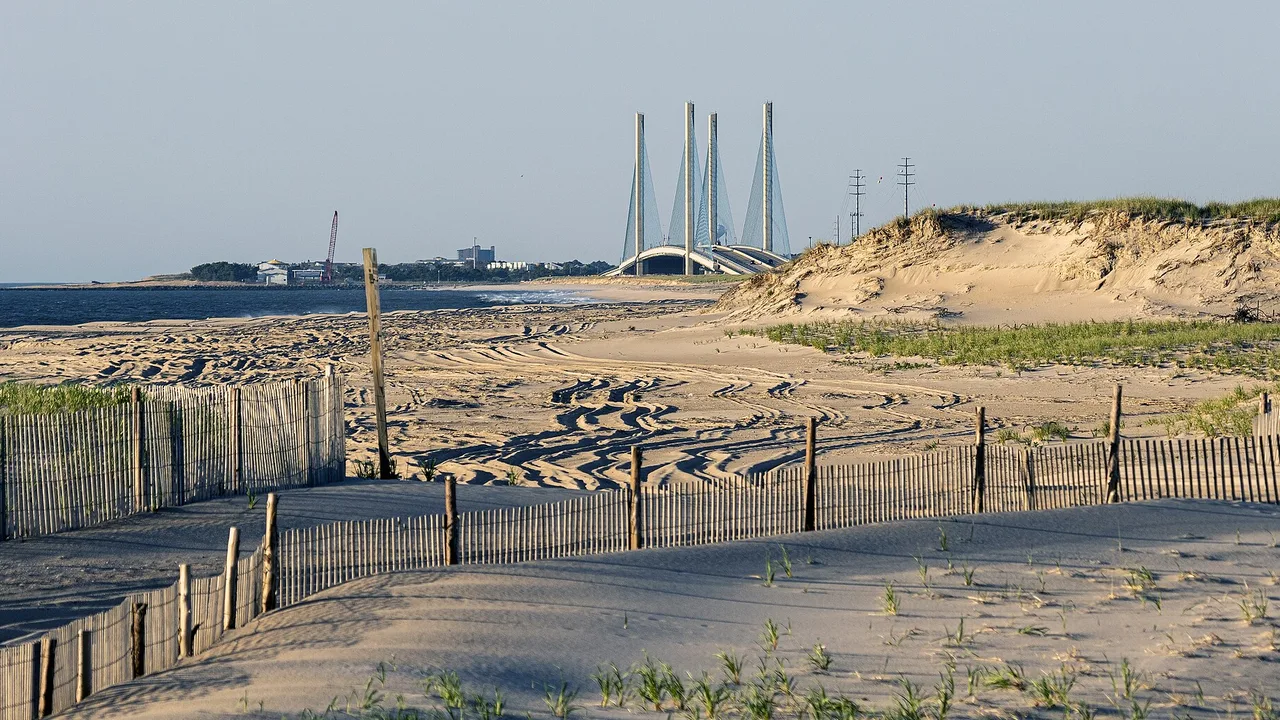
📍 Delaware, United States
Photo: Acroterion / Wikimedia Commons, CC BY-SA 4.0. A scenic shot, not an action photo — see the credits note on the page for why.
The data clearly point to surfing. The rules that govern it shift every few miles.
Delaware's Atlantic coast is about 25 miles long (sources cluster between 24 and 26, depending on how the shoreline is measured), running from Cape Henlopen State Park in the north to the Maryland state line at Fenwick Island in the south, located on the map between Maryland's Ocean City and New Jersey's Cape May. Search demand is clear, with "surfing Delaware" and "Delaware surfing" each measuring 140/mo, and searches for the named beaches registering as well — Rehoboth Beach (110/mo), Bethany Beach (50/mo), Dewey Beach (40/mo), Cape Henlopen (20/mo). By contrast, "kiteboarding Delaware" and "kitesurfing Delaware" tie at 10/mo each, "windsurfing Delaware" sits at 10/mo, and every kite or windsurf term we checked for Indian River Inlet specifically — the one spot on this coast with real current and rig-up culture — came back at literally 0/mo. This page focuses on surfing and the numbers, treating kiteboarding as a genuine but essentially unmeasured secondary activity.
This coast is notable not for the wind map but for the local regulations. Rehoboth Beach, Dewey Beach, Bethany Beach and Fenwick Island each have their own beach ordinance with different wording, and none should be taken to apply in a neighboring town. Indian River Inlet, roughly in the middle, divides the northern and southern towns and is the one place on this coast documented as genuinely current-hazardous rather than a family swim beach.

Rehoboth restricts surfing to one named "SURFING BEACH" zone at the north end; Dewey prohibits hard boards near bathers and, on summer weekends at midday, closes the beach to kites and other airborne-object sports.
Rehoboth & Dewey rules arrow_forward
Bethany's ordinance is the only one on this coast to explicitly name kiteboards; Fenwick Island caps surfboards at four feet and leaves the rest to lifeguard discretion.
Bethany & Fenwick rules arrow_forward
This is intentionally not a swimming beach — the currents that make it interesting to rig up in are the same currents the state park positions its swim zones around, not through.
Indian River Inlet arrow_forwardNDBC 44009 ("Delaware Bay, 26 NM Southeast of Cape May, NJ") — its live feed currently shows no recent reports; the 2021-2025 historical archive is intact, and we parsed it ourselves.
The nearest NDBC station to this coast, 44009, sits at 38.460°N, 74.692°W — roughly 17 nautical miles from Fenwick Island and 24-27 nautical miles from Rehoboth Beach and Cape Henlopen. Checking its live page today shows "No Recent Reports," so we did not pull a current reading from it. What we did instead, the same method as our South Carolina and Georgia pages, is download NOAA's own historical standard-meteorological archive for this station directly and aggregate five full years (2021-2025) of hourly data ourselves. The same offshore caveat applies as everywhere else in this guide: this is a deepwater reading well off the beach, not a Rehoboth- or Bethany-specific number, so treat it as a regional proxy for season and swell period.
| Month | Water temp | Wave height | Dominant period | Wind ≥15 kt |
|---|---|---|---|---|
| January | 7.9 °C / 46 °F | 1.30 m | 7.3 s | 46.5% |
| February | 6.5 °C / 44 °F | 1.34 m | 7.5 s | 38.5% |
| March | 7.5 °C / 45 °F | 1.35 m | 7.7 s | 37.5% |
| April | 10.1 °C / 50 °F | 1.17 m | 7.7 s | 26.4% |
| May | 14.4 °C / 58 °F | 1.16 m | 7.8 s | 21.1% |
| June | 19.7 °C / 67 °F | 0.92 m | 7.1 s | 10.8% |
| July | 24.0 °C / 75 °F | 0.88 m | 7.4 s | 10.0% |
| August | 23.7 °C / 75 °F | 1.03 m | 8.1 s | 11.7% |
| September | 22.7 °C / 73 °F | 1.44 m | 9.4 s | 27.5% |
| October | 19.2 °C / 67 °F | 1.30 m | 9.2 s | 35.1% |
| November | 15.7 °C / 60 °F | 1.22 m | 7.3 s | 42.7% |
| December | 11.2 °C / 52 °F | 1.28 m | 8.3 s | 38.4% |
This coast produces real groundswell and has a distinct winter wind season; winters are cold and by midsummer it becomes genuinely warm. The dominant period stays at 7.1-9.4 seconds year-round, rising to 9.4 s in September when the average wave height also peaks at 1.44 m — a pattern consistent with NOAA's Atlantic hurricane season (June 1-November 30, peaking around September 10) driving long-period swell up the coast, the same trend we note on our South Carolina and Georgia pages. Water temperature swings sharply for a mid-latitude shoreline: 44-46 °F during the depths of winter and reaching a 75 °F high in July, so a wetsuit is necessary for much of the year, unlike on the warmer Southeast pages in this guide. Winds over 15 knots are mainly a winter and shoulder-season feature — occurring 37-47% of hours from November through March and falling to 10-12% from June through August — which matches the autumn-into-winter nor'easter and hurricane-groundswell season this coast shares with southern New Jersey. Our wetsuit thickness guide converts water temperature into a suit recommendation.
Rehoboth Beach City Code § 95-7 and Dewey Beach's published beach rules were identified through search synthesis. ecode360.com blocked automated access to the ordinance text itself, so treat as COMMERCIAL-tier pending a direct human read.
Rehoboth Beach's ordinance prohibits surfboards throughout the city with a single exception rather than listing allowed zones. A search synthesis of the city's own code shows "No person shall use, maintain or operate a surfboard on the beach or in the waters adjacent to the beach within the corporate limits of the city" — except "the area north of the northernmost groin on the City's beach to the northernmost limits of the City's beach, which shall be designated as the 'SURFING BEACH.'" "Surfboard" is defined broadly enough ("any board other than an inflated mat or float containing any metal or other hard substance") that it likely sweeps in a kiteboard or windsurf board too, though neither is named outright — the same kind of inference, not a stated rule, that we flag rather than assert as fact.
A few miles south, Dewey Beach enforces a different set of rules based on distance from bathers and time of day. The town's published beach rules state "No person shall use a surfboard or skimboard, or any other type of water sport device that is constructed with non-flexible material within 100 feet of bathers. Between the hours of 11:00 a.m. and 3:00 p.m. on weekends and holidays the use of these devices shall also be prohibited." A separate clause is the only provision on this coast that addresses kiting "Between the hours of 11:00 a.m. and 3:00 p.m. on weekends and holidays all sport activities involving airborne objects other than volleyball and sports involving adults or teenagers over the age of 13 shall be prohibited." Dewey's own seasonal materials describe the Beach Patrol's authority over "active recreational activities" as covering kites by name, alongside footballs, drones and similar flying objects.
This session did not read either town's rule directly from the code — ecode360.com returned a 403 to every automated fetch attempt, the same access failure georgia.ts encountered on Tybee Island's ordinance. Both are reported here as a search synthesis rather than a verbatim statute read, and you should confirm with the town before you plan a session around the exact wording.
Bethany Beach Code Ch. 223, Art. VI, § 223-16, and Fenwick Island Code § 52-6 — based on search synthesis; the same access caveat noted above applies.
Bethany Beach is the only town on this coast whose ordinance names kiteboards outright, rather than leaving the question to a broad "surfboard" definition. As rendered by a search synthesis of the town's code: "It shall be unlawful for any person to ride a surfboard, paddleboard, kayak, kiteboard, hard-sided boogie board, boogie board with fins or any similar devices of a hard or solid nature whenever the lifeguards are on duty." Soft equipment is carved out — "Skimboards, soft-sided boogie boards or other padded small devices such as inflated mats and floats are exempt" — and a separate leash requirement applies to surfboards and boogie boards specifically. The practical effect: a kiteboard session at Bethany Beach itself is a before-hours or after-hours activity, by the ordinance's own terms, not an outright ban.
Fenwick Island's rule is sized rather than timed. As rendered by a search synthesis of § 52-6: "Unless prohibited by a lifeguard, the following devices are allowed: inflatable rafts; 'boogie boards'; 'noodles'; inner tubes; surfboards less than four feet in length with a leash attached to the rider in a nonstanding position." That is a narrow allowance — short boards, ridden lying or kneeling, not standing — with a further catch-all that any device a lifeguard judges unsafe is prohibited regardless. Neither kiteboarding nor windsurfing is named in Fenwick Island's rule, in either direction.
This session drew on search synthesis for Delaware Seashore State Park, DNREC's surf-fishing materials, and 7 DE Admin Code 9201. destateparks.com and regulations.delaware.gov were either blocked or failed to serve static text to our automated fetches.
We looked specifically for a documented kiteboard or windsurf launch rule at Indian River Inlet, the one spot on this coast with real current and a rig-up culture, and did not find one — a genuine absence, not a gap we are filling in. What is documented is more basic: the inlet is deliberately not where Delaware Seashore State Park puts its guarded swim beaches. A search synthesis of park-linked material states the channel has been scoured to "more than 100 feet" by dredging and tidal flow, and a separate fishing-focused source calls the inlet flatly "not a place to swim or wade." The park's two guarded ocean swim areas sit at Tower Road and south of the inlet — away from it, for that reason.
Surfing is recognized on the inlet's north side beach; DNREC's own dredging notices have called it "a very popular area for surfing and fishing" when announcing temporary closures for sand-bypass and nourishment work — measures taken for safety during construction, not a standing ban on surfing there. A few miles further north, Cape Henlopen State Park sets separate rules for vehicles used for surf fishing: DNREC's brochure language allows vehicle access to designated beaches "for the sole purpose of surf fishing," and separately states that "driving on swimming and surfboarding beaches during summer season day-use hours is not permitted" — a rule about where a vehicle may go, not about who may surf.
7 DE Admin Code 9201, a statewide park regulation, reportedly prohibits surfboards, sailboards, kayaks or "similar watercraft" from any designated guarded swimming area without the park Director's approval, and separately requires vessels to remain 100 feet from surfers and swimmers. We could not load this regulation's own text this session — regulations.delaware.gov serves it as a JavaScript application with no readable content in our fetch — so this is COMMERCIAL-tier, corroborated across two independent search passes rather than read verbatim. If it holds as described, "similar watercraft" is broad enough that a kiteboard could plausibly be read into it, but the regulation's own wording names only surfboards, sailboards and kayaks outright.
You can read Delaware Code Title 23, Chapter 21 §§ 2112, 2114, 2115 and Chapter 22 §§ 2201-2202, 2211-2212 at delcode.delaware.gov.
Delaware's core "vessel" definition, Title 23 § 2112(7), is broad: "'Vessel' shall mean every description of watercraft, other than a seaplane, used or capable of being used as a means of transportation on water or ice. Jet skis, surf jets, ski craft and other personal watercraft are vessels for purposes of this chapter." Unlike South Carolina's statute, which explicitly writes surfboards and windsurfers OUT of its "watercraft" definition, Delaware's never mentions them at all, in either direction — the same silence documented on our New Hampshire and Georgia pages, not South Carolina's carve-out.
The one genuinely distinctive Delaware finding sits in § 2115(c), not in the definitions. "No vessel propelled safely by wind power or physical exertion shall be subject to the licensing and registration fee of this subchapter, but shall be subject to all safety requirements referred to in § 2114 of this title." Delaware's statute designates wind- and paddle-powered vessels as a separate category — exempt from the registration FEE but still subject to safety requirements — which suggests the law treats things like a windsurfer or sailboat as a "vessel." This differs from South Carolina's flat exclusion rather than being a softer version of it; Delaware's silence on surfboards and kiteboards means neither this section nor the fee exemption settles where those craft fall.
Chapter 22 adds the actual wear rules, and they're narrow. § 2202: "Every operator of a recreational boat shall be responsible for providing for the protection of any child 12 years of age or under by having any such child who is aboard a recreational boat upon the waters of this State, properly wear a Type I, II, III or V Coast Guard-approved personal flotation device." That is a children-only wear mandate; no general adult wear requirement for kayaks, paddleboards, surfboards or windsurfers exists anywhere in Title 23. Personal watercraft (jet skis) are the one craft with an unconditional wear rule, at any age: § 2212(c), "No person shall operate or ride in a personal watercraft unless such person is wearing an approved personal flotation device," and § 2212(a) sets the PWC operator's minimum age at 16, with 14-15 year-olds permitted only "under the direct supervision" of a parent or guardian — no under-12 carve-out like South Carolina's Class A motorboat rule.
Kiteboards are not mentioned in Title 23, so the statute offers no guidance on how they should be classified; the same gap exists for South Carolina and Georgia. Do not treat the wind-powered-vessel fee exemption as deciding the matter by analogy. For the federal PFD baseline that fills gaps like this across every state, see our United States guide. If you encounter a sea emergency anywhere on this coast, call 911 or contact the Coast Guard on VHF 16.
At Rehoboth Beach, surfing is limited to a single designated area, the "SURFING BEACH" north of the city's northernmost groin — the same ordinance forbids surfing on the rest of Rehoboth's beach. Dewey Beach permits surfing beyond a 100-foot bather buffer and outside 11am-3pm on summer weekends and holidays. Indian River Inlet's north side beach is considered an actual surf spot but is occasionally closed for safety during dredging. Bethany Beach and Fenwick Island allow surfing outside lifeguard hours and, when guards are present, only within size/leash limits.
Search volume for kiteboarding in Delaware is nearly nonexistent — every kite and windsurf search term we checked, including at Indian River Inlet specifically, returned 0-10/mo. Only one town ordinance, Bethany Beach's, mentions kiteboards by name, and only to limit them to non-lifeguard hours together with other hard-sided craft. We did not find any town or state park rule that describes a designated kite launch anywhere on this coast.
Delaware's statute never names surfboards, kiteboards or windsurfers, so no PFD wear rule reaches them directly. The state's wear requirements are much narrower, covering children 12 and under aboard a "recreational boat" underway and anyone operating or riding a personal watercraft (jet ski), regardless of age. A separate section exempts wind- and paddle-powered vessels from the registration fee, not from PFD rules, which is a real but different finding — it doesn't resolve where a surfboard or kiteboard falls.
Delaware Seashore State Park's own guarded swim beaches are sited away from the inlet, not at it, because of strong tidal currents that a search synthesis of park-linked material describes as having scoured the channel floor to over 100 feet. It's documented as a surfing and fishing spot, not a swimming one.