
📍 California, United States
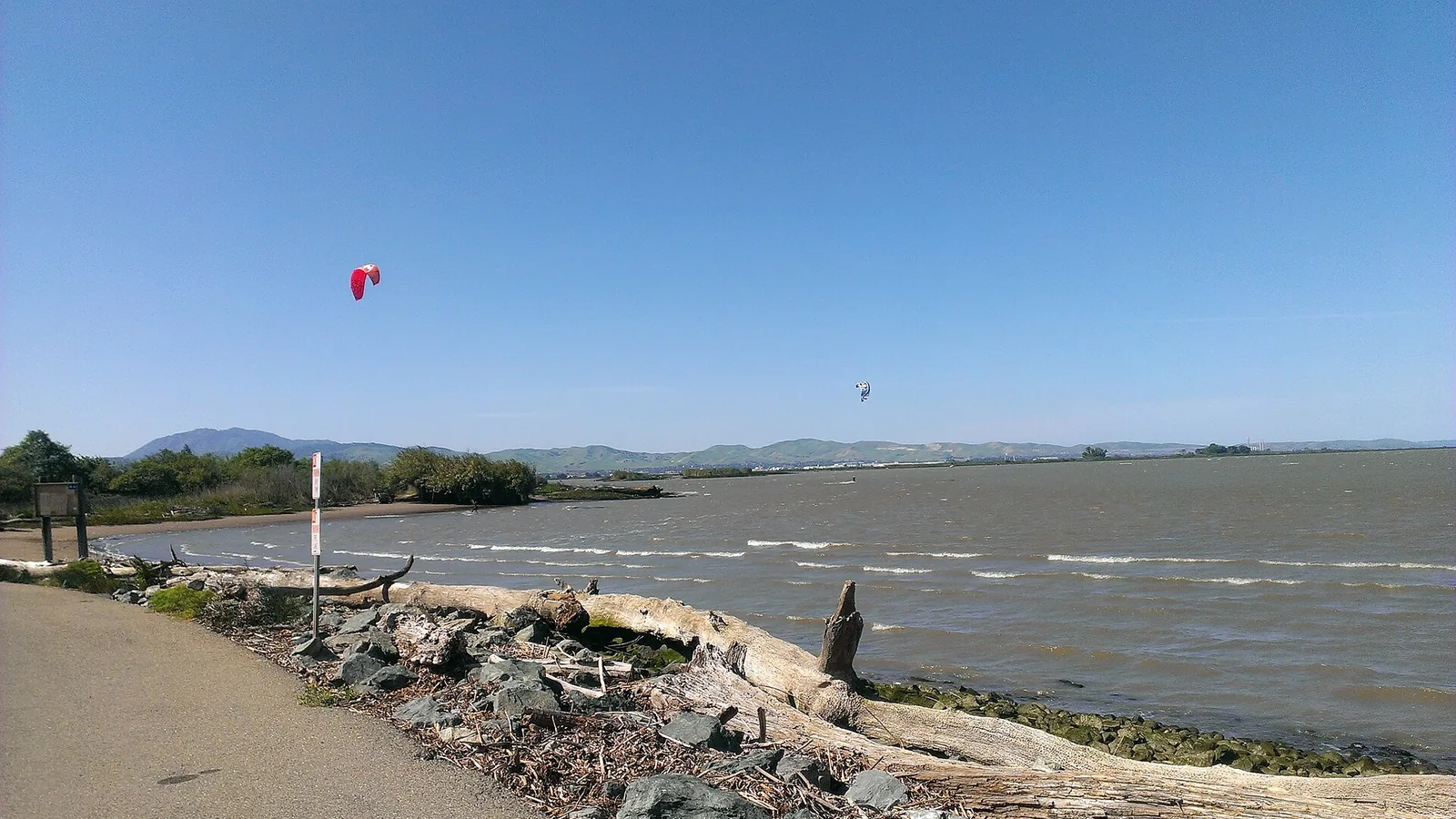
Photo: Aylapeters / Wikimedia Commons, CC BY-SA 4.0
The Delta and the Bay run on a thermal engine. The central coast runs on swell. San Diego runs on a season that is the opposite of both.
Sherman Island, Crissy Field, Third Avenue — a summer thermal that is among the most reliable wind on the planet.
The thermal spots arrow_forward
Waddell does wind and waves at once. Mavericks does neither — it does one thing, in winter, for experts only.
The swell coast arrow_forward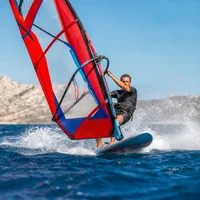
Warmer water, and the most heavily written-down rules in the state: Santa Barbara, Long Beach, San Diego.
Southern California arrow_forwardThis is the single most useful thing to know before you travel here, and the thing most spot guides get wrong by omission. California has no state-wide watersports regulation. Every restriction below is issued by a different authority — a State Parks district superintendent, a city council, a county, or the National Park Service — and they do not resemble one another.
Two beaches an hour apart can sit under completely different regimes. In one State Parks district, kitesurfing is prohibited by default and permitted only under listed conditions. In another, it is permitted but only between two named creek mouths. In a third district there is no posted order about it at all. None of those facts transfers to the next beach along the coast.
So the section below names the authority and the order number wherever one exists, and says plainly where we could not find one. An absence of rules in our research is not the same as permission — it means you should ask locally.
Northern California's wind is a heat engine, and understanding it tells you exactly when to book. The Central Valley bakes to 35–40 °C in summer while the coast sits at 13–18 °C. The hot valley air rises, forms a thermal low, and pulls cool marine air inland. The only efficient gap through the Coast Ranges is the Carquinez Strait, and the air accelerates through that chokepoint — the same venturi that made the Montezuma Hills a major wind-farm site.
That also tells you when not to come: in winter the valley–coast temperature difference collapses, and with it the wind. This is a April-to-September system, most consistent June to August.
Kite and windsurf only — this is a tidal river, not a surf spot. It sits directly in the Carquinez jet, between the Sacramento and San Joaquin rivers, and Sacramento County's own park page recognises it as a windsurfing location. Spot guides report 16–30 knots on most days through the season, with September and October strong and less crowded.
It is not the beginner venue its flat water suggests. There is real tidal current, shipping and recreational boat traffic on both rivers, and mid-summer afternoons are simply overpowered for most visiting riders.
Access and fees, from the county's own page: open year-round sunrise to sunset; $8 per vehicle, $15 with a trailer or RV, $45 a night to camp, with a 14-night maximum and self-contained vehicles only. Fees rise on summer holiday weekends. Note that at least one widely-read kite-travel guide quotes $5 day use and $7.50 camping — those figures do not match the county's and look badly out of date. Use the county's.
The same marine air, one constriction earlier: everything drawn toward the valley low has to pass the Golden Gate first, and Crissy sits immediately inside it. It is also one of the most demanding urban spots anywhere — gusty wind off the Presidio bluff, very strong tidal current through the Gate, and commercial shipping lanes. Community guidance is to launch west of the bathroom, get out past Anita Rock, stay clear of the windsurfers, and give beachgoers right of way. Experienced riders only, and not a place to learn.
The South Bay alternatives: flatter, shallower and less current than Crissy. Third Avenue in San Mateo is described by local riders as the most popular kite spot in Northern California, with a roughly 500 m walk from rigging to a slippery rocky launch — and you need a reliable upwind because there is only one downwind beach-out, ringed by rocks. Coyote Point leans windsurf, with grass rigging and navigation pylons downwind to watch. Crown Beach in Alameda is the light-wind and learner site; its kite launch moved north of "the shack" in 2022 because of erosion.
We found no municipal or district ordinance governing any of these three — all the guidance above is club and community tier. That is an absence in our research, not a documented permission.
Waddell is the rare California spot where "kite, windsurf and surf" is true rather than marketing. Steady northwesterly wind meets real ocean swell, giving side-onshore wave riding. The wind typically fills in around midday and holds until about five, with the best window mid-afternoon.
It is explicitly not for novices in any of those sports. Strong rips, cold water year-round, rocks at the north end that hide at higher tide, and a creek mouth that generates especially dangerous currents. Local etiquette leaves the peak in front of the car park to experienced locals.
It sits inside both Big Basin Redwoods State Park and Monterey Bay National Marine Sanctuary. We could not find any Santa Cruz District posted order covering kitesurfing at Waddell — and the State Parks orders quoted further down are from other districts and do not apply here.
Big-wave surf and nothing else. The wave exists because of a submerged ramp of rock about half a mile off Pillar Point: swell crossing the deep troughs on either side keeps full speed while the wave over the ramp slows, folding the wavefront into a V and focusing it onto one point. The reef rises from roughly 25–30 m on the approach to 6–8 m at the take-off, with an inner boneyard at 2–4 m.
November to March for the biggest surf, roughly September to April more broadly, and nothing in summer. Expert-only in the literal sense.
A powerful, shifting beach break facing an unobstructed North Pacific swell window — and the most dangerous commonly-accessed water on this page. San Francisco Fire Department names rip currents as the number one risk, warns about sneaker waves that run far further up the beach than the surrounding sea suggests, and states plainly that people "have been swept out to sea in 3 feet of water, disappearing in seconds."
There are no conventional lifeguards at Ocean Beach. The Golden Gate National Recreation Area provides Ocean Rescue personnel whose primary role is education. Swimming is officially strongly discouraged and wading advised only to knee depth.
An isolated, exposed stretch north of Point Conception, where the coastline turns sharply east — north of the point takes the full northwesterly wind and swell. Kite, windsurf and surf, all advanced-only, with strong winds that build suddenly in the afternoon, powerful surf, strong rips and no services for roughly twenty miles. It is a Santa Barbara County park; we could not find an official county page setting out watersports rules there, so everything we have on Jalama is community tier.
California State Parks publishes the rule here itself, and it is unusually specific: kiteboarding is permitted only at parking lot #1 — the southernmost open lot — downwind of people on the beach or in the water, and north of the Silver Strand Natural Preserve. A 2008 state environmental filing records the zone as roughly 133 yards of beach, with a windsock pole and a sand berm to manage access.
State Parks also notes the wind is stronger here than at other San Diego beaches, and rates the best riding October to January for intermediate and advanced riders — a season inverted from the Bay Area's summer thermal. Surfers are asked to stay north or south of the swimming area.
The city publishes its own kiteboarding guidelines, and they are worth reading before you rig: no kiteboarding within 500 feet of Stearns Wharf, none inside the swim buoys, and none within 200 feet of bathers, swimmers or vessels. There is a posted 200-foot-wide launch zone at Leadbetter Beach east of the permanent marker buoy, and a 200 ft × 1,000 ft zone at East Beach south of the Chase Palm Park restroom.
One genuinely easy rule to fall foul of: no kiteboarding at Leadbetter on Wednesdays after 5pm between 1 April and 1 November, because of the Wet Wednesdays regatta and the Nite Moves event. The city describes the harbour as too dangerous for kiting and West Beach as too small and congested for body-dragging practice.
The municipal code bars kite surfboards (along with sailboards, kayaks, surfboards and paddleboards) from the entrance channels of Shoreline Marina, Rainbow Marina and Rainbow Harbor and within 300 feet of them, and from the Alamitos Bay Marina entrance channel and within 500 yards of it. Kite lines must not be left lying on the beach and must be secured clear of city vehicles and beach users.
Newer and more likely to affect you: in April 2025 the city established a Kite Surfing Commercial Operator Program at Belmont Shore, near Claremont and La Verne Avenues. It caps the number of operators and sets the conditions under which each may run instruction on the sand and water. In practice, schools there now need a city permit — a change recent enough that most spot guides have not caught up with it.
San Diego runs a zone system written into its municipal code: swimming zones, board surfing zones, control zones, no-board-surfing zones, closed zones and boat launch zones, each extending 1,000 feet seaward of mean high tide. Lifeguards may move the boundaries on any given day for weather, crowds or events, signalled by signs or a chequered flag.
The rule visiting surfers most often trip over is the seasonal control zone: from the second Saturday in June through the first Sunday after Labor Day, board surfing is unlawful between 11:00 and 18:00 daily, while swimming is unlawful before 11:00 and after 18:00. Plan a summer San Diego surf around the morning.
Worth stating precisely, because it is easy to over-read: San Diego's beach code does not name kiteboarding or kitesurfing anywhere in the version we read. It regulates surfboards, windsurfers and sailboards. That is a finding, not permission and not a ban — the documented kite rule in the area is the State Parks one at Silver Strand, which is a different jurisdiction entirely.
Two California State Parks districts have written kitesurfing rules down properly. Neither applies outside its own district.
Covering Carpinteria, El Capitan, Emma Wood, Gaviota, Mandalay, McGrath, Refugio and San Buenaventura state beaches, this order begins from prohibition: no person shall fly, attempt to fly, launch, beach or possess a kite or kitesurf board within those units, except under the guidelines it then sets out. That is a materially different legal posture from "kiting is allowed here", and worth understanding before you assume a green light.
The conditions apply the district's vessel-launching and surfing-area restrictions to kitesurfers, apply Harbors and Navigation Code rules for vessels under sail, prohibit launching or landing when anyone is within a 90° arc either side of downwind, require the kite to be flown to a neutral position whenever someone enters the impact zone, and require a kite coming in from the water to be landed in the water and secured before coming ashore. State Park peace officers may override the order and prohibit launching whenever they judge conditions hazardous.
At Pismo, kiteboarding may take place from Pismo Creek south to Pier Avenue, with dry-land launching and landing permitted in that stretch, and wet launching plus open-water kitesurfing permitted south of Pier Avenue. Launching, landing and open-water kitesurfing are prohibited south of beach post marker #4. Land boarding, kite buggies and any kite- or sail-propelled land device are prohibited outright. This is a driveable beach, so riders must not obstruct vehicle access, and any lifeguard or peace officer may revoke the activity at any time.
A separate order in the same 2025 packet, also dated 1 January 2025, prohibits kites at Pismo State Beach south of Pier Avenue from 1 March to 30 September — and states it applies to any device capable of flight, controlled from the ground or water. Read together, the two appear to contradict each other on exactly the stretch and season a visiting kitesurfer would care about. We are reporting both rather than deciding which prevails. Do not assume summer kitesurfing south of Pier Avenue is legal; confirm with the Oceano Dunes District Office before you rig.
The National Park Service defines kitesurfing at Golden Gate as a form of surfing and regulates it as such. Surfing including kitesurfing is restricted at Stinson Beach when swimmers are present. Rodeo Lagoon, Rodeo Lake and the seasonal inlet in the Marin Headlands are closed to vessels including sail boards, kite boards and windsurfing boards. Point Bonita Cove and the water 300 feet offshore are closed to boating. Kite buggies and land sailing are prohibited.
Two things we could not confirm, and will not assert. A well-read community spot guide states that kiters at Crissy Field must hold a current NPS windsports permit and carry radio equipment; we found no such permit on the NPS site, and the compendium we read does not mention one. The sources disagree — check with Golden Gate NRA rather than trusting either. Separately, the Crissy Field Wildlife Protection Area extends 300 feet offshore, but we could not establish from the compendium exactly which activities that closes, so we are not going to tell you it closes the water to kiting.
A common and wrong assumption worth clearing up: Monterey Bay National Marine Sanctuary's rules cover mineral exploration, discharge, dredging, disturbing marine mammals and birds, motorised personal watercraft outside designated zones, and similar. None of them restricts surfing, kitesurfing or windsurfing, and NOAA's own visitor material names Steamer Lane, Pleasure Point and Asilomar as popular spots within it. The one prohibition a watersports visitor could realistically break is the sanctuary-wide ban on attracting a white shark. California's marine protected areas are likewise mostly take restrictions: the official guidance is that you may swim, dive, surf, kayak and watch wildlife in them.
These are real instrument means from NOAA tide stations and offshore buoys, 2023–2025 — not estimates. Two of them will surprise anyone who has not surfed here.
| Month | SF Bay (tide stn) | SF open coast (buoy) | Monterey | La Jolla |
|---|---|---|---|---|
| January | 13.5 °C | 12.7 °C | 12.9 °C | 14.5 °C |
| March | 12.5 °C | 10.9 °C | 12.9 °C | 14.8 °C |
| June | 16.2 °C | 11.9 °C | 14.0 °C | 17.8 °C |
| August | 17.7 °C | 14.0 °C | 15.5 °C | 20.4 °C |
| September | 18.6 °C | 14.9 °C | 15.7 °C | 19.8 °C |
| November | 15.6 °C | 13.0 °C | 13.9 °C | 16.9 °C |
Northern California never warms up. The open coast off San Francisco averages between about 11 °C and 15 °C in every single month of the year. And its coldest month is spring, not winter — March offshore of San Francisco, April off Port San Luis — because spring upwelling, not air temperature, controls it. Most travel writing gets this backwards.
One trap to avoid: do not use San Francisco Bay figures for Ocean Beach. The Bay tide station reads three to four degrees warmer than the buoy offshore, and the exposed coast is what you will actually be swimming in. San Diego is effectively a different ocean — La Jolla peaks above 20 °C in August, some 6 °C warmer than the San Francisco coast manages at its own annual peak.
We have deliberately not turned these into wetsuit recommendations here — that figure lives in one place on this site so it cannot drift. Put your number into the wetsuit thickness guide and it will tell you the millimetres, and whether boots, gloves and a hood are worth it.
In an emergency, call or text 911 — San Francisco Fire Department advises exactly that for coastal incidents. On the water, the US Coast Guard monitors VHF channel 16 continuously.
Lifeguard coverage is patchy and entirely jurisdiction-specific. San Diego has a city lifeguard division with legal authority to move zone boundaries, and disobeying their direction is an offence. Ocean Beach in San Francisco has none. Stinson Beach is guarded from Memorial Day to Labor Day, 10:00 to 18:00. At Oceano Dunes and in the Channel Coast District, State Parks lifeguards and peace officers can revoke kiting on the spot.
A 2022 peer-reviewed analysis of Californian shark incidents from 1950 to 2021 counted 201 verified incidents in 72 years — 107 non-fatal injuries and 15 fatalities. Surfing and bodyboarding accounted for the largest share at 80 incidents. Crucially, the paper argues against the Red Triangle idea: counties inside the commonly-drawn triangle accounted for 36% of incidents, while the two highest-incident counties were both in Southern California — Santa Barbara with 26 and San Diego with 23.
For scale, the same study puts the likelihood of drowning at a California beach at more than 125 times that of being killed by a shark: roughly 38 drowning deaths a year against about 0.2 shark fatalities.
California Department of Fish and Wildlife publishes different totals — fewer than 250 incidents, fewer than 20 of them fatal. The two almost certainly count different things (an "incident" is not the same as an "unprovoked bite"), and we are not going to pick one and present it as settled. What both agree on is that incidents are extremely rare, and that they have not risen in proportion to how much more the water is used than in 1950.
The hazards that actually put people in hospital here, in rough order: rip currents and drowning, sneaker waves, cold-water shock and hypothermia, rocks and reef, and boat traffic near marina entrances and in the Bay.
What riders ask most before heading to California.
For the Delta and San Francisco Bay, roughly April to September, most consistent June to August — it is a valley-heat thermal, so it collapses in winter. Southern California is different: State Parks rates Silver Strand's best kiteboarding as October to January. The two halves of the state are close to opposite.
Unresolved, and we will not guess. A well-known community spot guide says an NPS windsports permit is required; we could not find any such permit published by the National Park Service, and the Golden Gate compendium we read does not mention one. Check directly with Golden Gate NRA before travelling.
We genuinely cannot tell you. Two California State Parks orders in the same 2025 packet, both dated 1 January 2025, appear to contradict each other: one permits wet launching and open-water kitesurfing south of Pier Avenue, the other prohibits kites there from 1 March to 30 September and says it covers devices controlled from the water. Confirm with the Oceano Dunes District Office.
Yes, in the control zones. From the second Saturday in June through the first Sunday after Labor Day, board surfing is unlawful between 11:00 and 18:00 daily in those zones, and swimming is unlawful outside those hours. Lifeguards can move the boundaries on the day, signalled by a chequered flag.
Colder than almost anyone expects, and coldest in spring. The open coast off San Francisco averages 11–15 °C every month of the year, with its minimum in March because of upwelling. San Diego is much warmer, peaking above 20 °C in August. Do not use San Francisco Bay readings for Ocean Beach — the Bay runs three to four degrees warmer than the coast outside it.
No. Its rules cover mineral exploration, discharge, dredging, disturbing wildlife and motorised personal watercraft — none of them restricts non-motorised watersports, and NOAA itself names surf spots inside the sanctuary. The one rule you could realistically break is the ban on attracting a white shark.
Listing these is more useful than quietly filling the gaps. In each case we found no authoritative source, and an absence here means "ask locally", not "no rule exists".
Never assume a rule from one California beach applies at the next. Pismo, Silver Strand and Carpinteria sit under three different written regimes, and Waddell sits under none that we could find.
In a sea emergency, contact the US Coast Guard (VHF channel 16) or call or text 911.