

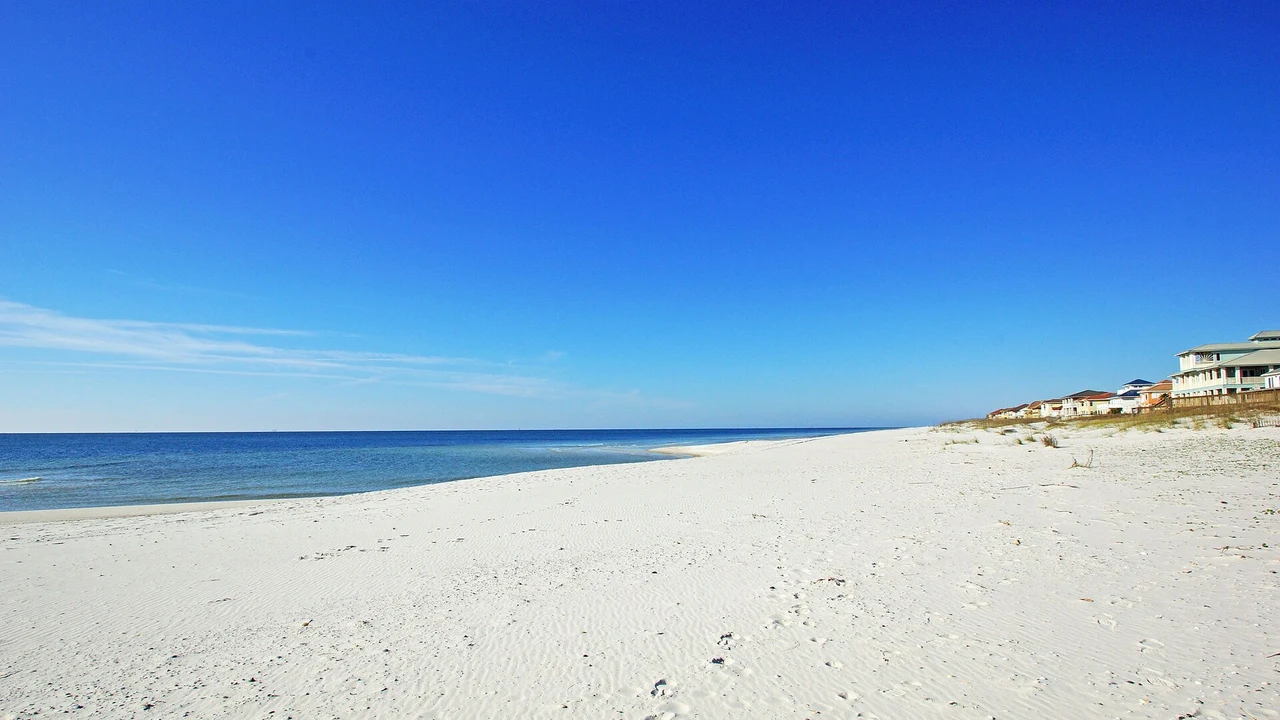
📍 Alabama, United States
Scenic shot rather than action — we couldn't find a suitably licensed photograph of anyone surfing, kiteboarding, or paddling on this coast on Commons during this pass. Photo: ourgulfshoresvacation.com / Wikimedia Commons, CC BY-SA 4.0
The figures show the clearest surf-over-kite margin recorded on any US page in this guide.
Alabama's Gulf coast is short — about 60 miles, most of it the heavily developed tourist strip between Gulf Shores and Orange Beach — and it is built around family beach tourism first: kayaking, paddleboarding and jet-ski rental measurably outrank surfing itself in search demand here, and surfing in turn outranks kiteboarding by a wider margin than anywhere else in this guide. Every kiteboarding- and kitesurfing-specific search term we measured for this coast came back at zero: not low, zero. Real kiteboarding lesson businesses do operate here — Gulf Shores Kiteboarding names Dauphin Island's Pelican Cove as its favourite teaching spot — but nothing in the search data supports treating kiteboarding as a second pillar of this page the way it is on our Georgia or Texas guides.
Surfing here is real, albeit modest and inconsistent. There are four named breaks around Orange Beach and Gulf Shores, a local surf shop, and swell that peaks in the colder months rather than summer. This page covers those spots, Dauphin Island, Fort Morgan's real rip-current risk, and what Alabama's own boating statute does and doesn't say about a surfboard, kiteboard or paddleboard.
The destination's tourism board lists four named breaks — Alabama Point, Spuds, Cotton Bayou and West Pass — and notes the area has one surf shop.
The surf spots arrow_forward
The NWS's current table documents dated rip-current fatalities on this coast, and both cities' pages publish a double-red-flag rule.
Rip currents & the flag rule arrow_forward
Alabama's "vessel" definition is broader than South Carolina's neighbouring statute and contains no written exclusion for surfboards or windsurfers.
The PFD law arrow_forwardNo verified multi-year NOAA buoy pull was done for this page — the ranges below come from commercial-tier sources, not a station reading.
Gulf Shores' tourism board states directly: surfing conditions peak in the colder months, "November through March," when cold fronts push larger, more organized swell into the Gulf; summer is mostly small unless a tropical system is forming offshore. You will need a wetsuit in winter; the rest of the year you generally won't.
Sea temperatures, taken from sea-temperature trackers and local tourism pages rather than a verified NOAA station reading, run roughly 55-60°F in mid-winter up to roughly 83-86°F at the late-summer peak — warm enough that a wetsuit is only a winter item. Our wetsuit thickness guide turns those figures into a suit recommendation rather than repeating one here.
Atlantic hurricane season runs June 1 through November 30. The National Hurricane Center's climatology places the practical risk window for this coast at roughly mid-August through mid-October, centred on the season's statistical peak around September 10. That window overlaps the front half of the "best surf" season above — the same weather that improves the waves can also mean storm risk, not just bigger swell.
Alabama's Beaches (the area's official tourism board) is a commercial source, not a government agency.
Alabama Point, a public beach access in Orange Beach, is described as the coast's most popular and most reliable spot. Nearby jetties and breakwaters help shape waves that can reach up to six feet on a southeast swell with a north wind. Boat traffic through the pass is a real, named hazard here.
Spuds, just east of Alabama Point, is a similar but less crowded exposed beach break. It works the same southeast-swell, northeast-wind pattern and has strong currents that can push a surfer toward the nearby jetties.
Cotton Bayou — known locally as Terry's Cove, or simply "The Cove" — is one spot with two names, not two separate breaks. An early pass through secondary listings treated them as different places; the tourism board's page makes clear they're the same. It sits beside a 700-foot concrete pier, breaks both left and right over a shallow sandbar, and is rarely as crowded as Alabama Point.
Little Lagoon Pass Park, also called West Pass, is Gulf Shores' one surfing spot. It's a reef break over a rocky bottom, shallow directly in front of the pass but with better waves 100 yards either side. Watch the nearby jetties and low tide specifically.
Tambo's Surf Shack, in Gulf Shores, is the area's surf shop, offering board and wetsuit rental plus private lessons. No Key West- or Cape Hatteras-scale surf school infrastructure exists here — this is a small, locally-run scene, not a destination surf economy.
Consult the NWS's current fatality table and each city's beach-safety pages directly rather than relying on secondhand summaries.
NWS Mobile/Pensacola — the National Weather Service office covering this exact coast — states on its own homepage that rip currents are "the #1 Weather Related Killer Along Gulf Coast Beaches." This isn't a generic warning: NWS's own current, live national Surf Zone Fatalities table lists a rip-current death at Fort Morgan, AL (male, age 40) on June 17, 2026 — a real, dated event on the exact stretch of coast this page covers, not a regional statistic standing in for it.
Each city posts a similar rule on its beach pages. Gulf Shores: "Within the corporate limits of Gulf Shores, it is ILLEGAL to enter the Gulf of Mexico when double red flags are flying," with a fine and possible arrest for violators; seasonal lifeguard coverage runs March through October. Orange Beach's flag-meaning page states the same in its FAQ: "Double Red - Waters closed to the public."
The "illegal to enter" rule and a separate commercial-operator ordinance are not the same instrument. A 2019 Gulf Shores ordinance amending City Code § 8-8 requires licensed watersports rental, parasail and towed-ride businesses to "comply with the municipal surf condition flag warning system and shall suspend all operations when double red flags are displayed" — but that ordinance governs commercial operators' business licenses, not the general public, and the word "kite" appears nowhere in its 22 pages. The broader "illegal for anyone to enter" rule stated on the city's own Beach Safety page is a separate, public-facing rule; we could not locate the specific general-conduct code section behind it this session.
Neither city's beach page names surfing, kiteboarding or windsurfing specifically — the flag system and the (unfound) general-conduct rule apply the same way to anyone in the water, board or no board. In an emergency anywhere on this coast: 911. Alabama does have a real marine law-enforcement division, ALEA's Marine Patrol (with a Southern District office in Orange Beach), but it is a specialized waterway-enforcement unit, not a substitute first-call number — 911 dispatches whichever responders a water emergency actually needs.
Ala. Code §§ 33-5-3, 33-5-69 and 33-5-51(b) and ALEA's own rules pages.
Alabama's own definitions section, § 33-5-3, defines "VESSEL" broadly: "Every description of watercraft, other than a seaplane, capable of being used as a means of transportation on the water," with only a narrow exception for very small craft on tiny farm ponds. Unlike South Carolina's statute — covered elsewhere in this guide — Alabama's definition does not exclude surfboards, windsurfers, kayaks or paddleboards. That difference alone does not settle the matter: the federal baseline that a paddlecraft counts as a "vessel" only once used beyond the limits of a swimming, surfing or bathing area still applies in addition to any state definition. In short, Alabama's starting text differs from its neighbour's, and this page does not assume the same interpretation carries over.
§ 33-5-69 mandates that every person under eight years old aboard "any vessel or boat of any kind" must wear a USCG-approved wearable PFD, except inside an enclosed cabin. § 33-5-51(b) makes the same requirement for anyone operating, riding on, or being towed by a personal watercraft (a jet ski), regardless of age. Neither section mentions surfboards, kiteboards or paddleboards by name.
The one place "surfboard" appears in Alabama's own flotation rules is about being towed, not about surfing independently. ALEA's own published rules state that no one may operate a vessel "towing a person or persons on water skis, surfboard, spinners, or other similar devices" unless the person being towed wears a USCG-approved wearable PFD. That's a wakesurfing-behind-a-boat rule, not a rule about paddling out at Alabama Point under your own power. General carriage — one wearable PFD per person aboard a recreational vessel — is ALEA's stated baseline for boats; whether that requirement reaches a lone surfer, paddleboarder or kiteboarder who might qualify as a "vessel" under § 33-5-3 is unresolved in the material we could find, and we're not resolving it here.
For the federal PFD baseline that applies across every US state, see our United States guide. In a water emergency on this coast: 911.
There are four named spots around Orange Beach and Gulf Shores — Alabama Point (the most popular and reliable), Spuds, Cotton Bayou (also called Terry's Cove or The Cove), and Little Lagoon Pass Park/West Pass, Gulf Shores' only break. The area's tourism board documents all of them rather than a government surf-zone rule.
Not on the numbers. Every kiteboarding- and kitesurfing-specific search term measured for this coast returned zero volume. Real kiteboarding lesson businesses do operate here — Gulf Shores Kiteboarding names Dauphin Island's Pelican Cove as a favourite teaching spot — but nothing in the search data supports it as a real kite destination the way Texas or Georgia's kite spots are.
Both cities' own pages confirm it. Gulf Shores states plainly that entering the Gulf under double red flags is illegal, with a fine and possible arrest; Orange Beach's FAQ defines double red as "waters closed to the public." Neither city's page carves out an exception for surfers, paddlers or kiteboarders.
Alabama's statute is not definitive. Unlike South Carolina, Alabama's "vessel" definition contains no exclusion for surfboards, windsurfers or paddleboards, while the specific wear mandates in Alabama's code target children under 8, personal-watercraft riders, and people being towed on water skis or a surfboard behind a boat — not a lone surfer or paddler under their own power. We found no clear rule either way for that case.