

SUP yoga does not need a special board, but it is unforgiving of the wrong one. Too narrow, under-inflated or lacking a surface for your hands, and downward dog turns into an accidental balance test. This page covers the kit and the choice of water. For the poses, fitness sessions and energy use, head to our SUP fitness and yoga page, which we do not repeat here. Matosurf does not test kit: the criteria come from manufacturer and retailer documentation.
Width and stability come first
In yoga you move from standing to kneeling, sitting, lying down, sometimes onto one leg. Your centre of gravity keeps shifting and the board has to stay calm. Three things give stability:
- Width. At the same length, a wide board is steadier at rest than a narrow one, which is built to glide. Avoid narrow touring or racing shapes for this. The width, thickness and volume figures for fitness and yoga are kept on the fitness page; repeating them here would mean two versions to keep up to date.
- Stiffness. An under-inflated board flexes under your knees and wobbles. Inflate to the pressure the manufacturer gives (see how to inflate your SUP) and check with a gauge rather than by feel.
- Load. A board used close to its maximum load sits low and becomes unstable. Compare your weight plus your kit with the stated maximum load: our page on the maximum weight of an inflatable SUP explains how to read it.
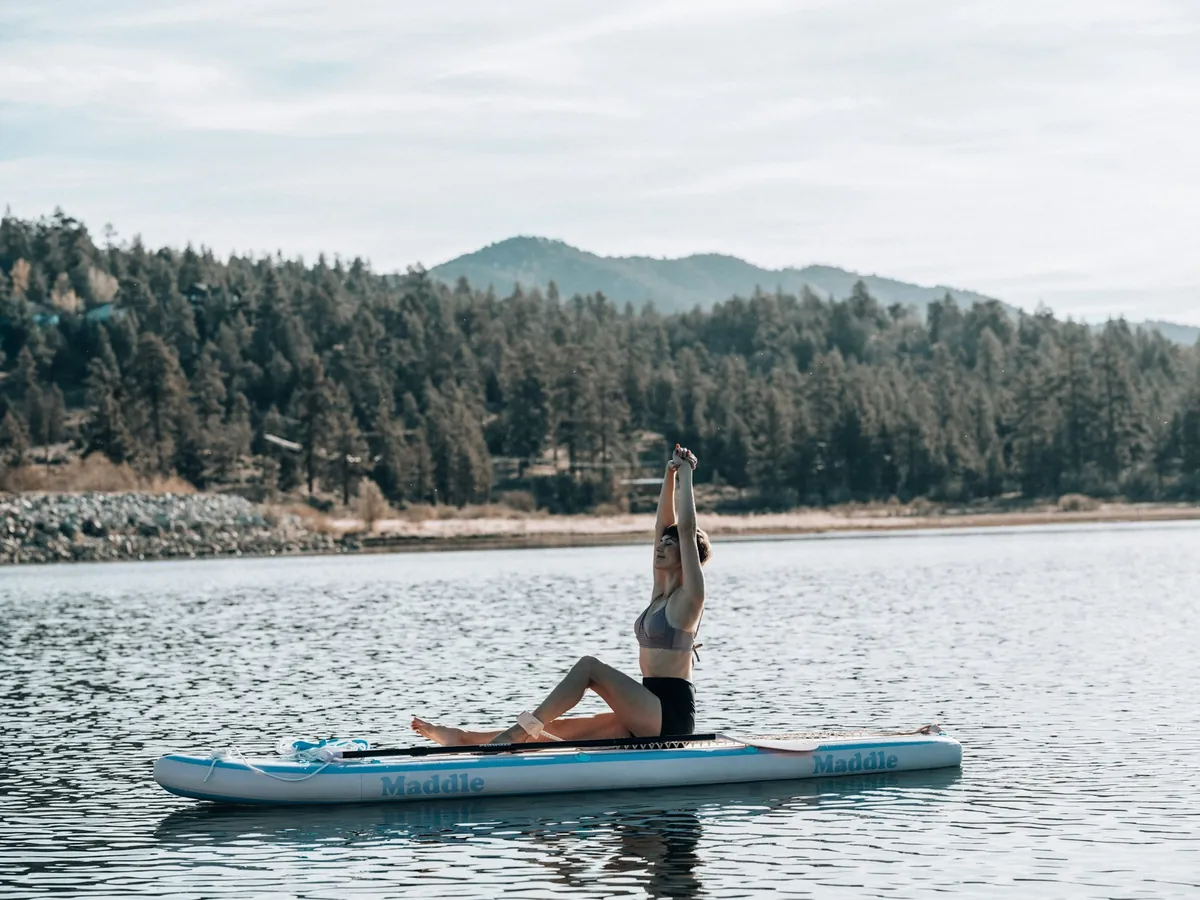
Inflatable or rigid for yoga
Both work. A well-tensioned inflatable is kind on the knees and easy to carry to the lake; a rigid board is naturally stiffer but bulkier. The full comparison is on inflatable or rigid SUP. For yoga, inflation quality and width matter more than the type of construction.
The deck pad: where the comfort really differs
The deck pad is the non-slip foam bonded to the top of the board. In yoga it is what takes your hands, knees, back and neck.
- Coverage. A pad that covers the whole middle section lets you change pose without sliding off the grippy area. A partial pad keeps you in one spot.
- Texture. It has to grip wet feet; if it is too aggressive it is hard on palms and knees. Try it in a shop if you can.
- Thickness. A thick pad cushions the knees on all fours.
If the pad on your board does not suit you, a thin non-slip yoga mat can top it up, as long as it stays put on the surface. That is a matter of personal comfort and we have no model to recommend.
Anchor and leash: staying where you put the board
Even a light breeze moves a board that is standing still: by the time you open your eyes after meditation you are ten metres from where you started. Two pieces of kit deal with it.
- A SUP anchor (a small, light mooring) or an anchor strap to a fixed point. On a deep lake you need a long enough line; in shallow, current-free water a light anchor may be enough. Each model has its own depth and current limits, so read the instructions.
- The leash, fixed to your ankle or calf, which keeps the board close if you fall. On calm water, the main point is a model that does not tangle round your legs during floor poses; our page on surf and SUP leashes helps you choose by type of water. On a river with current the rule is different: do not tie yourself to your board where the current could drag you.
A buoyancy aid is not required everywhere, but some lakes ask for one. See our buoyancy aids guide and the rules for the water you are using.
Choosing calm water
- Sheltered from the wind. A protected bay, the lee of an islet or a small enclosed lake beats a big exposed expanse. Wind is what most often ruins a session.
- Few boats. A motor's wash rolls the board. Avoid channels and busy beach launches.
- Early morning or evening, when the breeze has dropped and the water is quieter.
- A reachable edge. Choose somewhere you can get back to the bank by swimming or paddling, with no current or offshore wind pushing you out. At sea the question is different: see SUP at sea or on a lake and, for the rules, the sea regulations page.
- Local rules. On a lake or reservoir, check whether navigation, anchoring or a bathing area is regulated. Rules are set by whoever manages that water, so do not assume those of another place apply.
Checklist before you go
- Board inflated to the manufacturer's pressure, checked with a gauge.
- Clean deck pad, free of sand (sand chafes and slips).
- Anchor or anchor strap, with a line suited to the depth.
- Leash fitted, and a buoyancy aid if the place requires one or you prefer it.
- Paddle stowed or secured on the board, so you do not watch it drift off.
- Water, sun protection, quick-drying clothes, a towel.
- Forecast checked: light wind, no thunderstorms.
- Someone knows where you are.
When you do not need to buy anything
- To try it: many on-water yoga classes provide the board. Do one session before you invest.
- If you already own a wide inflatable SUP: it will do. A more comfortable mat or deck pad can come later.
- If you mostly tour: a narrow touring board is poor for yoga; hire a wide board for the occasional session instead.
Where to look
If you want an inflatable board in a versatile format, see inflatable paddleboards on OutletSUP (affiliate link; the shop page is in Spanish). We found no board presented as a "yoga" board: check the width, volume, maximum load and deck pad on each listing and compare them with the criteria above.