

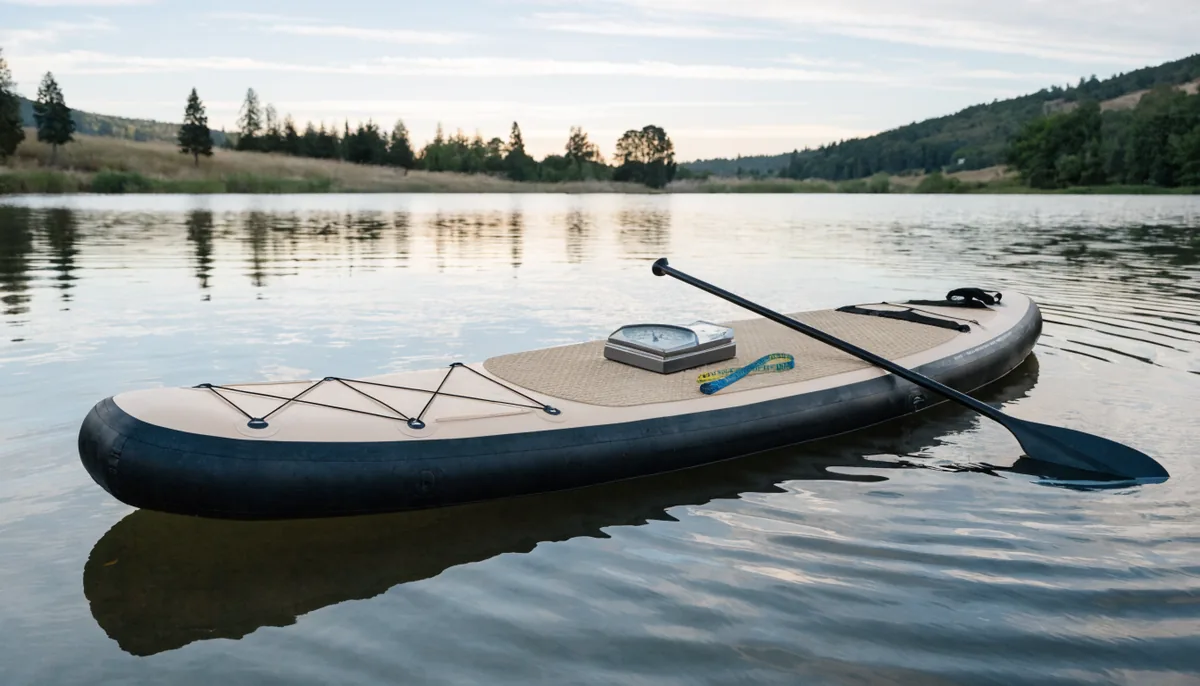
The maximum weight listed on an inflatable SUP's spec sheet isn't just a marketing number: read it the wrong way and you can end up choosing an unstable board, or swing the other way and buy something far bigger than you need. Here's how to read it correctly.
Why maximum load is a decisive factor
Maximum weight directly shapes how a board behaves on the water: a board loaded close to its limit sits lower, loses responsiveness and becomes harder to balance. A board that's well under-loaded, by contrast, stays lively and stable. That makes it just as important as length or width, and it's the figure most often overlooked in favour of looks or price.
What maximum weight actually means
Theoretical load
The figure a manufacturer quotes is a theoretical flotation load: the board stays afloat, but not necessarily stable or manoeuvrable. It's a technical limit, not a recommendation for comfortable use.
Comfortable real-world load
In practice, it's better to stay at 70-80% of the quoted maximum weight to keep a board responsive and easy to control. That margin should account for your own body weight as well as any kit you're carrying (bag, paddle, accessories).
How to choose by build
Lighter build
For a lighter build (under 60kg), a standard volume of around 220-260 litres is comfortably enough, and even gives you a bit of extra manoeuvrability.
Average build
For an average build (60-90kg), aim for a volume of 260-320 litres to keep a healthy margin without sacrificing stability.
Larger build
For a larger build (over 90kg), go for a generous volume above 320-350 litres to stay responsive despite the extra load.
For a solid volume that keeps a healthy margin for an average-build paddler, the WattSup Bream 10.6 — see it at OutletSUP →.
Paddling two-up, with a child or with a dog
Every extra passenger or piece of kit adds to the total load the board has to float. Heading out as a pair, with a child or with a dog needs a noticeably higher volume than solo paddling, or you'll find the board sitting low and losing stability. For regular two-up paddling, a dedicated tandem SUP remains the better option.
Common mistakes with an undersized board
The most common one is choosing a board with too little volume to save on price or on how much space it takes up to transport. The board still floats, but it feels soft, unstable and unpleasant to paddle, which puts beginners off when the real problem was the kit, not their skill.
FAQ
Can you trust the maximum weight a brand quotes?
Partly. That figure is a theoretical flotation load, not a comfortable real-world load. Always keep a margin of roughly 20 to 30% below the stated maximum.
How much margin should you keep?
Aim for 20 to 30% below the stated maximum weight to keep the board manoeuvrable and stable, rather than one that just about floats without gliding properly.
Can two people ride a standard SUP?
Occasionally yes, if the volume comfortably allows it, but a dedicated tandem SUP offers far better stability and weight distribution for regular two-up paddling.
What volume should a larger build choose?
Aim for a generous volume, above 320-350 litres, to keep a comfortable margin and a board that stays responsive despite the load.
Why does a loaded board become unstable?
When overloaded, a board sits lower in the water, loses perceived stiffness and becomes far more sensitive to the smallest shift in balance, which makes it harder to control.