

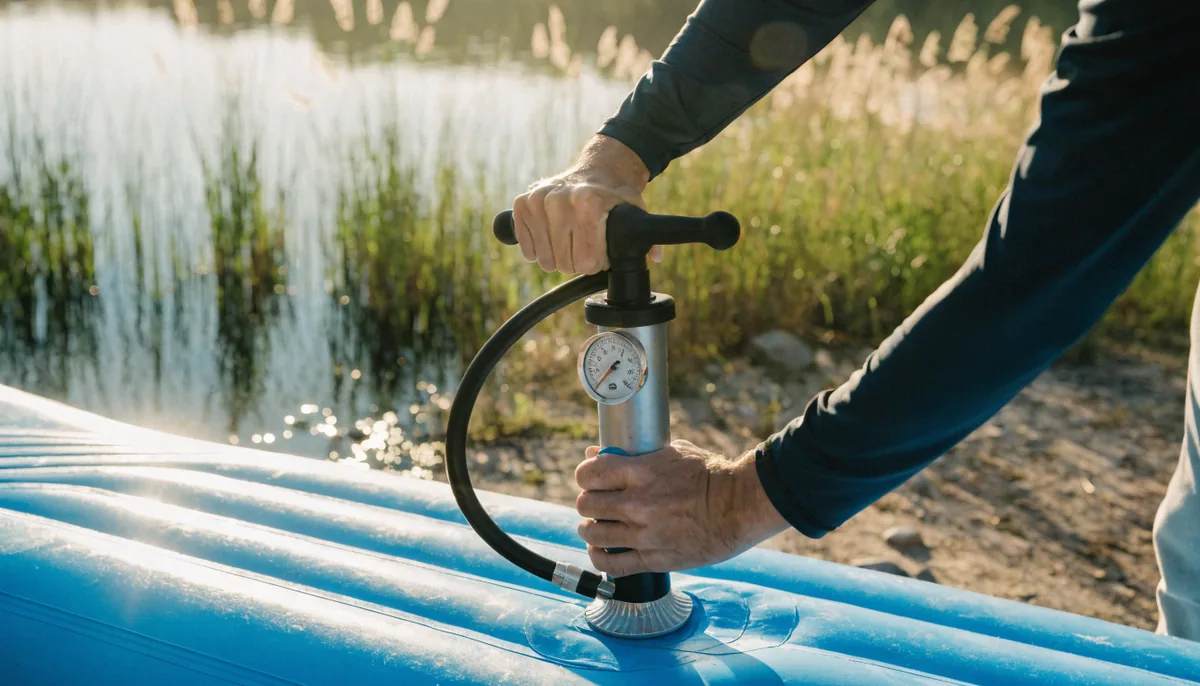
Inflating your SUP properly comes down to three things: reaching the right pressure, looking after the valve and not wearing yourself out for nothing. With the right technique and a decent pump, the job takes five to ten minutes and shouldn't feel like a battle. Here's the method that gets your board to the ideal stiffness without stressing the kit.
Before you start
Unroll the board on a flat, clean surface, in the shade if you can. Find the valve and check the seal is clean, with no sand or grit in it. Get out the pump and its hose, and check the gauge is working. A quick look at the recommended pressure, printed near the valve, gives you your target: usually 15 to 18 PSI. If you want to understand these numbers in more depth, our SUP kit guide covers board pressure and rigidity.
How to inflate a SUP efficiently
Prepare the valve
A SUP valve has two positions. To inflate, the small central pin needs to be in the raised (out) position, which stops air escaping once it's in. A light press of the finger is all it takes to flip it. If air is escaping while you pump, it's almost always because the valve has been left in the open position, the one used for deflating.
Connect the pump
Push the hose fitting onto the valve and screw it on firmly, turning until it stops, to make sure it's airtight. Check the connection at the pump end too: some pumps have a separate "inflate" and "deflate" port. A loose connection loses air and can make it seem like the board isn't filling up.
Build the pressure gradually
Start pumping at a steady rhythm; the first strokes are easy and the board takes shape quickly. Past around 7 to 10 PSI, the effort increases: keep a slow, steady rhythm, knees bent, using your body weight rather than just your arms. Keep going until you reach the manufacturer's recommended pressure, then stop.
Mistakes that tire you out or damage the kit
A poor connection
A loosely screwed fitting or a valve left in the wrong position are the most common causes of a hard slog at the pump. Before you push harder, check those two things, because it's easy to blame the pump when the real problem is a leaky seal.
Misreading the gauge
The gauge only starts to respond once you're past around 5 to 7 PSI, so don't assume too quickly that it's broken. Read the value with the pin released, not while you're pressing down on it, or you'll overestimate the pressure. Stopping as soon as the board "feels" firm almost always leaves you with an under-inflated board.
Sun exposure
Inflating in direct sun, or leaving the board out in the sun once it's inflated, pushes the pressure up beyond what you planned for as the heat builds. Inflate in the shade where you can, and in hot weather stay towards the lower end of the recommended range to leave yourself some headroom.
How to save time when inflating
Good technique with a manual pump
A double-action pump sends air in on both the upstroke and the downstroke of the piston and saves around a third of the time. Handy tip: keep it in double-action for the bulk of the job, then, if your pump allows it, switch to single-action for the last few PSI, which are harder to push. Allow five to ten minutes depending on the board. Most inflatable SUP packages already include a double-action pump as standard.
When to switch to electric
If you're often out on the water, paddling with others, or you just don't fancy the manual effort, an electric pump solves the problem: it inflates on its own in ten to fifteen minutes while you get everything else ready. Many models plug into a 12V car socket and stop automatically once they hit the set pressure. Handy for deflating at the end of a session too.
If your arms are done with manual pumping, an electric pump such as the Star Pump 6 gets your board to the right PSI on its own while you sort out the rest of your kit.
FAQ
How long does it take to inflate a SUP?
Allow five to ten minutes with a double-action hand pump, depending on the size of the board and your pace. An electric pump does the job on its own in around ten to fifteen minutes.
Why doesn't the gauge move straight away?
That's normal: the needle only starts to move once you're past around 5 to 7 PSI, by which point the board is already largely full. It isn't a fault with the pump. Keep going until you reach the recommended pressure.
Can you inflate your SUP in advance?
Yes, you can inflate it at home or the night before, but avoid storing it inflated for long periods in direct sun or a hot car, where the pressure can climb dangerously. For transport, a slight precautionary deflate is the safer bet.
Do you need to deflate a SUP after every session?
Not necessarily if you're heading out again the next day and storing the board in the shade at a moderate temperature. For storage of several days, or in hot weather, deflating it partly or fully helps protect the seams.
Can you leave an inflated SUP in the sun?
As little as possible. Heat expands the air inside and can push the pressure beyond the maximum, which stresses the welded seams. If the board is left in the sun between sessions, ease off the pressure a little and move it into the shade.