

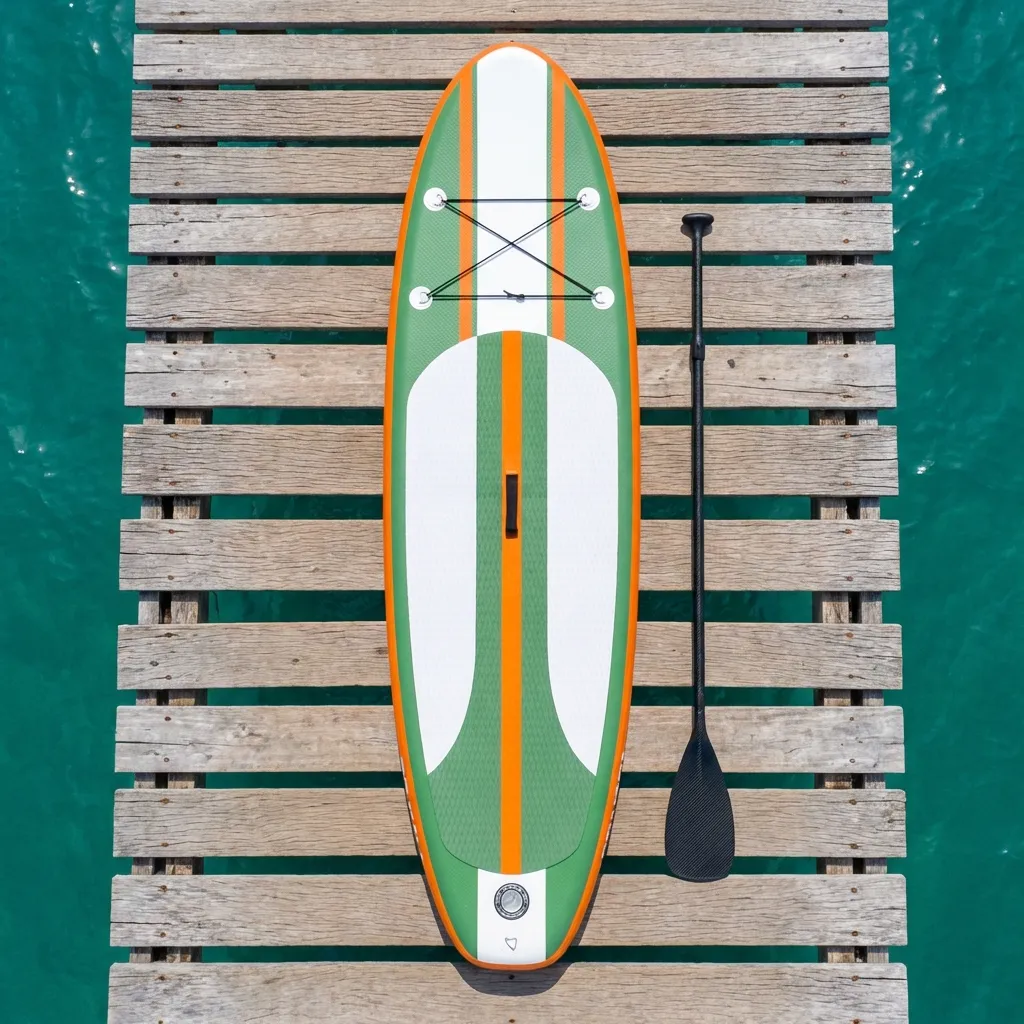
It's the question everyone asks before buying their first paddleboard. Inflatables have come on enormously in recent years and now dominate the leisure market. Rigid boards keep their edge in pure performance. The right choice depends on how you'll use it, where you live and your budget. Here's the full, honest comparison.
Whichever you choose, check conditions with the Met Office before heading out, always wear a leash and a buoyancy aid, and never paddle further than you're confident swimming back. In an emergency on the water, call 999 and ask for the Coastguard.
The inflatable SUP: what most people buy
How it works
An inflatable SUP is built with a drop-stitch structure: thousands of threads connect the top and bottom surfaces of the board, creating a rigid mattress once inflated to 15-18 PSI. The outer surface is coated with a reinforced PVC skin (single or double wall).
Modern inflatables are surprisingly stiff. A good double-wall drop-stitch construction gets close to the rigidity of a foam epoxy board. The difference is felt mainly in pure glide: the inflatable doesn't glide quite as freely once the speed builds.
Advantages of an inflatable
- Easy to transport: once deflated and rolled up, an inflatable SUP fits into a rucksack. You can carry it on foot, fit it in a small car boot, or even fly with it.
- Minimal storage: a cupboard, a garage or a corner of a cellar is enough. No need for roof bars or a trailer.
- Impact resistance: flexible PVC absorbs knocks against jetties, rocks and shells far better than a rigid board. Less risk of cracking or delamination.
- Accessible price: a complete package (board, paddle, pump, leash and bag) starts at an affordable price. A comparable-quality rigid board costs considerably more.
Two all-round inflatables that show what the category can do: the ZRAY X1 and the WattSup Bream 10.6 — see them at OutletSUP →.
Drawbacks of an inflatable
- Set-up time: 10 to 15 minutes of preparation (unrolling, inflating, fitting the fin) before every session. Not instant.
- Slightly less glide: the drop-stitch fabric creates a micro-texture on the surface that adds friction. At cruising speed, the difference is noticeable but stays marginal for leisure paddling.
- Sensitive to sun: PVC degrades under UV exposure. Never leave an inflated board sitting in direct sun for hours – it can expand and burst.
The rigid SUP: the performance benchmark
How it works
A rigid SUP is built like a surfboard: an EPS foam (or honeycomb) core, glass-fibre or carbon lamination, and epoxy resin. The result is a smooth, hard, lightweight shell that offers optimal glide.
Advantages of a rigid board
- Superior glide: a smooth surface, a precise hydrodynamic shape, no drop-stitch friction. A rigid board glides faster and further with every stroke.
- Ready to go: no inflating, no set-up. Drop it in the water and you're off. Ideal for spontaneous sessions.
- Long-term durability: a well-cared-for rigid board lasts 10 to 15 years, sometimes more. The laminate holds up to time better than the inflatable's PVC.
- Better for competition: for racing, surf and performance yoga, the rigid board is what competitors use.
Drawbacks of a rigid board
- Bulky to transport: 3 to 5 metres long and fragile, it needs roof bars or a trailer. It won't fit in a standard boot.
- Storage: you need a garage, a shed or a dedicated space. In a flat, that's often a deal-breaker.
- Vulnerable to impact: a knock against a jetty or rock, or a poorly handled fall, can crack the laminate. Repairs are possible but costly.
- Higher price: expect to pay a considerable premium for the board alone, depending on materials (fibreglass, carbon).
Comparison table: inflatable vs rigid
| Criterion | Inflatable SUP | Rigid SUP |
|---|---|---|
| Transport | Rucksack, any vehicle | Roof bars or a trailer |
| Storage | Cupboard / garage corner | Garage or dedicated space |
| Set-up | 10-15 min (inflating) | Immediate |
| Glide / performance | Good (leisure) | Excellent (all uses) |
| Impact resistance | Excellent | Moderate (can crack) |
| Lifespan | 5-8 years | 10-15+ years |
| Price (complete package) | Budget to mid-range | Mid-range to premium |
| Best for | Beginners, travel, flats | Performance, competition, house |
Which one should you choose?
You live in a flat with no garage → Inflatable. It's the only realistic choice. A 3.5m rigid board doesn't work in a block-of-flats corridor.
You want a board for holidays and road trips → Inflatable. Pack it in the boot, inflate it on arrival, deflate it and head home. No roof bars, no hassle.
You paddle regularly (2-3 times a week) near home → Either works. If you have a garage and roof bars, a rigid board gives more day-to-day pleasure (no set-up). Otherwise, an inflatable remains an excellent compromise.
You're chasing performance (racing, surf, competition) → Rigid, no question. The difference in glide and responsiveness is significant at a high level.
You're just starting out and aren't sure which discipline suits you → Inflatable. You can easily sell it on if you change your mind, and there's nothing stopping you moving to a rigid board later if you get hooked.
For the vast majority of leisure paddlers, an inflatable is the right call. It offers most of the performance of a rigid board at a fraction of the price, with zero storage headaches. A rigid board is an investment for regular paddlers with the logistics to support it.
To go further in choosing your SUP, see our guide on how to choose a paddleboard and our SUP gear guide.
FAQ: inflatable or rigid SUP
Is an inflatable SUP less capable than a rigid one?
For touring and general leisure paddling, the difference is minimal. A good-quality modern inflatable offers stiffness very close to a rigid board. For racing or surfing, a rigid board retains an edge in pure glide. But for leisure use, that difference rarely justifies the transport and storage demands of a rigid board.
How long does an inflatable SUP last?
With reasonable care, a quality inflatable SUP lasts 5 to 8 years. The main factors are the quality of the drop-stitch construction, careful inflating and deflating (never force the valve), and storage away from direct sun and damp.
Does it take long to pump up a SUP?
Between 5 and 10 minutes with a manual double-action pump. With an electric pump, expect around 10 to 15 minutes, though it does the work on its own while you get the rest of your kit ready. Setting up fully (unrolling, inflating, fitting the fin) takes around 15 minutes. It's the closest thing the inflatable has to a real drawback against a rigid board.
Can an inflatable SUP puncture easily?
No. The drop-stitch structure is highly resistant to punctures. The main risk comes from sharp objects such as shells, rocks or fishing hooks. An inflatable actually handles knocks against jetties and rocks better than a rigid board, thanks to the give in the PVC.
What should I budget for a quality inflatable SUP?
Entry-level complete packages (board, paddle, pump, leash and carry bag) sit at an accessible price point. Below that bracket, the quality of the drop-stitch and glue work is often questionable. Premium brands such as Red Paddle Co and Starboard cost considerably more for high-performance models.