

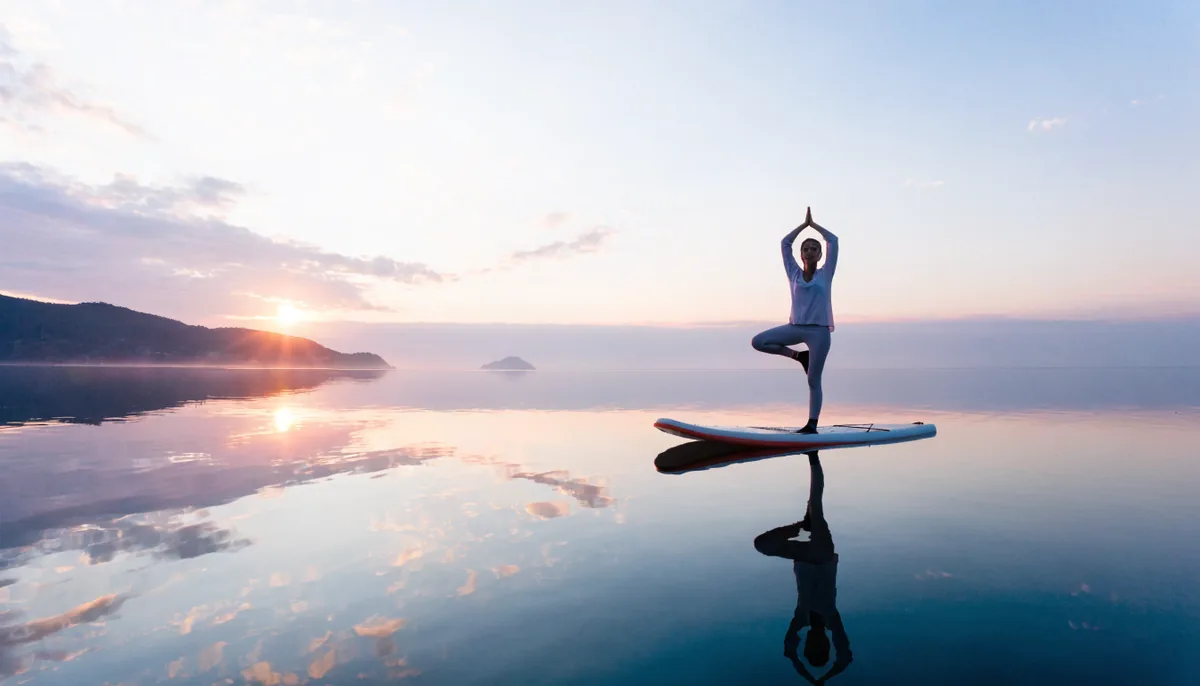
SUP fitness and yoga sits somewhere between sport, wellbeing and a good morning out on the water. Picture sun salutations in the middle of a lake at sunrise, or a full HIIT circuit out on open water: the board's instability makes your body work noticeably harder, while your mind gets an hour away from everything else. Treat it as a full workout, an unusual yoga class or simply an excuse to be outdoors – either way it combines physical effort and mental recharge like few other sports.
1. SUP fitness: HIIT workouts and strength training on board
SUP fitness means doing strength and conditioning exercises directly on your board. The board's natural instability on the water forces your deep muscles (core, stabilisers) to work constantly: up to 40% more muscle activation than the same exercise done on land.
HIIT on a SUP (High-Intensity Interval Training)
SUP HIIT combines short, intense exercises (30 to 45 seconds) with active recovery (gentle paddling). A sample circuit:
🔹 SUP HIIT circuit: 20 minutes
Warm-up (5 min): easy paddling + 10 light squats on the board.
Round 1 (4 exercises x 40 sec, 20 sec rest): SUP burpees, mountain climbers, jump squats, press-ups (hands on the board).
Recovery (2 min): easy paddling.
Round 2: plank with shoulder taps, alternating lunges, Russian twists, sprint paddling (30 fast strokes).
Recovery (2 min): easy paddling.
Round 3: burpees, side plank each side, jump squats, sprint paddling.
Cool-down (3 min): slow paddling + standing stretches.
Strength exercises on a SUP
Beyond HIIT, you can work in targeted strength exercises:
- Squats: feet hip-width apart, lower into a normal squat. The instability heavily engages your quads and ankle stabilisers.
- Lunges: one foot forward, one back, lower into a lunge. Excellent for one-sided balance.
- Press-ups: hands on the deck, body braced. The board flexes slightly, making press-ups a touch easier than on land, but the core engagement is higher.
- Plank: hold a plank on the board, with variations (shoulder taps, knee-to-elbow).
- Russian twists: sitting with knees bent, rotate your torso side to side. Great for the obliques.
For SUP fitness, clip your paddle to your leash or lay it flat on the board between exercises. A paddle drifting off mid-burpee is no fun. Bring an anchor line too if you're staying close to shore.
2. SUP yoga: adapted poses and benefits
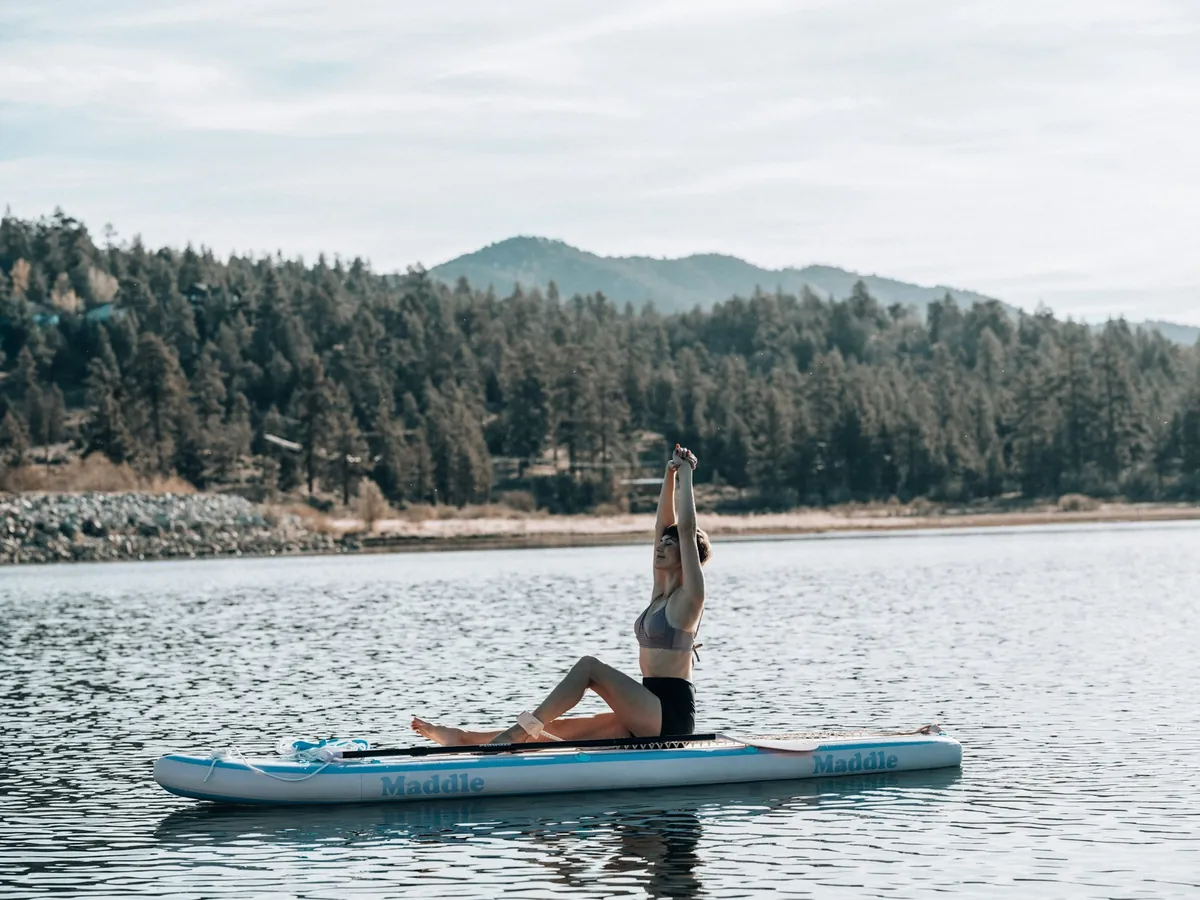
SUP yoga (also called paddleboard yoga) first took off in Aruba in 2009, when a yoga teacher began running classes on paddleboards, and has since spread worldwide. The practice combines traditional yoga poses with the instability and natural setting of a paddleboard.
Poses that work well on a SUP
Not every yoga pose transfers easily onto a board. These work best:
- Mountain Pose (Tadasana): the foundation. Standing, feet grounded, arms by your sides. It's your start and return point between exercises. Learn to feel the board's micro-adjustments under your feet.
- Downward Dog (Adho Mukha Svanasana): hands on the board, hips towards the sky. The board glides slightly: use that movement to deepen the stretch.
- Warrior I & II (Virabhadrasana): standing lunges. The balance challenge is intense but rewarding. Fix your gaze on a point on the horizon (drishti) to stay steady.
- Tree Pose (Vrksasana): balancing on one foot, the other sole against your ankle or thigh. The SUP version is noticeably harder than on land.
- Chair Pose (Utkatasana): an isometric squat, arms overhead. Your thighs will start shaking sooner on a SUP.
- Cobra (Bhujangasana) & Upward Dog: lying on your front, chest open. Very stable on the board, and excellent for the back.
- Child's Pose (Balasana): a resting pose, forehead on the board. Ideal for recovering between active postures.
- Savasana: lying on your back, arms by your sides. Gently rocking on the water: the most relaxing savasana you'll ever experience.
The specific benefits of SUP yoga
Beyond the usual benefits of yoga (flexibility, breathing, stress management), SUP yoga brings some unique advantages:
- Deeper core strength: the constant micro-adjustments activate deep stabiliser muscles (transverse abdominis, postural muscles) that yoga on land doesn't engage as much.
- Better proprioception: your sense of your body in space improves considerably thanks to the board's instability.
- Connection with nature: the sound of the water, sun on your skin and fresh air all amplify yoga's meditative effect.
- Confidence: holding a tree pose on the water gives a unique sense of achievement.
Start your SUP yoga session on flat, wind-free water (a calm lake or river early in the morning). Anchor your board with a light line if you can, to stop it drifting. Wear light, quick-drying activewear.
3. SUP touring: endurance and exploration
SUP touring is where the endurance side of the sport lives. It means covering meaningful distances (5 to 30km-plus) across varied stretches of water: lakes, rivers and sheltered coastline.
Why SUP touring is excellent cardio
Endurance paddling works your whole body: back, shoulders, core and legs for stability. At a moderate pace (60–70% max heart rate), it's a full cardiovascular workout that improves VO2 max and muscular endurance. In a two-hour outing you'll burn between 700 and 1,000 kcal.
Kit for SUP touring
Touring is best done on a long, narrow SUP (12'6" to 14', 75–82cm wide) for better glide. These boards have a displacement shape (a pointed nose) to cut through the water efficiently. Inflatable touring SUPs also exist (Red Paddle Co Voyager, Starboard Touring) with performance close to a hard board. For fitness, a wide all-round SUP is fine for shorter distances (3–8km), but if you're aiming for endurance, invest in a touring board.
Example touring fitness outing
🔹 Touring session: 10km on a lake (about 1h30)
0–15 min: warm-up, easy paddling, building your heart rate.
15–45 min: moderate pace (65% max HR), steady paddling, controlled breathing.
45–55 min: a break halfway round, a few standing stretches on the board, hydration.
55–80 min: the return leg, a stronger pace (75% max HR), intervals of 30 fast strokes / 30 slow strokes.
80–90 min: cool-down, slow paddling back to your start point.
To discover the best SUP touring spots around the UK, see our page on UK paddling spots.
4. Calories burned: SUP vs running vs cycling
How does SUP compare to classic cardio sports? Estimates for a 70kg person:
| Activity | Intensity | kcal / hour | Muscles worked |
|---|---|---|---|
| SUP yoga | Moderate | 300–400 | Core, balance, flexibility |
| SUP cruising | Light | 300–400 | Shoulders, back, core |
| SUP touring | Moderate to hard | 400–550 | Back, shoulders, core, legs |
| SUP fitness / HIIT | Intense | 500–700 | Full body, deep core |
| Running (10km/h) | Moderate | 500–600 | Legs, cardio |
| Running (12km/h) | Hard | 600–750 | Legs, cardio |
| Gentle cycling | Light | 350–450 | Quads, calves |
| Intense cycling (MTB) | Hard | 500–700 | Legs, core, cardio |
| Swimming (moderate front crawl) | Moderate | 400–550 | Full body, cardio |
SUP fitness sits at the upper end of cardio sports, comparable to running and mountain biking. Its real advantage is that it's low-impact on the joints. There's none of the repetitive shock on the knees and ankles you get from running. For anyone with joint sensitivity or in rehab, SUP is an excellent alternative.
5. Best SUP boards for fitness and yoga
Boards vary a lot for fitness and yoga work. The things that matter:
The key criteria
- Width: 86cm minimum (34in+). The wider the board, the more stable it is, which is crucial for yoga poses and exercises.
- Thickness: 15cm (inflatable). A thicker board gives more rigidity and buoyancy.
- Volume: 300 to 400 litres. Enough to support your weight, the board's weight and any dynamic movement.
- EVA foam deck pad: essential for yoga. The deck pad gives a non-slip, comfortable surface for hands, knees and back. Check it covers the full length of the board (full deck pad).
- Shape: all-round or dedicated yoga (rounded nose and tail). Avoid touring shapes (too narrow) and surf SUP shapes (too short).
Board categories to consider
- Premium all-round SUPs (e.g. Red Paddle Co Ride): the benchmark for SUP fitness. Full deck pad, 81cm wide, exceptional rigidity thanks to fused double-layer construction.
- Dedicated yoga SUPs (e.g. Starboard Yoga): purpose-built for yoga, textured deck pad, around 83cm wide, excellent stability rating.
- Budget-friendly all-rounders (e.g. Aqua Marina Vapor): good value for starting out with SUP fitness. Around 79cm wide, partial deck pad.
- Entry-level yoga boards (e.g. Jobe Lena): stable, affordable, full deck pad. Ideal for SUP yoga beginners.
Looking for a wide, stable option built for fitness and yoga work? The Coasto range ticks the width and volume boxes for holding poses and working through a circuit.
For a detailed comparison of SUP boards by activity, see our SUP kit guide and our article on choosing the right paddleboard.
6. SUP training routines: programmes by level
Beginner: 30-minute session
🔹 Beginner programme: 30 min
5 min: easy paddling (warm-up).
5 min: 10 squats + 10 lunges (alternating left/right).
5 min: moderate-pace paddling.
5 min: 30 sec plank + 30 sec rest x 4.
5 min: easy paddling.
5 min: 5 minutes of SUP yoga (mountain pose, downward dog, child's pose, savasana).
Intermediate: 45-minute session
🔹 Intermediate programme: 45 min
5 min: paddling warm-up.
Circuit x 3 rounds (15 min): burpees x 8, squats x 15, press-ups x 10, mountain climbers x 20, 1 min rest between rounds.
10 min: SUP yoga flow (sun salutation x 3, warrior I/II, tree pose each side).
10 min: endurance paddling (strong pace).
5 min: cool-down + stretches.
Advanced: 60-minute HIIT + yoga session
🔹 Advanced programme: 60 min
5 min: warm-up + standing joint mobility.
HIIT x 4 rounds (20 min): each exercise 45 sec / rest 15 sec: burpees, jump squats, plyo lunges, plank shoulder taps, sprint paddling, Russian twists, side plank each side, mountain climbers.
15 min: advanced SUP yoga flow (warrior III, half-moon, pigeon pose, camel pose).
15 min: fast touring (cardio pace, 75–80% max HR).
5 min: floating savasana + paddle back to shore.
7. The mental health benefits of SUP
SUP fitness and yoga doesn't just reshape your body: it settles your mind too. The psychological benefits are well documented and significant:
Reducing stress and anxiety
The combination of physical exercise (releasing endorphins), controlled breathing (yoga) and a natural environment (water, sun, fresh air) is a powerful combination against stress. Studies show that spending time near water (so-called "blue space") measurably lowers cortisol, the stress hormone. A 30-minute SUP yoga session can reduce perceived anxiety by 20 to 30%.
Better focus and mindfulness
On a paddleboard, you can't think about anything else. Balance demands total presence: every mental distraction shows up instantly as a wobble. This state of forced mindfulness is a form of active meditation. Regular practitioners report improved everyday focus as a result.
Confidence and resilience
Every SUP fitness session is a string of small challenges: holding a pose, falling, getting back up, trying again. That fail → learn → succeed loop builds confidence and resilience. Nailing a tree pose on the water or finishing a HIIT circuit on a board delivers a sense of achievement that spills over into other parts of life.
Social connection
Group SUP sessions (yoga classes, club outings, events) build strong social bonds. Practising together, laughing off the falls and cheering each other on builds real social connection, away from screens and social media.
If you're after an activity that combines physical AND mental health, SUP fitness/yoga is one of the best choices out there. To ease in gently, see our tips on learning to paddleboard.
8. SUP yoga events and communities in the UK
SUP yoga has been growing fast across the UK. Where to find sessions, events and other paddlers:
Where to look for sessions
- Lake and reservoir yoga sessions: many watersports centres on lakes such as Windermere and reservoirs around the country run seasonal SUP yoga sessions from spring through to early autumn, in a friendly, all-levels atmosphere.
- Coastal SUP yoga meet-ups: sunrise SUP yoga sessions have become popular along sheltered stretches of the South West and South Coast, typically in the calmer summer months. Booking ahead is recommended.
- Studio-led paddle days: yoga studios in coastal and lakeside towns increasingly run one-off SUP yoga days, usually a short paddle followed by a yoga flow on the water.
- SUP festivals: several UK paddlesport festivals now include SUP yoga and fitness sessions alongside demos and talks on watersports wellbeing, generally over the summer.
Joining a community
- British Canoeing and BSUPA-affiliated clubs: British Canoeing, the national governing body for paddlesport, and the British Stand Up Paddle Association (BSUPA) list clubs across the UK, many of which run SUP fitness and yoga sessions alongside general paddling.
- Yoga studios: a growing number of local yoga studios organise seasonal SUP yoga outings. Ask at your regular studio.
- Social media groups: Facebook groups and Instagram accounts dedicated to UK SUP yoga and paddle fitness are a good way to find local sessions and meet other paddlers.
- Meet-up apps: apps that list local group activities regularly feature SUP yoga and fitness sessions in coastal and lakeside towns across the UK.
Running your own session
You don't need an organised event to get started. Gather two to four friends with SUPs, pick a calm stretch of water, and put together your own session. Lay a yoga mat on the board (some brands make SUP-specific mats), put on a relaxing playlist on your phone, and see where it takes you. The best sessions are often the most spontaneous.
To build on your paddling and board-handling skills, see our page on SUP techniques.
Frequently asked questions about SUP fitness & yoga
How many calories do you burn doing SUP fitness?
With SUP fitness/HIIT, you burn between 500 and 700 kcal per hour. SUP yoga sits at 300 to 400 kcal/h, SUP touring at 400 to 550 kcal/h. That's comparable to moderate jogging (500 kcal/h) and higher than gentle cycling (350 kcal/h), with the bonus of being low-impact on the joints.
Which SUP board is best for fitness and yoga?
For fitness and yoga, choose a board that's wide (86cm minimum), thick (15cm) and stable, with a volume of 300 to 400 litres. A full-coverage EVA foam deck pad is essential for comfort during yoga. Look at premium all-round boards, dedicated yoga SUPs, or good-value entry-level all-rounders depending on budget.
Is SUP yoga suitable for beginners?
Yes, SUP yoga is accessible to beginners. The board's natural instability strengthens your deep core muscles and improves balance. Start on flat, wind-free water, with simple poses (mountain pose, downward dog, warrior I) and build up to more advanced postures.
Can you do HIIT on a paddleboard?
Yes, SUP HIIT combines strength exercises (burpees, mountain climbers, squats, press-ups) with bursts of fast paddling. The board's instability increases muscle activation by 20 to 40% compared with the same exercise on land. Plan for a 20- to 45-minute session.
Where can I find SUP yoga sessions in the UK?
British Canoeing and BSUPA-affiliated clubs, local yoga studios, and summer SUP festivals are the best starting points. Facebook groups and Instagram accounts dedicated to UK SUP yoga also list regular local sessions.