

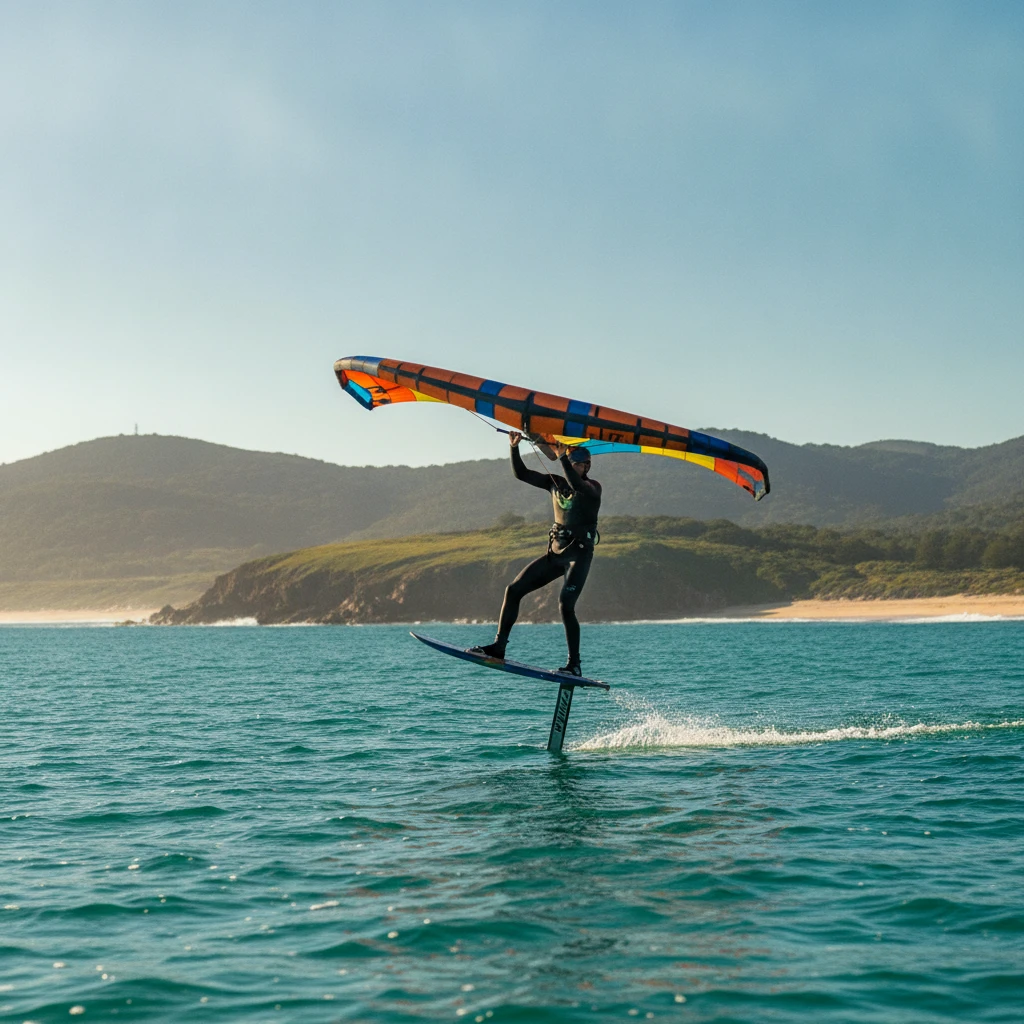
Two wind-powered sports, two philosophies. Kitesurfing gives you the power of a kite flown on 22 to 25 metres of lines; wing foiling pairs a handheld inflatable wing with a hydrofoil that lifts you clear of the water. Here's how to decide between them based on your profile, your local spot and your budget – judged purely on what each discipline actually demands.
Learning curve: who progresses faster?
Kitesurfing cannot be self-taught: your first sessions must be supervised by a qualified instructor, because the kit is technical and potentially dangerous in untrained hands. Supervised progress is quick, though: allow 6 to 10 hours of lessons (3 to 5 sessions) for basic independence – kite control on land, body dragging, then the waterstart – and 10 to 15 hours before you're riding regular sessions on your own. Riding upwind and jibing tend to click at around 20 to 30 hours on the water.
Wing foiling follows a gentler but far more independent path: 1 to 2 hours handling the wing on land, a few sessions on a big board without the foil, then your first take-offs. The first controlled flight comes after 5 to 10 sessions on average, and full independence (stable flight, turns, getting back to where you launched) after 8 to 15 sessions. Two to three hours of lessons with an RYA or British Kitesports instructor are enough to head off bad habits.
Verdict: starting from zero, wing foiling is quicker to learn and far more self-directed. And if you're coming from kitesurfing, your wing progression will be around 40% faster; a windsurfing background trims it by as much as 50%.
How much wind you need
Wing foiling is doable from 12 to 15 knots (force 3–4): enough for the wing to generate drive without making the kit a handful. Once independent, you'll ride from 12 to 25 knots by switching wing sizes (6 m² for light winds, 3 m² for 25–35 knots).
In kitesurfing, beginners do best in 10 to 15 knots on a 10–12 m² kite, but the sport often needs 15 knots or more to feel comfortable. In strong wind (25–30 knots and up), kitesurfing takes the lead: small kites, huge power, jumps and speed. When it's properly blowing, it's the higher-performance sport.
Spots: space and depth
Kitesurfing demands room: a clear launch zone (nobody within 50 metres downwind, no obstacles within 100 metres), a helper to launch and land the kite, and a wide stretch of water to ride with 22–25 metres of lines out. Big, open beaches with plenty of clear ground downwind are its natural habitat.
Wing foiling, by contrast, works on much smaller spots: sea, lake or lagoon, with no lines and no helper. You'll learn most easily in clear, shallow water (50cm to 1m) – a sheltered harbour, an estuary at low tide or a lagoon. The one constraint is depth: the foil mast (65 to 90cm) needs water under it as soon as you're flying.
In both disciplines, one absolute rule: never ride in offshore wind (blowing from land out to sea), which pushes you steadily away from the shore and makes the way back the hard part.
Safety: two different risk profiles
In kitesurfing, the main risk is pull. The kite is connected to your harness, and lines under tension can create dangerous situations. Mastering the quick release and the chicken loop is vital, and launching and landing remain the trickiest moments.
Wing foiling is inherently safer on the wing side: it isn't attached to the rider, and if you let go it simply drops into the water without dragging you. The foil, on the other hand, is razor-sharp, so a certified helmet and an impact vest are essential, along with a minimum distance of 20 metres from other riders and swimmers. In both sports, being able to swim (at least 200 metres for kitesurfing) is a non-negotiable prerequisite.
Kit and transport
Kitesurfing means a kite, bar and lines, a harness, a twin-tip board and a wetsuit, and setting up means unrolling and tensioning the lines, then launching the kite with a helper. Wing foiling means a wing that inflates in 2 minutes with a hand pump, a board and a take-apart foil – the whole lot fits in a backpack, and the full set-up takes 10 to 15 minutes, roughly a third of a kitesurfing rig-up. For heading out solo, with no helper and no big beach, the wing wins hands down.
Physical demands
Contrary to popular belief, kitesurfing doesn't require you to be an athlete: the wind does the work, and the pull goes through the harness, not your arms. Wing foiling, however, is ridden without a harness (at least at first): you hold the wing in your hands, which works the arms and core harder – even though control actually comes from subtle movements of the torso and hips, arms extended and core engaged. Balancing on the foil adds genuine leg work on top.
Budget
Bought new, a complete kitesurfing set-up costs noticeably less than a complete wing foiling kit: a new beginner wing package (wing, board, foil and accessories) runs to roughly a third more than its kitesurfing equivalent. The used market changes the picture: second-hand cuts the kitesurfing bill by 30 to 50%, and a second-hand wing kit costs roughly half the new price – so the gap between the two sports narrows considerably once you shop used. Our kitesurfing gear and wing foiling gear guides break down what to look for in each part of the kit.
Comparison table
| Criterion | Kitesurfing | Wing foiling |
|---|---|---|
| Learning from scratch | School compulsory, 6–10 h of lessons | Faster and freer, 8–15 sessions |
| Ideal beginner wind | 10–15 knots (10–12 m² kite) | 12–15 knots |
| Strong wind (25–30+ knots) | Excellent (small kites, jumps) | Possible on a 3 m², advanced riders |
| Spot needed | Big and clear (100 m downwind) | Small spots: sea, lake, lagoon |
| Wing/kite safety | Lines under tension, quick release vital | Let go of the wing and it just drops |
| Specific risk | Launch/landing, overpowering | Razor-sharp foil: helmet + impact vest |
| Set-up | Lines to rig + a helper | 10–15 min, 2-min inflation, solo |
| Transport | Kite, bar, board, harness | Fits in a backpack |
| Physical effort | Pull taken by the harness | Arms and core do more work |
| Beginner budget (new) | Less expensive new | Roughly a third more new; second-hand roughly halves it |
Verdict: which sport for which rider?
Complete beginner
Wing foiling. Moderate wind is enough, the wing drops harmlessly if you let go, the spots are varied (sea, lake, lagoon) and you can progress largely on your own after 2–3 hours of lessons. It's the most accessible foiling discipline for a first-timer. If it's raw power and jumps you're dreaming of, kitesurfing is still within reach: just budget for a compulsory supervised course of 3 to 5 sessions to get going. Follow our step-by-step guide to getting started in wing foiling.
Windsurfer looking to evolve
Wing foiling, no question. Your background cuts the learning time by around 50%: the riding stance and wind awareness are already there. The kit is far more compact and lighter than a windsurfing rig, much easier to take out on your own, and some boom-equipped wings even recreate the feel of a windsurf boom.
Curious kitesurfer
The wing as a complement to the kite. Your wind-reading skills nearly halve the learning time (−40%), and most kitesurfing centres now teach wing foiling too. The wing opens up days at spots too small or too crowded to lay out lines; keep the kite for the strong-wind days. And if it's the flying that draws you in, take a look at kite foiling as well.
Families
Wing foiling for flexibility, a kitesurfing course for the teenagers. The wing works on shallow lakes and lagoons, with kit that fits in a backpack and a wing that carries no pull-related danger: ideal for a multi-activity holiday. Kitesurfing can be started from age 12–14 with proper supervision – and there's no upper age limit; plenty of people take it up after 40. Either way, being a confident swimmer is the only real prerequisite.
The simplest way to decide is to try both. Most IKO-certified kitesurfing schools now teach wing foiling as well – see our kitesurfing courses and wing foiling courses pages.
Further reading
- Kitesurfing: the complete hub – getting started, technique, spots and safety
- Kitesurfing gear – kites, bars, boards and harnesses to kit yourself out properly
- Wing foiling: the complete guide – everything on the sport that's booming
- Learning to wing foil – from first handling the wing to your first flight
- Wing foiling gear – choosing your wing, board and foil
- The best kitesurfing spots in the UK
- The best wing foiling spots