Wing foiling is learnable on your own, but almost nobody does it quickly that way: the foil punishes small errors, and a beginner rarely owns kit the right size to forgive them. A few days with a qualified instructor on well-maintained gear typically gets a complete newcomer to a first flight. This guide covers the course formats, what separates a good centre from a mediocre one, where to go and what you'll pay.
Types of wing foil courses
👥 The group course (RYA-style progressive course)
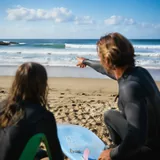
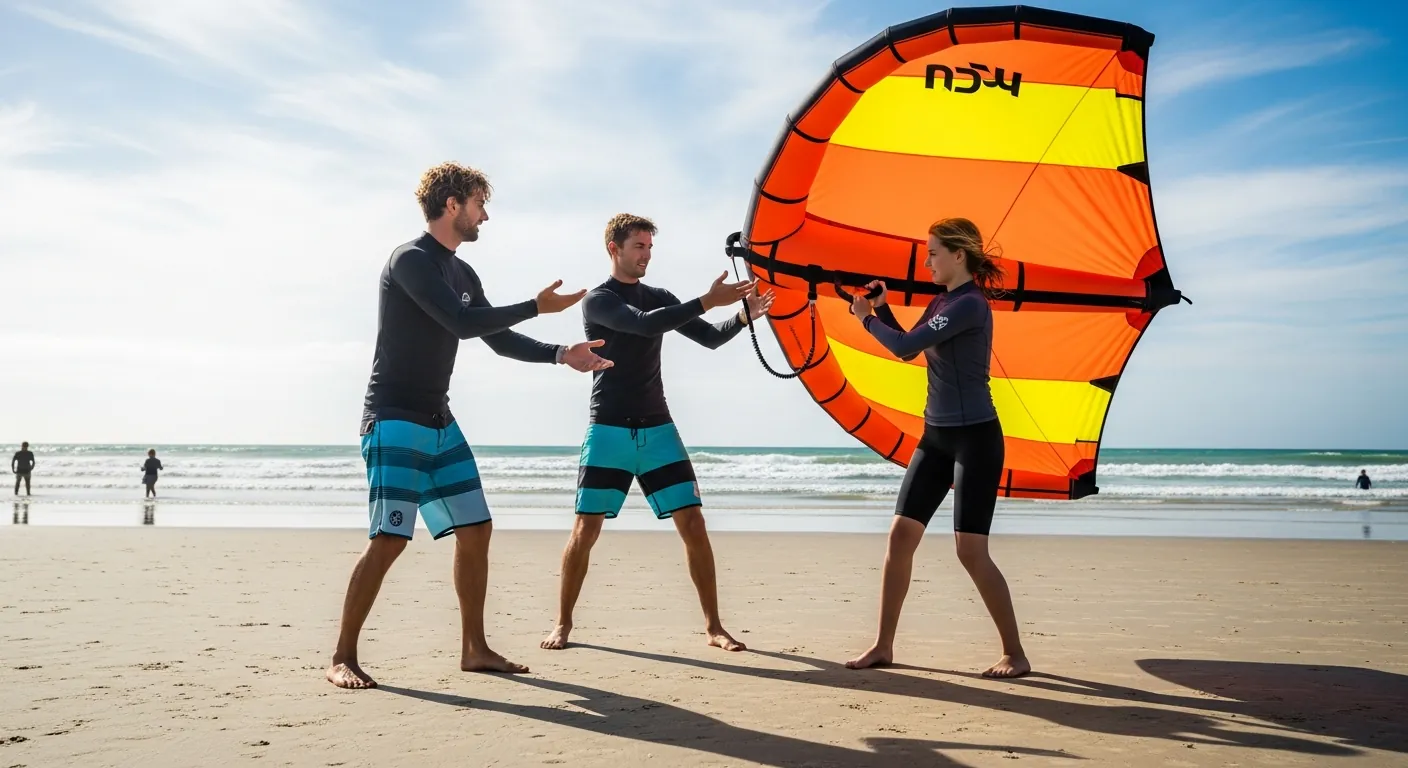
The most common and accessible format. A qualified instructor teaches a group of typically 3 to 6 students, following the RYA's progressive scheme: First Flights, then Sustained Flights as you advance. Sessions usually run 2 to 3 hours, with a strong ratio of instructor to students to keep progress moving.
Typical format: a full RYA First Flights course usually runs 6 to 8 hours across 2 to 4 sessions. Theory (reading the wind, safety, wing handling) comes first, followed by hands-on practice with the foil introduced progressively.
Budget: around £150 to £300 for a First Flights course, depending on the venue, session length and group size.
👤 Private coaching (one-to-one lessons)
One instructor, one rider, and a session shaped entirely around your goal – unpicking a stubborn fault, pushing on faster, or working towards wave riding, freestyle or downwinders. Most coaches film the session and go through it with you afterwards.
Typical format: 1.5 to 2 hours per session, 1 to 5 sessions depending on your goals. Video is what makes it stick, showing you your posture, your wing control and every foil-management error while the session is still fresh.
Budget: around £70 to £180 per session of 1.5 to 2 hours. Two to five sessions are usually enough for real, visible progress.
🏕️ The wing foil camp (all-inclusive break)
A week where the beds, the coaching, usually the food and often the lift to the water all come in one price, so you turn up and ride. Camps are well established in the warm-water spots UK riders head to for guaranteed wind, Fuerteventura and Tarifa above all.
Typical format: 5 to 7 days, around 2 hours of coaching a day plus supervised free-riding sessions, accommodation on site or nearby, breakfast included, kit provided.
Budget: around £400 to £900 a week depending on the destination and standard of accommodation, excluding flights.
A typical beginner wing foil course progression
A well-structured wing foil course builds in a logical order. Stage by stage, this is roughly what to expect.
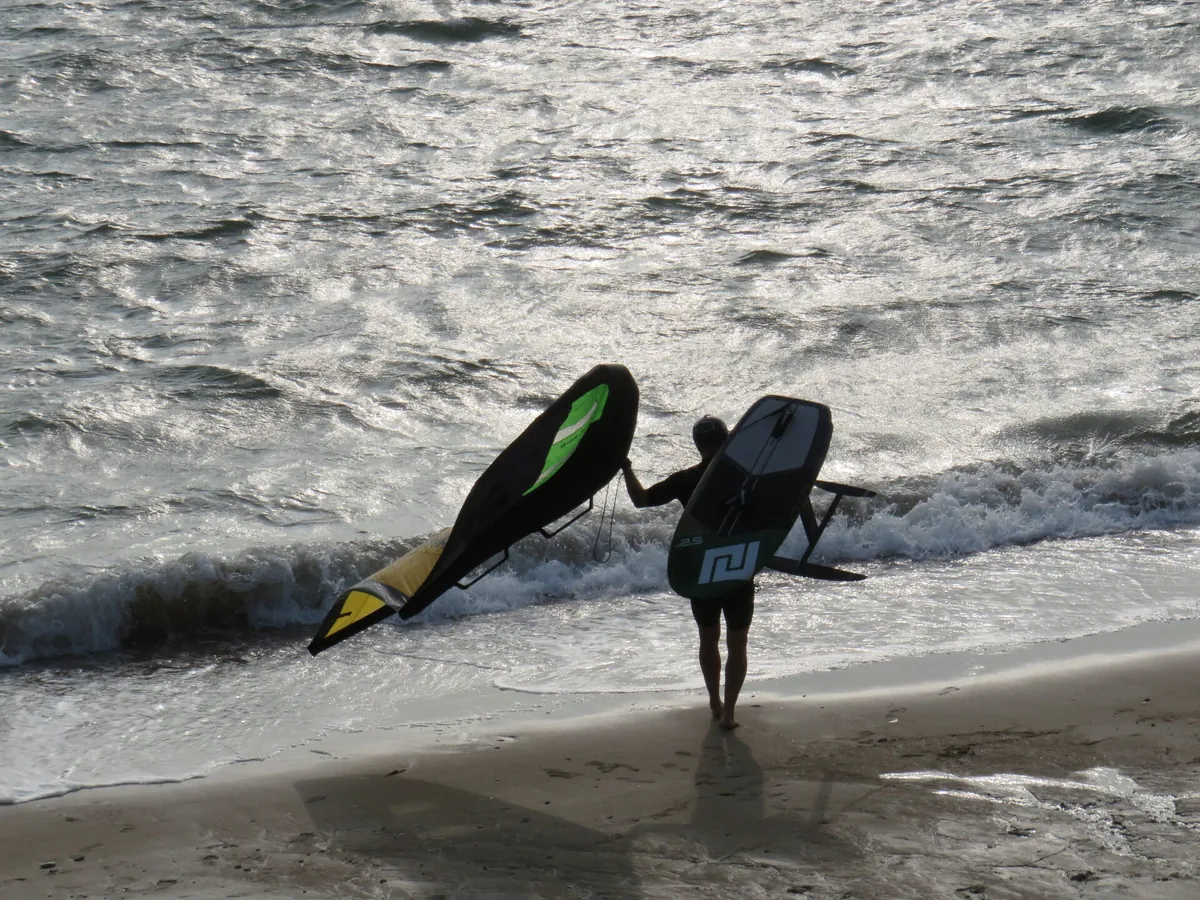
Stage 1 – Handling the wing on land (Day 1)
Everything starts on the beach. Your instructor teaches you how to hold the wing, feel the wind window, switch it from hand to hand and understand the power zone and the neutral position. You'll also learn to fold and pump up the wing correctly. Duration: 1 to 2 hours. This is the foundation for everything that follows – don't rush it.
Stage 2 – First runs on the water (Days 1 to 2)
You get in the water on a big board, with the foil removed or fitted but not yet used. The job is to get to your feet, stay standing, move using the wing and handle changes in direction. You'll also learn how to fall safely and climb back on the board. Duration: 2 to 3 sessions of around 1.5 hours.
Stage 3 – The water start (Days 2 to 3)
You learn to start from the water: with the wing in hand, you pull yourself up onto the board and find your balance. This is the central technical move in wing foiling. Your instructor guides you through body positioning, wing control and coordinating your movements. Duration: 2 to 4 sessions.
Stage 4 – First take-offs (Days 3 to 5)
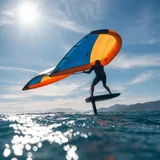
The foil comes into play. You start to feel the lift: the board rises, and you fly for a few seconds before settling back down. It's the most rewarding moment of the whole course – and the most technically demanding. Your instructor helps you manage ride height, pumping and correcting your line. Duration: 3 to 5 sessions depending on your watersports background.
Stage 5 – Controlled flight and early transitions (Day 5 onwards)
You fly steadily for 30 seconds to a minute. You start working on tacks (changing direction upwind) and early gybes. This is the gateway to riding independently. Duration: varies, but the basics are usually in place by the end of a 5-day course.
What speeds things up: if you've already done kitesurfing, SUP, windsurfing or surfing, your progress will be noticeably quicker. Balance on a board and reading the wind are both transferable skills. See our guide to getting started with wing foiling for more on progression.
How to choose a wing foil school
A good centre teaches in small groups, on kit that fits, at a spot that suits the day. Five things are worth checking.
Qualifications and accreditation in the UK
- RYA affiliation and qualified instructors: look for a centre that is an RYA Recognised Training Centre and whose instructors hold RYA wing foiling instructor qualifications. This is the UK benchmark for training quality and safety.
- Public liability insurance: the centre must carry adequate insurance for teaching watersports.
- British Kitesports accreditation: British Kitesports (the national association for kite and wing sports) also accredits schools and instructors and is worth checking for, alongside RYA recognition.
Quality markers to look for
- Instructor-to-student ratio: four to six per instructor at most. The foil needs watching closely, so a centre that teaches in smaller groups than it legally could is telling you something useful.
- Quality of kit: a good school provides recent wings (under 3 years old), boards matched to your weight and level, and foils in good condition. Check that kit is included in the course price.
- Flexibility with conditions: a serious school moves between spots depending on wind and tide rather than always staying put. That flexibility is a good sign of professionalism.
- Video analysis: more and more centres now offer video review of your sessions. It's a major accelerator for wing foiling progress.
- What past students say: recent social media posts are the quickest way to see the kit a centre runs and the conditions it puts students out in.
Stuck choosing a certified wing foil centre? Ask us and we'll point you at partners we rate, in the UK and further afield.
The best UK destinations for a wing foil course
💨 Hayling Island: the south coast hub
Level: All levels (mix of sheltered harbour and open sea)
Best season: March–November (reliable south-westerlies)
Course price: £150–£300
What makes it work: reliable sea breezes and a mix of flat, sheltered harbour water and open sea, backed by a strong local scene and several established schools. One of the busiest and best-supported wing foiling hubs in the country.
🏖️ Portland Harbour: the flat-water academy
Level: Beginner to intermediate
Best season: All year
Course price: £150–£280
What makes it work: one of the most sheltered stretches of flat water anywhere on the UK coast, and a national watersports venue with dedicated facilities. Superb for building flight time and confidence without waves or heavy chop getting in the way.
☀️ West Wittering: gentle beginnings
Level: All levels
Best season: April–October
Course price: £150–£280
What makes it work: shallow, flat water around the harbour mouth, a sandy bottom and steady sea breezes make this one of the gentlest places in the country to learn. Falls are soft and the water stays shallow a long way out.
🏔️ Rutland Water and inland reservoirs: pure technique
Level: Beginner to intermediate
Best season: April–October
Course price: £150–£280
What makes it work: flat, current-free and tide-free water lets you focus purely on technique, away from the variables of the coast. No waves, no tide: ideal for consolidating the basics. Check access, permits and club membership requirements before booking.
The best international destinations
🇪🇸 Fuerteventura (Canary Islands): wind all year round
Level: All levels
Best season: All year (water at 19–23°C, consistent wind)
Course price: £400–£700 a week (often all-inclusive)
What makes it work: in the depths of the UK winter, the wind here blows reliably (20–30 knots), and the Sotavento and El Cotillo spots offer both flat-water lagoons and wave zones. Fuerteventura is the UK's number-one winter wing foiling destination.
🇪🇸 Tarifa: the wind capital
Level: Intermediate to advanced (powerful wind)
Best season: May–October (Levante and Poniente)
Course price: £350–£650 a week
What makes it work: where the Mediterranean meets the Atlantic, Tarifa benefits from two reliable winds: the Levante (east) and the Poniente (west). Quality wing camps, an international crowd and an affordable cost of living. The wind can be strong – great for intermediates who want to progress in real conditions.
🇫🇷 Leucate (France): the Mediterranean lagoon
Level: All levels
Best season: April–October (steady tramontane)
Course price: £250–£450 a week
What makes it work: a short flight or drive away, Leucate's shallow lagoon and reliably strong tramontane wind (20–35 knots) make it one of Europe's most established wing foiling hubs, with plenty of certified schools and all-inclusive wing camps.
🇲🇺 Mauritius: the tropical lagoon
Level: All levels
Best season: June–November (south-east trade winds)
Course price: £500–£1,000 a week
What makes it work: Mauritius offers dream conditions: water at around 25°C, a steady 15–25 knots of wind, flat water inside the lagoon and waves beyond the reef. It's the 'luxury wing foil holiday' destination par excellence, with several resorts offering course-plus-accommodation packages.
Discover all the best wing foil spots in the UK and abroad: wind conditions, level required, access and recommended schools at each spot.
Budget: how much does a wing foil course cost?
Course in the UK
In the UK, reckon on £150 to £300 for a full RYA First Flights course (6 to 8 hours across a few sessions). Price varies with the venue, the number of teaching hours and the instructor-to-student ratio. Accommodation is usually not included – budget £50 to £120 a night depending on the standard.
Course abroad
Abroad, prices for a week-long, all-inclusive-style camp typically run from £350 to £1,000. Fuerteventura and Tarifa sit at the more accessible end (£350–£700), often bundled with accommodation. Mauritius and other premium destinations sit at the higher end (£700–£1,000), with more upmarket facilities.
Private coaching
One-to-one lessons cost £70 to £180 per session of 1.5 to 2 hours, in the UK or abroad. Private coaching is a worthwhile investment if you want to fix specific technical issues or accelerate your progress.
Kit provided or bought?
The great majority of courses include kit in the price (wing, board, foil, wetsuit). If you want to buy your own equipment after the course, budget £2,000 to £3,500 for a complete beginner set-up. See our guide to choosing wing foil gear to make the right call.
What to pack for a wing foil course
The essentials
- Your own wetsuit if you have one – centres lend them, but a suit that actually fits you is worth carrying
- Neoprene boots: useful below 15°C, and worth having anywhere you launch over stones or shingle
- Waterproof SPF 50+ sun cream, because wind and glare off the water do more damage than the temperature suggests
- A rash vest to take the sun and stop the wing handles chafing
- A changing robe, since most wing venues have nowhere to change
- A microfibre towel that packs down small
- A cap with a cord – anything loose ends up downwind
Comfort and safety
- Polarised sunglasses, which let you read depth and spot obstacles under the surface
- Flip-flops for the walk to the water
- Warm, loose clothes for afterwards
- Ear plugs, worth using in cold water to head off surfer's ear
- An insulated water bottle: wind dries you out faster than you notice
Documents
- Proof of insurance, checked to make sure watersports are actually included
- A medical fitness note if requested by the centre
- Your RYA membership card, if you have one
The best seasons for a wing foil course
Spring (April–June)
South-coast wind is fairly reliable, the water has come up to 12–16°C, spots are still quiet and accommodation prices are still gentle. This is the ideal window for a wing foil course in the UK.
Summer (July–August)
Warmest water of the year (16–19°C) and dependable south-coast sea breezes, at the price of crowded launch areas and peak accommodation rates. Book a month or two out.
Autumn (September–November)
September water still sits at 15–17°C, the autumn wind arrives and the summer crowds don't. For quiet, productive sessions this is often the pick of the year, and October holds up well at Hayling Island and Portland Harbour.
Winter (December–March)
Cold water (7–11°C in the UK), a 5/4mm wetsuit or a drysuit, and wind that is strong but bitter with it. For motivated, well-equipped riders. Fuerteventura, Tarifa and Mauritius are the best winter alternatives.
For a wing foil course in the UK, target May–June or September–October. You'll get reliable wind, bearable water, no crowds and gentler prices. For winter, head to the Canaries or Mauritius instead.
Progressing after your wing foil course
A course buys you a head start. Keeping it is down to what happens in the weeks afterwards.
- Get out twice a week: foiling reflexes fade quickly, so short, frequent sessions beat a single big block followed by a long gap.
- Off the water: a slackline or balance board sharpens the small corrections flight demands, and strong legs and core make long sessions possible.
- Video: a phone propped on the beach will show you what your hands and hips are doing far better than memory will.
- Going back to your course venue: water you already know frees you up to work on technique rather than reading the place from scratch.
- The next technical steps: after your first flights, work on transitions (tacks, gybes), wave riding, freestyle and downwinders. See our wing foiling techniques guide to progress step by step.
Back from your course? Keep progressing with our guides: getting started with wing foiling, choosing your gear, advanced techniques and finding the best spots.
❓ Frequently asked questions about wing foil courses
What does a wing foil course cost in the UK?
Reckon on £150 to £300 for the RYA First Flights course (typically 6 to 8 hours over 2 to 4 sessions) at a UK centre, depending on the venue and group size. Private one-to-one coaching runs from £70 to £180 per session. Accommodation is usually not included.
How long does it take to learn wing foiling on a course?
With a well-structured course of 6 to 10 hours, a complete beginner can usually reach their first controlled flights. Mastering transitions and carving generally takes a further 2 to 4 weeks of regular practice after the course.
Where can you do a wing foil course in the UK?
The main UK venues for wing foil courses are Hayling Island, Portland Harbour, West Wittering and Poole Harbour, with inland centres at Rutland Water and Grafham Water. Each spot offers different conditions: flat harbour water, sheltered reservoirs or open sea breezes.
Do you need to know how to surf or kitesurf before a wing foil course?
No, wing foiling is accessible to complete beginners. That said, experience in watersports (surfing, kitesurfing, SUP) noticeably speeds up progress, especially for balance and reading the wind.