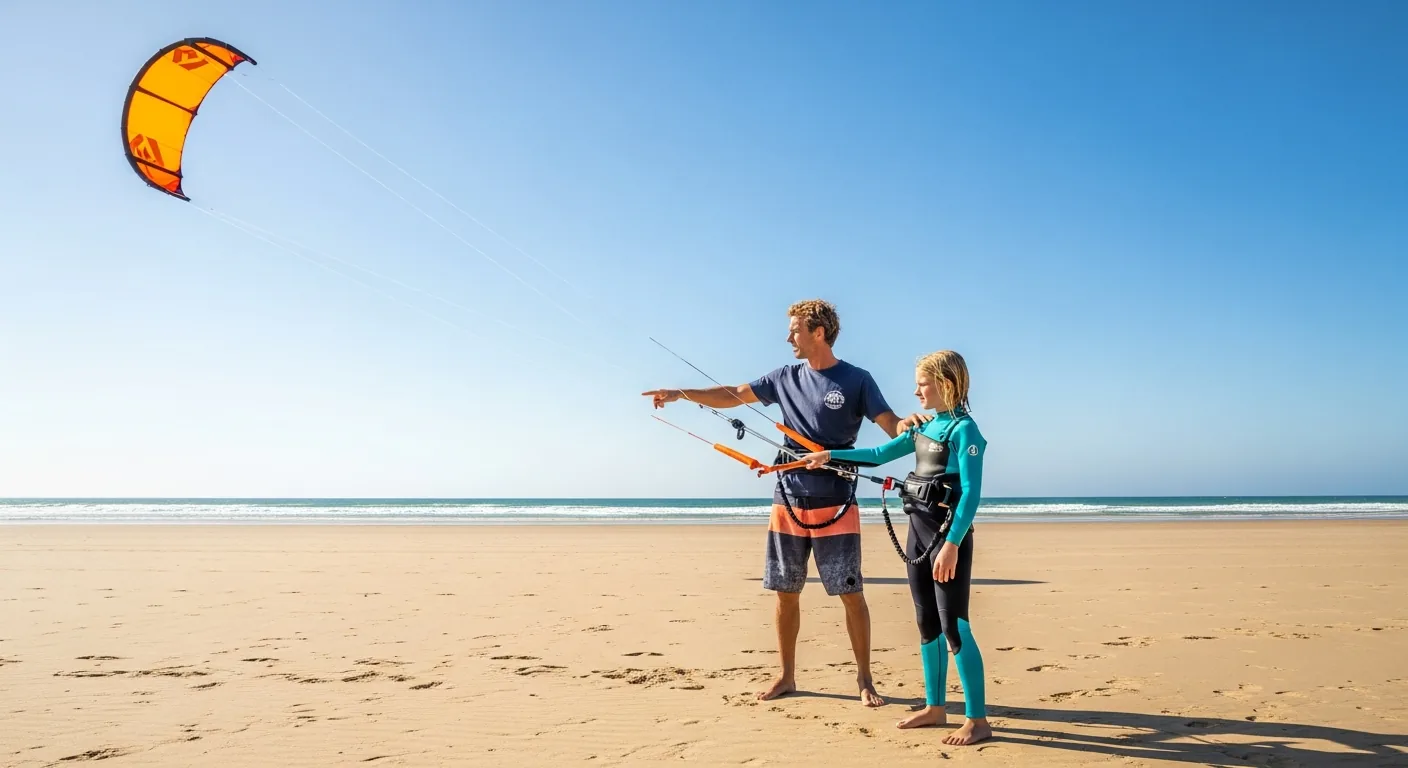
A proper kitesurf course is the safe, fast way to learn. With a BKSA-qualified instructor, on a spot suited to the day's conditions, using professional kit, a good course saves you months of trial and error compared with going it alone. Here's how to choose the instruction that's right for you, whatever your level.
Types of kitesurf lessons and courses
🎓 Group lessons
The most common and most affordable format. A qualified instructor supervises a group of 3 to 6 students. Each session runs 2 to 3 hours, with a supervision ratio designed to keep everyone safe while still progressing.
Typical format: 2 to 5 consecutive days, 2 to 3 hours of tuition per day. Theory (wind, weather, safety, riding zones) on day one, then progression in the water: kite control on land, body-drag, water start and your first runs.
Budget: £140 to £190 for a 1-day taster, £280 to £450 for a 3-day course.
👤 Private coaching
A dedicated instructor, fully tailored to you. Ideal for correcting specific technique, learning a new move (jumps, unhooked riding, transitions) or simply speeding up your progress. Private coaching often includes video analysis and a detailed debrief.
Typical format: 1.5 to 2.5 hours per session (depending on the wind), 1 to 5 sessions. Video analysis helps correct body position and speeds up understanding of the technique.
Budget: £60 to £100 per hour. Reckon on 2 to 4 sessions for real results on a specific skill.
🏕️ Kitesurf camps (all-inclusive trips)
The 'kitesurf holiday' format: accommodation, lessons, sometimes meals and transport to the spot all included. It's the easiest way to get a week of riding without the logistics. Kitesurf camps are common in Tarifa, Dakhla, El Gouna, Cabarete and in the UK (Camber Sands, Watergate Bay).
Typical format: 5 to 7 days, 2 to 3 hours of tuition a day plus supervised free-riding, accommodation on site or nearby, breakfast included, transport to the day's spot depending on the wind.
Budget: £450 to £1,000 a week depending on the destination and standard. Morocco and Egypt tend to offer the best value.
The progression of a beginner course
A beginner kitesurf course follows a structured teaching progression. Each stage should be nailed before moving on to the next. Over 3 to 5 days, the path usually runs like this.
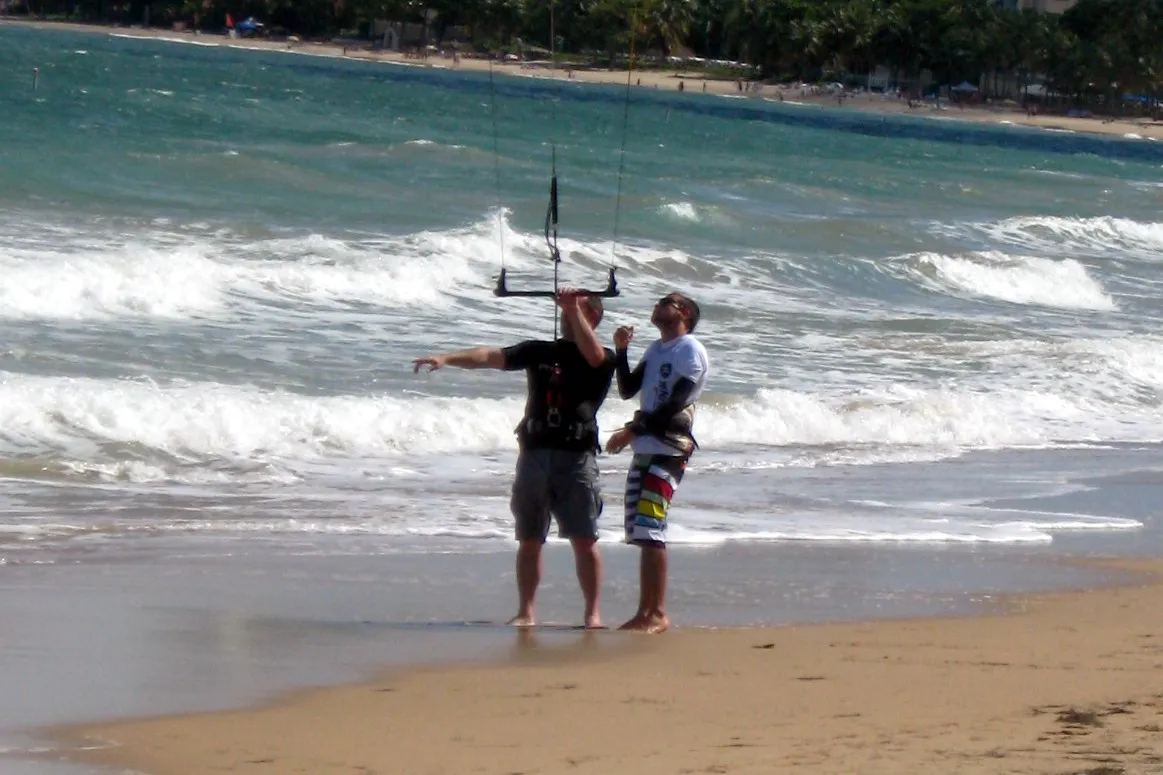
Theory and safety
Wind (onshore, sideshore, offshore), riding zones, right of way, the kite's release and safety systems. This step is essential before you touch any kit.
Kite control on land (trainer kite)
On the beach, with a small 2-4m² kite: learning the wind window, the 9, 12 and 3 o'clock positions, the basic movements and flying figures of eight. This is the foundation of all kite piloting.
Body-drag (being pulled through the water)
You get in the water with the kite (a 3-5m² depending on the wind) and learn to let it pull you along: body-drag upwind (to retrieve your board) and body-drag downwind. You'll also learn to relaunch the kite from the water.
Water start (getting up on the board)
Position the kite in the power zone, get set with the board on your feet, and use the kite's pull to stand up and start riding. This is the most technical stage and takes coordination to master.
First runs and riding
Once you're up on the board, the goal is to hold a line, ride in a straight run, then start working upwind. By the end of a 5-day course, an independent student can ride in light to moderate conditions.
Don't skip a stage. An instructor who puts you straight on the board without the body-drag is putting you at risk. The standard teaching progression is proven and safe: stick to it.
How to choose a kitesurf school
Choosing the right school matters for both the quality and the safety of your course. Kitesurfing carries real risk if it's taught badly, so it pays to check a few things before you book.
Certifications to look for in the UK
- BKSA affiliation: the British Kite Sports Association is the UK's national governing body for kitesurfing. A BKSA-recognised school follows agreed teaching and safety standards.
- Qualified instructors: your instructor should hold a recognised BKSA or IKO instructor qualification, backed by first-aid training.
- Public liability insurance: the school should be insured to teach kitesurfing.
- Visible credentials: check the school displays its certifications on site and on its website.
Quality criteria
- Instructor-to-student ratio: a maximum of around 6 students per instructor is standard practice in kitesurfing. A ratio of 3 to 4 is ideal for faster progress.
- Modern, well-maintained kit: a good school runs recent kites (under 5 years old), boards sized for beginners (big and stable), harnesses in good condition and working safety systems.
- Radio communication: more and more schools use radios to talk to students in the water. A real plus for safety and for real-time corrections.
- Video analysis: some schools film your sessions for a debrief. A genuine progress accelerator.
- Reviews: check Google Reviews, TripAdvisor and the school's social media before you book.
Looking for a BKSA-certified kitesurf school? Get in touch and we'll point you towards trusted partner schools at the best UK spots.
The best UK destinations for a kitesurf course
🌬️ Hayling Island (Hampshire): the birthplace of windsurfing
Level: All levels
Best season: April–October (reliable sea breezes)
Course price: £280–450 / 3-day course
Why go: Hayling Island is one of the UK's best-known watersports spots, with a huge beach, a sheltered harbour entrance and several long-established BKSA-affiliated schools. A strong kite community and reliable summer wind make it a top pick for learning.
💨 West Wittering (West Sussex): the managed spot
Level: Beginner to Intermediate
Best season: April–October (steady SW–W wind)
Course price: £280–450 / 3-day course
Why go: a sheltered lagoon behind the spit gives flat, shallow water for learning, with a managed zoning system that keeps kitesurfers, swimmers and other beach users apart safely. A great, family-friendly setting.
☀️ Camber Sands (East Sussex): the vast beach spot
Level: Beginner to Intermediate
Best season: April–October (consistent sea breezes)
Course price: £280–450 / 3-day course
Why go: a huge, dune-backed beach with plenty of room for lessons at low tide, well-established BKSA schools and a friendly, welcoming kite scene.
🌊 Watergate Bay (Cornwall): the Atlantic spot
Level: Intermediate and above
Best season: September–May (SW Atlantic wind)
Course price: £280–450 / 3-day course
Why go: two miles of open sand and reliable Atlantic wind through autumn and winter make Watergate Bay one of the country's best-known kite beaches, with room to progress from your first sessions through to wave riding.
The best international kitesurf course destinations
🇪🇸 Tarifa (Spain): the windiest spot in Europe
Spots: Playa de Los Lances, Valdevaqueros
Best season: March–October (Poniente and Levante winds)
Course price: £220–380 / week
Kitesurf camp price: £430–680 / week (all-inclusive)
Why go: Tarifa is the wind capital of Europe. The Poniente (westerly) and Levante (easterly) winds mean it blows on almost every day of the season. The vibe is international, the schools are plentiful, and Los Lances is perfect for beginners. Only a 2-hour ferry from Morocco.
🇲🇦 Dakhla (Morocco): the kitesurfer's paradise
Spots: Dakhla Lagoon, White Dune
Best season: Year-round (constant 15–25 knot wind)
Course price: £170–300 / week
Kitesurf camp price: £340–600 / week (all-inclusive)
Why go: Dakhla is every kitesurfer's dream spot. A vast flat-water lagoon, constant 15–25 knot wind for around 300 days a year, and some of the lowest prices around. The White Dune spot (reachable at low tide) is iconic. Great for beginners and advanced riders alike.
🇪🇬 El Gouna (Egypt): the Red Sea lagoon
Spots: El Gouna Lagoon, Mangroovy
Best season: March–November (steady thermal wind)
Course price: £170–300 / week
Kitesurf camp price: £340–600 / week (all-inclusive)
Why go: a turquoise, shallow lagoon with a reliable 15–20 knot thermal wind most afternoons. El Gouna is a full resort town with restaurants, spas and other activities. Great value for warm-water, dependable wind.
🇩🇴 Cabarete (Dominican Republic): Caribbean kitesurfing
Spots: Cabarete Beach, Kite Beach
Best season: June–September (steady trade winds)
Course price: £220–350 / week
Kitesurf camp price: £430–770 / week (all-inclusive)
Why go: Caribbean trade winds give a constant 15–20 knots, 27°C water and waves for those wanting to move into freeride or wave riding. A great international kite scene and reasonable prices.
Explore all our UK kitesurf spots, with detailed guides by destination: wind conditions, best season, level required, access and recommended schools.
Budget: how much does a kitesurf course cost?
In the UK
- Taster course (1 day): £140 to £190
- Full course (3 days): £280 to £450
- Private coaching (per hour): £60 to £100
- Accommodation (not included): £35 to £110 / night depending on the destination
Abroad
- Tarifa (Spain): £220 to £380 / week of lessons, £430–680 for a kitesurf camp
- Dakhla (Morocco): £170 to £300 / week of lessons, £340–600 for a kitesurf camp
- El Gouna (Egypt): £170 to £300 / week of lessons, £340–600 for a kitesurf camp
- Cabarete (Dominican Republic): £220 to £350 / week of lessons, £430–770 for a kitesurf camp
Budget tip: a kitesurf camp in Dakhla or El Gouna often works out cheaper than a course in the UK once you add up lessons, accommodation and food – and the wind is far more reliable.
When to book a kitesurf course
Spring (April–June)
The best all-rounder in the UK: steady wind, mild temperatures and fewer crowds than summer. The water is still cool (10–13°C) but a 4/3 wetsuit is enough for most days. A great season to progress calmly.
Summer (July–August)
Warmer water (16–19°C) and a proper holiday atmosphere, at the price of crowded spots and peak rates. Wind on the South Coast can be light some days if the sea breeze doesn't fill in. Book 2 to 3 months ahead. This is, however, the best season for Tarifa (steady Levante).
Autumn (September–November)
The kitesurfers' season: water is still reasonably warm in September (14–17°C), autumn wind picks up as Atlantic depressions return, and the spots empty out. This is the best time of year for a course on the Atlantic coast, with September and October prime months at Watergate Bay.
Winter (December–March)
The most demanding in the UK: cold water (7–10°C), thick wetsuits needed (5/4 or 6/5/4 with boots, gloves and a hood), and wind that can be very strong (tough conditions for beginners). For the committed only. Abroad, Dakhla and El Gouna are in full season, with constant wind and 22–25°C water.
If you can choose your dates, book May–June or September–October. You get steady wind, bearable water, quieter spots and better prices. Abroad, Dakhla from March to November is hard to beat.
What to pack for a kitesurf course
The essentials
- A neoprene wetsuit suited to the season (often provided by the school, but your own is more comfortable) – expect to need 4/3 in summer and 5/4 or 6/5/4 outside it
- Neoprene boots (essential for most of the year in UK water, and useful on any spot with a rocky or shelly bottom)
- Neoprene gloves (recommended in cold water)
- Waterproof SPF 50+ sun cream
- A rash vest (sun protection and to stop harness rub)
- A changing robe for getting changed on the beach
- A microfibre towel (dries fast, packs small)
- Polarised sunglasses (UV protection and reading the wind on the water)
Comfort and safety
- A cap with a cord (sun protection out of the water)
- A beach mat or changing mat to sit on between sessions
- Energy snacks (bars, dried fruit): kitesurfing burns plenty of calories
- An insulated water bottle (staying hydrated matters)
- A basic first-aid kit (plasters, antiseptic, soothing cream)
- Ear plugs (to help prevent exostosis, especially in cold water)
Documents
- Proof of insurance (check you're covered for watersports, and bring your BKSA membership card if you have one)
- A GHIC or valid travel insurance if you're heading abroad for a course
- Any completed health or fitness declaration your school asks for in advance
- Proof of a previous course or certification if you have one (speeds up your placement in the right group)
Progressing after your course
A kitesurf course is an accelerator, but progress continues afterwards:
- Kite often: two short sessions a week will get you further than one intensive week and nothing after it. The movements only become automatic through repetition.
- Dry-land practice: flying a trainer kite on the beach, core work and general strength training. Strong kitesurfers put the work in on land as well as on the water.
- Video analysis: if your school doesn't offer it, film your own sessions on your phone (or a GoPro) and compare them against reference tutorials.
- A recognised certification: some schools offer an IKO or BKSA proficiency card to record your progress. It's also a good progression goal in itself.
- Moving on to foiling: once you're comfortable on a twin-tip, kite foiling is the natural next step. Less physical, more accessible in light wind, and a genuinely different feeling of flight. See our kite foil guide to find out more.
Back from your course? Keep progressing with our other guides: getting started in kitesurfing, choosing your gear and our safety rules for your next sessions.
❓ Frequently asked questions about kitesurf courses
How much do kitesurf lessons cost in the UK?
Expect to pay around £280 to £450 for a 3-day beginner course in the UK. Private tuition costs roughly £60 to £100 per hour. A short taster or 1-day course typically runs £140 to £190.
How many days does it take to learn kitesurfing?
A course of 3 to 5 days is generally enough to reach independence in light conditions: kite control on land, body-drag, water start and your first runs. Full confidence takes several weeks of regular practice after that.
Where's the best place for a beginner kitesurf course in the UK?
Hayling Island, West Wittering, Camber Sands and Poole Harbour all offer sheltered water, dependable wind and BKSA-certified schools within easy reach of the launch.