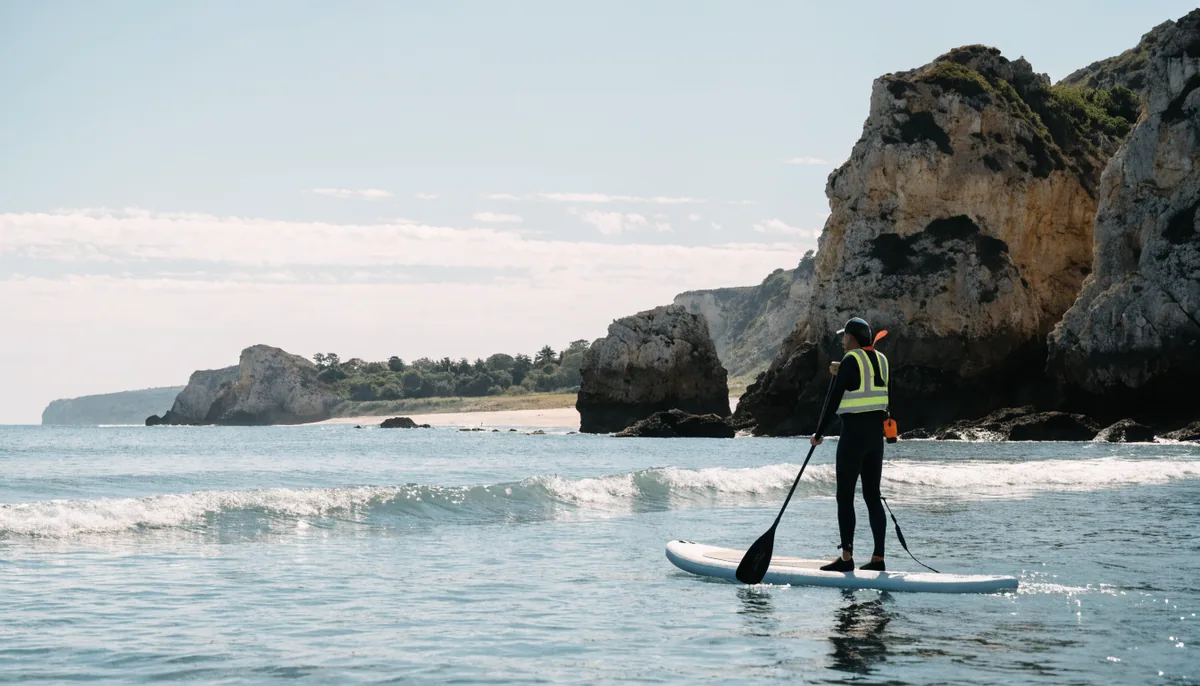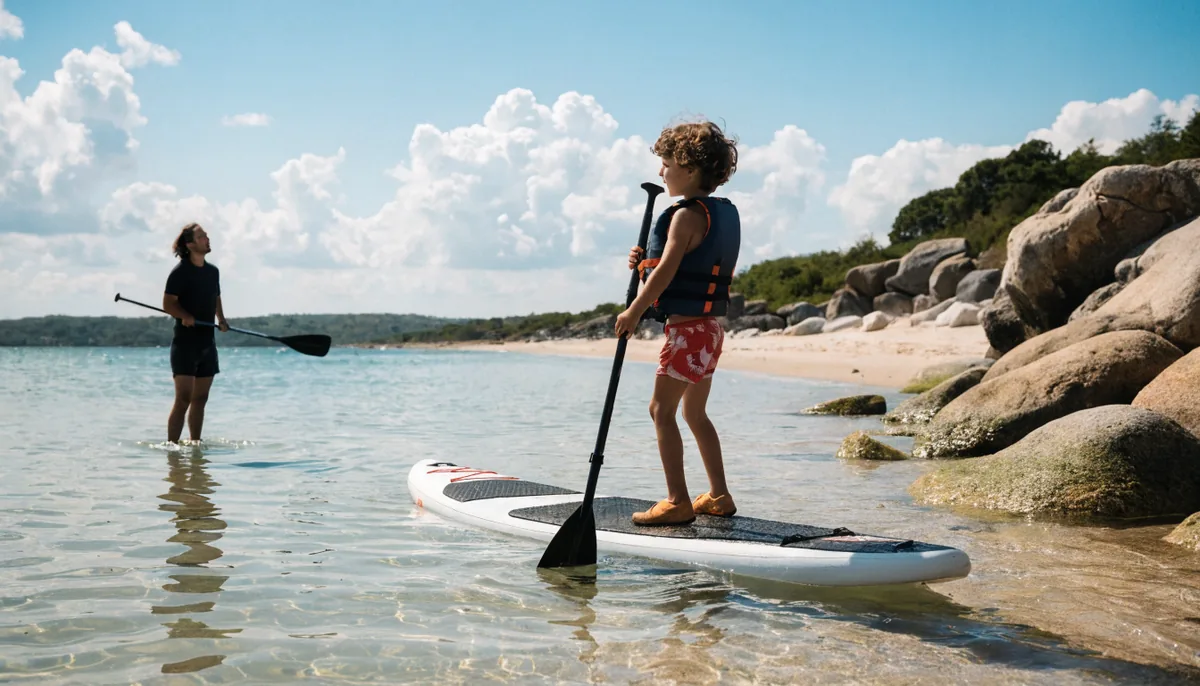

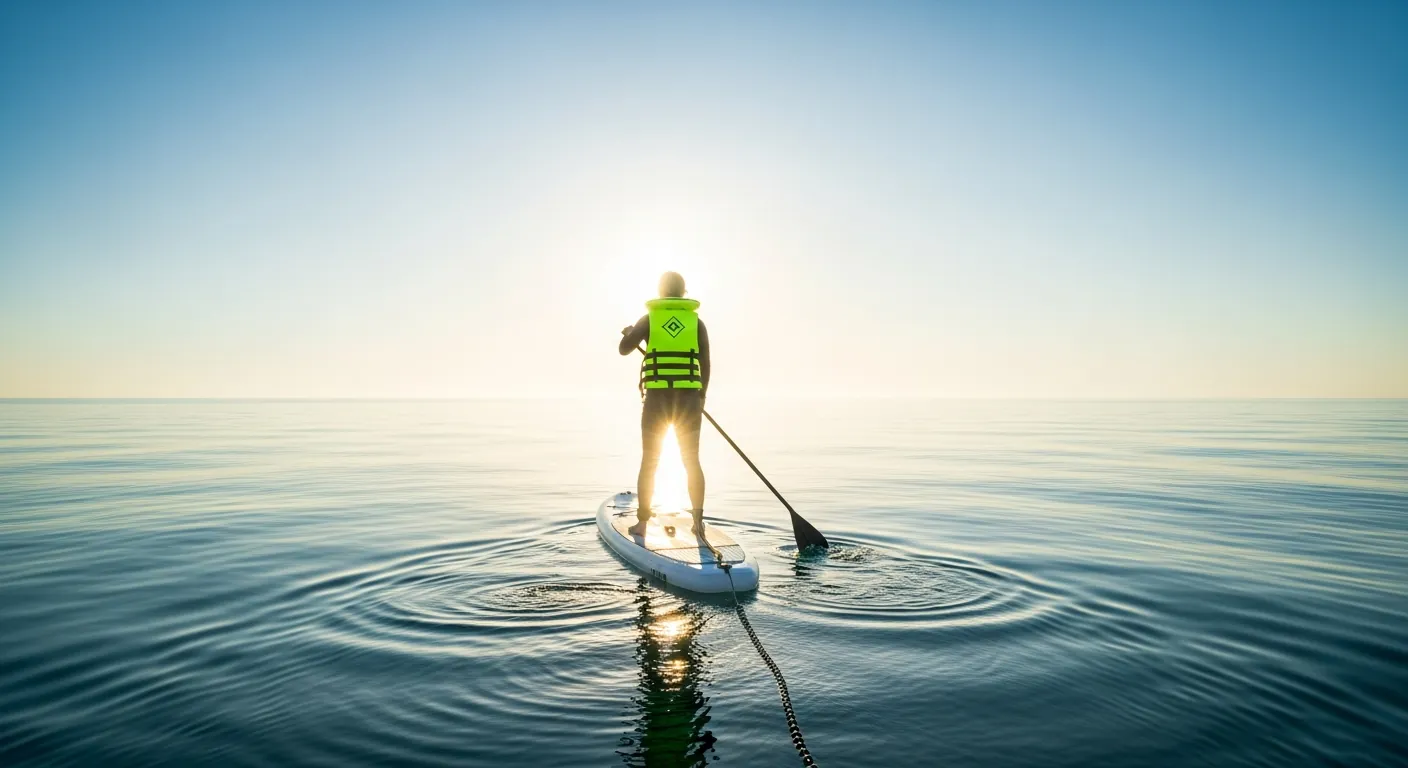
Stand-up paddleboarding looks like a gentle pursuit – right up until the wind gets up. Every year paddlers get blown out to sea or have to be rescued. To keep out of trouble, here's what really matters: the kit to wear, the traps set by the wind, reading the forecast, self-rescue and knowing your limits. Worth reading before your first paddle – and worth a re-read now and then.
The safety kit to wear
SUP has a well-earned reputation for being safe, but the sea and open water demand respect. A short list of kit, worn every time, is what keeps a bad moment from becoming an emergency. On the sea, always tell someone your plan and your expected time back.
🔹 Leash
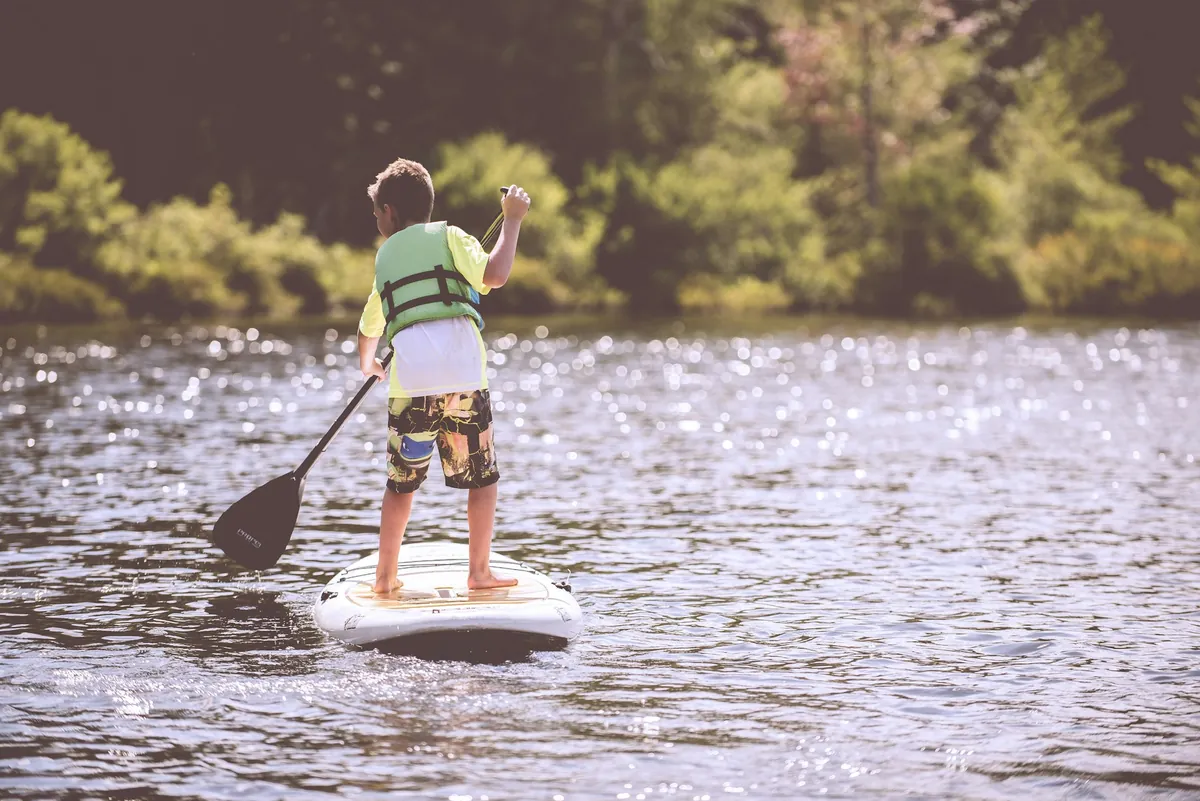
The leash keeps you attached to your board, which is your biggest float. Always wear one. On the sea and on flat water, choose a coiled leash that doesn't drag or snag on the waves. On moving water and rivers, never use an ankle leash: wear a quick-release waist leash instead, so you can free yourself instantly.
🔹 Buoyancy aid
ISO classes, fit and care: our buoyancy aid guide for SUP covers the choice in detail.
Wear a buoyancy aid every time you paddle, even if you're a strong swimmer. A foam 50N aid never needs arming and always floats; a belt-pack inflatable is discreet and comfortable for SUP. Cold water saps your strength fast, and a buoyancy aid buys you time. Put one on as a matter of course, especially at sea.
🔹 A means of calling for help
Carry a phone in a waterproof pouch on a lanyard, clipped to your buoyancy aid. It's how you'll call for help or use your GPS. On bigger open-water paddles, a small handheld VHF is better still. A whistle attached to your buoyancy aid lets you signal your position.
🔹 A light for poor visibility
A waterproof light is essential if you're on the water near dusk or in poor visibility (fog, rain). A waterproof head torch clipped to your buoyancy aid does the job and makes you visible to other craft.
Check your kit before every paddle. A frayed leash, a buoyancy aid you've left in the car or a lost whistle can turn a small problem into a serious one. Two minutes of checks on the bank is time well spent.
The wind: the paddler's number-one danger
Offshore wind: the invisible trap
The offshore wind (blowing from the land out to sea) is the most insidious danger in SUP. Unlike an onshore wind (which pushes you back towards the beach), an offshore wind carries you away from the shore without your realising it, especially when you're standing and focused on your paddling.
⛔ Offshore wind = immediate danger
If the wind is blowing off the land, don't paddle out into it. Even a light wind (10–15 knots, roughly 12–17mph) can carry you a couple of hundred metres offshore in minutes. A standing paddler acts like a sail: you'll go faster than you think. An orange windsock on the beach warns of offshore wind.
How to spot an offshore wind
- Check the wind direction before you go (the Met Office marine forecast, Windy, Windguru)
- Watch the waves: if they're heading towards the beach, the wind is offshore
- Look at the flags on the beach, and any orange windsock: if they point out to sea, take care
- Stand facing the water: if you feel the wind on your back, it's blowing out to sea – offshore
What to do if you're caught in an offshore wind
- Lie down on your board, chest to the deck
- Paddle on your front back towards shore, with your hands or your paddle
- Don't stay standing: you catch far too much wind
- If you can't make progress, stay on your board, call for help (999, ask for the Coastguard) and use your whistle
- Don't panic: your board is a float, so stay on it
Offshore wind is the single most common reason paddlers need rescuing, and some drift for miles before help reaches them. Never underestimate it.
Currents and tides
Rip currents
As with surfing, a rip current is a real hazard on a SUP. It forms where water piled up by the waves rushes back out to sea. On a board you're more visible than a swimmer, but a rip can still carry you off.
Tidal currents
Around much of the UK coast, tidal currents are strong, especially near headlands, points and narrow channels. A current of 3 to 5 knots can stop you making headway however hard you paddle. Check the tide times and range and any local tidal-stream information before you go out.
How to plan around the currents
- Watch the water from the bank for 5 to 10 minutes before you set off
- Pick out the areas where the water looks darker or more churned up
- Identify the exit points along the shore where you could get back to land
- Paddle into the current or wind first, so it helps carry you home if you tire
Just starting out? Begin on calm water (a lake, a slow river, a sheltered bay) before you take on the sea. Read our getting started on a paddleboard guide to build up steadily.
The forecast and conditions
Before every paddle, check:
- The wind: direction, strength and gusts in knots (the Met Office, Windy)
- The swell: size and period (a long swell, even a small one, can drive currents)
- The tides: times and range (the water level changes the currents and access to your launch)
- The general forecast: storms, fronts and Met Office weather warnings
- The water temperature: it dictates your wetsuit and the risk of cold-water shock
Never paddle in a thunderstorm. Water conducts electricity, and your carbon or aluminium paddle acts like a lightning rod. Get off the water at the first sign of a storm and wait 30 minutes after the last lightning before going back out.
How far from shore to paddle
There are no rigid rules for how far you can paddle, but there is plenty of common sense. The single best habit is to stay within a distance you could comfortably get back from if things changed.
🔹 Close to shore (up to about 200 metres)
The sensible zone for beginners and for casual outings. You're easy to see from the beach, help can reach you quickly, and you could swim back if you had to. Minimum kit: a leash and a buoyancy aid.
🔹 Further out (up to a mile or so)
A proper open-water paddle for the experienced and well-equipped. Carry the full kit: buoyancy aid, leash, whistle, a light and a means of calling for help (a phone in a waterproof pouch, ideally a handheld VHF). You must be able to look after yourself if something goes wrong.
⛔ Long open crossings
Longer coastal crossings are for experienced paddlers only, with full kit (VHF, GPS, a nav light, a tow line) and a proper understanding of the tides, the traffic and the forecast. Don't attempt one without the preparation, the equipment and the experience.
When in doubt, stay within about 200 metres of the shore. You'll be visible from the beach, help can reach you sooner, and you can get back to land under your own steam. See our SUP kit guide for the gear to match how far out you paddle.
Self-rescue techniques
Getting back on your board after a fall
- Stay calm: your board floats, and so do you
- Reel your board back in using the leash
- Position yourself side-on to the board, level with the centre carry handle
- Grab both rails and pull the board towards you to slide your chest onto it
- Slide your legs up behind you into a lying position
- Get up gradually, one knee at a time, then stand
The waiting position (if you can't get back to shore)
Lie chest-down on the board, arms and legs hanging in the water. This position cuts the wind you catch and lets you rest. Use your whistle to signal your position if you need to.
Paddling on your knees if you tire
If you're tired or the wind picks up, drop to your knees on the board. You catch less wind and you're more stable. Paddle on alternate sides to keep moving in a straight line.
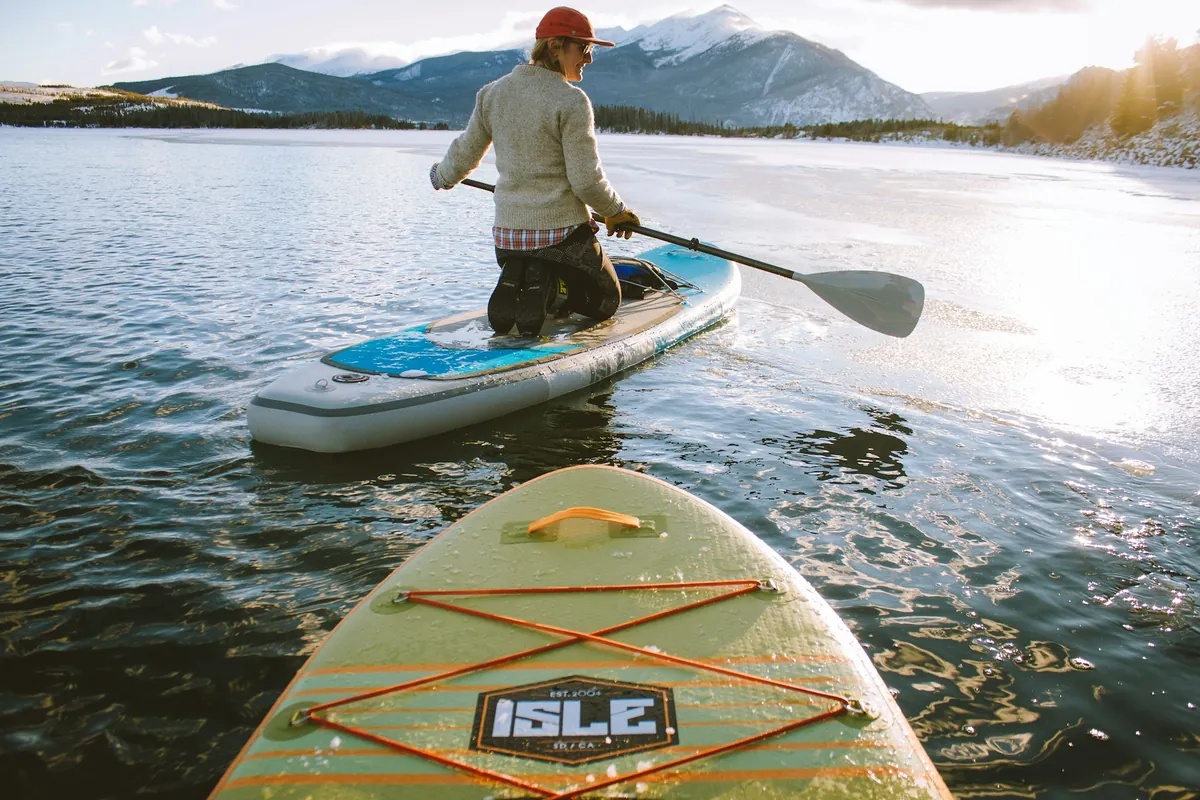
Never abandon your board. It's your best life raft. However tired you are, stay with it. Rescuers will spot you far more easily on a brightly coloured board than on your own in the water.
The hazards to watch for
Boats and powered craft
At sea, boats (fishing boats, motor cruisers, jet skis) are a major hazard. A paddler is hard to spot from a boat. Stay visible (bright clothing, a hi-vis buoyancy aid), keep out of navigation channels and swimming areas, and remember a paddler has no priority over powered vessels.
Swimmers and bathing areas
Never paddle into marked bathing areas. On lifeguarded beaches, the black-and-white chequered flags mark the zone for craft like SUPs; keep clear of the red-and-yellow swimming area between them. You put both the swimmers and yourself at risk. Keep well clear of anyone in the water.
Cold water and hypothermia
Cold water (below 15°C, which is most UK water for much of the year) causes cold-water shock if you fall in. The first minutes are critical: a gasp reflex, then a loss of coordination. Wear a wetsuit to suit the water temperature. On UK coasts in winter, a 4/3mm or 5/4mm is the sensible standard.
Sun and dehydration
On the water the sun reflects up and doubles your UV exposure. Wear a hat (with a retainer), sunglasses (on a cord) and a rash vest, and apply waterproof sun cream (SPF 50+) every couple of hours. Bring water: dehydration creeps up fast, even in winter.
Obstacles: rocks, posts and nets
On a SUP you can't always see underwater obstacles (rocks, wrecks, fishing nets). If in doubt, lift the fin clear and let it pass. Don't paddle too close to rocks or harbour structures.
⛔ The golden rule: never paddle alone
Always paddle with at least one other person, or tell someone on land your route and your expected time back. If something goes wrong, a companion can call for help and assist you.
Emergencies and the numbers to know
The emergency number
- 999 (or 112): in any coastal or sea emergency, dial 999 and ask for the Coastguard. HM Coastguard coordinates search and rescue around the UK coast, 24 hours a day.
- 112: the European emergency number, which works across Europe and often even without your own mobile signal.
How to call for help
When you call 999 and ask for the Coastguard, give:
- Your position: as precisely as you can (GPS coordinates, a visible landmark, your distance from the beach)
- The number of people in trouble
- Their apparent condition (conscious, injured, hypothermic)
- The conditions: wind, swell, visibility
- Your kit: buoyancy aid, leash, VHF if you have one
Keep your phone in a waterproof pouch attached to your buoyancy aid or your board. Turn on battery-saver mode. In an emergency you'll need it to call for help or use your GPS.
Access, permits and local rules
Where you can and can't paddle
You don't need a licence to paddle recreationally on the sea. On many inland waters – canals, some rivers and reservoirs – you may need an access permit or licence, and some stretches are private or off-limits. Check before you launch, and always respect access signs, anglers and other water users.
Local rules
Many places have their own local rules for SUP: permitted zones, times, distance from shore, launch restrictions. Ask at the harbour master's office, the local sailing club or the landowner if you're unsure.
What's expected of you on the water
- Know and follow the rules of the water (give way to larger vessels, don't obstruct navigation)
- Wear the right safety kit for where and how far you're paddling
- Don't go out in dangerous conditions
- Respect restricted areas (nature reserves, wildlife zones, bathing areas)
- Report any hazard you come across (drifting objects, pollution) to the relevant authority
The British Stand Up Paddle Association (BSUPA) sets coaching standards and safety guidance for SUP in the UK. A lesson or two with a BSUPA-recognised instructor is the fastest way to learn the right habits from the start.
Respecting the environment
Safety also means respecting the water and its wildlife:
- Take everything home: wrappers, litter and other people's too.
- Respect the wildlife: don't chase birds, fish or seals. Watch from a distance.
- Avoid sensitive areas: seagrass beds, nesting sites and nature reserves.
- Choose reef-safe sun cream and clean your kit without harsh chemicals.
- Check the water quality after heavy rain, when storm overflows can affect popular spots.
Looking for safe places to paddle? Browse our pick of the best UK paddling spots, and brush up on your SUP techniques to handle the trickier moments with confidence.
❓ Frequently asked questions about SUP safety
What safety kit do I need for stand-up paddleboarding?
Always wear a leash and a buoyancy aid, and carry a means of calling for help (a phone in a waterproof pouch) and a whistle. Add a light if you're on the water in poor visibility or near dusk. Check everything is in good order before every paddle.
How far from shore should I paddle on a SUP?
As a beginner, stay close to shore, within about 200 metres, where you're easy to see and could get back if the wind picked up. Only head further out, up to a mile or more, once you're experienced, properly equipped and confident in the conditions, the tide and the forecast.
Is offshore wind dangerous on a SUP?
Yes, it's the number-one danger. Offshore wind pushes you out to sea without your noticing. If you're caught, lie down on your board and paddle back to shore on your front. Never try to stay standing in a strong offshore wind. An orange windsock on the beach warns of offshore wind.