
Getting better at stand-up paddleboarding comes down to a handful of core techniques. From the forward stroke to the sweep turn, every move builds on fundamentals worth drilling until they're automatic. Below are the techniques for paddling efficiently, turning, catching waves and mixing up your paddling.
1. The forward stroke
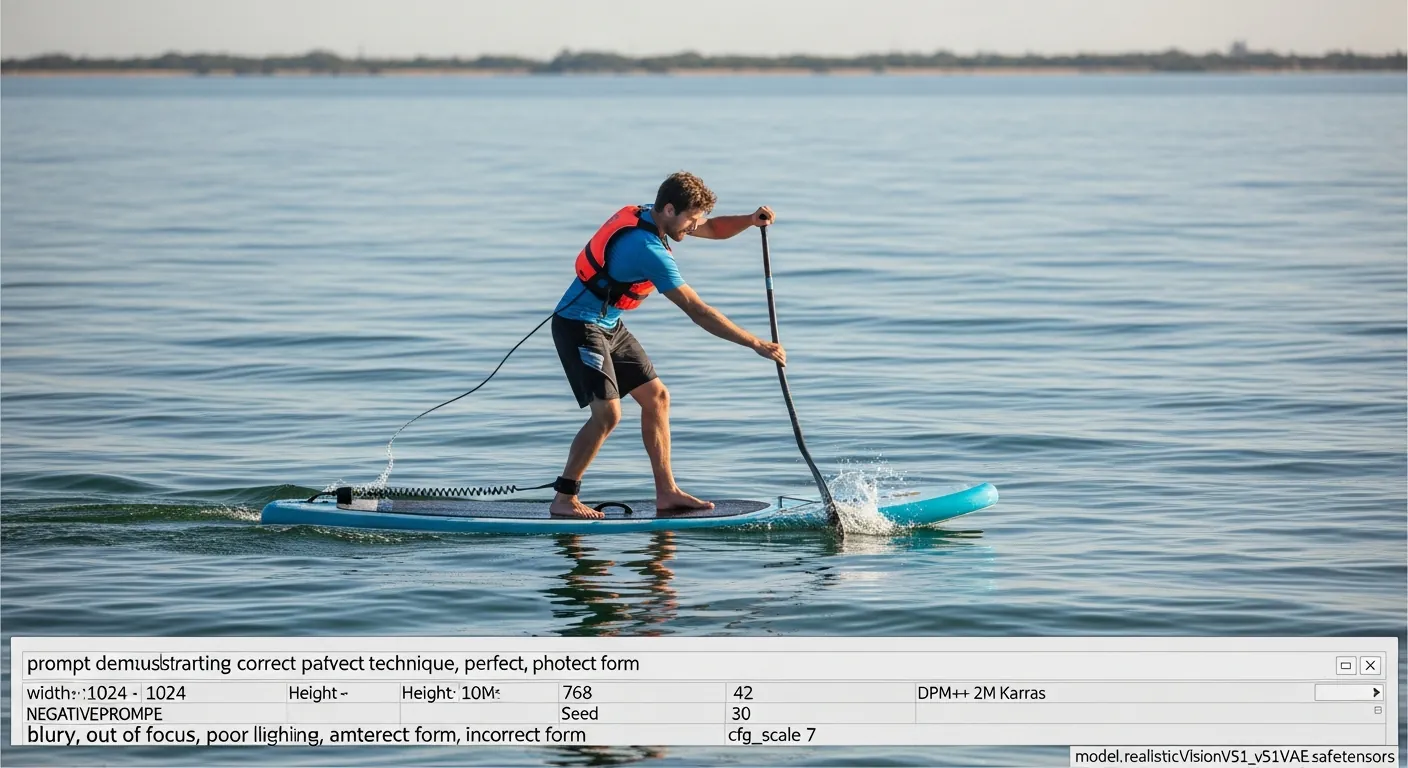
The forward stroke is the most fundamental technique in SUP. It's the move that drives your board forwards. An efficient stroke means more power, less fatigue and a straight line without constantly having to correct your course.
🔹 The set-up position
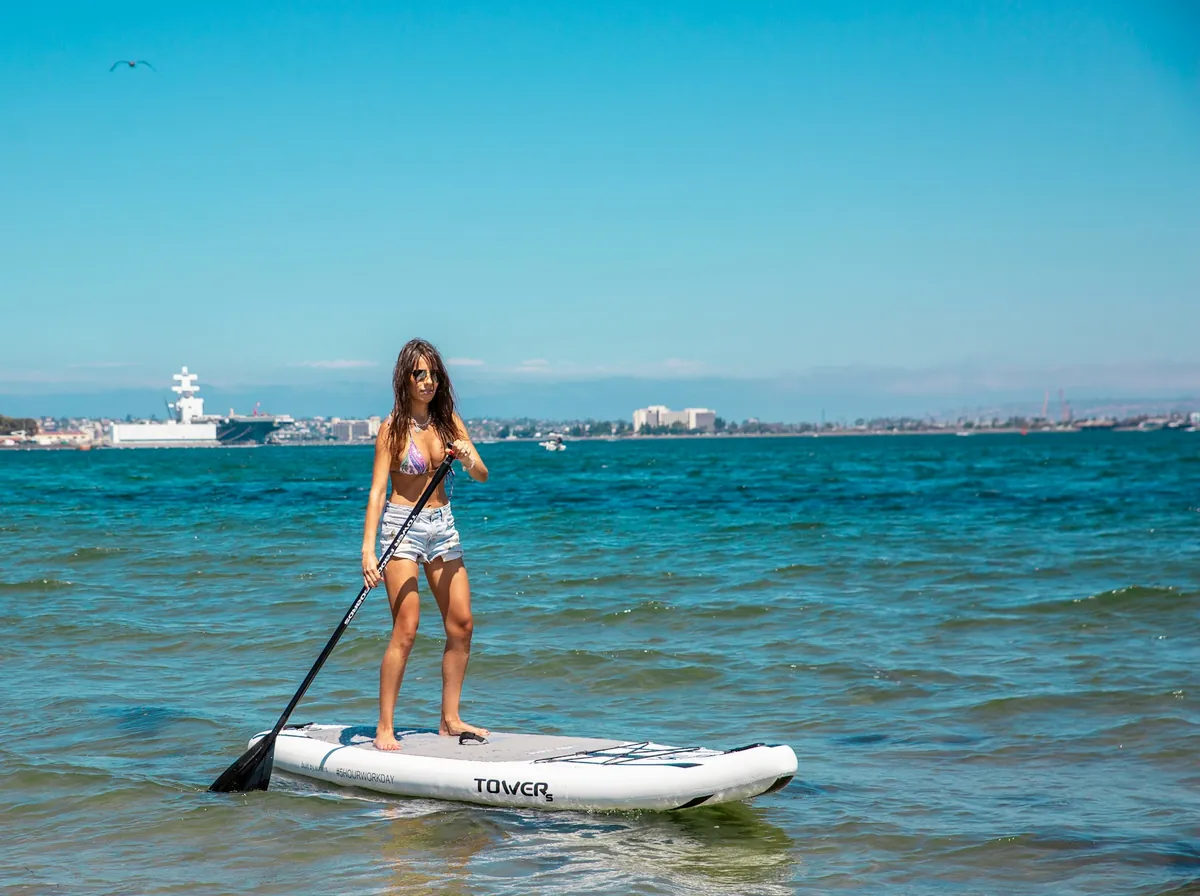
Standing on the board, knees softly bent, feet parallel and hip-width apart. Your leading foot (the one you naturally put forward) in front. Hold the paddle with your top hand on the T-grip and your bottom hand on the shaft, arm extended.
🔹 The catch (plant)
Plant the blade fully submerged in the water, in front of your feet – not alongside you. The further forward you reach, the longer and more powerful the pulling phase. Your torso rotates towards the blade, shoulders turned.
🔹 The pull
Draw the paddle back while keeping your top arm straight. That's the key: the top arm doesn't bend, it works as a pivot. The power comes from your torso and core unwinding, not from your biceps. The blade tracks alongside the board.
🔹 The exit and recovery
When the blade reaches your ankles, lift it out of the water. Don't pull any further: past your feet, you start braking the board. Bring the paddle forward for the next stroke. The movement should be smooth and continuous.
Swapping sides
To go in a straight line, change sides every three to five strokes. Count in your head to begin with: '1, 2, 3 – change'. With practice, your body will sense instinctively when the board is veering and it's time to swap sides.
The number-one beginner mistake: paddling with your arms. An efficient stroke uses your core and back. Picture yourself pulling the board forwards with your torso, rather than pulling the water with your biceps. The difference in power and stamina is considerable.
2. The sweep turn
The sweep turn is the most-used turn in SUP. Simple, effective and intuitive, it lets you turn 90°, 180° or gently correct your course.
🔹 To turn right
Plant the paddle well forward of the nose, on the right of the board. Sweep it in a wide arc, from front to back, keeping the blade submerged. The movement is broad and smooth, like a broom drawing a half-circle in the water.
🔹 To turn left
Reverse the movement: plant on the left, sweep in an arc back towards the tail. The wider the arc, the sharper the turn.
The quick pivot (back sweep)
For a tight turn on the spot (handy for avoiding an obstacle or repositioning): plant the blade beside the middle of the board on the opposite side to the turn, and push forwards instead of pulling back. The board pivots on itself. Combine it with a forward stroke on the other side for a quick 180°.
To practise: picture a circle around a fixed point on the water. Try to paddle a full circle using only sweep turns on one side. It's the ideal drill for getting a feel for the range of the movement.
3. The reverse stroke
The reverse stroke is the opposite of the forward stroke. Instead of pulling back, you push the blade forwards. It's the 'brake' and the 'reverse gear' of SUP.
When to use it
- Braking: as you approach an obstacle, a jetty or other paddlers.
- Backing up: to move away from a hazard or reposition at the peak.
- Stabilising: if you lose your balance, a reverse stroke plants the blade as a point of support and helps you right yourself.
- Finishing a turn: combined with the sweep turn for a quick pivot.
🔹 The technique
Plant the blade beside your feet or slightly behind. Push the shaft towards the nose of the board, so the blade tracks forwards through the water. Keep your arms straight and your core engaged. The movement is short (30 to 50cm of travel) but powerful.
4. The draw stroke (moving sideways)
The draw stroke lets you move the board sideways without going forwards or backwards. It's the essential technique for SUP yoga (repositioning), coming alongside a pontoon, or lining up parallel to another paddler.
🔹 The simple sideways draw
To move to the right: plant the blade away from the board on the right-hand side (about a metre from the rail). Draw the blade in a straight line towards the rail, as if pulling the board over to the paddle. Lift the blade out before it touches the board. Repeat until you've moved across as far as you need.
🔹 The sculling draw (figure-of-eight)
For continuous sideways movement without lifting the blade out: trace a horizontal figure-of-eight with the blade in the water, beside the board. The movement alternates between drawing towards you and pushing away from you. The board glides sideways smoothly. It's an advanced technique that takes practice but is very satisfying once you've got it.
In practice: coming alongside a pontoon
Approach parallel to the pontoon, two or three metres off. Use draw strokes on the pontoon side to ease in gently, without moving forwards. Combine with reverse strokes if you've carried too much speed. It's more precise and more elegant than trying to turn around close to the edge.
5. SUP surfing: catching waves standing up
SUP surfing is a sport of its own. You use a shorter, livelier board (8' to 10') to catch waves of 0.5 to 1.5 metres. The feel is close to surfing, with the advantage of a more stable, more voluminous board.
The board
A SUP surf shape stands apart in a few ways:
- Reduced length: 8' to 10' for manoeuvrability
- A rounded or scooped nose: to stop it burying in the wave
- Pronounced rocker (the curve of the board): for turning on the face
- Multiple fins: often a thruster (three fins) or a quad (four fins) for grip
Catching the wave
🔹 Positioning
Sit behind the break (where the wave starts to break), facing out to sea. Watch the sets and pick out the peak (where the wave breaks first).
🔹 The committing strokes
As the wave arrives: three to five deep, powerful strokes out to sea. The aim is to match the speed of the wave. Don't look back – trust the feeling. When the board tips forwards (the nose dropping into the descent), the wave has got you.
🔹 The take-off and drop
Once you're up, your weight is slightly on your front foot to drive the drop. Knees bent, arms out for balance. Your eyes look towards the shoulder of the wave (where you want to go), never down at your feet.
🔹 Steering the board
Use the sweep turn to line yourself up along the face. Shift your weight onto your back foot to climb back towards the lip, onto your front foot to drop back down. The initial aim: stay in the 'pocket' (the steepest section of the wave) for as long as you can.
Start by surfing whitewater (broken, white foam) before green waves. The foam is slower and more predictable: ideal for learning to position yourself and steer the board. Move on to green waves once you can hold a whitewater ride for 10 to 15 seconds.
6. SUP yoga: balance and postures on the board
SUP yoga combines traditional yoga with the natural instability of the board. That combination gives you an intense core workout, deep proprioceptive training and a meditative hour out in nature.
The ideal board
SUP yoga is done on a wide (34 to 36 inches) and thick board, with a full-length deck pad (non-slip foam covering the whole surface). Yoga and fitness boards run 10'6" to 12' with a volume of 300 to 400-plus litres for maximum stability.
Accessible postures to start with
🔹 Mountain Pose (Tadasana), standing
Standing in the middle of the board, feet hip-width apart, arms by your sides. Close your eyes and feel the water beneath the board. Your body constantly adjusts to the micro-movements – that's the proprioceptive work. Hold for 10 to 15 breaths.
🔹 Warrior II (Virabhadrasana II)
Standing, step your feet about a metre apart, front knee bent to 90°, arms extended out to the sides. Look out over your front hand. The instability of the board intensifies the work in your thighs and core. Five breaths on each side.
🔹 Downward Dog (Adho Mukha Svanasana)
On all fours on the board, lift your hips towards the sky, arms and legs extended. Steady on flat water, it's an accessible posture. On the water, the challenge is keeping the board centred while you shift your weight.
🔹 Savasana (lying relaxation)
Lying on your back in the middle of the board, arms and legs spread, let the board float. It's the pose SUP yoga builds towards: relaxing out on the water, rocked by the ripples. Five to 10 minutes on calm water, at sunrise or sunset.
Practise SUP yoga on flat, sheltered water (a lake, a pond or a sheltered bay). Never at sea with wind or current. Anchor your board with a small folding anchor if you can, to stop it drifting during the lying postures.
7. Touring techniques (long-distance paddling)
SUP touring is about covering long distances (5 to 30-plus km) on a paddleboard. The skill is paddling efficiently for one to four hours, conserving your energy and holding a steady pace.
The touring kit
- A long, tapered board: 12'6" to 14', with a pointed nose to slice through the water
- A carbon or fibreglass paddle: weight matters – every gram saved over thousands of strokes makes a difference
- A carry system: bungees on the nose for water, food and a waterproof phone case
The touring stroke
🔹 A steady cadence
In touring, consistency beats power. Find your cruising rhythm: a cadence you can hold for hours without running out of puff. Reckon on 40 to 60 strokes a minute at a moderate pace.
🔹 Torso rotation
Over distance, your torso does 70% of the work and your arms 30%. On each stroke your torso rotates towards the blade, unwinds through the pull and returns forward for the next stroke. It's a cyclical, fluid movement, like a windmill.
🔹 Holding your line
Pick a fixed point on the horizon (a lighthouse, a summit, a building) and paddle towards it. Check your line every two to three minutes. Currents and wind push you off course without your noticing: regular little corrections work better than one big catch-up.
Managing the effort over distance
On a session of over an hour:
- Drink every 20 to 30 minutes, even if you're not thirsty
- Swap sides every 10 to 15 strokes to even out the muscle fatigue
- Vary the cadence: alternate five moderate minutes with two quicker ones to keep your focus
- Rest: lay the paddle across the board and let yourself float for a minute or two every 30 to 45 minutes
Looking for SUP touring routes? Browse our guide to the best UK paddling spots, from the lakes and lochs to the gentle rivers of the countryside.
8. Common mistakes and how to fix them
Mistake 1: Bending your top arm
Your top arm (on the grip) should stay straight through the pull. If it bends, you lose power and tire out your bicep. Fix: think 'straight arm, rotating torso'. The top arm is a pivot, not an engine.
Mistake 2: Planting the paddle too close
If the blade goes in beside your feet rather than in front, the pulling phase is short and inefficient. Fix: aim to plant the blade as far forward as you can, almost at the limit of your reach. The longer the pull, the more effective each stroke.
Mistake 3: Looking at your feet
Looking down throws your spine out of line, upsets your balance and reduces your torso rotation. Fix: your eyes look to the horizon, where you want to go. Your body naturally follows the direction of your gaze.
Mistake 4: A paddle set to the wrong length
A paddle that's too short makes you stoop; one that's too long tires your shoulders. Fix: standing on the board, arm stretched above your head, the paddle handle should sit in your palm. See our SUP kit guide for the finer points of setting it up.
Mistake 5: Feet too close together
Feet jammed together give you a narrow base and nothing to balance against. Fix: keep your feet at least hip-width apart. The choppier the water, the wider you should stand for stability.
Mistake 6: Not bending your knees
Stiff legs mean a high centre of gravity, which means instability and fatigue. Fix: keep your knees softly bent at all times. Your legs act as shock absorbers and lower your centre of gravity. It's the difference between 'I'm wobbling' and 'I'm steady'.
Film yourself: ask a friend to film 30 seconds while you paddle. You'll spot your posture and stroke mistakes straight away. It's the most effective feedback there is for progressing quickly.
A lighter, stiffer paddle makes it far easier to feel and correct these mistakes: something like the Coasto Feather Carbon 100% transmits more of your torso rotation straight into the stroke.
9. Progression timeline
🟢 Session 1: First steps
Aim: get to your feet, paddle a straight line for 50 to 100 metres, fall in and
climb back on without stress.
Focus: the kneeling position, the transition to
standing, your first strokes, setting the paddle.
🟢 Sessions 2 to 5: Basic independence
Aim: paddle 30 minutes in a straight line, sweep turns left and right, a reverse
stroke to brake.
Focus: the forward stroke technique, swapping sides, basic
turns.
🟡 Sessions 5 to 15: Intermediate technique
Aim: paddle for an hour with an efficient stroke (torso, not arms), a draw stroke
for moving sideways, paddling in mixed conditions (a light breeze, a gentle current).
Focus:
torso rotation, stroke efficiency, reading the water.
🟡 Sessions 15 to 30: Advanced paddling
Aim: SUP surfing on whitewater, first SUP yoga sessions, touring outings of 2 to
5km.
Focus: catching waves, balance in yoga, managing the effort over
distance.
🔴 Sessions 30+: Advanced level
Aim: SUP surfing on green waves, touring 10 to 20-plus km, flowing SUP yoga,
mastering the sculling draw and advanced turns.
Focus: flow, advanced
wave-reading, endurance, variety in your paddling.
Just starting out on a SUP? Read our guide to getting started on a paddleboard for your first sessions, or browse the essential kit to set yourself up for your paddling and your budget.
❓ Frequently asked questions about SUP techniques
What is the fundamental technique in stand-up paddleboarding?
The forward stroke is the fundamental technique. Plant the blade in front of your feet, pull with your torso (not your arms), and lift the paddle out at your ankles. Swap between the left and right sides every three to five strokes to hold a straight line.
How do I turn efficiently on a paddleboard?
The sweep turn is the simplest: plant the paddle well forward of the nose on the opposite side to the turn you want, and sweep it in a wide arc back to the tail of the board. For a tight turn, use a back sweep (the paddle pushed forwards on the side you're turning towards).
How long does it take to master stand-up paddleboarding?
Most beginners stand up and paddle within 15 to 30 minutes. To paddle efficiently for one to two hours, reckon on 5 to 10 sessions. Intermediate techniques (surfing, advanced turns) take 20 to 40 regular sessions.
How do I get into SUP surfing?
SUP surfing needs a suitable board (an 8' to 10' SUP surf shape) and waves of 0.5 to 1.5 metres. Sit behind the break, paddle hard as the wave arrives, stand up and use the sweep turn to steer. Start on whitewater before you move on to green waves.