Choosing the right SUP kit is the key to a good first experience. A board that's too narrow will have you falling in, a paddle set to the wrong length will tire your shoulders, and heading out without a leash or a buoyancy aid can be dangerous. This guide runs through every essential piece of kit so you can take up stand-up paddleboarding with confidence.
1. Inflatable versus hard board: the head-to-head
Your first decision is the type of construction. It's the choice that will affect your experience the most:
Inflatable SUP (recommended for beginners)
Construction: double-wall drop-stitch PVC
Weight: 8 to
15kg depending on size
Best for: most beginners, limited storage,
carrying in a car
The inflatable has dominated the market since 2020. It inflates in 5 to 10 minutes, packs down into a rucksack, and offers superior stability thanks to its extra width. Recent models rival hard boards for stiffness. The downsides are the time it takes to pump up and a slight loss of outright speed.
Hard board
Construction: EPS foam plus fibreglass or carbon
Weight:
10 to 18kg depending on size
Best for: performance, racing, easy storage
(garage or garden)
The hard board offers better performance: faster, more manoeuvrable, a slicker glide. But it's bulky at 11 feet and easily dinged, and it needs roof bars to carry. One for keen paddlers with room to store it.
For most beginners, the inflatable SUP is the best choice. Easy to transport and store, and hard to beat for stability. Move to a hard board only if you're chasing performance or racing.
A solid inflatable to start your search: the ZRAY X1 — see it at OutletSUP →.
2. The types of SUP
Every kind of paddling has its ideal board. There are five main families:
All-round (the Swiss army knife)
Size: 10'6" to 11' × 30 to 34"
Volume: 250 to 320
litres
Best for: beginners, family outings, calm water
The default choice. Wide enough to be stable, long enough to move along nicely. Perfect for lakes, gentle rivers and the sea in fine weather. It's the board most recreational paddlers end up on.
Touring
Size: 12'6" to 14' × 28 to 32"
Volume: 280 to 380
litres
Best for: touring, long distances, exploring
A pointed nose to slice through the water, and a tapered shape for speed and holding a line. Ideal for lake crossings, river runs and sessions of two to four hours. Less stable than an all-round when you're getting going.
SUP surf
Size: 8' to 10' × 22 to 28"
Volume: 100 to 200
litres
Best for: experienced surfers, waves of 0.5 to 2 metres
A short, lively board for surfing waves standing up. It demands a good level of SUP skill and wave-reading. Not one for learning to paddle on.
SUP yoga / fitness
Size: 10'6" to 12' × 34 to 36"
Volume: 300 to 400-plus
litres
Best for: yoga on the water, fitness, meditation
Ultra-wide and ultra-stable, with a full-length non-slip deck pad. Perfect for a sunrise yoga session. Too bulky for speed.
Racing
Size: 14' × 22 to 26"
Volume: 200 to 280
litres
Best for: racers, seasoned paddlers
A long, narrow shape built for pure speed. Unstable for a beginner. One for regular paddlers with an eye on races and rankings.
How to choose the right size of SUP
Two main criteria:
- Your weight: aim for a volume (in litres) of at least three times your weight in kg. An 80kg paddler needs at least 240 litres.
- Your paddling: all-round for versatility, touring for distance, yoga for fitness.
Not sure how to size your board and paddle? Our beginner's guide walks through the dimensions to match your weight, your height and the way you want to paddle.
3. The paddle: what drives the board
A good paddle makes all the difference to comfort, efficiency and fatigue. The things to weigh up:
Shaft material
Aluminium (entry level)
Weight: 800 to 1,000g
Pros: tough,
affordable
Cons: heavy, cold in winter, transmits vibration
Fine for starting out and occasional sessions. It's what comes with the majority of inflatable SUP packages.
Fibreglass (mid-range)
Weight: 600 to 800g
Pros: a good balance of weight and
stiffness
Cons: can crack in a hard knock
The sweet spot for the regular paddler. Around 30% lighter than aluminium, and you feel the difference from the very first session.
Carbon (premium)
Weight: 400 to 600g
Pros: ultra-light, stiff, damps
vibration
Cons: pricier, vulnerable to side impacts
For keen paddlers and racers. Carbon really earns its keep on sessions of two hours and more.
Paddle length
The paddle should be 20 to 25cm taller than you. A few examples:
- 1.60m tall → a paddle of 1.80m to 1.85m
- 1.70m tall → a paddle of 1.90m to 1.95m
- 1.80m tall → a paddle of 2.00m to 2.05m
- 1.90m tall → a paddle of 2.10m to 2.15m
Fixed versus adjustable
Two options:
- Fixed paddle (one piece): lighter, stiffer, more durable. Ideal if you're the only one using it.
- Adjustable paddle (three parts): adapts to several users and packs down into the SUP bag. Perfect for families or if you lend your kit out. Reckon on a little extra weight and a slight loss of stiffness.
For a quick check on the water: standing on the board with your arm stretched above your head, the handle should sit in your palm. See our beginner's guide for the details on setting it up.
A carbon paddle worth considering: the Coasto Feather Carbon 100 — see it at OutletSUP →.
4. The pump: manual or electric
Pumping up your SUP is part and parcel of an inflatable. The pump you choose has a direct bearing on your experience:
Double-action manual pump (recommended)
Inflation time: 5 to 8 minutes for a 10'6"
SUP
Pros: no power needed, light (around 800g),
reliable
Cons: takes physical effort, can be sweaty work in summer
A double-action pump inflates on both the push and the pull, cutting the effort by around 40%. It's what most paddlers use. Go for a model with a built-in pressure gauge so you can check the pressure.
Electric pump
Inflation time: 3 to 5 minutes (automatic)
Pros: zero
effort, cuts out automatically at the target pressure
Cons: needs a 12V
supply (a car socket), heavier (2 to 4kg)
Ideal if you paddle often, have a bad back, or share the SUP around the family. The comfort comes at a cost.
Whichever pump you use, inflate to the pressure printed on the board (usually 15 to 18 PSI) and check it with the gauge before you head out. An under-inflated board flexes and feels unstable.
5. The essential accessories
The leash
The leash connects your ankle or calf to the board. Always wear one – it keeps your board, your biggest float, right next to you after a fall:
- Coiled leash: recommended for flat-water SUP. It doesn't drag in the water or create resistance.
- Straight leash: for SUP surfing in the waves, giving a quick release.
- Quick-release waist leash: essential on moving water and rivers, where you must never use an ankle leash. It lets you free yourself instantly if the leash snags.
- Length: the same length as the board. A 10' leash for a 10'6" SUP.
The buoyancy aid
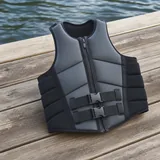
Wear a buoyancy aid every time you paddle, even if you're a strong swimmer:
- Foam buoyancy aid (50N): ideal for beginners and children, it never needs arming and always floats
- Belt-pack inflatable: discreet and comfortable, and popular for SUP
- Automatic lifejacket: the most compact option, inflating automatically if you go in
The dry bag
For carrying your phone, keys, documents and snacks safely:
- 10 to 20 litres: enough for a phone, keys and a snack
- 20 to 30 litres: for a half-day out with a picnic
- Clip it to a deck bungee so it can't drift off if you fall in
The fin
Most inflatable SUPs come with a central fin. Check:
- US box system: the market standard, compatible with most fins
- Fixed fin: simpler but not replaceable
- Spare fin: worth having if you snap the original
The repair kit
Essential for small leaks and knocks:
- PVC patch: for holes of 1 to 5mm
- PVC glue: for bigger repairs
- Valve key: for replacing the valve if it leaks
- Often included with the SUP package
Other useful accessories
- Waterproof sun cream (SPF 50+): the water reflects UV, doubling your exposure.
- Sunglasses with a retainer cord: a must on a bright day.
- A wetsuit: a 3/2mm for the shoulder seasons, stepping up to a 4/3mm or 5/4mm for UK winters. See our surf gear guide for the details.
- Neoprene boots (winter): to keep your feet warm on cold launches.
SUP safety is non-negotiable. Read our dedicated guide for the kit that keeps you safe and the habits worth building before every paddle.
6. New or second-hand: the verdict
Second-hand is a sensible option for an inflatable SUP, especially one that's less than two years old. Things to check:
- Air-tightness test: inflate the board and check it holds pressure (15 PSI) for at least 30 minutes.
- Seams: inspect the joins between the walls. Any cracking means a guaranteed leak.
- Valve: check it isn't cracked and that the cap seals properly.
- Deck pad: normal wear is fine, but any lifting or peeling is a deal-breaker.
Buy new: your leash, your buoyancy aid and your repair kit. These are safety items.
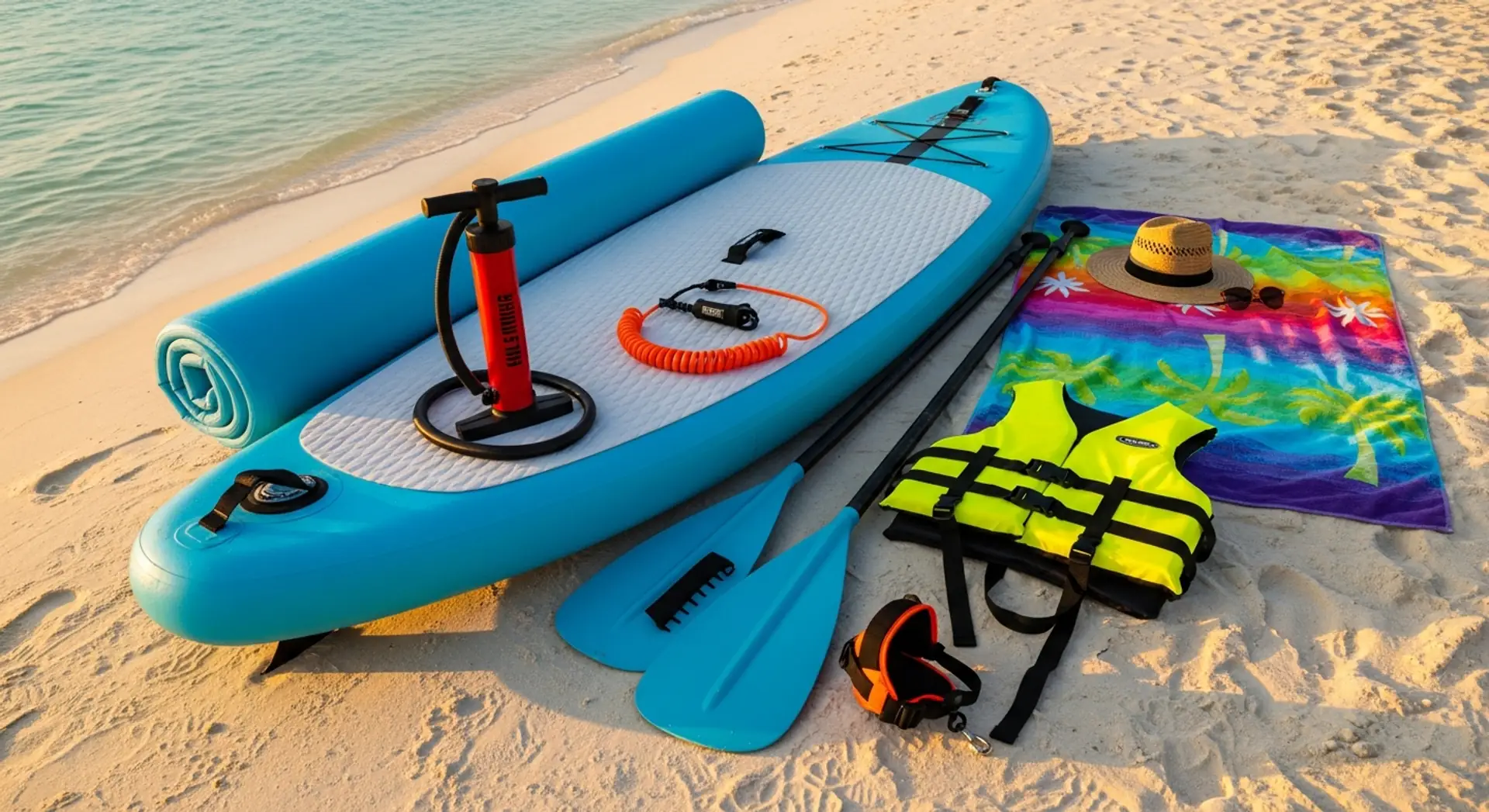
Many inflatable SUP packages bundle the board, paddle, pump, carry bag and repair kit together – an easy way to cover the essentials in one go. Add a leash and a buoyancy aid, and you're ready for the water.
7. Brands worth knowing
Red Paddle Co
The British name that leads the premium inflatable SUP market. Its MSL construction (a fusion of the PVC layers) gives exceptional stiffness and a first-rate finish. The 10'6" Ride and 11' Sport are long-standing best-sellers.
Fanatic
A brand with deep board-sports roots and a well-earned reputation for its shapes. The Fly Air and Ray Air ranges offer an excellent balance of performance and everyday usability, from all-round to touring.
Starboard
A SUP pioneer and a global benchmark for performance and innovation. A very complete range – all-round, touring, yoga, racing – with a strong focus on recycled materials and sustainability.
Bluefin
This UK outfit has built its name on well-specced all-round and cruiser boards that come complete with a generous package of kit. A popular first board for family paddling.
Two Bare Feet
Another British brand, known for accessible all-round and family boards. A sensible starting point for anyone dipping a toe into stand-up paddleboarding without over-committing.
For a first board, a stable all-round inflatable of 10'6" to 11' from any reputable brand will serve you well. Prioritise stiffness, width and a good pressure gauge over headline features.
Got your kit? Time to get on the water. Read our guide to getting started on a paddleboard, our SUP techniques, and browse the best UK paddling spots.
❓ Frequently asked questions about paddle board kit
Inflatable or hard board: which should I choose to start out?
An inflatable is recommended for beginners: it's more stable, far easier to transport and store, and simpler to look after. A hard board offers better performance but is bulky to store and more easily damaged. For most first-time paddlers, an inflatable all-round board is the sensible choice.
What do I need in a complete SUP set-up?
A complete set-up is a board, a paddle, a pump, a leash, a buoyancy aid, a dry bag and a repair kit. Many inflatable packages bundle the board, paddle, pump, bag and repair kit together. Always add a leash and a buoyancy aid, and wear both every time you paddle.
What size SUP should I choose to start out?
An all-round SUP of 10'6" to 11' with a width of 30 to 34 inches and a volume of 250 to 320 litres is ideal for a beginner. The wider the board, the more stable it is. As a rule of thumb, aim for a volume of at least three times your body weight in kg.