

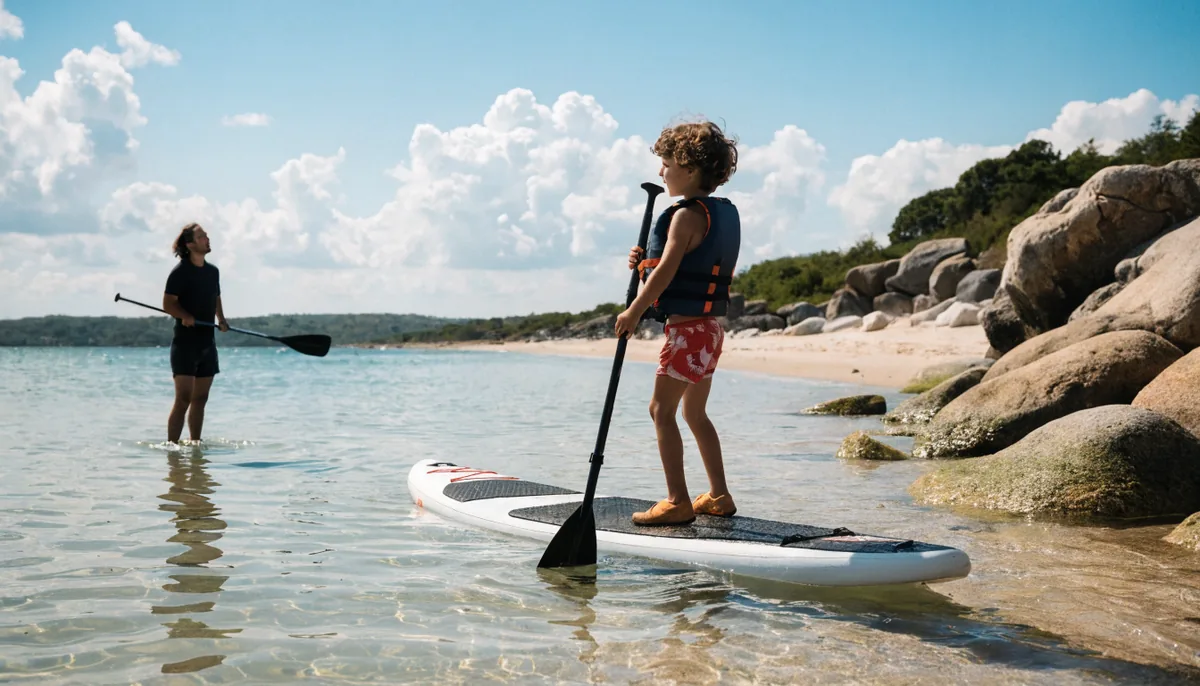
Paddleboarding is shared with children long before they have a board of their own: first as a passenger on the front of an adult's board, then, once they can manage on their own, on something sized for them. Here is when to start, how to keep the outing safe, and which board suits each stage.
When can you start paddleboarding with a child?
There's no official minimum age, but as soon as a child is comfortable in the water and can wear a buoyancy aid without fuss, often around 4 to 5 years old, they can ride as a passenger on an adult's board. Below that age it's better to wait a little longer. For a board of their own, think more like 8 to 10: that's the age most children can manage their own kit without constant close supervision.
Paddling with a child aboard
Stability
A wide board, at least 32 inches, gives the balance you need to absorb the child's movements without unbalancing the whole thing.
Payload
The combined weight of adult and child should stay well below the board's maximum load. Our SUP kit guide explains how to work out that margin.
Space on the deck
A clear deck and enough room at the front let the child sit or stand comfortably without getting in the way of the adult's paddle strokes.
A stable all-rounder such as the WattSup Bream 10.6 on OutletSUP gives enough volume to paddle safely with a child aboard.
The safety rules you don't negotiate
Buoyancy aid
A buoyancy aid sized for the child is non-negotiable, even if they can already swim. It's the one guarantee if there's an unexpected fall, and the RNLI recommends a correctly fitted buoyancy aid for everyone on the water.
Suitable water
Always pick a lake or a sheltered cove, in shallow water with no current, over a trip out to sea for this first taste of the sport. Check the Met Office forecast before you set off, and if you get into difficulty at the coast, call 999 and ask for the Coastguard.
Length of the outing
A first outing of 20 to 30 minutes is plenty. It's better to stop on a good note than to push on until the child gets bored or cold. For the youngest, keep family sessions to 30-45 minutes.
What's different between an adult SUP and a kids' SUP?
A kids' SUP isn't simply a smaller adult board: it's proportionally wider to make up for a lighter build, and its volume is calibrated to give good flotation without becoming too heavy or too big for a young paddler to handle.
The essential things to look for
Board size
A length of 7 to 9 feet (2.1 to 2.7m) suits most children, depending on their age and how confident they are in the water. A board that's too long becomes hard to handle; one that's too short lacks stability.
The child's weight
As with an adult board, the volume needs to stay comfortably above the child's weight to keep the board responsive.
Ease of handling
A kids' SUP needs to stay light to carry and easy to manoeuvre with the paddle, or the child will tire quickly and lose interest.
Should you buy a proper kids' board or a small adult model?
For a child who's already confident and keen, a genuine kids' board — lighter and better proportioned — makes a real difference to comfort and handling. For a one-off first try, sharing an adult's board is perfectly adequate before you commit to buying.
Useful extra kit
A suitable paddle
An adjustable-length paddle, set to roughly wrist height with the arm raised overhead, grows with the child so you're not buying a new one every year.
Buoyancy aids and a leash
Correctly sized buoyancy aids for everyone and a leash per board round out the basic kit. The leash keeps the child attached to their board if they fall in, so it doesn't drift away — just as important a safety item as the buoyancy aid. Our paddleboard safety guide covers the basics.
Sun protection
A water-resistant sun cream and a UV top save the outing being cut short by sunburn: glare off the water is markedly stronger than on the beach.
Where to paddle as a family
A lake
A lake gives you flat water and a bank that's always close by, the most reassuring setting for a first outing with children. Big sheltered lakes such as Windermere work well.
A very sheltered coast
Protected bays, estuaries and harbours on a still day are gentle enough for family paddling.
A watersports centre
Watersports centres, often with lifeguarded swimming zones and kit hire on site, make organising a family outing much simpler.
The most common mistakes
The most frequent is dragging the outing on too long to make the launch feel worthwhile, at the risk of tiring or frightening the child. Next comes choosing a board that's too small or too short on volume, which makes balance hard for both of you. Finally, skipping the buoyancy aids because the water looks calm, or going out in wind or chop for a first go, are mistakes to avoid at all costs.
FAQ
At what age can a child get on a paddleboard?
As soon as they're comfortable in the water and happy wearing a buoyancy aid, often around 4 to 5 years old, a child can ride as a passenger on an adult's board, in calm shallow water.
What age can a child have their own SUP?
Generally from around 8-10 years old, once a child is confident and comfortable enough in the water to manage their own board, even a small one, without constant close supervision.
What size SUP suits a child?
A board of 7 to 9 feet (2.1 to 2.7m) suits most children, with enough width to stay stable despite a lighter build.
Is a buoyancy aid compulsory?
There is no blanket legal requirement for paddleboarding in the UK, but the RNLI recommends a correctly fitted buoyancy aid for everyone on the water, and with a child aboard it should be treated as non-negotiable.
Which board suits a family?
A wide, high-volume board gives you the deck space and load margin to share the outing between several people without losing stability.
Can you go out with two children?
Yes, provided the board has enough volume to carry the combined weight and the children stay calm and evenly spread across the deck.
Is a kids' SUP really worth it?
Yes, for a child who is already paddling on their own: a board sized for them is far easier to handle than an adult board that is too big and heavy.
Which paddle for a young rider?
An adjustable-length paddle, set to roughly wrist height with the arm raised overhead, is the best compromise as the child grows.
Can you share an adult board at first?
Yes, and it is the sensible way to start: it lets you check the child is interested and comfortable before buying a dedicated board.