

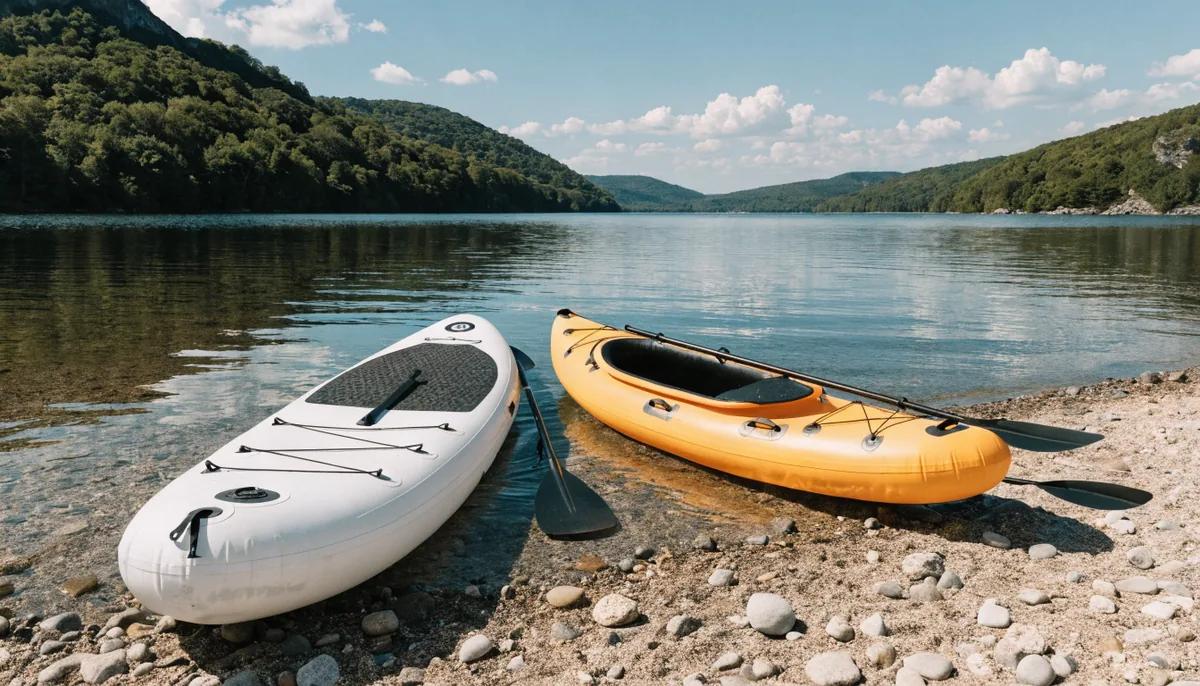
Looking for an inflatable fishing kayak, you soon hit the same dilemma: a proper kayak, where you sit, or an inflatable SUP, where you stand or sit on an added seat. This page does not decide for you and promises no performance. It compares what a retailer's spec sheets say, point by point, so you know which questions to ask before buying. Matosurf does not test kit; everything below comes from product documentation.
In short
On the listings we read, the kayaks state a maximum load of 180 kg and a seat with a backrest included, and the two SUPs 125 kg and four rings for fitting a seat. No listing, kayak or SUP, mentions fishing or a rod-holder mounting point. The choice therefore comes down to load, position and weight, and to what the seller confirms in writing.
What the listings say, side by side
On 4 October 2026 we read the listings for two single-seat inflatable kayaks and two inflatable SUPs on OutletSUP. The figures are the retailer's, with no measurement on our side; an empty cell means the listing does not give that information.
| Model | Type | Length × width | Max. load | Stated weight | Supplied according to the listing |
|---|---|---|---|---|---|
| Wattsup COD 1P | Kayak, 1 seat | 310 × 85 cm | 180 kg | 24.80 kg | Detachable double paddle, seat with backrest, wheeled backpack, high-pressure pump with gauge, repair kit |
| Wattsup Torpedo 1P | Kayak, 1 seat | 365 × 72 cm | 180 kg | 24.80 kg | Same items as the COD 1P |
| Wattsup Bream 10.6 | Inflatable SUP | 320 × 81 cm, 15 cm thick | 125 kg | Not stated | Kayak seat, 4-piece double paddle; 4 stainless-steel rings for the seat, bungee cargo cord at the front |
| Zray X1 | Inflatable SUP | 310 × 81 cm, 15 cm thick | 125 kg | 8.5 kg (board) | EVA pad, removable fins; 4 rings to fit a kayak seat; paddle and seat not specified |
Two notes on reading it. The weights are not comparable: 24.80 kg is the product weight of a kayak, and 8.5 kg that of the Zray X1 board alone, without paddle or bag. And the COD 1P and Torpedo 1P listings give the same weight and package dimensions even though their lengths and widths differ, one more reason to ask the seller to confirm.
See inflatable kayaks on OutletSUP or compare inflatable SUPs on OutletSUP, whichever way you are leaning (the shop pages are in Spanish).
Sitting or standing: what the shape of the product dictates
This is the difference that design makes obvious without any need to measure it. In a kayak you sit inside the craft, with a seat and backrest; those of the two kayaks above are supplied. On a SUP you stand on the deck, or sit on a seat you fit yourself, and that is where the rings matter: the Bream has four for its seat, and so does the Zray X1. The two SUPs in the table are 81 cm wide and 15 cm thick, the two kayaks 85 and 72 cm wide.
Our paddleboard or kayak page gives the general comparison, including a section on fishing. Here we stick to what the listings let you check.
Maximum load matters more than you think
When fishing you carry more than yourself. The stated maximum load normally covers everything on board: you, the kit, the cool box, the catch. A deliberately simple example: an angler of 85 kg with 15 kg of kit comes to 100 kg. That is still under the 125 kg of the two SUPs in our table, with 25 kg to spare; against the 180 kg of the kayaks, the margin is 80 kg. It is not a promise of how a craft behaves on the water, only arithmetic to redo with your own weight and your own kit.
If you are close to the limit, do not plan on going over it "a little". Our page on the maximum weight of an inflatable SUP explains the idea.
Attachment points: the real unknown
None of the four listings mentions rod holders, rails or mounting points designed for fishing. What they show are rings for a seat (Bream, Zray X1) and a bungee cargo cord at the front (Bream). The kayak listings do not mention any rings.
That does not mean fitting one is impossible, only that nothing is documented. Before buying, ask the seller in writing:
- whether extra fittings can be added, and which;
- whether the manufacturer allows accessories to be added to the hull or deck;
- what size and position the rings or the cord are;
- whether the warranty covers use with fishing tackle.
Weight, transport and inflation
Both families pack into a bag, which is one thing they share. The kayaks in our table come with a wheeled backpack, a high-pressure pump with gauge and a repair kit. The Bream is sold as a pack with seat and paddle. For the Zray X1, the listing specifies neither the paddle nor the pump.
If you have to walk to the water, the stated weight weighs on the decision, with the caveat above about figures that cannot be compared. For storage, drying and transport by car, see our guide to storing and transporting an inflatable SUP.
The hybrid case: a SUP with a seat
That is what the Bream (kayak seat included) and, through its four rings, the Zray X1 offer: a board you can use standing or with a seat. It gives you a choice of position without buying two products, but the maximum load remains that of a SUP (125 kg on these two listings), and the 4 rings say nothing about what else the manufacturer allows.
Choose an inflatable kayak if…
- you want a seat with a backrest, a double paddle and a pump supplied in the same box;
- your total load, you plus kit, approaches 125 kg;
- you would rather sit inside the craft than on a flat deck.
Choose an inflatable SUP if…
- you want to alternate between standing and sitting on the same board;
- your total load stays well below 125 kg;
- you also want to use it without a rod, like an ordinary SUP.
Construction, as the listings describe it
All four products use drop-stitch technology, the network of threads that joins two layers of PVC and allows high-pressure inflation. The detail varies: "PVC + dropstitch" for the COD 1P, "dropstitch" for the Torpedo 1P, "single-layer drop stitch" for the Bream and "lightweight drop stitch" for the Zray X1. These mentions describe construction, not durability. If wear resistance matters to you, the listing is not enough: look at the warranty (2 years stated on the Bream and the Zray X1) and what it excludes.
Five questions before you order
- What is my weight, plus my kit, plus the catch?
- Do I want to fish sitting, standing or alternating?
- Where will the rod, the tackle box and the cool box go? Does the listing say?
- How many metres must I carry the folded product, and at what stated weight?
- What does the seller confirm in writing about use for fishing and the warranty?
When to buy neither
If you fish from the bank, you do not need a craft. If you are new to the water, get the measure of the craft before adding a rod, with our beginner's guide to inflatable kayaks or the guide to getting started with SUP. And whichever you choose, plan safety before the rod: our SUP safety page and the one on buoyancy aids apply to an angler too.
Fishing rules: find out before you go
This page describes no fishing rules, because they depend on the place, the water and the time of year. For rod fishing for salmon, trout, freshwater fish, smelt or eel in England and Wales, GOV.UK states that a licence is needed (children under 13 are exempt; 13 to 16 need a free junior licence): GOV.UK fishing licences. You may also need permission from the landowner or the fishery. We have not read the rules for sea fishing or for Scotland and Northern Ireland, so for those check the local rules with the authority for the water you intend to fish. For the paddling itself, see our SUP sea regulations page.