

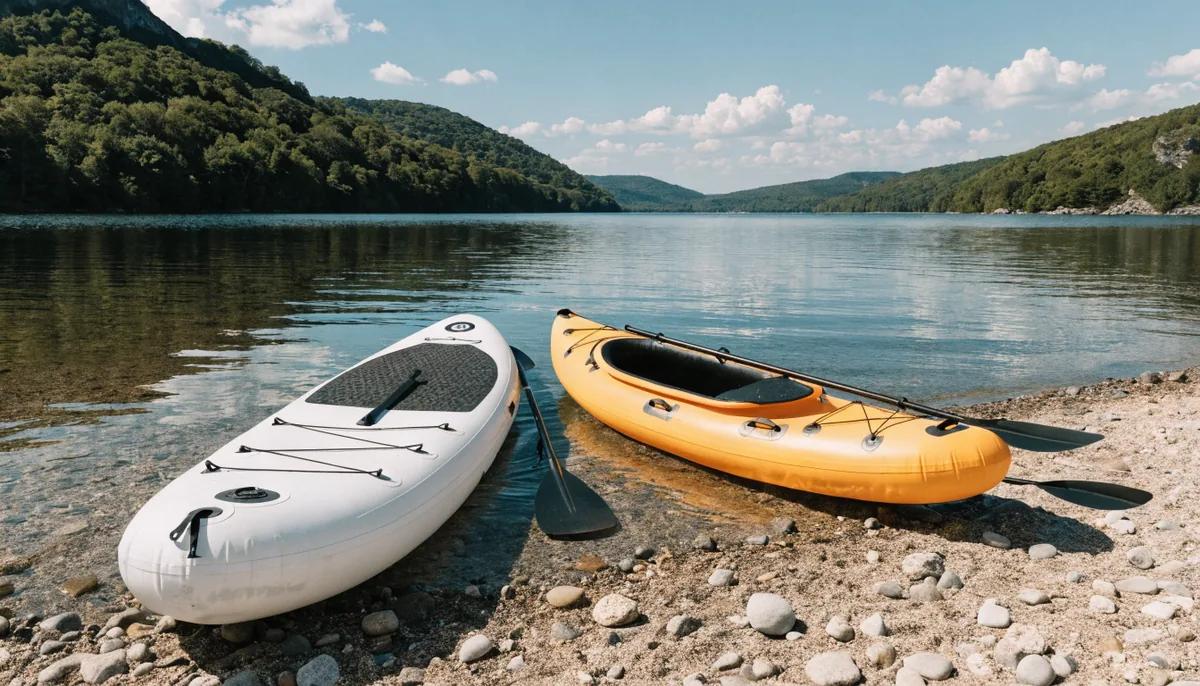
The inflatable kayak has become a simple, affordable way into kayaking, without the hassle of a hardshell. Here's how to choose between solo and tandem, and how to get the basics right before your first outing.
Why choose an inflatable kayak?
A hardshell kayak needs roof bars to transport, takes up a chunk of garage or shed space, and often costs considerably more than an equivalent inflatable. An inflatable kayak solves all three problems at once: it packs down into a rucksack roughly the size of cabin luggage, fits in a car boot, and brings the sport within reach at a noticeably lower price point.
The technology has moved on a great deal in recent years. Today's inflatable kayaks, built from drop-stitch material (like inflatable SUPs) or reinforced multi-layer PVC, are properly rigid and impact-resistant once pumped up to full pressure. They actually cope better with knocks against rocks or pontoons than a hardshell plastic kayak, which makes them a sound choice for a beginner who isn't yet worried about babying the gear.
The trade-off is that you always need a few minutes to inflate before setting off, and the glide is slightly less crisp than a sleek hardshell. For regular use, family outings or getting started, that trade-off is a reasonable price to pay for the convenience.
Solo (1-person) or tandem (2-person)?
This is the question nearly every beginner asks, and the answer mostly comes down to how you plan to paddle.
A solo kayak is lighter (typically 8-14kg inflated), far easier to carry down to the water, and much more responsive once you're paddling on your own – it reacts to every stroke and lets you build real technique faster. It's the sensible pick if you'll mostly be out alone, want the smallest possible footprint, or want to build genuine independence on the water.
A tandem kayak (2-person) is more stable thanks to its extra width, and lets you share the outing with a partner, a friend or a child. It's also better value: one kayak for two people costs less than two solos. The catch is that it's noticeably heavier (15-25kg inflated), bulkier to carry and store, and far less enjoyable to paddle solo when your other half isn't around – the longer hull needs more effort to keep tracking straight with only one paddler. Many tandems do paddle reasonably well solo on an occasional basis, provided you accept reduced manoeuvrability.
To picture the two side by side: for solo paddling there's the Coasto Lotus 1 Place, light and manoeuvrable for building independence; for two paddlers there's the Coasto Capitole 2 Places tandem – see them at OutletSUP →.
Technique and safety for your first outing
Start out on flat, sheltered water with no wind or current: a lake or a calm bay is the ideal place to learn. Get in from a pontoon or shallow bank rather than from open water, keeping your weight low and sitting down before bringing your feet in.
The basic kayak stroke is an alternating, symmetrical action: the blade enters the water near your feet, pulls back along the hull to your hip, then lifts out as the opposite blade drops in on the other side. The power comes from rotating your torso, not just your arms, which keeps fatigue in check over a longer paddle. To turn, lengthen the stroke on one side or shorten it on the other; for a tight turn, alternate a forward stroke on one side with a reverse stroke on the other.
On safety: wear a buoyancy aid or life jacket on every outing, whatever the distance from shore, even if you're a confident swimmer. Check the Met Office forecast and the wind direction before you launch – an offshore wind can carry you out faster than you'd expect. Always tell someone your planned route and expected return time, and check any local waterway byelaws before you go.
For a first outing, stay within sight of the shore, avoid areas used by powered craft, and take a means of communication in a waterproof pouch. If you get into difficulty, call 999 and ask for the Coastguard.
Choosing an inflatable kayak
A handful of technical details separate a good beginner kayak from a disappointing one.
Length, width and weight capacity
A solo kayak typically runs 2.8-3.5m long and 75-90cm wide, with a weight capacity of 100-150kg. A tandem stretches to 3.5-4.5m with a capacity of 180-250kg. A wider kayak is more stable but glides less efficiently; a longer one tracks better but becomes harder for one person to carry.
Material and build
Reinforced multi-layer PVC (usually three layers with a polyester weave) is the standard for entry- and mid-range inflatable kayaks: tough, UV-resistant and forgiving of minor punctures. Some higher-end models use drop-stitch on the floor for a stiffness closer to a hardshell. Check for multiple independent air chambers: if one is punctured, the kayak stays afloat on the others.
What's included
Most inflatable kayak packages include a manual high-pressure pump, one or two take-apart paddles, an adjustable padded seat or two, a repair kit and a carry bag. Always check the full kit list before buying – a package without a paddle or pump can look cheaper on the shelf but ends up costing more once you add the missing pieces separately.
Worth comparing for a solo paddler on a tighter budget: the Coasto Lotus 1 Place – see it at OutletSUP →.
Where to paddle an inflatable kayak in the UK
Inland lakes are the easiest place to learn: flat water, no tide, no current. Windermere in the Lake District has sheltered stretches that suit a first outing well, with plenty of launch points around the shore. On the South Devon coast, the calm estuary at Bantham is well suited to kayaking on the flood tide, though the upper stretches turn very shallow at low water, so check tide times before heading out.
To weigh up the two disciplines in more depth, read our full paddleboard vs kayak comparison, covering stability, speed, fishing and transport for each.