

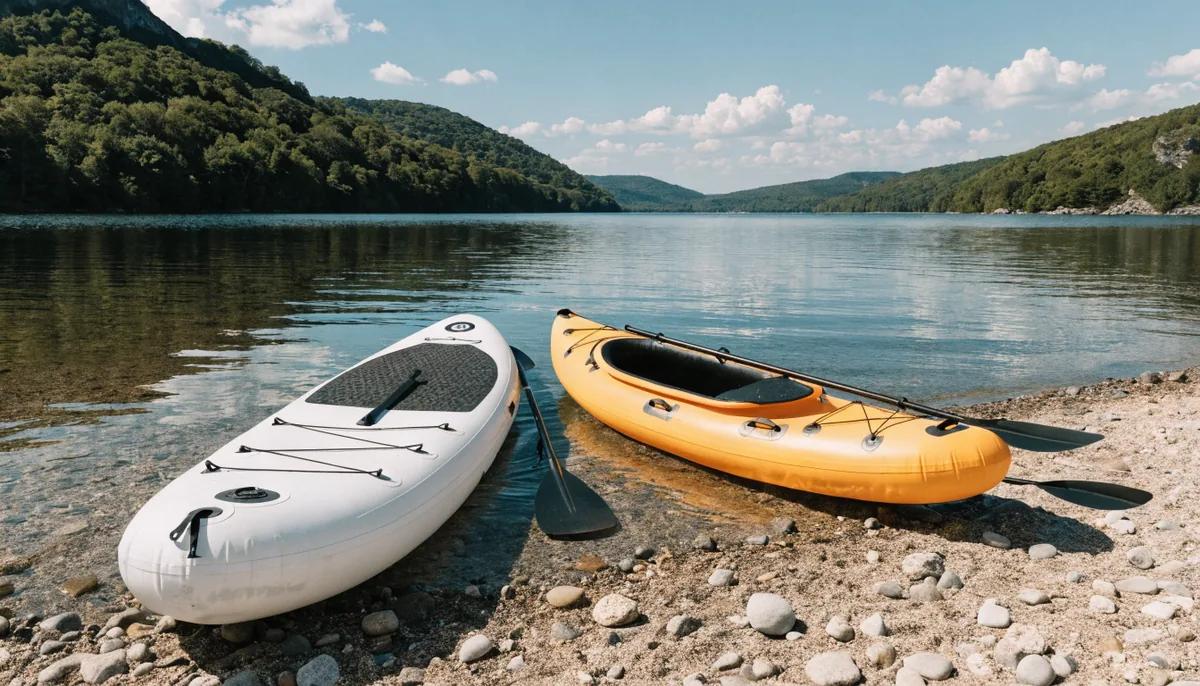
Paddleboards and kayaks suit different days out. One has you standing, the other sitting; the effort lands in different muscles, and one carries a great deal more kit than the other. Here's how to decide based on what you're really after.
Position and comfort
The kayak offers a seated position with a low centre of gravity, very stable and undemanding over long distances. You paddle a SUP standing, which asks more of your core and balance – a real bonus if you want a complete workout, a drawback if you mainly want to unwind.
Speed and learning curve
For the same effort, a sleek kayak is generally faster than a paddleboard, thanks to its hydrodynamics and the efficiency of the double-bladed paddle (an alternating, symmetrical action, against a single-blade paddle you have to switch sides on a SUP). The kayak is also more intuitive for a beginner: you sit down and paddle, whereas a paddleboard needs a short learning curve to find your balance standing up.
Fishing and carrying capacity
The SUP gives you a clear platform to cast from standing and access to very shallow water. A fishing kayak gives you more built-in storage and better stability for handling gear. To carry camping or picnic kit, the kayak excels thanks to its watertight compartments and bungees, whereas the SUP is limited to a bungee at the nose.
Transport and storage
A hard SUP (around 7.5 to 12kg) is much lighter and easier to carry on a car roof than a hard kayak (12 to 25kg and up). In inflatable form, both pack down into a comparable rucksack.
Comparison table
| Criterion | SUP (paddleboard) | Kayak |
|---|---|---|
| Stability | Moderate (standing) | High (seated) |
| Speed | Moderate | Faster |
| Learning curve | A few sessions | Very quick |
| Long distances | Tiring | Comfortable |
| Transport (hard) | Light (7-12kg) | Heavy (12-25kg) |
| Carrying capacity | Limited | High |
| Fishing | Good visibility | Better storage |
The 2-in-1 solution
Many inflatable SUPs have D-rings that let you fit a kayak seat, and can convert with a suitable paddle. It's an excellent way to enjoy both without doubling up on purchases. Another plus of the paddleboard: its raised standing position gives a superb view for spotting the bottom, fish and weed beds included.
Comparing the two in the flesh: the all-round ZRAY X1 paddleboard and the solo WattSup COD 1P kayak – see them at OutletSUP →.
Whichever you choose, the safety basics are the same in the UK: a leash and a buoyancy aid on every outing. Check the Met Office forecast, watch for offshore winds that can carry you out fast, and if you get into difficulty call 999 and ask for the Coastguard.
To go further, read our complete paddleboarding guide and our safety on the water section.