

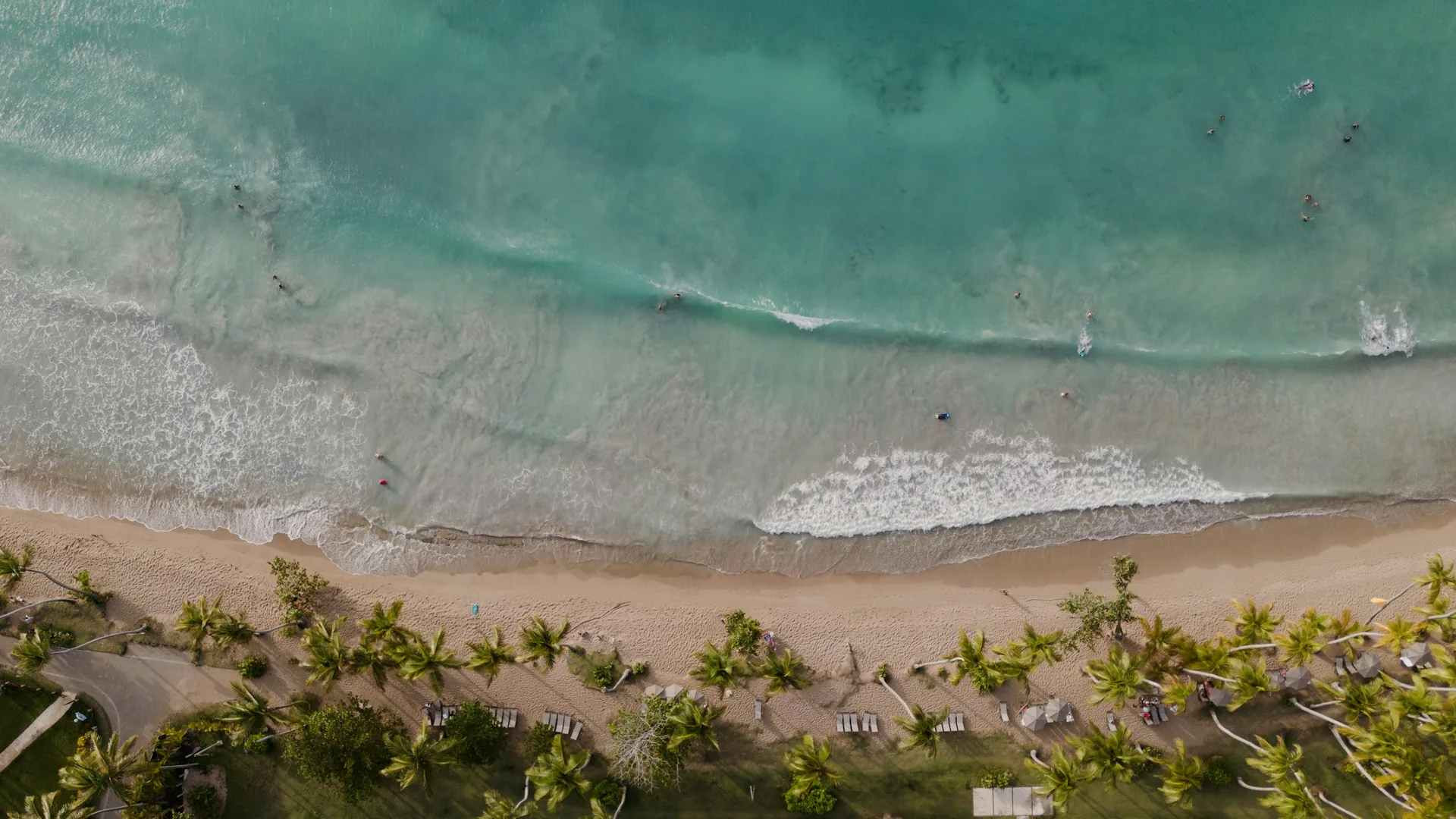
📍 Dominican Republic, north coast
This page places the Dominican Republic as a whole. For beach-by-beach detail, follow the links to our Cabarete and Buen Hombre guides.
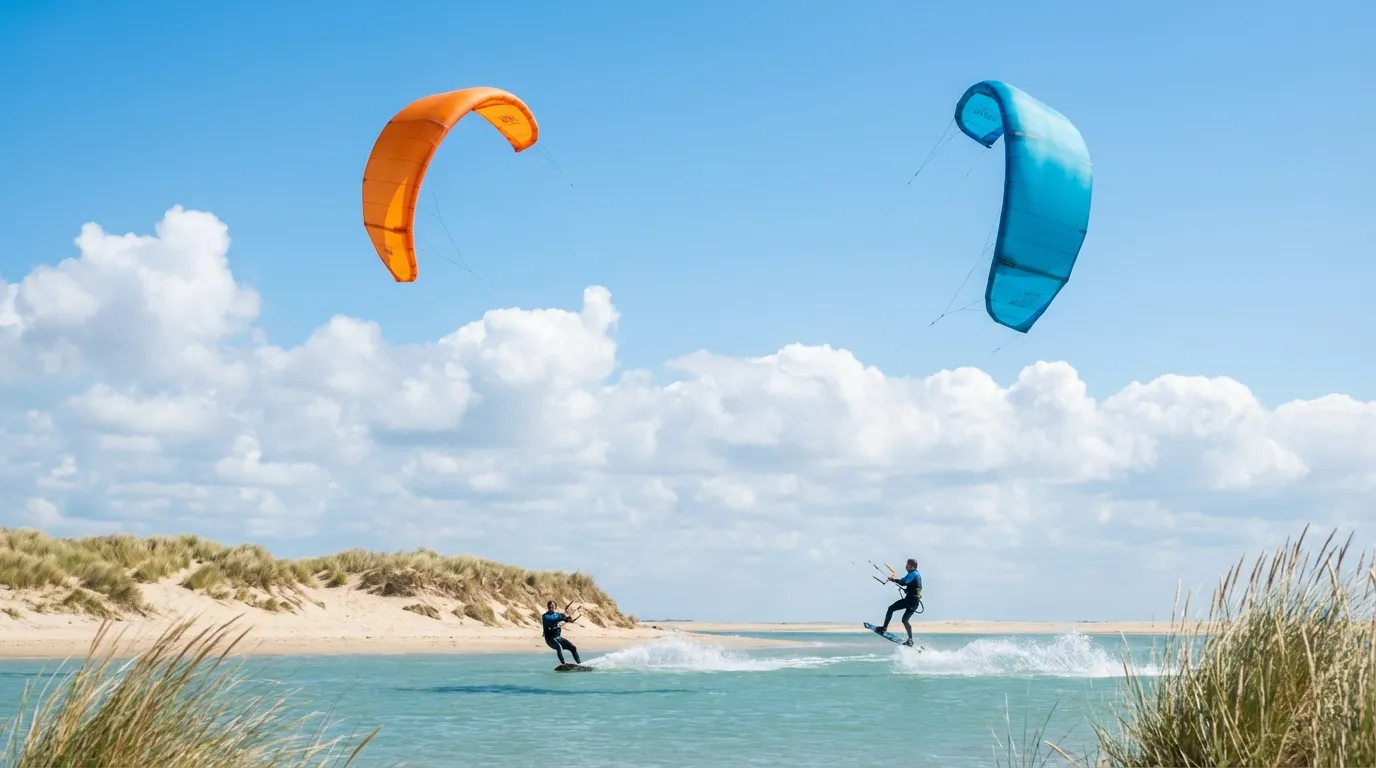
Four beaches that play off each other — Kite Beach, Bozo Beach, Cabarete Bay and Encuentro — an unusual concentration of schools, and a thermal that builds every summer afternoon.
Cabarete guide arrow_forward
At the far end of the same coast, a coral reef closes off a strip of flat water. Almost nobody on it, cays within downwinder range, and comfort that's deliberately basic.
Buen Hombre guide arrow_forward
The country has no code governing kitesurfing or paddleboarding. Schools and local authorities set the etiquette, beach by beach. 911 works everywhere.
Kitesurfing safety arrow_forwardWhat to have in mind before booking a riding trip to the island.
An Atlantic trade wind, terrain that heats fast, and a coastline that lines the two up.
The Dominican north coast faces the Atlantic and takes the easterly trade wind head-on. That synoptic wind blows for much of the year, but on its own it doesn't explain the island's reputation. The second storey does: on any sunny day the land heats faster than the sea, air rises over the ridges of the Cordillera Septentrional, and a thermal breeze stacks onto the trade in the same direction. Hence the rhythm everyone describes locally — a slack morning where you're only riding big kit, then a clear step up from early afternoon.
This two-stage pattern is good news if you're learning. Schools put first lessons in the late morning, while the wind's still manageable, and keep the afternoon for riding on your own. A complete beginner doesn't have to choose between "windy" and "windy enough to handle" — both exist on the same day, a few hours apart. The flip side is that a full day on the water needs planning, because the good slot lands in full sun: hat, water, sunscreen.
The Samaná peninsula in the north-east is the island's third wind area: Las Terrenas runs on the same trade-plus-thermal regime, with a long season stretching roughly December to August and a core somewhere between March and July. It's a genuine kitesurfing destination, just less built up than Cabarete.
The east of the island plays an entirely different tune. Punta Cana, Bávaro and Cap Cana sit behind a coral reef that leaves calm, shallow, often flat water inside it — and the wind arrives spent, because this coast lies downwind of Puerto Rico, so the trade barely reaches it and the sea breeze usually tops out around 8–10 knots. That's not a kitesurfing destination: a few schools do operate in the better months, but Bávaro itself is best avoided for kiting given the boat traffic and the numbers in the swimming area. What that warm flat water does make the east is paddleboarding country — beach clubs and operators hire boards and run outings, with the calmest conditions between April and October.
So: if your trip is built around wind, head for the north coast or Samaná. If what you want is calm water and a beach base to paddle from, the east does that job very well.
Same coast, same trade wind, and yet two trips with almost nothing in common.
Cabarete is a watersports town in the full sense: schools lined up along the beach, hire kit in every size, accommodation at every price and restaurants open late. You can arrive without a board and leave having kitesurfed, windsurfed and surfed in the same week, across four neighbouring beaches with distinct characters. That's also the trade-off — Kite Beach fills up in the afternoons in high season, and the water is choppy rather than flat. If you're starting out, that density of schools is exactly the point.
Read the full Cabarete guide arrow_forward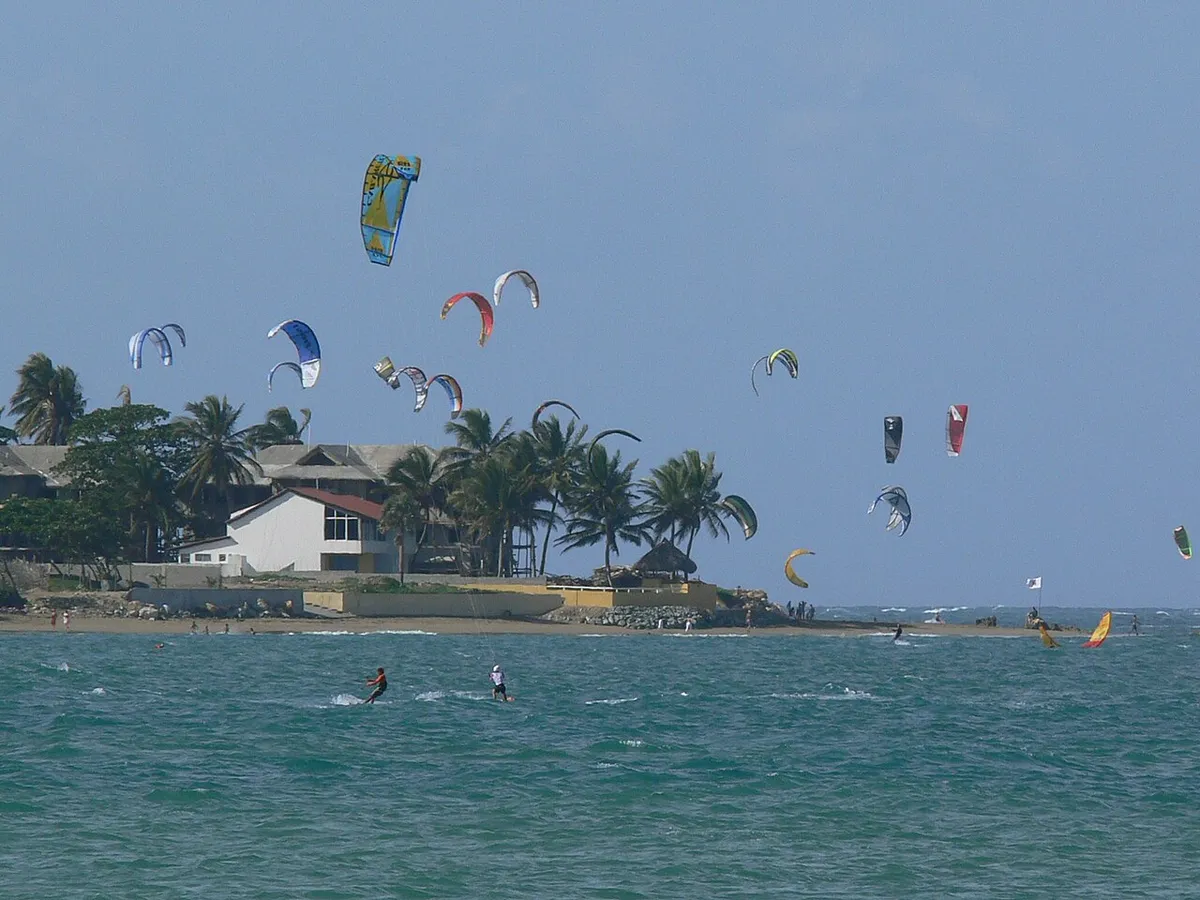
Around three hours' drive west, in Monte Cristi province, Buen Hombre is the exact opposite. A coral reef cuts the swell and leaves a flat lagoon even when the trade is blowing hard — the setup riders want when they're working on their riding or moving to foil. The offshore cays put downwinders within reach. In exchange, the electricity is intermittent, the signal weak and services scarce: this is a fishing village, not a resort. That isolation is precisely what keeps the lagoon empty.
Read the full Buen Hombre guide arrow_forwardSince both sit on the same coast and share the same airports, a two-part trip is easy to put together: a few days in Cabarete for lessons and hire kit, then the second half at Buen Hombre riding flat water in peace. That order makes the most sense, because you'll progress faster where the schools are. Book the hire car from arrival — there's no public transport link between the two.
Six international airports, but only two that matter if you're going to ride.
Gregorio Luperón International at Puerto Plata (POP) is the north coast gateway and the closest airport to Cabarete. Cibao International at Santiago (STI) is the second option — further inland, but often better served, and a practical starting point for the north-west and Buen Hombre. No international airport serves Monte Cristi directly: the last stretch is by road from one of those two hubs.
Las Américas at Santo Domingo (SDQ) serves the capital and the south. Punta Cana (PUJ) covers the east and the Bávaro hotel strip. Samaná El Catey (AZS) is the airport for the Samaná peninsula and therefore for Las Terrenas. La Romana (LRM) serves the south-east. All of them are a long way from the north coast — landing at Punta Cana to get to Cabarete means crossing the country.
The tourist card, long bought on arrival, has been included in the ticket price for arrivals by air since April 2018, as has the US$20 departure tax. Do check the entry conditions that apply to your own nationality before travelling, since these rules change fairly regularly. Once there, a hire car is the most flexible way to reach the spots; in town, taxis and motoconchos handle short hops.
Wind for most of the year, but two windows that suit the two spots differently.
From June to August the land–sea temperature gap is at its widest and the thermal effect is at full strength: this is when Cabarete posts its most consistent wind statistics, with afternoons commonly at 15–25 knots and very few days written off. It's also high season, with everything that implies for crowds on the water and prices on land.
From December to April the thermal eases off but the trade wind is still very much there, with passing fronts making the pattern a little less even. This is the core season at Buen Hombre, whose drier climate and north-western exposure make more of that regime. It's also when the north coast picks up its winter swells, which the surfers appreciate.
The Atlantic hurricane season officially runs from 1 June to 30 November, peaking between August and October. In practice, local watersports guides treat September and October as the window to avoid: tropical storm risk sits on top of less reliable wind, and some operators wind down. If you're going anyway, take insurance covering cancellation and repatriation, and check the bulletins before every session.
What Dominican law says about board sports — and, more to the point, what it doesn't.
There's no national code in the Dominican Republic governing kitesurfing, windsurfing or paddleboarding: no mandatory kit list, no distance-from-shore limit, no licence required of the rider. We'd rather say so plainly than transplant a rule from somewhere else. In practice the navy and the port authorities cover navigation, municipalities cover the beaches, and above all the schools on the sand set the etiquette — launch zones, timings, distance from the swimming area. Those conventions vary from beach to beach, so the only reliable method is to ask on the spot before you rig.
911 is the single national emergency number, free from any phone, covering police, fire and medical. Travel insurance including medical repatriation is strongly advised, especially for Buen Hombre, where distance from the major hospitals stretches response times considerably if you're seriously hurt. On the water, the two recurring hazards on this coast are the reef — sharp, and shallow in places at low tide — and wind that can build fast in the early afternoon. Ride with someone for the first few days and get the zones confirmed by a local school.
What riders ask most before booking.
The north coast faces the Atlantic and takes the easterly trade wind head-on. On top of that synoptic wind sits a daily thermal: the land heats faster than the sea, so the breeze builds through the day. That's the rhythm everyone describes on the ground — a slack morning, then a clear step up from early afternoon. The two stacking together is what made Cabarete's name.
Cabarete if you want to learn, hire kit, pick between schools and eat out afterwards — it's a proper watersports town, with the chop and the crowds that come with one. Buen Hombre if you're after flat water behind a reef, almost nobody on it, and downwinders out to the cays, and you can live with intermittent electricity, weak signal and few services. Both sit on the same coast, roughly three hours' drive apart.
Puerto Plata (POP), Gregorio Luperón International, is the north coast gateway and the closest to Cabarete. Santiago (STI) is the other practical option, particularly for the north-west and Buen Hombre. Santo Domingo (SDQ) serves the south, Punta Cana (PUJ) the east, and Samaná El Catey (AZS) the Samaná peninsula.
No. There's no detailed national code covering kitesurfing, windsurfing or paddleboarding — no mandatory kit list, no distance-from-shore limit, no rider licence. The navy and the port authorities cover navigation, municipalities cover the beaches, and in practice the local schools set the etiquette beach by beach. Ask on the spot rather than assuming a European rule applies. The emergency number is 911, nationwide.
It's not the right coast for it. The east of the island lies downwind of Puerto Rico, so the trade wind arrives badly weakened and the sea breeze usually tops out around 8–10 knots. A few schools operate in the better months, but Bávaro itself is best avoided for kiting given the boat traffic and the numbers in the swimming area. The flat water behind the reef does make this a very good stretch of coast for paddleboarding, calmest between April and October. For wind, head to Cabarete or Las Terrenas.
The Atlantic hurricane season runs from 1 June to 30 November, peaking between August and October. Local watersports guides treat September and October as the window to avoid, both for tropical storm risk and for less reliable wind. If you do travel then, take insurance covering cancellation and repatriation, and check the forecast before every session. See also all our Caribbean destinations.
