

Kitesurfing is a spectacular sport, but it carries real risks: lines under tension, a kite full of power, unpredictable wind. Every year serious accidents happen through carelessness or not knowing the safety rules. This guide covers the essentials: right of way, safety systems, self-rescue and emergency procedures. Read it before you pump up your kite – and re-read it before every session.
Right of way in kitesurfing
As in sailing, right of way in kitesurfing is based on which way you are travelling relative to the wind (starboard / port). Sticking to it prevents head-on collisions, which can be violent given the speed and power involved.
🔹 Rule 1: Starboard has right of way over port
The rider on starboard (right hand forward on the bar, kite to the right, wind coming from the right) has right of way. The rider on port (wind coming from the left) must give way, either by dropping their kite low or passing behind the starboard rider.
🔹 Rule 2: The windward rider gives way to the leeward rider
If two riders are on the same tack, the one who is upwind (higher relative to the wind) must give way. The leeward rider has right of way because they have less room to manoeuvre and can't always see the rider coming from behind.
🔹 Rule 3: The overtaking rider gives way
If you're overtaking another rider, it's up to you to give way, not them. Pass behind them by dropping your kite low or altering your line.
🔹 Rule 4: Priority to the rider coming in
A rider heading back to the beach has right of way over a rider about to launch. Never cross the landing zone of a rider coming in.
If in any doubt about right of way, drop your kite low and let them pass. Better to lose a run than to cause a collision. On busy beaches, talk to the other riders to make your intentions clear.
The kite's safety systems
The chicken loop
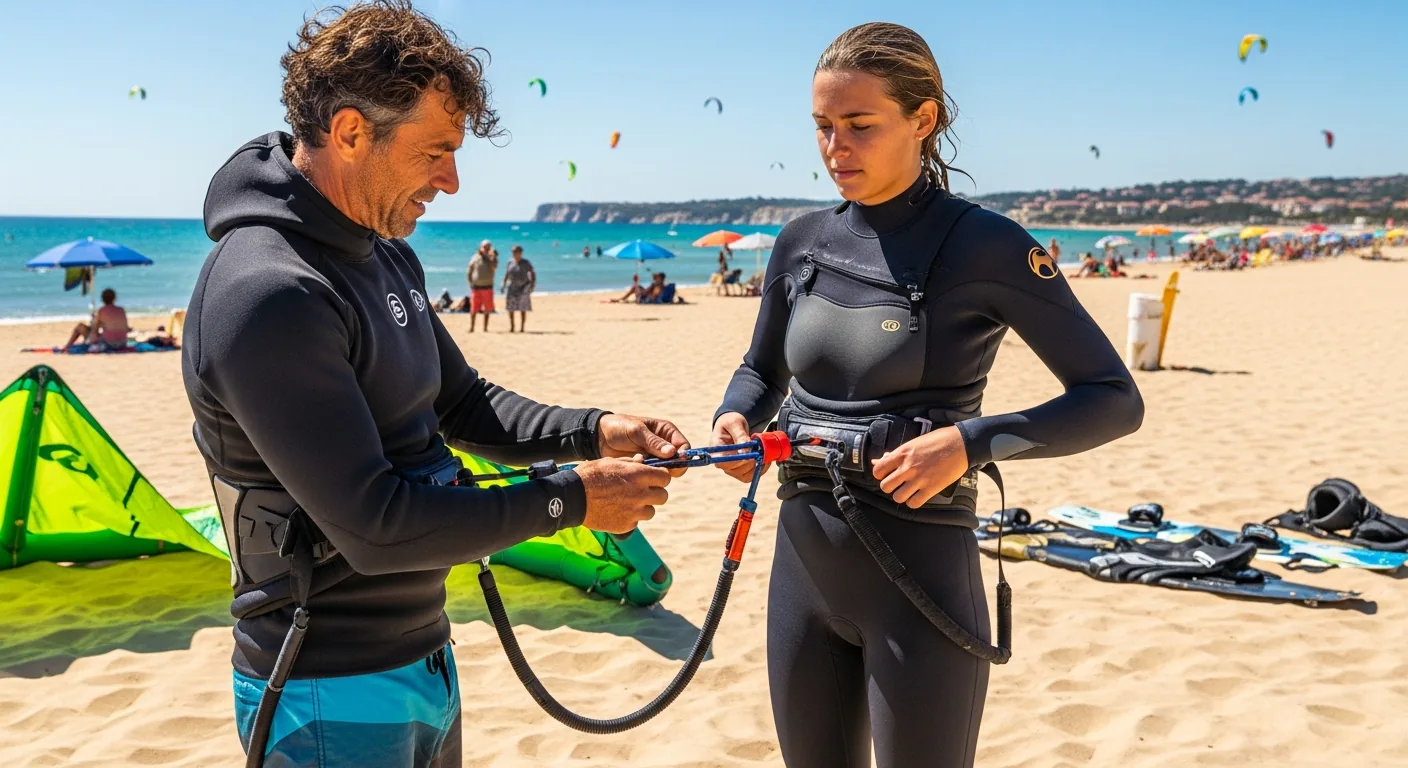
The chicken loop is the loop that connects your harness to the bar, and the main attachment point on the whole set-up. Check it before every session: wear on the rubber, that the locking system is engaged, and the state of the release (push-away) line.
The quick release
The quick release is the mechanism that lets you separate instantly from the kite by pulling a handle or flap. No other safety action in kitesurfing matters more, and the sequence is always the same.
- Activate the quick release and the kite detaches from the chicken loop
- The kite stays attached to you only by the safety leash
- The kite flags out and loses all its power
- You keep control without being dragged violently
Practise the quick release on land before every session. In a panic, your motor reflexes vanish. You need to be able to fire the release with your eyes shut. If you don't know your kite's system, don't use it.
Flagging out
Flagging out is where the kite ends up once you fire the quick release. It flaps in the wind like a flag, with no power, and that's the safe position. To get going again, you'll need to relaunch it from the water.
Full release (safety leash)
As a last resort, if flagging out isn't enough (very strong wind, a kite that drops and relaunches itself), some systems allow a full release: you also detach from the safety leash and the kite flies off on its own. Be warned – you lose your kite. Only do it in extreme danger.
The wind: conditions and hazards
Safe wind speeds
Every kite has a wind range quoted by the maker. As a general rule:
- 10–15 knots (12–17 mph): ideal conditions for beginners, on a 10–12m² kite
- 15–25 knots (17–29 mph): standard conditions for intermediate riders, on a 7–9m² kite
- 25–30+ knots (29–35+ mph): expert conditions for experienced riders only, on a 5–7m² kite
- Above 30 knots (35 mph): strongly discouraged except for very experienced riders
⛔ Offshore wind: a deadly danger
An offshore wind (blowing from the land out to sea) is the number-one danger in kitesurfing. It pushes you inexorably out to sea and can stop you getting back. Never kite in an offshore wind, even if it seems light. The wind can build without warning and carry you hundreds of metres from shore. Always check the wind direction before you rig up – on a lifeguarded beach, an orange windsock is the signal for an offshore wind. For the full picture on named winds and wind direction, see our wind glossary.
Gusts
Gusts are sudden jumps in wind speed, often 10 to 20 knots above the average. They are common:
- As a squall or line of storms approaches
- Near coastal obstacles (cliffs, buildings, sea walls)
- Late in the day, as the thermal breeze shifts
In a gust, depower your kite (push the bar away) to cut the power at once. If the gust is too violent, fire the quick release.
A sudden change in the colour of the sky (dark clouds coming in fast), the sea turning abruptly darker, or an unnatural drop in the wind are all warning signs of a squall. Land your kite at once and head back to the beach.
Launching and landing safely
Communicating with your helper
Launching and landing are the most dangerous moments. You need a helper (another kitesurfer or a trained person). Agree clear signals before the manoeuvre:
- Thumbs up (OK, you can launch / OK, the kite is down)
- Hand on head (STOP, don't touch anything)
- Arm across the throat (emergency STOP, release everything)
The launch zone
Always launch in a clear area:
- No people within 50 metres downwind
- No obstacles (trees, buildings, cliffs) within 100 metres downwind
- Never any power lines (risk of fatal electrocution)
- No road or car park nearby (the kite can drift)
Launch technique
Your helper holds the kite by the leading edge. You get into position and check your lines, your harness and your quick release. You give the 'OK' signal. Your helper lets go of the kite and steps clear at once. You control the kite up and park it at the zenith.
Lines under tension can cut like razors. Never walk through the lines, never wrap them around your hands, and never let anyone near them while the kite is in the air. A line in 20 knots (23 mph) of wind can be carrying a load of 50 to 80kg.
Safety on the water
The body-drag: the rescue technique
The body-drag means letting the kite pull you along without a board, using your body alone. Three situations make it essential.
- Recovering your board after a fall
- Getting back to the beach if you have lost your board
- Helping another rider in difficulty
Upwind body-drag: lie on your front, one arm in the water like a dagger board, the other on the bar. Fly the kite in figures of eight to generate pull. The arm in the water slows one side and works you back upwind.
Self-rescue
Self-rescue is the procedure for getting back to the beach when you can no longer use your kite (the wind has dropped, kit has broken, exhaustion):
- Fire the quick release to flag the kite out
- Wind the kite in around the bar to reduce the sail area (the 'SAG' position: Safety All Good)
- Secure the kite firmly to the bar with the lines
- Put the kite on your back, where it doubles as a float
- Come back by kicking or swimming, the kite on your back or towed
Recovering a kite in the water
If you come across a rider whose kite is down in the water:
- Never grab a kite that is still flying – it can pull hard and without warning
- Approach from downwind (below the kite)
- Grab the kite by the tip or the trailing edge
- Don't get tangled in the lines
- Help the rider relaunch or secure the kite
If you're in a self-rescue and can't get back on your own, never let go of your kit. The kite doubles as a float and is visible from a distance. Raise one arm to call for help. In the UK, dial 999 (or 112) and ask for the Coastguard.
Pre-session checks
Before every session, run through the following checks without fail:
The kit
- Lines: check that no line is twisted, frayed or damaged. All four lines must be the same length.
- Chicken loop: state of the rubber, the locking system engaged, a working quick release.
- Safety leash: check the stitching, the clips and the elastic.
- Kite: inspect the canopy (holes, seams), the leading edge (leaks, pressure) and the bridle seams.
- Bar: a working trim system, handles in good order, lines correctly connected (colours matching).
- Harness: the harness strap not worn, a rescue knife within reach, the harness leash in good order.
- Pump: check the leading-edge pressure (usually 8–10 PSI – check your kite's manual).
The environment
- Wind direction: check the windsock or watch the flags. Never an offshore wind.
- Wind strength: an anemometer or an estimate. Is it within your kite's range?
- Tides: on a falling tide you can end up stranded a long way from the shore. Check the times.
- Obstacles: identify the launch and landing zones and the areas to avoid.
- Other users: swimmers, windsurfers, boats. Adapt your riding area.
⛔ The 30-second check
Before you go, run through this list in your head: lines (no knots, no damage), chicken loop (locked, quick release OK), harness (properly done up, knife within reach), kite (pressure OK, no leak), wind (direction and strength OK), zone (clear, no obstacles). If even one thing is wrong, don't go.
The specific hazards of kitesurfing
Lines under tension
Kitesurfing lines are made of Dyneema or Spectra, materials stronger than steel for the same diameter. Under tension they can slice clean through fingers, hands or any part of the body. Never wrap them around your hands or fingers. If you must handle lines under tension, wear gloves.
The kite's power zone
The power zone is where the kite generates the most pull: the arc of wind between 10 and 2 o'clock (when the kite is low in the wind window). That is where:
- Jumps and tricks are done
- The pull is at its most violent
- The risk of losing control is highest
Never put your kite in the power zone when launching or landing. Keep the kite at the zenith (12 o'clock) or at the edge of the window (10 / 2 o'clock) when you are near the ground or other people.
Other water users
Swimmers, windsurfers, surfers and boats all share the water with you, and avoiding them is your job, not theirs.
- Never kite over or near swimmers
- Keep a safe distance of at least 50 metres from other water users
- Anticipate the paths of windsurfers and surfers (they move faster than they look)
- Boats always have right of way: keep clear of their course
A kitesurfer can cover 50 to 100 metres in a few seconds. Always anticipate your own path and everyone else's. If a spot is too busy to kite safely, move on or wait.
Emergency procedures
Who to call
In the UK, in any emergency at sea or on the coast:
- 999: the emergency number – dial it and ask for the Coastguard for any incident on or near the water
- 112: the European emergency number (works across Europe and reaches the same services)
- VHF Channel 16: the distress calling channel to reach HM Coastguard from the water
Give the operator your exact position (the name of the beach, GPS coordinates), the number of people in trouble, the apparent condition of the casualty and the conditions (wind, sea, tide).
Basic first aid
While you wait for help:
- Don't put yourself in danger: don't go into the water if the conditions are too dangerous
- Check for consciousness: is the person conscious? Are they breathing?
- Get them warm and sheltered: get the person out of the water if you can, and cover them (hypothermia)
- CPR: if the person isn't breathing, give 30 chest compressions to 2 rescue breaths
- Use an AED: if an automated external defibrillator is available, follow the voice prompts
Get some first-aid training (a one-day course with St John Ambulance or the British Red Cross). No other skill saves more lives. The RLSS also runs water-rescue and lifesaving courses for watersports.
Insurance and the rules in the UK
British Kitesports Association membership
In the UK, the British Kitesports Association (BKSA) is the national governing body for kitesurfing. BKSA membership is well worth having because it includes:
- Third-party liability insurance (for damage you cause to others)
- Access to affiliated clubs and recognised schools
- Support in protecting access to beaches and spots
- Up-to-date safety and coaching guidance
Outside a membership scheme, kitesurfing is free to do but you are personally responsible for your actions and any damage caused to others. In that case, specific watersports insurance is essential.
Specific insurance
If you're not a BKSA member, take out watersports insurance that covers:
- Third-party liability (damage to others, to boats, to property)
- Personal accident (medical costs, repatriation, disability)
- Your kit (theft, breakage, loss): optional but recommended
- Repatriation assistance (essential if you kite abroad)
Local rules and byelaws
Each local authority can regulate kitesurfing on its stretch of coast:
- No-go areas: some beaches ban kitesurfing (swimming areas, nature reserves)
- Permitted zones: launch corridors are marked out for the sport
- Time restrictions: some spots have seasonal or time-of-day limits
- Distance from shore: local byelaws may limit how far out you can go
Check with the local council or the local club before you kite at a new spot. The RYA also publishes guidance on coastal navigation and right of way. See our guide to the best UK kite spots to find permitted, safe places to ride.
New to kitesurfing? The best way to learn safely is through a recognised, BKSA-affiliated kite school with a qualified instructor. You'll learn the safety rules, kite handling and self-rescue techniques in a controlled setting. See our advice on getting started in kitesurfing and our guide to the gear.
❓ Frequently asked questions about kitesurfing safety
Who has right of way in kitesurfing?
The rider on starboard (right hand forward on the bar, kite to the right) has right of way. The rider on port must give way, either by dropping their kite low or passing behind. When two paths cross, the rider going upwind (windward) gives way to the one coming downwind (leeward).
How does the quick release work in kitesurfing?
The quick release sits on the chicken loop. Pulling it releases the kite from the bar so it flags out, instantly killing the power of the wind. It is the number-one safety action to master before every session.
Can you kitesurf in an offshore wind?
No. An offshore wind (blowing from the land out to sea) is extremely dangerous in kitesurfing. It pushes you inexorably out to sea and can stop you getting back to the beach. Never kite in an offshore wind, even a light one.





.jpg)