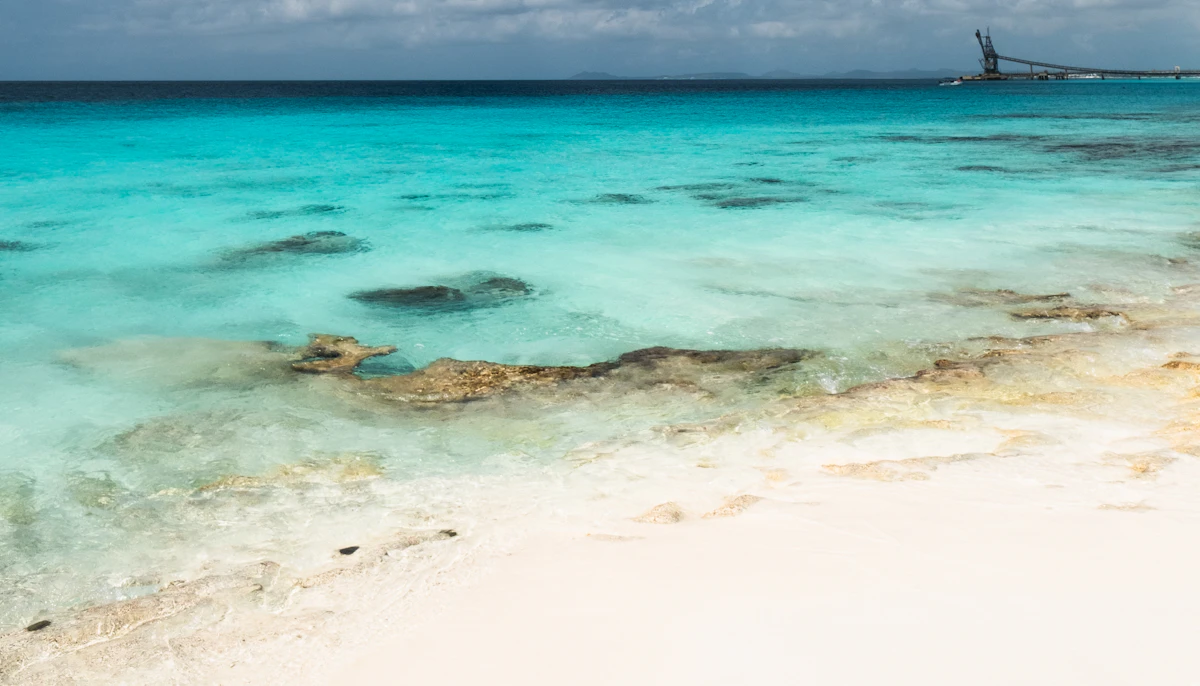
📍 Bonaire, Dutch Caribbean
This page is part of our Caribbean guide. Where the overview summarises, this one works through the bay spot by spot and school by school.
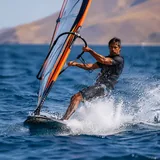
Warm water, never deeper than 1.2m, flat and sheltered by a fringing reef: Lac Bay is rated as one of the best windsurfing spots on the planet, from complete beginner to freestyle level.
Windsurf guide arrow_forward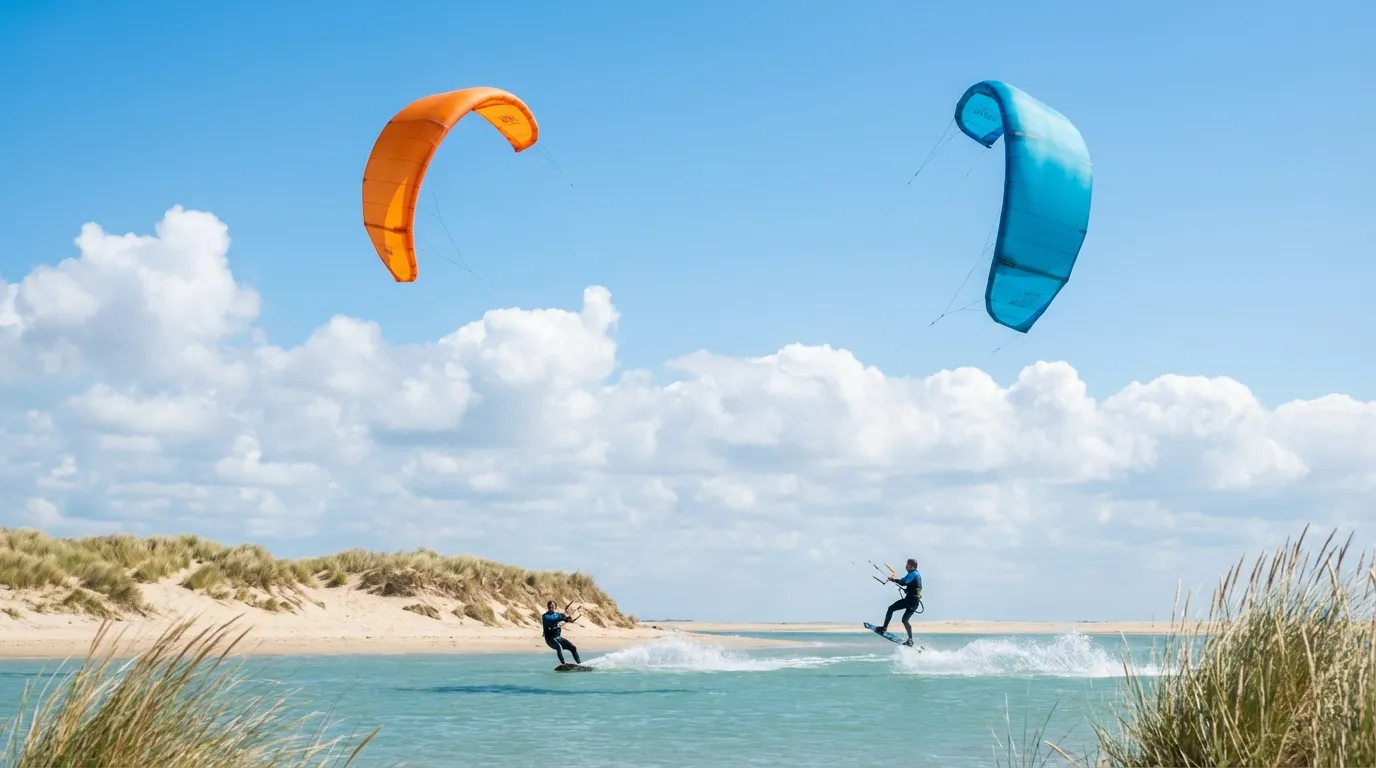
To protect the Ramsar wetland and its frigatebird colony, kitesurfing is banned across Lac Bay. Head instead to Atlantis Beach or Pink Beach, where two schools run out of converted yellow school buses.
Kitesurf guide arrow_forward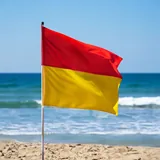
The Bonaire National Marine Park protects the whole coast, from the high-water mark down to 60m. Anchoring on the reef is banned, mooring buoys are compulsory, and a Nature Fee applies to diving and snorkelling.
Watersports safety arrow_forwardWhat to know before you book.
A near-enclosed bay, a clean cross-shore trade wind, and a bottom you can touch almost anywhere.
Lac Bay is a nearly enclosed bay roughly 9km around, ringed by a coral reef that breaks the swell before it reaches the inside. The result is flat water inside the bay regardless of what the open sea is doing. The trade wind blows cross-shore relative to Sorobon beach, about as forgiving a direction as it gets — if something goes wrong, you drift down the beach rather than out to sea. The shallow depth, never more than 1.2m and often closer to 80cm, means you can stand up almost anywhere in the bay, which does wonders for the confidence of beginners and of children learning alongside parents.
View on Google Maps open_in_newSorobon is the small beach settlement on the southern shore of Lac Bay, effectively built around windsurfing since the 1990s. Four centres share the same stretch of beach, a short walk from one another: Jibe City, one of the longest-running, known for its laid-back, waterfront-bar atmosphere; Bonaire Windsurf Place, operating since 1995 with a large rental fleet; the Dunkerbeck Pro Center, founded by Dutch windsurfer Björn Dunkerbeck, a multiple world champion who still runs high-level clinics there; and The Frans Paradise, a newer addition rounding out the offer with freestyle gear and wing foil. All four rent boards, sails and harnesses by the day or week, and run lessons for every level, from first waterstarts through to freestyle tricks.
It's worth being upfront about this before you pack: kitesurfing is banned across the whole of Lac Bay, Sorobon included. The bay is listed as a wetland of international importance under the Ramsar Convention, and it's recognised as an Important Bird Area by BirdLife International. Its mangroves shelter one of the Caribbean's few nesting and roosting colonies of magnificent frigatebirds, an impressive seabird with a wingspan of over 2 metres that's sensitive to disturbance. Kites, which range over a much wider area of sky than windsurf sails, would directly disturb that roost. The rule is simple and non-negotiable: Lac Bay is a sanctuary for windsurfing and, increasingly, wing foiling (whose sail sits low and close to the water), but not for kites.
The section closest to Sorobon, the most sheltered part, suits first waterstarts well: little chop, a stable bottom, steady wind. Moving further out towards the centre and eastern end of the bay, the wind picks up and there's more room to work on gybes and freestyle. Advanced riders rate Lac Bay especially highly for tricks: the flatness of the water makes jumps and rotations far more predictable than in open sea, which is one reason so many freestyle competitors base themselves here during the European winter.
Kitesurfing happens elsewhere on the island, with a different vibe and different conditions to Lac Bay.
On the island's south-west coast, Atlantis Beach — usually just called Kite Beach — is Bonaire's official kitesurfing spot. The water stays flat more than 90% of the year, a rarity at this latitude, with steady trade winds of 15-25 knots and enough room that riders aren't tripping over each other. Two schools are permanently based here, each operating out of a converted American yellow school bus that doubles as base and meeting point: Kiteboarding Bonaire, with more than twenty years on the island, and Kiters Paradise, on the beach for over a decade and open daily through the morning and afternoon. Both offer lessons, equipment rental, repairs and a proper social hub for visiting kitesurfers.
View on Google Maps open_in_newFurther south, near the old salt pans and their white salt mounds, Pink Beach takes its name from the pinkish tint of its sand, coloured by coral fragments and other marine organisms. It's quieter than Atlantis Beach, appreciated by riders after a bit more space, or a late-afternoon session with the low light catching the flamingos over the neighbouring salt flats. The water here is similarly shallow and the wind carries in much the same way, but access and infrastructure are more limited — turn up already kitted out rather than expecting to rent on the spot.
View on Google Maps open_in_newIf you're travelling with both disciplines, it's roughly a twenty-minute drive between Sorobon and Atlantis Beach — easily done in a day. Plenty of visitors alternate: freestyle windsurfing in the morning at Lac Bay while the wind is still moderate, then kiting in the afternoon at Atlantis Beach once the trades pick up. That's one of the island's real strengths: two world-class spots, a few kilometres apart, each dedicated to its own discipline.
The island's entire coastline, down to 60m depth, has been a protected marine park since 1979.
Bonaire built a global diving reputation long before it became a wind sports name, and 'Diver's Paradise' appears on the island's number plates for good reason. The fringing reef that surrounds Bonaire and the neighbouring islet of Klein Bonaire drops off steeply from just a few metres of depth, which makes shore diving unusually easy — no boat required, on dozens of marked sites signposted by simple yellow-painted rocks along the coastal road. For anyone travelling with wind gear, that's a real bonus: a dive or snorkel break slots in easily between sessions without eating up a whole day.
The Bonaire National Marine Park was established in 1979 and covers the entire coastline, from the high-water mark down to 60m depth, all the way around Bonaire and Klein Bonaire. It's managed by STINAPA Bonaire, the island's conservation body. Diving or snorkelling within the park requires an annual Nature Fee, valid for the calendar year; the old plastic tags have been replaced by a simple digital QR code emailed after paying online, shown to dive operators or park rangers as proof.
Anchoring on the reef is strictly forbidden throughout the park: boats must use the mooring buoys installed at the busiest dive sites, with a single exception for small traditional fishing boats that use coral rocks as anchors. That rule indirectly applies to the support boats that sometimes accompany kitesurfers at Atlantis Beach too — never drop anchor onto the reef. Anchor damage has historically been one of the biggest threats to the island's corals, which explains why the rule is so strictly enforced. For anyone kiting or wing foiling near the coast, the principle is the same one already in force at Lac Bay: avoid flying over or landing on the shallow coral that lines much of Bonaire's shoreline.
An international airport, direct links from Europe and the US, and regional flights from Aruba and Curaçao.
Flamingo International Airport serves Bonaire directly, about ten minutes' drive from Kralendijk, the capital, and roughly twenty minutes from either Sorobon or Atlantis Beach. From Europe, KLM runs a daily direct service from Amsterdam Schiphol, a flight of around 9.5 hours; TUI fly and Corendon add several weekly rotations on the same route. From the US, American Airlines connects Bonaire to Miami several times a week (more in high season) on a flight of around 3 hours 15 minutes, and United Airlines runs a year-round service from Houston. There's no direct flight from the UK; routing through Amsterdam is the simplest option.
Bonaire, Aruba and Curaçao form the informal "ABC islands" of the southern Dutch Caribbean. Regional carriers such as Divi Divi Air and EZ Air run daily flights from Curaçao (around 15 minutes' flying time) and from Aruba, a handy way to combine Bonaire with another regional spot, such as Fisherman's Huts in Aruba.
Hiring a car is close to essential: the distances between the airport, Kralendijk, Sorobon and Atlantis Beach are all measured in tens of minutes, and public transport is very limited. 4x4s are popular for reaching more remote areas such as Pink Beach or Washington Slagbaai National Park in the island's north. The official currency has been the US dollar since Bonaire became a special municipality of the Netherlands in 2010, which simplifies things for visitors arriving from the Americas.
A long wind season running December to August, with a clearly defined peak.
This is the most reliable window of the year: north-east trade winds blow on nearly every day, 15-25 knots, at both Lac Bay and Atlantis Beach. It's also when the most advanced riders show up and Sorobon's schools run at full capacity — worth booking kit and lessons ahead for April and May, particularly busy months.
Wind stays present outside the peak window, though slightly less consistent. It's a decent trade-off between solid conditions and a less crowded beach, especially at Lac Bay, where space gets scarcer at the height of the season.
Wind drops to an average of 12-15 knots, gentler conditions that suit beginner windsurfers at Sorobon particularly well. It's also a good stretch, outside the most active hurricane period, for mixing wind sessions with diving and island exploration — Bonaire sits outside the Atlantic's main hurricane belt, a genuine advantage over other Caribbean destinations at this time of year.
Bonaire runs on Dutch emergency infrastructure, more standardised than on some neighbouring islands.
As a special municipality of the Netherlands, Bonaire has dedicated emergency numbers: 911 for police, 912 for ambulance, 919 for fire, and 913 for the Coast Guard and marine emergencies, also monitored on VHF channel 16. The Dutch Caribbean Coast Guard covers the island's waters. That said, travel insurance with medical evacuation cover is worth having: the island's hospital facilities, while real, are limited for serious cases, and a transfer to Curaçao or the Netherlands can be necessary for the most severe emergencies.
Kit is simple here: the water sits around 27-28°C year-round, so no wetsuit and no boots. Reef-safe sunscreen, on the other hand, is non-negotiable, given the entire coastline falls within the marine park. Most schools at Lac Bay and Atlantis Beach rent full kit by the day or week, which saves travelling with your own quiver, and a lot of hassle at the airline check-in desk.
What riders ask most before booking.
No. Kitesurfing is banned across the whole of Lac Bay, including at Sorobon, to protect this Ramsar-listed wetland, its mangroves and its roosting colony of magnificent frigatebirds. Kitesurfers head to Atlantis Beach on the west coast, or Pink Beach further south. Lac Bay stays reserved for windsurfing and, increasingly, wing foiling.
Four centres share the same stretch of Sorobon beach: Jibe City, Bonaire Windsurf Place, the Dunkerbeck Pro Center (founded by multiple world windsurfing champion Björn Dunkerbeck) and The Frans Paradise. All rent kit and run lessons, from complete beginners through to freestyle.
Flamingo International Airport (BON) takes direct flights from KLM, TUI fly and Corendon out of Amsterdam Schiphol (roughly 9.5 hours), American Airlines from Miami, and United Airlines from Houston. From Aruba or Curaçao, regional carriers such as Divi Divi Air connect in around fifteen minutes.
The entire Bonaire coastline forms the Bonaire National Marine Park, managed by STINAPA. Diving and snorkelling require an annual Nature Fee, now issued as a digital QR code. Anchoring on the reef is banned; boats must use the designated mooring buoys at the main sites.
No, it's also one of the world's great shore-diving destinations, nicknamed 'Diver's Paradise'. Plenty of visitors combine a week of windsurfing or kitesurfing at Lac Bay or Atlantis Beach with a few dives or snorkel trips on the fringing reef that surrounds the island. Discover Aruba, its Dutch Caribbean neighbour, or explore the rest of our Caribbean guide.