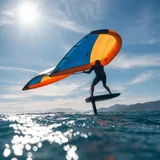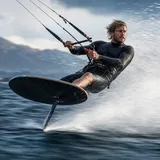

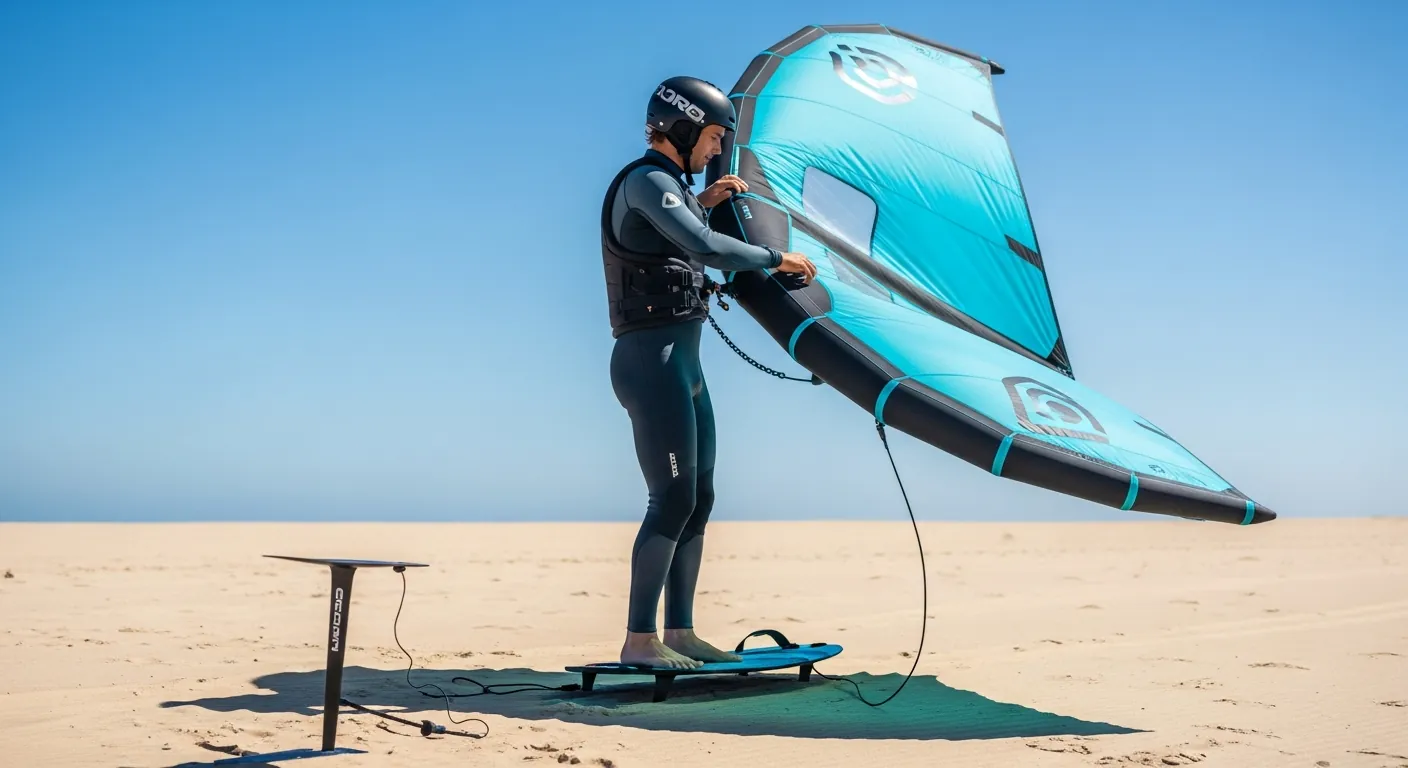
Wing foiling is a demanding and rewarding sport, but it carries specific risks that every rider needs to know. The foil is razor-sharp, the wing can become unmanageable in strong wind, and right of way is often poorly understood. We cover the essentials: kit, hazards, right of way and rescue. Read it before your first session, and re-read it regularly.
1. Safety kit
Protective kit is your first line of defence in wing foiling. Each item has a specific job and should never be skipped.
The helmet: essential
The helmet is the single most important item in wing foiling. The edges of the foil (mast, front and rear wings in carbon or aluminium) are sharp and can cause serious head injuries in a fall or a collision. A helmet certified to CE EN 1385 (the watersports helmet standard) is strongly recommended at every level.
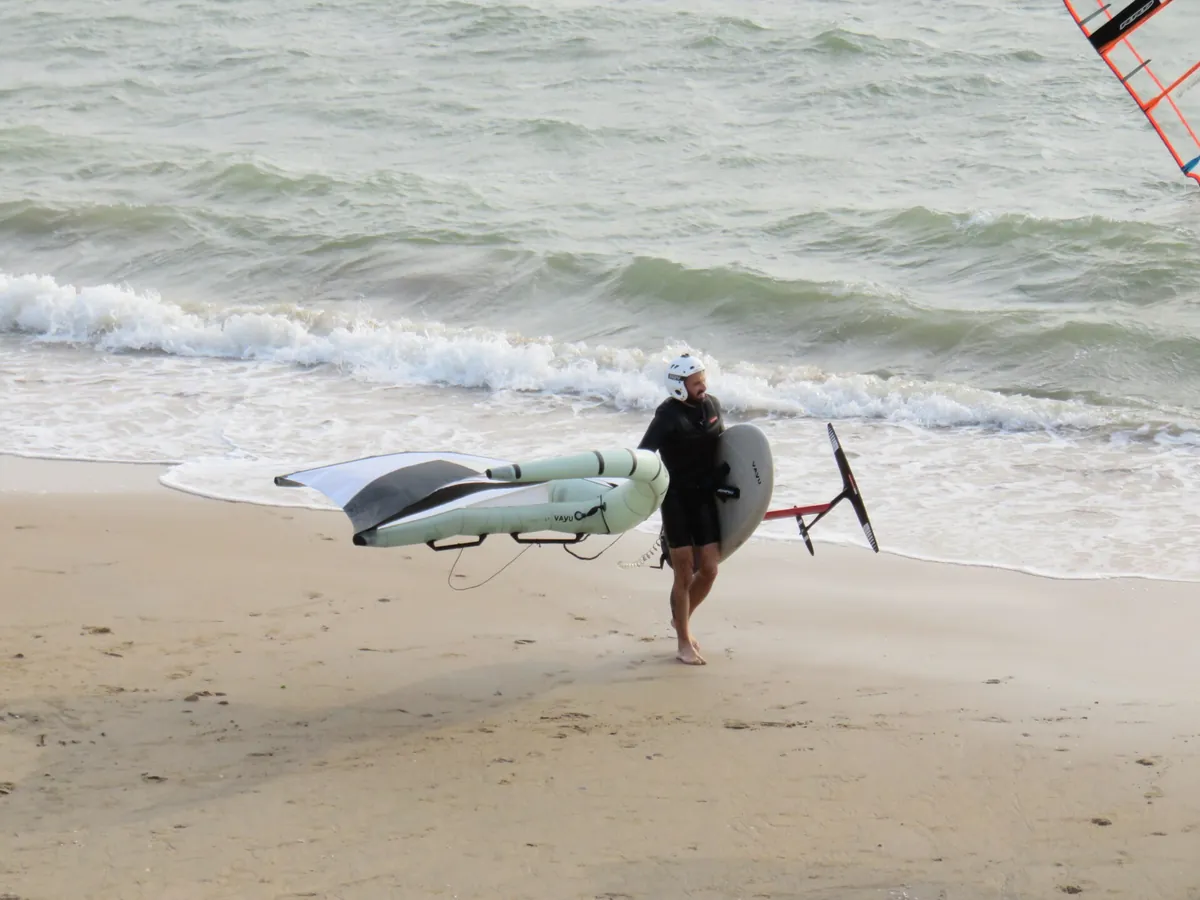
⛔ Never ride without a helmet
The foil sits just a few centimetres below the surface. As you fall, your head can strike the foil of your own board or another rider's. A helmet isn't an accessory here, it's the one bit of kit that saves lives.
The impact vest
The impact vest protects the torso, ribs and back in a heavy fall or a collision with the board. It also adds useful buoyancy during a self-rescue. Choose a model built for watersports (not a rigid water-ski vest).
Leash: ankle or waist?
The leash choice matters in wing foiling:
- Waist leash: recommended for wing foiling. Worn around the waist on a belt, it keeps the board away from your body in a fall, reducing the risk of striking the foil. It's what most experienced wingers use.
- Ankle leash: useful in prone foiling, where the board stays close to the rider. In wing foiling it keeps the board by your legs, which raises the risk of a collision with the foil in a fall.
What length? A leash of 3 to 5 metres is plenty. Longer and it tangles; shorter and it tugs the board and can pull it dangerously back towards you.
The leash is a double-edged sword in wing foiling. If you're swept away by wind or current while clipped in, the board – and its sharp foil – comes back towards you. In an offshore wind, think twice before attaching it at all, because letting the board go and swimming for shore is sometimes the safer call.
2. Wing safety
The wing is light and inflatable, but it carries specific risks you need to know.
The wingtips: sharp and dangerous
The wingtips are often rigid and can injure on contact, especially in strong wind. When you fold or unfold the wing, do it facing the wind, controlling the power. Never leave an inflated wing unattended on the beach, because one gust will send it down the sand.
The wing in the wind: never let go
Unlike kitesurfing, where the kite is attached to the harness, the wing is held in your hands. If you let go, the wing takes off and can:
- Strike other people on the beach or the water
- Fly out to sea and be lost
- Hit craft or swimmers
Always hold the wing firmly by the handles, especially while pumping up, carrying it and entering the water.
Dropping the wing: when and how to let go
In an emergency (loss of control, the wind suddenly too strong), you need to know how to drop the wing correctly:
- Point the wing into the wind (leading edge to windward)
- Release the handles and let the wing settle on the water or the sand
- Don't chase it if it flies off: your safety comes first
While learning, practise handling the wing on the beach before you get in the water. Learn to depower it by changing its angle to the wind. See our guide to getting started with wing foiling to build up gently.
3. The dangers of the foil
The foil is the most dangerous part of wing foiling. Its carbon or aluminium edges are razor-sharp and cause deep injuries.
The sharp edges
The mast (50 to 90cm), the front wing and the rear wing (stabiliser) all have cutting edges. Even a worn foil stays dangerous. Always handle it with care:
- Wear protective gloves when assembling and dismantling
- Use foil covers for transport
- Never leave a bare foil lying on the ground or anywhere busy
Falling technique
Knowing how to fall well greatly cuts the risk of injury:
- Fall away from the board: push the board behind you or to the side as you fall
- Protect your head with your arms if you fall towards the foil
- Fall flat (like a starfish) rather than diving in head first
- Never fall forwards – that's where the foil is
⛔ Minimum distance: 20 metres
Always keep at least 20 metres between yourself and any other rider, swimmer or craft. The foil can cause deep cuts in a collision. If someone falls near you, stop immediately and move away.
4. Wind conditions
The wind is the engine of wing foiling, and also the main source of danger. Learning to read and anticipate the conditions is essential.
Offshore wind: the biggest danger
An offshore wind (blowing from the land out to sea) is the number-one danger in wing foiling. If you lose control or your wing drops onto the water, the wind carries you out to sea. Getting back to the beach becomes impossible without help.
⛔ Offshore wind = don't ride alone
Never ride alone in an offshore wind. If you are carried out, no one can help you. Favour onshore or side-shore winds. If you must ride in an offshore wind, stay close to the beach, tell someone on shore and carry a waterproof means of communication (a phone in a pouch). Watch for the orange windsock on lifeguarded beaches – it signals an offshore wind.
Gusts
Gusts are sudden increases in wind that can make you lose control of the wing. They are common:
- Near high ground (cliffs, hills, buildings)
- During squalls or weather fronts
- Late in the day when thermal breezes mix
When a gust hits, depower straight away by taking the wing up out of the wind window, or let go with one hand to spill the power.
Maximum wind: know your limits
- Beginner: 12 to 20 knots (14 to 23 mph) maximum
- Intermediate: 15 to 25 knots (17 to 29 mph) maximum
- Accomplished: 20 to 30 knots (23 to 35 mph) maximum
- Expert: 30 to 35 knots (35 to 40 mph), with a 3 to 4m² wing
Above 35 knots (40 mph), the risks of lofting (being lifted by the wind), uncontrolled collisions and drowning rise sharply. This is no playground for wing foilers.
Always check the forecast before you ride. Use the Met Office marine forecast, Windy or Windguru to check the wind direction and strength, plus the forecast gusts. Don't rely on the wind you feel on the beach: out at sea it can be 30 to 50 per cent stronger.
5. Safety on the water
Self-rescue
Self-rescue is the ability to get yourself back to the beach when things go wrong. In wing foiling it runs as follows.
- Stay calm, because panic is what drowns people
- Retrieve your wing and fold it or hold it onto the board
- Lie on the board (prone, as in surfing), the wing under your arm or on the board
- Use the wing as a makeshift sail: held horizontally, it can push you slowly towards the beach if the wind is onshore
- Swim if needed: if the wind is against you, lay the wing on the board and swim, using the board as a float
The wing as a float
An inflated wing is an excellent flotation aid. If you're exhausted, lie on the wing (not the board, which is unstable) and use it as a buoy. The wing is built to support your weight and keep you out of the water.
Swimming to the beach
If you have to swim:
- Stay with your board wherever you can – it floats you and keeps you visible
- Leash on or off? If the leash pulls you out to sea (offshore wind), release it. If the wind is pushing you towards the beach, keep it on.
- Save your energy – don't swim against the current, drift if you must and signal your position
If an offshore wind carries you out and you can't get back, don't panic. Lie on your board, keep the wing with you so you stay visible, then call for help – dial 999 and ask for the Coastguard. An offshore wind carries you out, but you never drift as fast as you fear – rescuers have time to reach you.
6. Right of way and navigation
At sea, the COLREGs (the International Regulations for Preventing Collisions at Sea) apply to wing foiling just as they do to all water users.
🔹 Priority 1: swimmers and bathers
Swimmers always have absolute priority. Keep a minimum distance of 50 metres from bathing areas, and stay well clear of the red-and-yellow lifeguarded zone. Never ride in an area used by swimmers.
🔹 Priority 2: motor craft and sailing boats
Under the COLREGs, larger and less manoeuvrable vessels are generally given way to. Always give way to boats even where you technically have priority, because a wing foil weighs nothing against a hull.
🔹 Wing foiling vs kitesurfing
Between wingers and kitesurfers, whoever is riding a wave has right of way. A kitesurfer must not cross the path of a winger riding a wave, and vice versa. On a crossing, the rider on starboard tack (right hand forward) has priority.
🔹 Wing foiling vs surfers
Surfers have priority in the line-up. Don't cross a surf line-up on a wing foil, because the foil is lethal to anyone who happens to be under the surface. If you must cross, remove the foil or pass well clear of the area.
🔹 Wing foiling vs wing foiling
Between wingers, the starboard-tack rule applies: whoever has their right hand forward (starboard tack) has priority. The rider on port tack (left hand forward) must keep clear. On a wave, whoever is closest to the peak (where the wave first breaks) has priority.
When in doubt, always give way. A missed wave costs you nothing; a foil injury is another matter entirely.
7. Emergency procedures
Emergency numbers
In the UK, these are the numbers to know:
- 999: the main emergency number. For any incident on the water or coast, dial 999 and ask for the Coastguard. HM Coastguard coordinates search and rescue around the UK coast, 24 hours a day.
- 112: the European emergency number. It works across Europe and connects to the same UK services, even with no credit or signal on your own network.
- RNLI lifeguards: on lifeguarded beaches, the RNLI lifeguards are your fastest first response. Ride near a lifeguarded beach where you can.
⛔ In an emergency, dial 999 and ask for the Coastguard
Give the operator your exact location (GPS coordinates if you can, or a visual landmark), the number of people in trouble, the apparent condition of the casualty, and the conditions (wind, current, sea state). Don't hang up until the operator tells you to.
Helping others
If you witness an accident:
- Call for help (999, ask for the Coastguard) before anything else
- Don't put yourself in danger – if conditions are too tough, stay clear and guide the rescuers in
- Throw a float or a buoyant object to the casualty if they are close
- Don't drag an unconscious person by the arms: keep their head clear of the water and wait for help
8. Rules and insurance
UK rules and local byelaws
In the UK, wing foiling is governed largely by local rules and byelaws rather than a single national law:
- Local byelaws: many beaches and harbours have byelaws setting out zoned areas, launch sites and speed limits for craft. Check with the local council or harbour authority.
- Distance from swimmers: keep well clear of bathers and lifeguarded bathing zones – at least 50 metres.
- Restricted areas: some areas are off limits to foiling (harbours, shipping channels, nature reserves and Sites of Special Scientific Interest). Check before you rig up.
- Beach restrictions: some beaches restrict or ban foiling in season. Look for signage and check the local rules before you ride.
British Kitesports and the RYA
Two national bodies support the sport in the UK:
- British Kitesports: the national association for kite and wing sports. It runs instructor and rider training, recognised schools and safety guidance for wing foiling.
- RYA (Royal Yachting Association): the national governing body for boating and watersports. It provides training, guidance and recognised centres relevant to wind sports.
Membership of British Kitesports (or the RYA) typically includes third-party liability insurance, which covers damage you might cause to others.
Get insured. Home insurance rarely covers higher-risk watersports. Check your policy or join British Kitesports or the RYA for third-party liability cover. If you injure someone else (a swimmer, another rider), the costs can be considerable. See our wing foiling gear guide to kit yourself out properly.
Lessons and training
Coached sessions with a British Kitesports-recognised instructor are the best way to learn safety in wing foiling. They cover:
- Handling the wing safely
- Right of way and navigation rules
- Falling technique and self-rescue
- Reading the wind and sea conditions
Just starting out? A couple of coached sessions will put the right safety habits in place before anything else has a chance to. Plan your sessions around the best UK spots, starting with our guide to wing foil spots in the UK.
Frequently asked questions about wing foiling safety
Is a helmet compulsory for wing foiling?
A helmet is not compulsory but strongly recommended. The sharp edges of the foil (mast, carbon wings) can cause serious injuries in a fall. A helmet certified to CE EN 1385 (the watersports helmet standard) protects the head against a knock from the board or the foil.
Which leash should you choose for wing foiling: ankle or waist?
A waist leash is recommended for wing foiling because it keeps the board away from your body in a fall, reducing the risk of striking the foil. An ankle leash is useful for prone foiling but exposes you to collisions with the foil when you fall wing foiling.
Is the foil dangerous to other people?
Yes, the foil is razor-sharp. Its carbon or aluminium edges can cause deep cuts. Always keep a minimum distance of 20 metres from other riders, swimmers and craft. Never ride in a busy area.
What is the maximum wind for wing foiling?
For beginners, don't exceed 20 knots (23 mph). Accomplished riders can ride up to 30 to 35 knots (35 to 40 mph) with a suitable wing (3 to 4m²). Above 35 knots, the risks of losing control, being lofted and getting hurt rise sharply.
Who has right of way between a wing foiler and a kitesurfer?
At sea, the COLREGs (collision regulations) apply. Neither the wing foiler nor the kitesurfer has automatic priority. The general rule is that whoever is riding a wave has right of way. In all cases, give way to swimmers and to motor craft.