A surf holiday is the fastest way to improve. With a qualified coach, waves matched to your level and a consistency you simply can't manage on your own, a good course packs months of progress into a few days. This is how to pick the trip that suits you.
The types of surf camp and surf holiday
🎓 The surf course (group lessons)
The most common and most accessible format. A qualified instructor coaches a small group, usually four to eight surfers, with each session running around two hours. Keeping the group small is what makes the coaching count.
Typical shape: three to five consecutive days, a couple of hours in the water each day. Expect some theory – reading the waves, beach safety – on day one, then daily practice.
👤 Private coaching (one-to-one)
A dedicated coach, fully tailored to you. Ideal for ironing out specific faults or accelerating your progress, and often paired with video analysis of your sessions.
Typical shape: around 90 minutes to two hours a session, one to three sessions. The video review is the real bonus – seeing your own mistakes fixes them far faster.
🏄 The surf camp (all-in)
The surf-holiday package: accommodation, lessons and sometimes meals and lifts to the beach all rolled in. The easiest way to spend a week surfing with none of the planning. Camps are common in Cornwall and Wales, and across Portugal, Spain and Morocco.
Typical shape: five to seven days, a couple of hours' coaching a day plus supervised free surfs, on-site or nearby accommodation, breakfast usually included.
👨👩👧 The family surf holiday
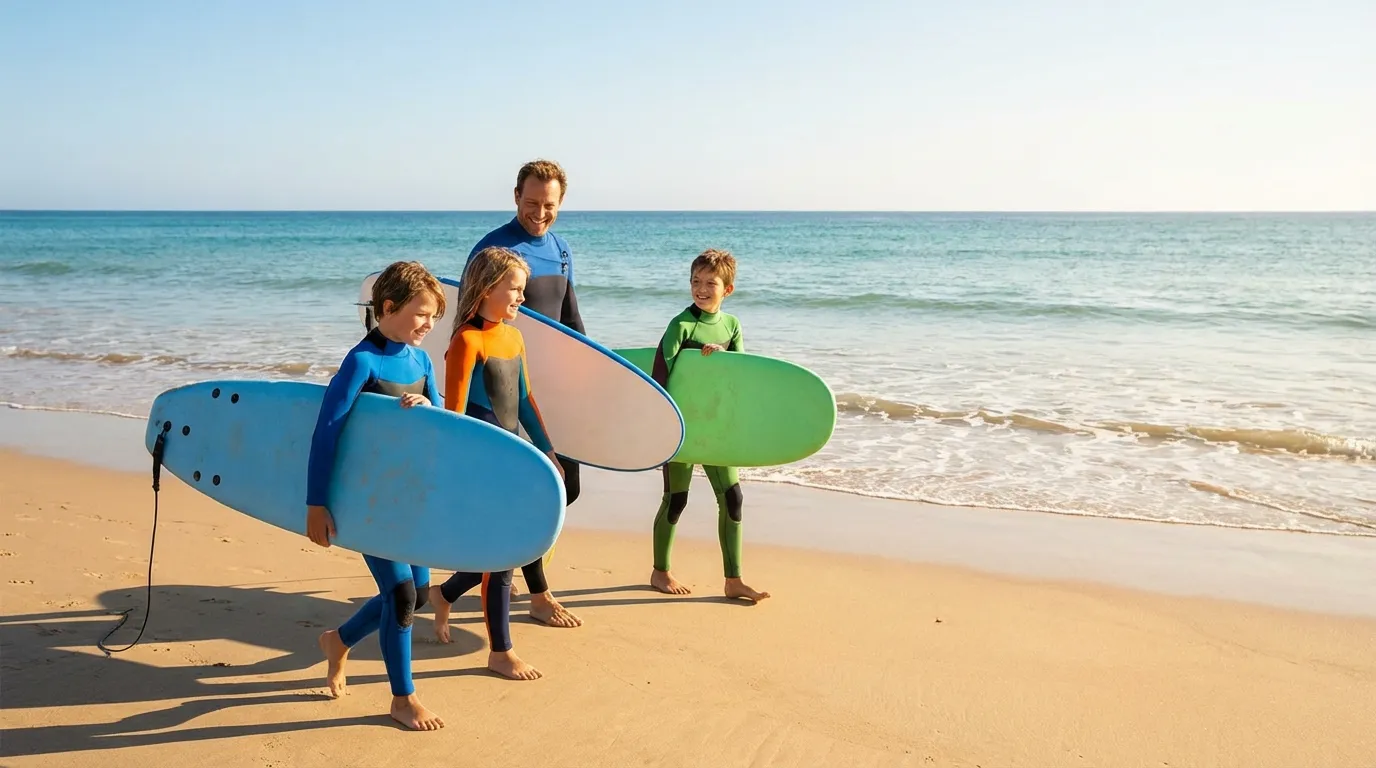
More and more spots offer a 'surf plus family' set-up: lessons for the kids (from around five or six), activities for the non-surfers and family-friendly accommodation. A holiday that mixes the surf with proper time together.
Typical shape: a week, an hour a day of kids' coaching with the right supervision, family activities in the afternoons, and self-catering, camping or a guesthouse to stay in.
The best surf destinations in the UK
🌊 Newquay & Fistral: the home of UK surfing
Level: all abilities (beginner beaches and expert peaks)
Best season: September to November (clean autumn swells, water still bearable)
The draw: Cornwall's surf capital, with Fistral's punchy beach break, a huge concentration of surf schools and gentler options at Towan and Watergate Bay just up the coast. Plenty of waves for every level.
🏖️ Croyde & Woolacombe: North Devon's finest
Level: beginner to advanced
Best season: April to October
The draw: Croyde is a powerful, hollow beach break for the confident, while long, forgiving Woolacombe next door is ideal for learning. Established surf schools on the sand and an easy-going surf town to base yourself in.
🌊 The Gower & Llangennith: the Welsh classic
Level: beginner to intermediate
Best season: May to October
The draw: the wide, exposed sweep of Llangennith on the Gower Peninsula picks up plenty of Atlantic swell and has room for everyone. Surf schools on the beach and mellow, rolling waves make it a superb place to start.
🏄 Bude & the North Cornwall coast
Level: beginner to advanced
Best season: most of the year
The draw: a run of beaches with varied aspects, so when one spot isn't working another usually is. Summerleaze and Widemouth Bay are friendly for learners, with plenty of coaching on hand.
🌬️ Thurso & the Scottish north coast
Level: intermediate to advanced
Best season: September to April (Atlantic swells)
The draw: cold-water reefs and a wild, uncrowded setting for surfers who've earned it. Thurso East is a world-class right-hander. Wrap up warm – this is proper 5/4mm-and-hood territory.
Want the full ranking? See the best surf spots in the UK, ranked, with wave type, level and season for each.
The best surf destinations abroad
🇵🇹 Portugal: the best value in Europe
Spots: Peniche, Sagres, Ericeira, Nazaré
Best season: April to October (water around 16–19°C, consistent waves)
The draw: waves for every level, a great choice of surf camps, a modest cost of living and a warm welcome. Ericeira is Europe's only World Surfing Reserve, and it's a short, cheap flight from most UK airports.
🇪🇸 The Canaries: year-round surf
Spots: Fuerteventura, Lanzarote, Tenerife
Best season: all year (water around 19–23°C)
The draw: the antidote to a British winter – warm water and consistent waves within a few hours' flight. Fuerteventura is a top pick for beginners escaping the cold.
🇲🇦 Morocco: adventure surf on a budget
Spots: Taghazout, Imsouane, Agadir, Anchor Point
Best season: October to April
The draw: endless point breaks (Imsouane peels for hundreds of metres), keen prices and a rich culture. Taghazout is the hub for good-value surf camps.
🇮🇩 Bali: the surf-trip dream
Spots: Kuta, Canggu, Uluwatu, Padang Padang
Best season: April to October (dry season, offshore winds)
The draw: waves for every level, a low cost of living and a huge travelling-surfer scene. A longer haul from the UK, but a bucket-list trip for good reason.
Browse all our surf destinations for detailed spot guides covering conditions, best season, the level you'll need, access and where to learn.
How to choose a surf school
The school makes all the difference to how much you learn and how safe you are. Check these before you book.
Accreditation and safety
- Recognised coaching qualifications: look for instructors qualified through Surfing England (or the equivalent body in Wales, Scotland or Ireland).
- Beach lifeguard / water-safety cover: a reputable school runs sessions with qualified safety cover and works with lifeguarded beaches where possible.
- Insurance: the school should carry public liability insurance for teaching surfing.
Marks of a good school
- Coach-to-pupil ratio: smaller is better – four to six per coach is ideal for real progress.
- Kit provided: a good school supplies board, wetsuit and leash. Check it's in decent nick.
- Video analysis: more schools now film your sessions, and it's a genuine accelerator.
- Reviews: read Google and TripAdvisor reviews and the school's social media.
- Spot choice: a good school takes you to the beach that suits the day's conditions, not always the same one.
Not sure where to start? Have a look at our UK spot guides to find a beginner-friendly beach with established surf schools near you.
When to go
Spring (April to June)
The best all-round window. Consistent waves, the water slowly warming (roughly 10–13°C), fewer crowds than summer and lower accommodation prices. Conditions on the Atlantic coast are often excellent.
Summer (July and August)
The busiest stretch of the year, with the warmest water (around 15–18°C) and a holiday buzz, but crowded line-ups and peak prices. Waves are often smaller through summer as the swell drops off. Book two to three months ahead.
Autumn (September to November)
The surfers' season: the water's still relatively mild in September, the autumn swells fill in and the crowds thin out. The best time of year to improve – a wetsuit upgrade to a winter suit sees you through the back end of it.
Winter (December to March)
The most demanding season by some way: cold water (around 7–9°C), thick wetsuits with boots, gloves and a hood, plus powerful waves. For the committed and well-kitted. The Canaries and Morocco are the go-to winter escapes.
Our pick: aim for September to October for a UK trip. You'll get milder water, the best swells, thinner crowds and gentler prices – the sweet spot of the surf year.
What to pack for a surf holiday
The essentials
- A wetsuit to suit the season (schools usually provide one, but your own fits better) – a 3/2mm spring to autumn, a 5/4mm for winter
- Boots, gloves and a hood if the water's cold
- Water-resistant factor 50+ sun cream
- A rash vest (UV and board-rub protection)
- A changing robe or towelling poncho for the car park
- A quick-drying microfibre towel
The comforts
- A cap or hat for out of the water
- Polarised sunglasses
- Flip-flops or sliders
- Comfy clothes for afterwards
- Vented earplugs (surfer's ear prevention)
The paperwork
- EHIC/GHIC or travel insurance covering watersports for trips abroad
- Proof of any relevant insurance cover
- Any health form the school asks you to complete in advance
Keeping it going after your holiday
A surf holiday is a springboard, but the progress carries on afterwards:
- Consistency: two sessions a week will do more for you than one big week followed by nothing.
- Dry-land training: pop-ups on the sand, core work, squats and a bit of surfskate all complement your time in the water.
- Video analysis: if your school doesn't offer it, film yourself on your phone and compare against a good tutorial.
- Returning to the same beach: going back to where you learned lets you lock in the reference points you picked up.
Back from your trip? Keep the momentum with our guides: learn to surf, the fundamental techniques, and choosing your gear for the sessions ahead.
❓ Surf camp and surf holiday FAQs
Where should a beginner go for a surf holiday in the UK?
Newquay, Croyde and Woolacombe, and Llangennith on the Gower are all ideal for beginners: sandy beach breaks, established surf schools and plenty of surf-town atmosphere.
What's the best season for a surf holiday?
Spring (April to June) and autumn (September to October) offer the best balance: consistent waves, water that's still bearable and quieter line-ups.
Do I need my own gear for a surf course?
No – a good surf school provides a board, wetsuit and leash. Bringing your own wetsuit is worth it for the fit, but it isn't essential to get started.